Whenever I go back to Adams, someone asks about Hong Kong, and I tell them about the monkeys, and they don’t believe me. Every single time. The skyline, they believe. The dim sum, they believe. The efficiency of the trains, fine. But when I say there are wild monkeys on the hiking trails that will look you directly in the eye and take your food out of your hands with the calm professionalism of someone who has done this a thousand times and does not require your consent, I get the face. The face that says: you are exaggerating, or you are confused, or you have been in Asia too long and things have gotten weird. I try to explain that these experience are part of the unique Hong Kong wildlife.
I am not exaggerating. I am not confused. Things have gotten weird, but not about this. The monkeys are real. So are the boars. So are the cows.
Nobody told me about the animals. The relocation guides mention the skyline. They mention the tax rate. They mention the dim sum and the efficiency of the MTR and the fact that you can get a suit tailored in forty-eight hours. Nobody sits you down before you move to Hong Kong and says, listen, there are wild boars the size of small furniture roaming through neighborhoods like they have business there, there are feral cows standing in the middle of roads on Lantau with the authority of creatures who were here first and know it, and there are monkeys, actual monkeys, who will assess your belongings, determine their value, and take them from you with a speed that suggests professional training. This is the fascinating aspect of Hong Kong wildlife.
I saw my first boar near a bus stop. Not on a trail. Not in a park. Near a bus stop, where I was standing, like a person, in a city, where I had assumed the wildlife would be pigeons and the occasional ambitious cockroach. The boar was not afraid of me. I want to be precise about this. The boar looked at me the way a waiter looks at a table that hasn’t decided yet. It was assessing. It was unimpressed. It moved on. I did not move on. I stood there processing what had just happened, and when I got home and told Ruth, she said, “Yes, they’re everywhere,” as though I had reported that it was humid in August, as though a wild boar at a bus stop is simply how things work here and I was the strange one for finding it noteworthy.
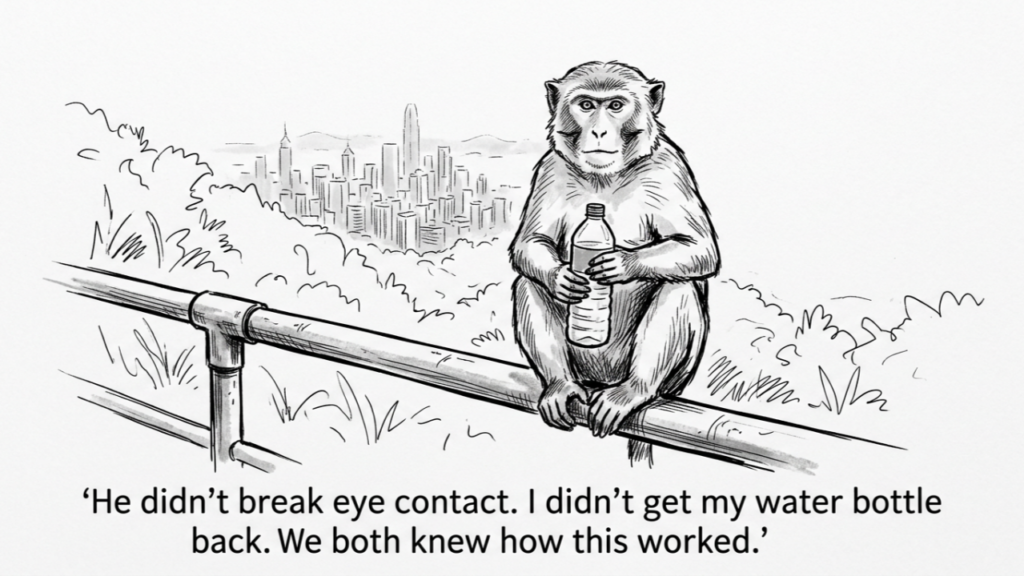
The monkeys are worse. The monkeys are worse because they have hands, and because they have strategy, and because they operate in groups with what I can only describe as coordinated intent. You go hiking near Kam Shan, which people call Monkey Mountain for reasons that become immediately and viscerally obvious, and they are sitting on the railings like a welcoming committee, except they are not welcoming you, they are inventorying your belongings. They want your bag. They want whatever is in your bag. If you are holding food, they want the food. If you are holding a water bottle, they want the water bottle. If you are holding nothing, they will check, because maybe you are lying, because people lie, and the monkeys have learned this about people.
We already have encountered monkeys like this before. In Bali, at a hotel called Ayana where everything was perfect, the pool warm, the butler responsive, the cliff bar impossibly beautiful, a troop of macaques came over the villa wall and stole Ruth’s bathing suit off the railing with the precision of a commando unit executing a rehearsed operation. Just grabbed it and disappeared into the canopy. The hotel sent a search party. They found it. They laundered it. They returned it in better condition than it left. Ruth held it up and said, “It’s softer.” That was Bali, where the monkeys steal your things and someone chases them down for you. In Hong Kong, when a monkey takes your granola bar near Kam Shan, that granola bar is gone, and you are expected to process this quietly and move on with your life, which is exactly what Ruth does, because Ruth does not give monkeys the satisfaction of seeing her upset.
Ruth took me to Monkey Mountain early in our time here. She said it would be a nice walk. She mentioned the monkeys the way you might mention that a restaurant has outdoor seating, as an incidental feature rather than the defining characteristic of the experience. We got about ten minutes up the trail before a macaque the size of a small dog dropped from a branch onto the railing directly beside me and stared at my backpack with such focused intensity that I clutched it to my chest like a tourist on a Roman subway. Ruth said, “Don’t make eye contact.” I said, “It’s making eye contact with me.” She said, “Then you’ve already lost.” She kept walking. The monkey lost interest eventually. I think it could sense I had nothing worth taking. I have never been so relieved to be found unworthy of robbery.
The cows are different. The cows are gentle. The cows are not trying to take anything from anyone. The cows are simply standing in the road because they are cows and the road is where they have decided to stand, and nothing you do, no amount of honking or inching forward with what you hope is gentle authority, will make them move until they are ready to move. They were here before the highway. They were here before the bus route. You built this road through their field and now you’re upset that they’re standing in it, and they do not care, and they will never care, and you will wait.
Ruth, who once went on a cow safari, loves the cows. Ruth, who does not eat beef, who has never eaten beef, who will not eat beef, loves the cows with the uncomplicated affection of a woman whose relationship with cattle has never been transactional. She will pull out her phone and photograph them every single time, as though she has not already taken four hundred photographs of these exact same cows doing this exact same thing. I once pointed out that she has more photos of Lantau cows than she has of me. She said, “The cows are more photogenic.” She said, “The cows don’t make that face.” I asked what face. She took a photo of me asking what face and showed it to me and said, “That face.” The cows do not make that face. I concede this point. The cows stand in the road looking enormous and calm and entirely without self-consciousness, and Ruth photographs them with the reverence of a woman documenting old friends, and I stand next to her making the face, and this is our life now, and I am fine with it.
But my favorite thing, the thing I did not know I needed until I moved here, is when the animals invade. Not the quiet coexistence, not the background wildlife, but the full incursion. A boar in a shopping mall. A boar in a parking garage. Monkeys raiding a fruit stand with battlefield coordination, one acting as lookout while the others grab mangoes and bananas and whatever else fits in their strange little hands. There is security camera footage of this kind of thing that circulates online periodically, and it plays like a heist film, except nobody planned it on a whiteboard, and the getaway vehicle is just a tree.
I watched a video once of a boar trotting through an MTR station. Not running. Not panicking. Trotting. At a leisurely pace. Past the turnstiles. Like it had somewhere to be and was running on schedule. People stepped aside. The boar did not acknowledge them. The boar was commuting. I showed Ruth. She watched the whole thing and said, “At least it didn’t jump the turnstile.” This is what I live with. This is who I married. A woman who watches a wild boar in a subway station and her first observation is that it demonstrated civic responsibility by not fare-evading.
People back home, when I tell them this, say, “What do you even do?” And the answer is nothing. You do nothing. You step aside. You let the boar pass. You do not call anyone. You do not intervene. The boar is going somewhere. You are also going somewhere. Your paths have briefly converged. This is not a crisis. This is coexistence.
The British brought the monkeys, by the way. Sometime in the early twentieth century, someone decided it would be a good idea to release macaques into the Kowloon hills, supposedly to control some kind of poisonous plant, or to add atmosphere, or for some reason that made sense to an Englishman in a pith helmet who would not personally be around to deal with the consequences a century later. This is, I have come to understand, something of a pattern. Show up uninvited. Rearrange the local ecosystem. Introduce new elements that benefit you and inconvenience everyone else. Leave when the arrangement stops being profitable. Let the people who actually live there sort out what you left behind.
The British left in 1997. They handed back the land, the buildings, the harbor, the institutions. They did not take the monkeys with them. Nobody asked for the monkeys back. The monkeys were not part of the handover ceremony. And so the monkeys remain, the one colonial inheritance that never got returned, still taking whatever they want from whoever is holding it, still operating with the unshakeable confidence that everything in front of them is rightfully theirs, that borders are suggestions, that possession is a matter of speed and audacity rather than ownership. The empire is gone. The monkeys are its monument.
But here is the thing I keep coming back to. People ask, “Aren’t you afraid?” And the honest answer is no. Not of the boar. Not of the monkeys. Not even of the cows, who could crush me if they wanted to but do not want to and have never wanted to and will never want to. I am not afraid because the animals are not invading. The animals are not encroaching. The animals live here. They have always lived here. This city is seven and a half million people pressed into a space that would make Manhattan feel roomy, towers stacked on towers, density that defies logic, and the animals never left. They did not retreat to some shrinking preserve at the margins. They adjusted. They incorporated the bus stops and the parking garages and the MTR stations into their territory, because this is their territory, and we also live here, and the arrangement is that we share it whether anyone signed off on this or not.
There is something in that. Something I did not expect to find in Hong Kong, a city that looks, from the skyline photos, like the most aggressively human-built environment on earth. Something that settles you. Ruth said it once. We were on a walk and a family of boars crossed the path ahead of us, a mother and several small ones moving in a line, completely indifferent to us, heading from one patch of green to another across pavement that someone laid through the middle of their commute. Ruth stopped and watched them and said, “This is what I like about here. Nothing is completely tamed.”
She is right. She is usually right, even when she is wrong about the tofu. The city is not tame. The hills behind the towers are full of things with teeth and hands and hooves that do not care about your schedule or your personal space or your assumption that a city should contain only city things. You learn to live alongside them. You learn that the boar at the bus stop is not an emergency, just a neighbor with different hours. You learn that the cows will move when they move. You learn that you do not own this place any more than anything else does. And there is something in that realization, something that teaches you a kind of humility you did not know you were missing, a kind of humility that hits you fully only when a monkey takes your water bottle and disappears into the trees and you realize, standing there empty-handed on a trail in a city of seven and a half million people, that the monkey had a point.
You were on his mountain. He let you walk there. The water bottle was rent.