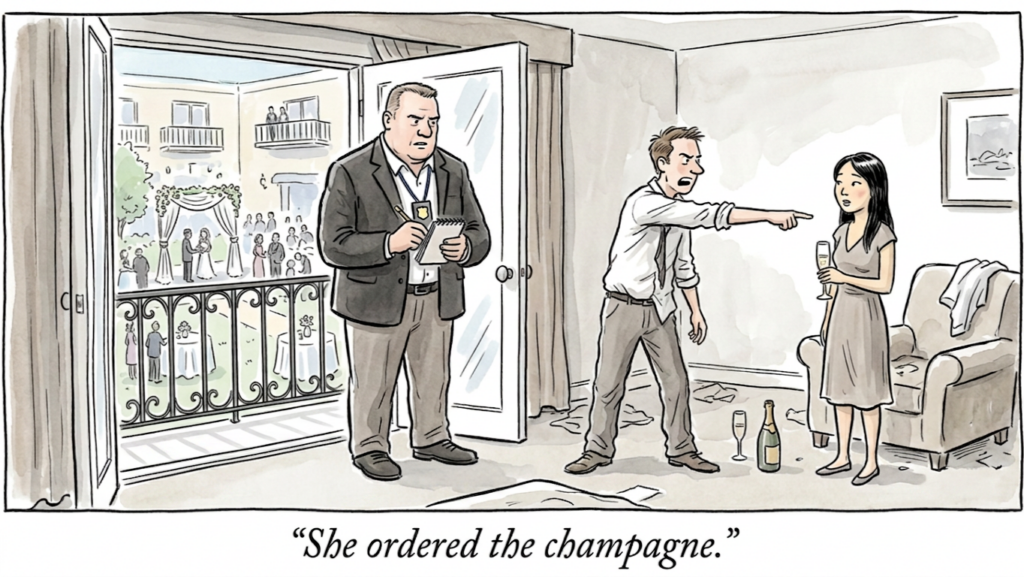
On MLMs, Mei Foo, and why you should never open champagne above a wedding.
I am sitting in the Cathay lounge at Hong Kong International Airport trying to write a thank-you email to a woman I met once, over a decade ago, at the front desk of a Hilton at Logan Airport. I have started it six times. “Dear Kathryn.” “Hi Kathryn.” “Kathryn, you won’t remember me, but,” deleted, because she might remember me, and starting a thank-you note by telling someone they’ve forgotten you is not gratitude, it is guilt wrapped in a compliment. The email is simple: you did something kind for me once, and I never thanked you properly.
The Job
Kathryn was working the front desk when I checked in. I was passing through Boston for a single day, on business I am going to describe quickly, the way you pull a tooth that’s already loose.
I worked for an MLM company.
I had been practicing law for a decade. I was not young. I was not between things. I was a credentialed, functioning adult who had been arguing cases in courtrooms for years and should have known better. I never submitted a resume. The phone rang one day and a voice on the other end offered me a job that involved flying to places and inspecting things, and I said yes because when you have been doing one thing for a decade sometimes a different thing, any different thing, feels like oxygen. The interview, and the international arrest warrants that were issued for the company’s leadership, is a story for another day.
The things were merchandise. The merchandise was questionable in the way that all MLM merchandise is questionable, which is to say it existed primarily to justify a compensation structure rather than to meet a market demand. My first clue that the operation was not destined for the Harvard Business School case study library was the convention in Jakarta where a man in a silk shirt explained the compensation plan using a diagram that looked like a family tree drawn by someone who had married all of their cousins. I stayed anyway. For a while. Because the flights.
One of the flights sent me to Boston. The work took a few hours, and then I was done, and I had a room at the Hilton at Logan because the company, for all its structural resemblance to a pyramid, did at least put you in decent hotels.
The Call
Kathryn was the kind of person who asks you questions not because the training manual says to ask questions but because she is interested, actually interested, in the answer. She asked where I was coming from. She asked where I was going next. I told her Hawaii. This was true. The MLM company owned a vegetarian grocery chain in Hawaii called Down to Earth, which was founded by, and I need you to stay with me here, a Hare Krishna offshoot. I was being sent to consult for them on something. I don’t remember what. The details of this period of my life have the quality of a dream you’re not sure you actually had.
I told Kathryn I was going to Hawaii. I told her I was staying at the Modern Hotel in Honolulu. She lit up. She said she had worked at the Modern Hotel. She said she still had friends there. She said, and I want you to hear the casualness of this, the absolute offhandedness of it, as though she were offering me a glass of water and not a thing I would remember for the rest of my life: “Let me make a call.”
She made a call. From the front desk of the Hilton at Logan Airport, on a random Thursday, for a guest she had met four minutes ago, a man whose professional life at that moment consisted of inspecting MLM merchandise and consulting for a vegetarian grocery chain founded by a religious sect. She called her friends at the Modern Hotel and arranged an upgrade.
I thanked her. I took my key card. I went to my room. I flew to Hawaii.
I did not think about it again until my wife arrived.
Ruth flew in a few days later, in business class, on United miles that I had booked for her and that United, due to their merger with Continental, never actually deducted from my account. A free business class ticket to Hawaii. I mention this not because it is central to the story but because it is the kind of logistical miracle that a person from Adams, Massachusetts, carries with him for life, the kind of thing you whisper to yourself when the world feels hostile, they never took the miles, they never took the miles.
Ruth is Cantonese. She could have married a banker. Instead she married a man who briefly worked for an MLM company and once pointed at her when hotel security arrived, which I will get to. She walked into our room at the Modern Hotel, a room that was significantly nicer than what I had booked, and she looked at the view, and she looked at the space, and she looked at me, and she said: “You did this for me?”
I did not correct her.
This is what they don’t tell you about marriage. They tell you about communication and compromise. They do not tell you that sometimes a stranger’s generosity becomes your reputation and you keep your mouth shut and accept the grace. I am the kind of husband who benefits from the kindness of strangers and takes credit for it silently and has been getting away with it for over a decade. Kathryn, if you are reading this: thank you. And also: I’m sorry. I have been dining out on your phone call for years.
The Coincidence
We checked in. And the young woman at the front desk of the Modern Hotel was Cantonese.
Ruth got to talking, which is what Ruth does when she meets another Cantonese person abroad, which is what a Catholic does when they find another Catholic in a foxhole: immediately, intensely, and with the relief of someone who has been code-switching all day and can finally stop. They talked in Cantonese and I stood there the way I always stand there when Ruth finds her people, which is slightly to the side, smiling, understanding every fourth word and none of the subtext. My contribution to these moments is that I can hum the TVB theme. Every Hong Konger recognizes it. It is the one piece of cultural currency I have and I spend it every time, regardless of context, regardless of whether it has been invited, like a man pulling a card trick at a funeral. The clerk looked at me the way you look at someone’s husband when you are trying to figure out what is wrong with him and whether your new friend needs help. Ruth did not translate the look. She didn’t have to.
She was from Mei Foo Sun Chuen.
Mei Foo Sun Chuen is where we live. A housing estate in Lai Chi Kok, on the Kowloon side of Hong Kong, ninety-nine towers, roughly forty thousand people, built in the 1960s on what used to be an oil depot. I had flown from Hong Kong to Boston to Hawaii, a journey of approximately ten thousand miles, propelled by an MLM and a vegetarian grocery chain founded by a Hare Krishna offshoot, and I had arrived at a hotel where the woman behind the desk had grown up in my building.
Ruth turned to me. “She’s from Mei Foo,” she said, as though reporting it to me would make it more real or less strange. It did neither.
Ruth wanted to celebrate. Ruth always wants to celebrate. Ruth’s definition of “celebrate” includes, but is not limited to: arriving at a hotel, leaving a hotel, the sun going down, and the general fact of being alive in a place where champagne is available. The room was beautiful, thanks to Kathryn. The coincidence of the woman from Mei Foo was still buzzing in us. Ruth ordered champagne.
The Cork
I should have known. I have been married to this woman long enough to know that she and champagne exist in a relationship that physics has not fully explained. I should have known, and I did know, and I opened the bottle anyway, because we were celebrating, and because the balcony was beautiful, and because below us, in the courtyard of the hotel, there was a wedding.
It was a proper wedding. White chairs in rows. An arch covered in flowers that someone had spent real money on. Guests in that particular posture of people who have dressed up in the tropics and are trying not to sweat visibly. A string quartet. A photographer crouching at angles. The kind of event that has a coordinator with a headset and a clipboard and a timeline measured in minutes. From our balcony it looked like a diorama, something staged and miniature and not entirely real, which is perhaps why I did not register it as a threat. I registered it as ambiance.
I opened the bottle.
The cork did not go up. The cork went out. Over the railing. With the trajectory of a thing that has been aimed, which it had not been. The cork sailed into the courtyard and struck what I can only describe, based on his position in the front row and the quality of his suit and the speed with which security subsequently arrived at our door, as a VIP.
The knock came five minutes later. It was not a polite knock. It was the knock of a man whose knuckles have been trained for knocking, a knock that communicates, through the medium of wood and air, that the person on the other side is large and unhappy and has questions.
I opened the door.
The largest security guard I have ever seen was standing in the hallway. He looked at me. He looked past me, into the room, where Ruth was standing with a champagne glass in her hand and the expression of a woman who has been caught but has not yet decided whether to admit it.
I did what any reasonable person would do.
I pointed at my wife.
I pointed at her with the full arm, the extended index finger, the complete and unambiguous gesture of a man who has made his choice and his choice is self-preservation. I pointed at her the way a witness points at a defendant in a courtroom, the way a man who is, professionally, a defense lawyer, points at the person he has decided to not defend.
The guard delivered a lecture. It covered hotel policy, the courtyard, the wedding, the VIP, the concept of gravity, and the general inadvisability of opening pressurized bottles on balconies above events that people have spent months planning. He delivered this lecture to Ruth, because I had pointed at Ruth, because I am not proud of this, but I am alive, and the guard was very large.
The guard left. The door closed. Ruth looked at me.
“You pointed at me.”
“You ordered the champagne.”
“You opened the bottle.”
“The cork went over the railing.”
“And you pointed at me.”
She did not speak to me for approximately forty minutes, which, as I have noted in other contexts, was a nice break.
The Storm
Two days later, we rented a convertible. The North Shore. Top down. Wind in your hair. The whole fantasy, the one you have when you are from Adams, Massachusetts, and the closest you ever got to a convertible was riding in the back of an El Camino on Route 8.
The sun was out when we left. The sun was out long enough for Ruth to arrange her hair and her sunglasses and the particular posture she adopts when she is in a convertible, which is the posture of a woman in a commercial for a life that costs more than ours does. She looked beautiful. She looked like the kind of woman who could have married a banker and is instead married to a man who recently pointed at her in front of hotel security.
Then the sky changed. Hawaii weather changes the way Hong Kong elevator doors close: without warning, without negotiation, without any consideration for the plans of the people who are about to be affected. One minute: sun, blue, the kind of sky that makes you believe the brochure. The next minute: a cloud the color of a bruise, and then the rain.
Not drizzle. Rain. The kind that arrives all at once, like someone has turned on every faucet in the sky simultaneously and aimed them all at a single convertible on the North Shore. And the top was manual, because of course the top was manual, because this is a rental and the rental company has given us a machine that requires physical intervention to perform the one function that distinguishes it from a regular car.
Ruth and liquid. The champagne had gone sideways. The champagne had hit a man at his own wedding. And now the sky was returning the favor, because apparently the universe had decided that Ruth and liquid were going to be the theme of this trip, and if she was going to launch liquid at strangers then liquid was going to be launched at her, in volume, from directly above, while her husband fought a manual latch on a rented convertible.
I got it up. Eventually. Not quickly. We sat in the car, engine idling, rain hammering the canvas above our heads, both of us drenched, the seats holding water, the floor mats gone, the windshield fogged. Ruth’s hair was flat against her skull. Her makeup had migrated to her jaw. Her sunglasses were still on, which was deranged, but I have learned not to comment on the sunglasses.
Two days earlier, liquid had gone over a railing and we’d gotten a lecture. Now liquid was coming from the sky and there was no one to blame and no one to point at. The wedding cork had a target. The rain didn’t. It was just the two of us, equally soaked, equally guilty of renting a convertible in a place where the weather changes without filing a notice.
She laughed.
She laughed the way she laughed on the plane when I sang “magic pants.” She laughed the way she laughs when something has gone so completely sideways that anger would be redundant. And this time I was not pointing at her. This time I was sitting beside her, just as wet, and when she laughed I laughed, and we sat there for a long time, two people in a filling car, neither of us reaching for the key.
The Elbows
Wong Kar-wai said it, or rather a woman in one of his films said it, in Fallen Angels: every day we rub elbows with many people, and some of them may become close friends or confidants.
Kathryn was an elbow. I walked up to a front desk. She was behind it. She asked a question. I answered. She picked up the phone. And from that, from a thirty-second interaction between a woman doing her job and a man who was barely doing his, came an upgrade, and from the upgrade came the look on Ruth’s face, and from Ruth’s face came a version of my marriage in which I am occasionally credited for things I did not do.
The woman from Mei Foo was an elbow. Ten thousand miles from home, standing behind a desk, and Ruth walked in and they were from the same place.
The champagne cork was an elbow. Delivered at velocity. To a VIP. At his own wedding.
The storm was an elbow from the sky.
I am about to send this email. Kathryn is not at the Hilton at Logan anymore, she’s moved to another hotel in the area, but I have found her. The email will be short. It will say: you did something you didn’t have to do for someone you had no reason to help. I never thanked you properly. I am thanking you now. It will say I remember.
It will not say: your phone call led to a champagne cork striking a VIP at his own wedding.
Some things you confess. Some things you let ripple.
I’m pressing send.