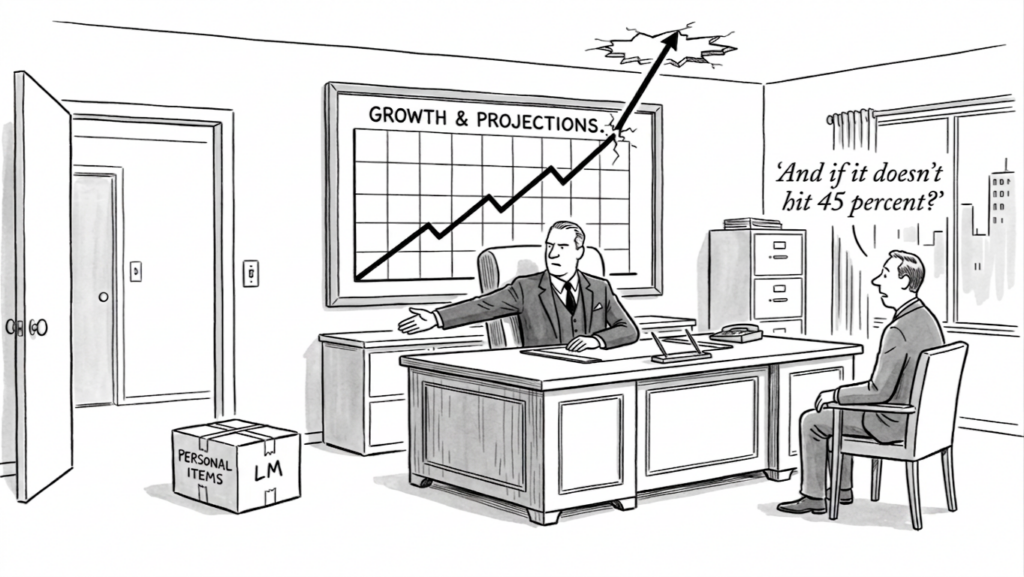
On cooperatives, digestion, and what happens when the company Leif Tullberg built measures its progress in the people it no longer needs.
In 1976, in a country where the fields are flat and the highways run straight to the sea, a business developer named Leif Tullberg and nine independent trucking companies made a decision. They would stop competing with each other and start cooperating. They pooled their bargaining power, their procurement, their commercial operations, and their reputations into a single entity and gave it a name that said exactly what it was: De Sammensluttede Vognmænd. The Joint Haulers. DSV.
The name was not aspirational. It was descriptive. Ten founding parties, joined. That was the whole of it. They did not have a headquarters. They had a handshake. They did not have a strategy deck. They had a shared conviction that ten haulers operating together could negotiate rates that one hauler operating alone could not, and that the distance between a shipper’s load and a buyer’s dock was best covered by people who knew the roads because they drove them, who understood the freight because they loaded it, who grasped the economics because the economics were their mortgage payments.
It was a cooperative. The word matters. A cooperative is not a corporation. A cooperative is a structure in which the members are the mission. The haulers did not work for DSV. They were DSV. The company was not an abstraction that employed them. It was the name they gave to the fact of their togetherness. The freight moved because they moved it. The money came because they earned it. The thing was small, and personal, and Danish, and it worked.
What Tullberg could not have known, what no one who starts a cooperative ever knows, because the whole point of a cooperative is that it rejects the premise, is that he was building the chassis of the largest freight forwarding company on earth. That his handshake would, within fifty years, become a €14.3 billion acquisition. That the company he named after unity would become the most efficient instrument of workforce reduction in the history of the logistics industry. That the joint haulers would one day un-join more than ten thousand people from their livelihoods, and that the process would be described, without irony, as integration.
But I am getting ahead of the story.
DSV grew the way certain organisms grow: by ingestion. It did not build offices in new countries. It bought companies that had offices. It did not develop trade lanes over decades. It acquired companies that had trade lanes. It did not cultivate customer relationships patiently, over years, through the daily unglamorous work of returning phone calls and solving problems. It purchased companies that had done all of that, and then it digested them, absorbing the revenue, metabolizing the systems, and excreting the headcount it deemed redundant. This is not a slur. This is DSV’s stated operating model, refined over twenty-five years and six major acquisitions, each one extending the reach, each one proving the thesis that a company built on consolidation can always consolidate more.
DFDS Dan Transport Group in 2000. Frans Maas in 2006. ABX Logistics in 2008. UTi Worldwide in 2016. Panalpina in 2019. Agility’s Global Integrated Logistics business in 2021. Each name was, before DSV arrived, a company. A culture. A set of relationships held together by people who knew each other’s names and answered each other’s calls. Each name, after DSV arrived, became a line item in an integration playbook. The playbook is consistent because the methodology is consistent: acquire, migrate systems, eliminate overlap, reduce headcount, improve the conversion ratio, move on. The organism eats. The organism digests. The organism grows. The organism gets hungry again.
And then it ate Schenker.
Gottfried Schenker, a Swiss-born entrepreneur, founded his freight forwarding company in Vienna in 1872, in an era when freight meant rail and the Austro-Hungarian Empire was not yet a memory but a map. The company he built became one of the most recognized names in global logistics, a forwarding giant that operated across more than 130 countries with roughly 71,000 employees and the deep institutional memory that comes from 153 years of moving freight through wars, partitions, unifications, recessions, pandemics, and the particular chaos of European borders that shift like weather. Deutsche Bahn, Germany’s state-owned railway operator, acquired Schenker in 2002 and held it for twenty-three years before selling it to DSV for €14.3 billion in a deal that closed on April 30, 2025.
Schenker was not a troubled company. It was not declining. It was not operationally dysfunctional. It was a company owned by an entity that needed the capital for other purposes. The freight was moving. The customers were served. The people were employed. The company was not broken. It was sold. The distinction matters because it determines what happens next: when you buy something that is broken, you fix it. When you buy something that is not broken, what you do to it reveals not a necessity but a philosophy.
DSV’s philosophy has a metric, and the metric is the conversion ratio: operating profit divided by gross profit. It is the number by which the forwarding industry judges operational discipline, the way a hospital judges a surgeon’s outcomes or a law firm judges its realization rate. Before the acquisition, DSV’s conversion ratio was among the highest in the industry. Schenker’s was not. That gap is not a flaw in Schenker. It is the reason DSV bought Schenker. The gap is the meal. Closing the gap is the digestion. And digestion, at DSV, means removing the people whose labor costs sit between the gross profit line and the operating profit line like soft tissue between the organism and its nutrition.
The price was large. The promise was larger. DSV projected DKK 9 billion in annual synergies, with full financial impact now anticipated in 2027 rather than 2028, and at least DKK 4 billion in incremental synergy impact for the current year, on top of the DKK 800 million realized across all of 2025. The organism was hungry. The organism was confident. The organism had done this before.
Here is how fast it moved.
Just over fourteen months after the deal closed, DSV had completed 45 percent of the integration, cut more than 7,000 white-collar positions, and pulled the completion date forward by two years, from the original 2028 horizon to end-of-2026. Twenty months. From acquisition to completion, twenty months. For context, most integrations of this scale take three to five years. DSV is doing it in less than two. CEO Jens Lund, who assumed the role in February 2024 after Jens Bjørn Andersen stepped aside, told analysts that DSV had reduced headcount by just shy of 1,000 FTEs in its Air & Sea division during Q1 alone and expected a similar run rate in Q2. He has publicly acknowledged the eventual target: a 6 to 8 percent reduction in the combined workforce, translating to roughly 10,000 to 13,000 positions overall.
Thirteen thousand people. The number deserves its own silence before we continue. Thirteen thousand people who had a job when the acquisition closed and will not have that job when the integration ends. Thirteen thousand badges returned, email addresses deactivated, institutional memories escorted from the building or simply allowed to evaporate in the parking lot. The ten parties who founded DSV represented ten enterprises, ten sets of livelihoods, ten kitchen tables where someone came home and talked about the day’s freight. The integration of Schenker will affect thirteen thousand of those tables. The scale is different. The arithmetic is the same. Someone who had a job does not have a job. Someone who answered the phone in Hamburg or Rotterdam or São Paulo for twenty years is now updating their LinkedIn profile, adding the words that have become the industry’s quiet anthem: open to opportunities.
And the numbers, the other numbers, the ones the organism cares about, are going up.
Q1 2026 EBIT before special items rose 31.2 percent year-on-year to DKK 4,855 million. Revenue surged 74.7 percent to DKK 70.4 billion. Gross profit climbed 78.4 percent to DKK 18,903 million. In air freight, DSV’s Q1 volumes of 518,000 tons narrowly edged Kuehne+Nagel’s 516,000, giving it a credible claim to the world’s largest airfreight forwarder on a quarterly basis. The combined entity now generates more than €40 billion in revenue, operates across more than 90 countries, and employs close to 160,000 people, a number that is, by design, declining. The organism ate. The organism digested. The organism grew. The stock market, which does not metabolize human consequences, approved.
But there is another set of numbers, and they tell a story the organism prefers to call temporary.
The conversion ratio dropped to 25.7 percent from 35.1 percent in the prior-year quarter. Operating margin compressed to 6.9 percent from 9.3. The cost base nearly doubled, swelling to DKK 14.0 billion from DKK 7.1 billion. Adjusted free cash flow fell to DKK 1,517 million from DKK 3,165 million. Pre-tax return on invested capital slid from 15.5 percent to 13.3.
Lund was candid. He told analysts DSV had “hit the trough,” that the compression was a product of mathematics, because Schenker had a lower conversion ratio than DSV had. He was right. It is mathematics. But mathematics and meaning are not the same thing. The mathematics say the ratio declined because DSV absorbed a less profitable business. The meaning is that Schenker was a less profitable business because Schenker employed more people per unit of output than DSV’s model tolerates, and the integration exists, in significant part, to correct that fact. The trough is not an accident. The trough is the point. The trough is what happens when an organism swallows something large and must spend energy breaking it down before it can extract the nutrition.
The nutrition is margin. And margin, at DSV, is produced by removing people.
Lund does not use that language. He uses a different metric, and the metric tells you everything about the philosophy. The metric is shipments per person per day. Not shipments per day. Shipments per person per day. The denominator is the person. The way to improve the ratio is to either increase the numerator or decrease the denominator, and in an integration, decreasing the denominator is faster, cheaper, and more predictable than growing volume in a freight market buffeted by Middle East disruption and tariff uncertainty. The person is the variable to be optimized. The person is the cost to be managed. The person, in the framework DSV has refined over six acquisitions and a quarter century of practice, is the thing you remove to make the number go up.
When a Morgan Stanley analyst asked whether conversion margins above 45 percent were achievable in the future, Lund did not hedge: “No, I fully agree. Otherwise, we’ve failed. Was that clear?” Forty-five percent. The number sits there, a target pinned to the wall of a future in which DSV has absorbed every system, migrated every customer, and removed every person the model says is redundant. To reach 45 from 25.7 requires either a near-doubling of operating profit or a dramatic reduction in cost, or both. The cost, predominantly, is people. The path to 45 percent runs through the desks of workers who are, right now, this quarter, processing shipments and answering phones and maintaining the customer relationships that the organism acquired for €14.3 billion. Those people are not obstacles to the target. They are the target. Their removal is the plan.
I want to be careful about what I am saying, and what I am not.
I am not saying DSV is wrong to integrate Schenker. It paid €14.3 billion. It is entitled to operate the business it bought. Integration is not optional at this scale; it is the price of admission, and the alternative, running two parallel systems, two cultures, two cost structures, two sets of trade-lane managers calling the same customer from different phone numbers, would be a dereliction of the fiduciary duty that any public company owes its shareholders. I am not saying the 7,000 jobs cut so far should not have been cut. Some were genuine overlaps: two regional managers where one will do, two finance teams where one suffices, two IT platforms where one must prevail. Duplication is real, and eliminating it is not cruelty. It is arithmetic.
What I am saying is that the arithmetic is being performed by people who experience it as productivity, on people who experience it as loss. And the speed at which DSV is performing it, pulling the completion date forward by two years, cutting 7,000 positions in fourteen months, targeting up to 13,000 overall, suggests that the organism’s appetite is governed not by need but by capacity. DSV is cutting as fast as it can because DSV has always cut as fast as it can. Speed kills risk, the company believes. The faster you integrate, the less time competitors have to pick off your customers and the sooner synergies flow to the bottom line. It is a thesis. It has been proven before. UTi, Panalpina, Agility, each time, the organism moved fast, and each time, the organism was right. But the thesis contains an assumption that deserves scrutiny: that the risk being killed is external, and not internal.
The external risk is the competitor circling, the customer wavering. That risk is real. Competitors have been openly courting displaced Schenker customers and talent since the day the deal closed. Mid-tier forwarders are picking up business from shippers anxious about service continuity during systems migration, and the anxiety is not theoretical: DSV itself acknowledged temporary service disruptions during country go-lives in the Netherlands and Germany earlier this year. The last major go-lives, France and Germany, are scheduled for July and August 2026, meaning DSV is right now, this quarter, in the most operationally intense phase of the entire integration, the phase where the systems are switching over and the customers are being told their new account manager’s name and the old account manager is updating their CV.
The internal risk is different. The internal risk is that you cut so fast, and so deep, that the people who remain are not energized by the transformation but paralyzed by it. That the survivors look at the 7,000 already gone and the 6,000 still to come and conclude that the safest move is not to stay and fight but to leave before the organism gets hungry again. That the institutional knowledge walks out the door not because you pushed it but because it saw what happened to the knowledge that stayed.
In Germany, where Schenker employed around 15,000 people and where the social contract between employer and worker is written into law in ways that would strike an American HR department as foreign, DSV negotiated a frame agreement with works councils and committed €1 billion in investments over three to five years. The commitment is real. It is also accompanied by targeted reductions of 1,600 to 1,900 positions in Germany alone. The billion euros is the anesthetic. The 1,900 lost positions are the surgery. Both are happening at the same time, to the same workforce, and the workers are expected to be grateful for the investment while absorbing the cuts, as though capital expenditure and human elimination are separate processes rather than two movements of the same hand.
Total transaction and integration costs are expected to reach approximately DKK 11 billion. By the end of Q1, some DKK 6 billion had already been spent. The gearing ratio stood at 2.8 times, with net interest-bearing debt reduced by approximately DKK 8 billion since the transaction closed, and a target of below 2.0 times by the first half of 2027. The organism is managing its debt. The organism is managing its margins. The organism is managing its timeline. What the organism is not managing, because the organism was never designed to manage it, is the thing that happens when 13,000 people who used to answer the phone for Schenker stop answering the phone for anyone.
Here is the thing the playbook does not account for, has never accounted for, across six acquisitions and twenty-five years of refinement. When you eliminate a person from a freight forwarding company, they do not disappear. They go to Kuehne+Nagel or DHL or Flexport or the regional forwarder on the next street, and they take with them the name of the customs inspector in Hamburg who needs the paperwork formatted a particular way, the memory of the carrier in São Paulo who actually shows up on a Friday afternoon, the knowledge of which customer in Detroit panics when the tracking goes dark and needs a human voice, not a system notification, a voice, saying I’m on it before they pick up the phone and call someone else. That knowledge does not exist in a TMS. It does not transfer during a system migration. It lives in a person, and when the person is reclassified as overlap and walked to the door with a severance package and a reference letter, the knowledge walks with them. It is perishable, the same way freight is perishable, and it spoils just as fast.
DSV’s bet, the bet it has made six times before and won six times before, is that customers will stay. Lund told analysts that retention remains strong, that volumes with key accounts have been maintained, that the footprint has even expanded during tender season. He may be right. He has been right before. The organism has digested before and emerged larger and more profitable, and the customers who were supposed to leave did not leave, and the analysts who predicted disruption were proven wrong, and the stock went up.
But the organism has never digested anything this large. Schenker is not UTi, a troubled South African logistics company with declining revenues and operational dysfunction. Schenker is not Panalpina, a mid-tier Swiss forwarder with a controlling shareholder ready to sell. Schenker is 153 years old. Schenker operated across more than 130 countries. Schenker had roughly 71,000 employees and customer relationships that predate the European Union, relationships maintained by people who learned their trade lanes not from a dashboard but from decades of daily repetition, the accumulated muscle memory of ten thousand phone calls and a hundred thousand emails and the particular way a shipment to Lagos needs to be documented to avoid a three-week hold that no system prompt has ever been trained to anticipate. That is not overlap. That is the business.
DSV has maintained its full-year 2026 EBIT guidance of DKK 23.0 to 25.5 billion. The guidance sits there, a promise to the market, a number the organism intends to hit, and the path to hitting it runs through the same desks it has been clearing for fourteen months. The analysts will ask their questions. The conversion ratio will climb. The headcount will fall. The synergies will materialize, because at DSV, synergies always materialize. That is the playbook. That is the proof. That is the organism’s track record, presented on slides and validated by returns.
I do not doubt the track record. I doubt the transfer.
Every previous acquisition was smaller, simpler, or sicker than this one. Every previous integration operated in a freight market that was not simultaneously managing Red Sea disruptions, tariff volatility, and the structural overcapacity that follows every boom. And every previous integration asked DSV to absorb a company whose institutional complexity was manageable within the organism’s existing digestive capacity. Schenker is different. Schenker is not a meal. Schenker is a meal the size of the organism itself, and the organism is chewing as fast as it can, and the chewing is impressive, and the speed is remarkable, and the analysts are nodding, and somewhere in the middle of it all, 13,000 people are discovering that their twenty years of expertise have been reclassified as a cost to be synergized.
The word “synergy” deserves one final moment of attention. It comes from the Greek synergia, meaning joint work, cooperation, from synergos, meaning working together. Its original meaning is cooperation. The founding parties who established DSV in 1976 were practicing synergy in the truest sense of the word: independent haulers working together, pooling their operations, producing an outcome greater than the sum of its parts. The word has since been captured by the acquisition industry and repurposed to mean its opposite: the savings achieved by eliminating the people whose working together is no longer required. Synergy, in 1976, meant ten parties joining. Synergy, in 2026, means 13,000 workers leaving. The word has not changed. The meaning has been gutted and rebuilt, like a company.
Somewhere in Hedehusene, Denmark, in a headquarters that a trucking cooperative could not have imagined, the organism is processing another quarter of results. The EBIT is up. The conversion ratio is climbing out of its trough. The integration is ahead of schedule. The playbook is working. The analysts are nodding. The stock is reflecting what the market considers to be excellence.
And somewhere in Hamburg, or Lyon, or São Paulo, a person who spent two decades at Schenker, who knew the trade lanes and the customs codes and the dock manager’s name and the way the freight shifts in a container when the seas are rough off Bremerhaven, is closing their laptop and thinking the thought that 7,000 people have already thought and 6,000 more will think before this is over:
The joint haulers are no longer joined. The convoy has arrived at its destination. And the destination did not require this many drivers.
De Sammensluttede Vognmænd. The Joint Haulers. Ten founding parties who believed that the person in the cab mattered as much as the freight in the trailer. Their company now spans the world. Their name still means what it meant. But the organism that carries the name has learned something the ten founders never knew, something no cooperative is designed to learn:
That the most efficient convoy is the one with the fewest drivers.
That the mathematics always work.
And that the mathematics never grieve.