On credentials, accidental careers, and why a man who once impersonated a department store at two in the morning has no business telling anyone what to do with their life, but is going to do it anyway.
I did not decide to become a lawyer. This is not false modesty. This is not the charming, self-deprecating origin story of a man who wants you to think he stumbled into success with his hands in his pockets. I did not decide to become a lawyer the way I did not decide to move to Hong Kong and did not decide to stop bowing in courtrooms and did not decide to wear shorts to a law firm in a jurisdiction where barristers dress like the cast of a period drama. These things happened. They happened in sequence. They happened with a momentum that I mistook, at the time, for direction, and by the time I looked up and asked myself where I was going, I was already there, holding a practicing certificate in a common law jurisdiction eight thousand miles from the town where I couldn’t sit still long enough to complete a worksheet.
Ruth says I fell into law the way other people fall into swimming pools. Not gracefully. Not on purpose. With a sound that everyone in the vicinity heard and nobody could ignore.
She is not wrong.
But before I tell you how I became a lawyer, I need to tell you about the kids I see now. The ones who did it on purpose. The ones who did everything right. The ones who are miserable.
There is a woman in my office. I will not name her. She is twenty-eight. She is brilliant in the way that people in Hong Kong are brilliant, which is to say: her brilliance was identified early, catalogued, measured against a standardized rubric, rewarded with grades that opened doors that opened more doors, and funneled, with the efficiency of water finding its level, into the legal profession.
She went to a Band 1 school. She went to HKU. She did the PCLL. She secured a training contract at a firm whose name, spoken in certain company, produces the same slight involuntary stiffening of the posture that the name Pizani once produced in the hallways of Hoosac Valley High School, except instead of fearing a punch, people fear being asked to bill 2,200 hours a year. She did everything right. Every box checked. Every credential earned. Every expectation met with the precision of a person who has been meeting expectations since she was six years old and sat for her first public exam and was told, by implication and by architecture, that the number on the paper was the number that she was.
She is in my office because she left that firm. She left because she was dying there. Not literally. Not the kind of dying that produces a body. The kind of dying that produces a person who arrives home at ten o’clock at night and feels nothing. Not tired. Not angry. Not sad. Nothing. The absence of feeling that is worse than any feeling, because at least feelings confirm that you are still inside your own life, still a participant, still someone to whom things are happening rather than someone through whom things are passing.
She sat across from me in the interview and said, “I want to do work that matters.”
And I thought: you are twenty-eight years old and you have done everything right and nobody, in the entire twenty-two years between your first exam and this moment, ever asked you what you wanted to do. They asked you what you could do. They asked you what you should do. They asked you what the grades qualified you for, and the answer was always the same, the answer was always law, because law is where the grades go in Hong Kong the way water goes downhill. Not because it wants to. Because the architecture permits nothing else.
I need to tell you about the architecture.
In Adams, Massachusetts, where I grew up, the architecture of expectation was simple. You were expected to get a job. Any job. A job at the mill, except the mills were closing. A job at the store, except the stores were leaving. A job somewhere, doing something, that paid enough to keep you in Adams, because Adams expected you to stay. The town held you. The town watched you. The town did not care what the job was as long as you had one and you showed up to the Polish National Alliance bar on Saturday night and you could look your father in the eye and say you were doing fine.
Nobody in Adams told me to be a lawyer. Nobody in Adams told me to be anything. The guidance counselor at Hoosac Valley, a man whose office smelled like old coffee and whose filing system consisted of a single drawer that may or may not have contained my records, told me I should consider the trades. He said this with the practiced diplomacy of a man who has looked at a student’s grades, looked at the student, and decided that the kindest thing he can do is lower the trajectory before the trajectory lowers itself. He was not wrong, based on the evidence. The evidence, which consisted of four years of incomplete homework, disruptive behavior, and the kind of test scores that said can but not does, supported his conclusion. I was not university material. I was not lawyer material. I was material that had not yet been identified, that did not fit in the drawer, that floated between categories with the confident aimlessness of a kid who could see every answer in the room but could not sit still long enough for anyone to notice.
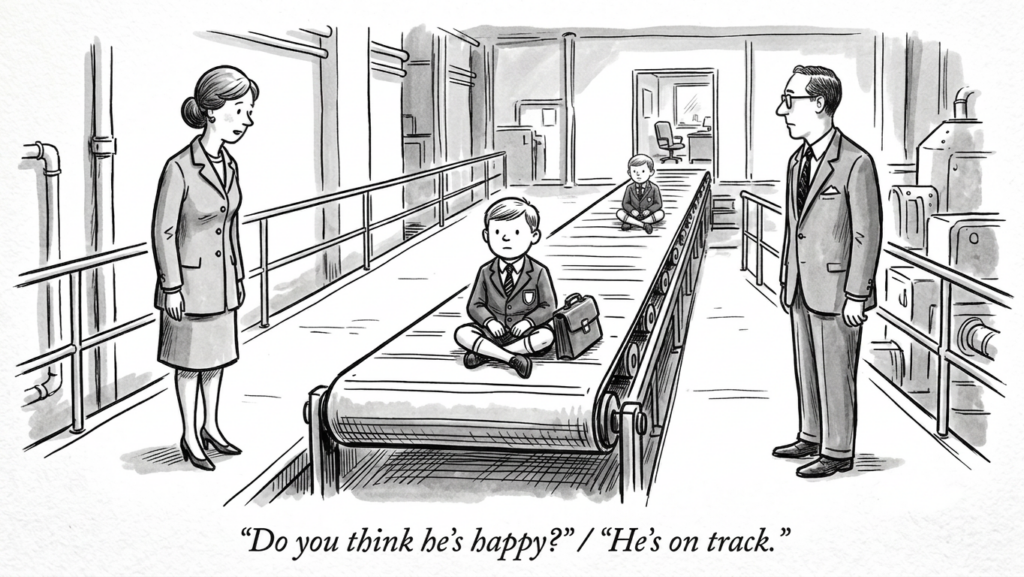
In Hong Kong, the architecture is different. The architecture is a conveyor belt. A conveyor belt that begins in kindergarten and does not stop moving until you are sitting in a corner office in a tower on the harbor, wearing a suit that costs more than my first car, holding a business card with a title that your mother can show to her friends at dim sum. The conveyor belt does not ask if you want to be on it. The conveyor belt does not have an off button. The conveyor belt has parents standing on either side of it, and the parents are not pushing, exactly, but they are also not stepping back, and the difference between pushing and not stepping back is a distinction that would require a therapist to parse, and the therapist costs twelve hundred dollars an hour, and you cannot afford the therapist because you are spending everything on the PCLL prep course that your parents are paying for because they sacrificed everything so that you could have this opportunity, and the opportunity is not optional, because the opportunity is what the sacrifice was for, and to refuse the opportunity is to refuse the sacrifice, and to refuse the sacrifice is to say that everything your parents did, every extra shift, every skipped holiday, every dollar that went to your tuition instead of their retirement, was for nothing.
That is the weight. That is what sits on the chest of every twenty-four-year-old in Hong Kong who is studying for the PCLL and does not want to be a lawyer and cannot say so. Cannot say it at dinner. Cannot say it at New Year. Cannot say it in any room where their parents are present, because the room does not contain the language for it. The language for “I don’t want this” does not exist in a culture where want is a luxury and duty is a floor that everyone stands on and nobody questions.
I have never felt that weight. I have never felt it because nobody in Adams, Massachusetts, invested a single dollar in the expectation that I would become a lawyer. I became a lawyer the way I became everything else in my life: by moving in a direction and not stopping. I had no conveyor belt. I had no parents standing on either side with the quiet intensity of people who had given up everything for this moment. I had momentum. That is all I have ever had. The momentum of a kid who could not sit still, applied, eventually and by accident, to a set of standardized exams that he passed because standardized exams, unlike homework, can be taken in a single burst of hyper focused energy by a brain that was designed for single bursts and nothing else.
The difference between me and the woman in my office is that I was never supposed to be here. She was always supposed to be here. And the person who was never supposed to be here is free in a way that the person who was always supposed to be here will never be, because I have nothing to betray. I have no one’s sacrifice to dishonor. My mother did not work extra shifts so that I could sit for the PCLL. My father did not skip holidays so that I could article at a firm whose name produces a stiffening of the posture. I arrived at this career the way a man arrives at a party he wasn’t invited to. I walked in. I stayed. Nobody asked for my invitation because I was already inside, and at a certain point it became more awkward to check than to let me remain.
The woman in my office does not have that freedom. She has credentials. Credentials are the opposite of freedom. Credentials are a cage with a diploma on the wall.
I want to talk about the cage.
The cage is beautiful. That is the problem. The cage in Hong Kong is polished, well-lit, ergonomically designed, and climate-controlled to exactly twenty-two degrees Celsius, which is the temperature at which a human body can sit motionless for twelve hours without technically suffering. The cage pays well. The cage has a name that your mother can say at dim sum. The cage has an annual bonus that arrives in March and tastes, for approximately forty-eight hours, like validation, before it is absorbed into the mortgage and the lease on the car and the school fees for the child who will one day sit on the same conveyor belt, and the cycle, the beautiful, efficient, Hong Kong cycle, continues.
I have watched young lawyers inside the cage. I have watched them for over a decade now, from the peculiar vantage point of a man who wears shorts to the office and was once known as the non-bower and who, by every measure of traditional legal professionalism, should not be the person anyone looks to for guidance on how to build a meaningful career. And yet they come to me. They come because I left at 6pm. They come because I wore shorts. They come because the fact that I am here at all, practicing law in this jurisdiction, with my history and my accent and my undiagnosed ADHD and my French name that is not French, suggests that the conveyor belt is not the only way in. That there might be a side door. That the side door might even lead somewhere better.
They don’t ask me about law. They ask me about purpose.
“How did you know this was what you wanted?”
I didn’t. I never knew. I still don’t know. I am fifty years into a life governed by momentum and I have never once sat down and asked myself what I want to be when I grow up, because by the time I thought to ask the question, I was already grown and already being it and the question was moot. This is not a philosophy. This is not advice. This is a confession. I am an accidental lawyer the way some people are accidental parents, which is to say: the accident turned out to be the best thing that ever happened to me, and I have no idea how to replicate it, and I would not recommend the method to anyone whose risk tolerance is below “catastrophic.”
But here is what I tell them, when they sit in my office and look at me with the particular expression of a person who has done everything right and feels nothing:
The credential is not the career. The career is not the life. The life is the thing that happens in the hours you are not billing. And if the hours you are billing are eating the hours you are living, then the credential, however impressive, however expensive, however much sacrifice it represents, is a very beautiful cage with a very expensive lock and you are the only person holding the key.
There is a thing that happens to young lawyers in Hong Kong around year three. I have seen it enough times to call it a pattern. I have seen it in my own office. I have seen it in friends’ firms. I have seen it in the faces of people at the Hong Kong Law Society continuing education events, which I attend because they are mandatory and because the buffet is adequate and because I enjoy watching a room full of people in suits pretend to be interested in regulatory updates while their eyes say help me.
Year three is when the anesthesia wears off.
Years one and two are survival. You are learning. You are billing. You are terrified. The terror is productive in the way that all terror is productive, it keeps you moving, it keeps you alert, it keeps you too busy to ask whether you want to be here because the question of wanting is a luxury and you do not have time for luxuries, you have time for billing and eating and sleeping, in that order, and sleeping is negotiable.
Year three, you look up.
You look up and you see the partner. The partner is fifteen years ahead of you on the same path. The partner drives a car that costs what your parents’ house costs. The partner has a watch that costs what your car costs. The partner also has a divorce, or a marriage that operates with the warmth of a business arrangement, or children who see him on weekends the way they see a distant relative, with polite interest and no real intimacy. The partner leaves his jacket on his chair and his light on when he goes to dinner and fifty people sit frozen on the floor waiting for permission to leave, and the partner either does not know or does not care, and you cannot decide which is worse.
You look at the partner and you think: that is where this conveyor belt goes. That is the destination. That is what all the exams and the PCLL and the training contract and the years of face-time and the three months of life donated annually to an empty ritual are building toward. A corner office. A watch. A jacket on a chair. A reputation that stiffens postures. And a life that, viewed from the outside, is a success, and viewed from the inside, is a question that was never answered because it was never asked.
Is this all there is?
I hear that question now the way Jack Gallivan heard the question about dummies. I hear it because they trust me enough to ask it, which is its own kind of compliment, the Massachusetts kind, the kind that lives in the gap between what is said and what is meant. When a twenty-eight-year-old lawyer asks you “is this all there is,” she is not asking about the profession. She is asking about herself. She is asking: am I allowed to want something else? Am I allowed to say this isn’t working? Am I allowed to disappoint the people who built the conveyor belt and stood on either side of it and gave up everything so that I could be exactly here, in exactly this cage, with exactly this lock?
I think about the kid I was at Hoosac Valley. The kid who floated. The kid who belonged to no group and committed to nothing and confused independence with fear. The kid who was dumb for not crossing the hallway.
I think about how that kid became a lawyer not because anyone expected it but because the momentum carried him there, the way momentum carries everything, forward, without plan, without strategy, with nothing but the dumb, beautiful, inexhaustible energy of a person who cannot sit still.
And I think about how the kids in Hong Kong, the brilliant ones, the ones who did everything right, are trapped by the opposite problem. They are too still. They have been trained to sit. They have been trained to stay in the chair, to endure the fluorescent lights, to donate the three months, to perform the ritual, to climb the ladder rung by rung without ever looking sideways to ask whether the ladder is leaning against the right wall. They were placed on the conveyor belt at six years old and they have been sitting still ever since, and the sitting still, which looks like discipline and smells like success, is killing them the way it killed the woman in my office, slowly, invisibly, in the absence of feeling that is worse than any feeling.
I was the kid who could not sit still. They are the kids who cannot stand up.
It is the same problem. It is the same cage. The dimensions are different but the bars are the same. My cage was made of low expectations and empty drawers and a guidance counselor who smelled like old coffee and thought I should consider the trades. Their cage is made of high expectations and full drawers and parents who smell like sacrifice and think they should consider nothing, because everything has already been considered, and the consideration produced this, and this is the PCLL, and the PCLL is the firm, and the firm is the cage, and the cage is the life.
I do not have advice. I have never had advice. I have momentum and I have Ruth and I have a story about calling the toughest kid’s dad at two in the morning pretending to be Sears, and none of these things qualify me to tell a twenty-eight-year-old what to do with her life.
But I have something else. I have the example of the accident. The example of a man who did nothing right, in the traditional sense, and ended up somewhere anyway. Somewhere good. Somewhere meaningful. Somewhere that involves shorts and courtrooms and a wife who could have married a banker and a practice that lets him leave whenever he wants and a life that is, by any measure that matters, which is to say by the measures that do not appear on a CV, full.
The woman in my office, the one who left the firm with the name that stiffens postures. She is here now. In my office. Where we leave at six. Where nobody checks the clock. Where the work matters because the work is the point, not the presence, not the hours, not the body in the chair.
She told me, after her first month, that she had started cooking. Dinner. At home. On weeknights. Not delivery. Actual cooking. She said it the way a person describes a miracle they are not sure they believe in yet. As if cooking dinner on a Wednesday was a radical act. As if feeding yourself at a reasonable hour was a form of rebellion.
It is. In Hong Kong, it is.
She started running. Along the waterfront. After work. In the daylight. She said she had forgotten what the harbor looked like at six-thirty. She had worked in a tower overlooking it for three years and she had never seen it at six-thirty because at six-thirty she was at her desk performing the Productive Lean and watching OpenRice and waiting for a jacket to leave a chair.
She is reading again. Books. Not case law. Books that take time, that ask something, that leave a residue. She told me she read forty pages on the MTR last week and felt something she couldn’t name.
I could name it. Stevenson named it two hundred years ago. The duty of being happy. The raw material of it, reclaimed. One evening at a time. One run at a time. One meal cooked in a kitchen that used to be dark at this hour but isn’t anymore because she is in it, and she is in it because someone told her that if her work was done, she should leave, and she left, and the world did not end.
The ladder is against the wrong wall. I know this because I have watched people climb it for a decade. I have watched them reach the top and find nothing there but a corner office and a jacket and a view they never see because they are always facing inward, always performing, always staying.
I am not the person to tell them where to put the ladder instead. I never had a ladder. I had momentum. I had the unfair, unearned, completely accidental advantage of never having been expected to be anything, which freed me to become something. The freedom of low expectations is a privilege that nobody would choose and that I would not trade.
But I can tell them this. I can tell them what I told the woman in the interview. What I told the associate who glanced at my office at six o’clock. What I tell every young lawyer who sits across from me with that year-three look, that is-this-all-there-is look, that look that says the anesthesia has worn off and they can feel everything now and what they feel is nothing:
The credential got you here. It will not keep you here. The thing that keeps you here, in the profession, in the life, in the chair that you are allowed to leave at six o’clock because your work is done and you are a person and persons go home and cook dinner and run along waterfronts and read books and live, the thing that keeps you here is not the grade or the certificate or the name on the door. It is the moment you find the work that makes the staying voluntary. The staying that is not performance. The staying that is not fear. The staying that is choice, because the work matters, because the client matters, because you looked at what was on your desk and felt something other than nothing.
I found it by accident. Most people who find it do. The conveyor belt does not deliver you to purpose. The conveyor belt delivers you to a salary, and a salary is not a purpose, and the gap between the two is where the year-three crisis lives.
If you are in that gap. If you are twenty-eight or thirty-two or forty-five and you are staring at the back of your boss’s head and willing him to stand up so that you can leave so that you can go home so that you can feel something. If you did everything right and it feels wrong. If the credential is heavy and the cage is beautiful and the key is in your pocket and you are terrified to use it because using it means admitting that the sacrifice, your parents’ sacrifice, was for a destination you do not want to reach.
I cannot tell you what to do. I fell into a pool. I am not a swimming instructor.
But I can tell you that the pool is survivable. I can tell you that the side door exists. I can tell you that a man from Adams, Massachusetts, with undiagnosed ADHD and a French name he’s been mispronouncing his entire life and a guidance counselor who told him to consider the trades, is practicing law in Hong Kong in shorts, and leaving at six, and his work matters, and his life is full, and he got here by accident, and the accident was the best thing that ever happened to him.
And I can tell you that the woman in my office is cooking dinner on Wednesdays now. That is not nothing. That is everything. That is three months of a life, returned. That is the raw material of happiness, reclaimed from a ritual that produced nothing.
The ladder doesn’t matter. The wall matters. Lean it against the right one and every rung makes sense. Lean it against the wrong one and you arrive at the top with a corner office and a jacket and a view you never see and a life that passes through you without leaving a mark.
I’m the wrong person to say all of this. I’m the non-bower in shorts with a tattoo I can’t read. But the wrong person is sometimes the only person willing to say it, because the right people are still on the conveyor belt, still climbing, still facing inward.
The pool is survivable. The side door is open. The key is in your pocket.
Use it.
And for God’s sake, leave at six.