The Orchard
In 1905, in a town on the Red River where the Dakota wind bent the grass flat and the railroad tracks were still warm from being laid, a man named Charles Henry Robinson saw something simple and built a company around it. Settlers needed produce. Farmers needed buyers. The distance between the two was not merely geographic. It was logistical, informational, and perishable. Robinson brokered the gap. He connected growers to wholesalers, matched supply to demand, and did it with a handshake and a telegraph and whatever conviction a New York City native turned traveling salesman in St. Louis carries in his chest when he decides to stop traveling and start building.
He was gone within a few years. According to local legend, he sold out of his company and ran off with Annie Oakley. The historical record is murkier. One detailed company history notes that Robinson did not die in 1909 as the legend claims, and that the timeline of his departure from the partnership is more complicated than the folk account suggests. What is clear is that by 1913 the Nash brothers were the sole owners of the company. What matters is that the company outlived its founder’s involvement, which is what happens when the thing you build is not a personality but a system.
The system was simple. Robinson did not own farms. He did not own trucks. He did not own warehouses or railcars or cold storage. He owned relationships.
The system was simple. Robinson did not own farms. He did not own trucks. He did not own warehouses or railcars or cold storage. He owned relationships. He was the intermediary, the broker, the man in the middle who knew where the apples were and who needed them and how fast they would rot if nobody moved. The company that bore his name became, over the next century, the largest third-party logistics provider in North America. Not by acquiring assets. By connecting people. By being, in the language of the industry, non-asset-based. The asset was the people.
And the people, for most of the company’s history, owned the company back.
In 1976, C.H. Robinson bought out the last shares held by the Nash Finch Company and became entirely employee-owned. The employees were not merely workers. They were shareholders. They swept the floors and held the equity. They answered the phones and collected the dividends. The alignment was not theoretical. It was structural. The person booking your freight had a financial interest in booking it well, because the company’s success was not an abstraction reported in a quarterly filing they would never read. It was their retirement. Their children’s tuition. Their kitchen table.
That was the orchard. Not a metaphor for a company. The company itself, rooted in produce brokerage, grown by people who understood that perishable goods require trust, and that trust, once established, compounds in the same way that a well-tended tree produces more fruit each year than the year before. The employees tended the orchard because they owned the orchard. The orchard fed them because they fed it.
In 1997, C.H. Robinson went public. The IPO raised $190 million for the 101 employees who sold their shares. The initial market value totaled $743 million. The company renamed itself C.H. Robinson Worldwide, Inc., began trading on NASDAQ under the symbol CHRW, and entered the era in which the orchard would no longer belong to the people who tended it. It would belong to the market. And the market, as markets do, would eventually send someone to measure the trees not by their fruit but by the cost of their shade.
I want to be careful here. The IPO was not a betrayal. Employee-owned companies go public for legitimate reasons, liquidity chief among them. The people who sold their shares had built something real, and they were entitled to realize the value of what they built. The question is not whether the IPO was justified. The question is what happens to a culture built on ownership when the owners become employees and the new owners become institutions that hold the stock in index funds and have never smelled a rotting pallet of produce in their lives.
The Turn
For a long time, the answer was: nothing changes. Or at least nothing visible. John Wiehoff, who joined as corporate controller in 1992 and became CEO in 2002, ran the company for seventeen years. During his tenure, total revenues increased over 500 percent to $16.6 billion. Annualized total shareholder returns ran at 13 percent. When Wiehoff handed the company to his successor in 2019, he said the thing that every departing CEO says, but said it with the particular emphasis of a man who believed it. He said the company’s success “has always been driven by our people, processes, and technology.” People first. Technology third. The order mattered, because the order was the culture, and the culture was the engine, and the engine was the returns.
He kept the orchard.
Wiehoff had spent eight years at Arthur Andersen before joining Robinson. I note this not to impugn him. He was an auditor, not a consultant, and he left a decade before the firm’s collapse. But the irony is structural: Andersen’s failure was a failure of institutional integrity, a system that looked sound from the outside while the inside had been hollowed by people who understood the machinery but not the purpose it served. Wiehoff, whatever he learned at Andersen, appears to have learned the right lesson. He built a company where the machinery and the purpose pointed in the same direction. He kept the orchard.
His successor, Bob Biesterfeld, was a company man. Twenty-four years at Robinson. He started in Robinson Fresh, the produce division, the founding business, the literal orchard. He rose through the ranks the way people rose at Robinson, which was slowly, deliberately, and with the institutional memory that comes from having booked the freight yourself before you managed the person who booked the freight. When he was named CEO in 2019, he said he was honored to serve “our more than 15,000 employees across the globe.” He talked about talented people and high-performing culture. He committed a billion dollars to technology investment over five years.
He was fired three and a half years later. The SEC filing used the phrase “involuntary termination without cause.” The board was unanimous. An analyst at JPMorgan wrote that the departure was driven by business results. The freight market had turned. The pandemic boom had produced a glut of capacity and a collapse in rates. Robinson had hired aggressively during the upcycle and was caught with too many people and too few loads to move. The activist investor Ancora Holdings, having won two board seats earlier that year, wanted new leadership, faster cost cuts, a different kind of CEO.
They got one.
David Bozeman arrived in June 2023 from Ford Motor Company, where he had served as a vice president. Before Ford, he spent five years at Amazon Transportation Services. Before Amazon, eight years at Caterpillar. Before Caterpillar, sixteen years at Harley-Davidson. Thirty years of experience at industry-leading companies, not one of which was a freight brokerage. Not one of which was non-asset-based. Not one of which had ever been employee-owned. And not one of which was a service business. Harley-Davidson makes motorcycles. Caterpillar makes mining equipment. Amazon moves packages through a network it owns. Ford makes cars. These are product companies, every one, where the revenue comes from a thing that rolls off a line or arrives in a box. A freight brokerage sells nothing you can hold in your hands. It sells the ability to solve a problem before the problem becomes a loss. Bozeman had never sold that product.
And there is a second absence in the résumé that matters as much as the first: Bozeman had never owned a P&L. His roles were operational, manufacturing at Harley, enterprise systems at Caterpillar, middle-mile transportation at Amazon, parts logistics at Ford. Cost-side roles. Throughput roles. He optimized processes. He reduced waste. He managed the machinery of delivery. But he had never been the person who wakes up responsible for both the revenue and the margin, who wins the customer and then lives or dies by whether that customer stays. He had never run a business where the top line is a relationship and the bottom line is trust.
Bozeman had spent his career in organizations where the asset was the machine, not the person standing next to it. He came from a world where lean manufacturing meant eliminating waste from a production line, where waste was defined as anything that did not add value to the output, and where the person on the line was an input to be optimized.
He was not hired to tend the orchard. He was hired to harvest it.
I want to concede something before I continue, because fairness requires it and because the strongest version of the counterargument deserves to be heard before it is weighed. C.H. Robinson was in trouble when Bozeman arrived. The freight recession was real. The over hiring during the pandemic was real. Digital upstarts like Uber Freight and, before its collapse, Convoy, had been threatening the traditional brokerage model. Margins were compressing. The stock was underperforming. An activist investor was on the board, and activist investors do not arrive because a company is executing well. The case for a turnaround CEO, an outsider with operational discipline, a man who could cut costs and impose structure on an organization that had arguably grown complacent, that case is not frivolous. The board made a bet. Bozeman was the bet.
The question is not whether the company needed change. The question is what kind of change, at what cost, to whom, and whether the man making the cuts understands what he is cutting—or whether he is applying a manufacturing playbook to a relationship business, a business he had never run, in an industry he had never served, with a P&L structure he had never been accountable for, and calling the difference in results a productivity gain.
The Cuts
Here is what the productivity gain looks like from the inside.
Since Bozeman’s arrival, C.H. Robinson’s workforce has declined by roughly 31 percent. The company employed 17,399 people in 2022. By the end of the last fiscal year, it had 11,855. That is approximately 5,500 people. Five thousand five hundred human beings who had a job at C.H. Robinson and no longer do. The number is not spread evenly across an unfortunate period. It was engineered, in waves, each one rationalized differently, each one producing the same result.
In November 2022, before Bozeman arrived but after Ancora’s board seats were secured, 650 employees were laid off. In May 2023, another 300 were cut, the second round in seven months. In July 2024, C.H. Robinson laid off around 80 of its remaining 150 enterprise sales representatives in the United States. Over fifty percent of the sales team, gone in a single day. The terminated reps were told they were not being let go for performance reasons. Most were meeting or exceeding their sales goals. A source told FreightWaves the decision would “take C.H. Robinson a decade to recover.” Another said the company “gave the freight community a gift when they fired these extremely talented and knowledgeable sales representatives.”
More cuts followed. Three hundred in another round. Then voluntary buyout packages offered to high-level managers. About 160 were offered. Roughly 26 accepted. The company has recorded $30.4 million in restructuring charges in 2025 and plans another $50 to $75 million over the remaining three years of its plan. The plan has a name. The plan always has a name. This one is called “Lean AI.”
The question is whether he can tell the difference between waste and root structure.
The name is important. Bozeman is a lean practitioner. He has been a lean practitioner for over thirty years, across four companies in four industries, and the method travels with him the way a surgeon’s hands travel. Lean is a mentality and a methodology that you can apply to any industry, he has said. He applies lean principles within his personal life. This is a man who cannot look at a process without seeing waste. The question is whether he can tell the difference between waste and root structure.
At C.H. Robinson, Lean AI means this: the company has deployed over thirty AI agents that process freight orders, extract data from emails, send price quotes, book appointments, and automate carrier bookings. The company claims a 40 percent productivity increase since 2022. Price quotes that once took seventeen to twenty minutes are now delivered in thirty-two seconds. Three million shipping tasks have been automated. More than 10,000 routine transactions per day run without human hands. The savings are real. The efficiency is real. The line is going up and to the right.
And the people are going out the door.
Bozeman told the Star Tribune that “there are no workforce reduction goals tied to AI.” He told McKinsey that “we don’t have a KPI for headcount. That’s not how we think.” He told investors that “humans propel at-scale problem-solving. The tech supercharges them.” He said people could “show up as their best selves, creatively and authentically, without fear.” Without fear.
Those statements exist. They are on the record. They were made on microphones, in rooms where the consequences of imprecision are social, not legal. They were made by a man whose company, in the same period he was making them, eliminated 31 percent of its workforce. The podcast says there are no headcount KPIs. The headcount says there are.
On Indeed, an employee wrote: “This company is being taken over by technology. GPT is literally replacing people’s jobs. People were fired on the floor in front of people because their jobs were deemed unnecessary.” On Glassdoor, another wrote about layoffs and restructuring that “keep people on edge thinking they’ll get the boot next.” A long-time employee reported: “It used to be great but the company insists AI is the answer. Spoiler alert: it’s not. Due to this, all of the good workers are leaving.” On TheLayoff.com, someone who had watched it all wrote the sentence that sits like a headstone over the old culture: “Now all that remains are 20 somethings that don’t know better and a bunch of lifers that are trying to survive to retirement.”
Fear is what is keeping most people in IT in place, another employee wrote.
That is the orchard now. Not tended. Not fed. Harvested. The trees that remain are not growing. They are waiting, with the stillness of living things that have learned the sound of the saw.
The Ratio
And the man with the saw collected $28 million in total compensation in his first full fiscal year. By fiscal year 2024, the CEO-to-median-employee pay ratio had reached 149 to 1. Meanwhile, employee merit raises were canceled. Bonuses were eliminated. The 401k match was suspended. The people who remained, the ones who absorbed the work of the 5,500 who left, who took on new accounts and new territories and new tasks without additional headcount because the AI was supposed to handle the difference, those people were paid less, in real terms, than they were paid before Bozeman arrived.
The story is the ratio. The story is 149 to 1.
I want to be precise about what the $28 million means, because the number alone does not tell the story. The story is the ratio. The story is 149 to 1. A CEO who earns in twelve days what his median employee earns in a year, who canceled that employee’s merit raise while collecting stock options that vest when the productivity metrics his headcount cuts produce hit their targets. The alignment that once ran from the warehouse floor to the shareholder register now runs from the C-suite to the stock price and nowhere else. The employees are not owners. They are not partners. They are not even, in the lean framework, colleagues. They are inputs. They are the waste the methodology was designed to identify and eliminate.
Let me tell you what Bozeman told CNBC. He said he is “building a new company, a new culture.” He said it without irony. He said it as a description of progress, as though the culture he replaced were a draft to be revised rather than a structure to be honored. He did not say he was preserving a culture. He did not say he was strengthening one. He said he was building a new one. In the mouth of a man who has been at the company for three years, who arrived from outside the industry, who has never brokered a load or dispatched a truck or sat across from a shipper in a warehouse in a Minnesota winter, the word “new” does not mean innovation. It means replacement. The old culture, the one built by Wiehoff and the people before Wiehoff, the one that ran on trust and tenure and the particular loyalty that grows when people own what they build, that culture is not being improved. It is being overwritten.
And the overwriting is not quiet. It is loud and proud and celebrated in investor presentations and McKinsey interviews and CNBC segments in which the CEO sits on a stage and explains how AI agents are transforming the logistics industry while the people those agents replaced watch from their kitchen tables. Or from their competitors’ offices.
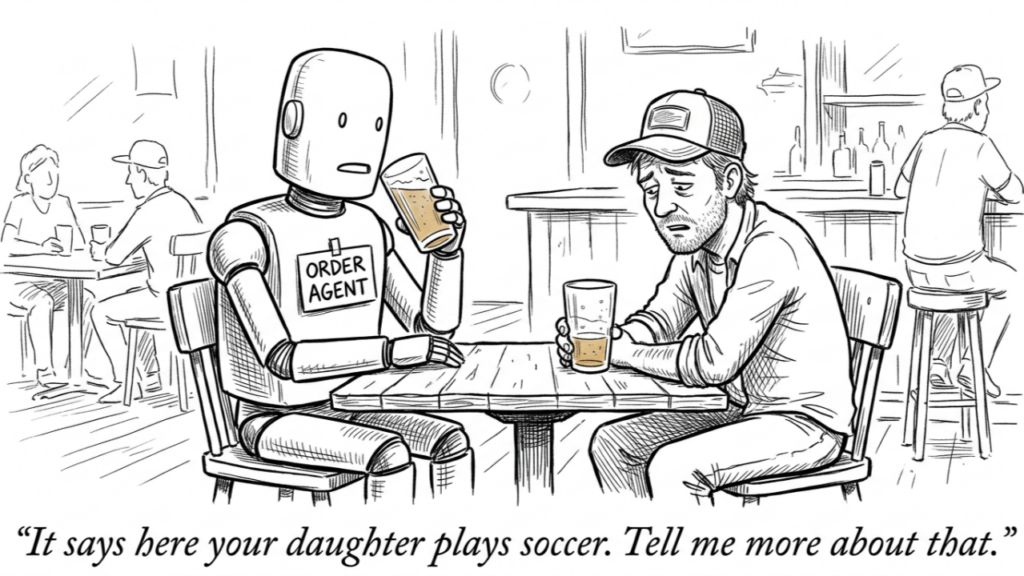
Because here is the thing the lean methodology does not account for, the thing no manufacturing framework ever accounts for when it is imported into a relationship business. When you fire a sales representative who was meeting or exceeding their goals, they do not disappear. They go to Kuehne+Nagel or DHL or DSV or the competitor down the street, and they take with them twenty years of relationships, institutional knowledge that no large language model can replicate, the name of the dock manager at the customer’s warehouse, the memory of the shipment that went sideways in 2019 and how it was fixed, the trust that was built one freight bill at a time over a decade. The AI agent can process 10,000 quotes per day. It cannot call a shipper by name and ask about their daughter’s soccer tournament. It cannot know that this particular customer panics when the tracking updates go dark and needs a human voice saying I’m on it before they move their business.
The Epsilon
That is the epsilon. The thing that does not appear on the productivity dashboard but lives in every customer relationship the company has ever built. It is the difference between a quote delivered in thirty-two seconds and a quote delivered by someone who remembers your name. It is the residue of the employee-ownership culture, the ghost of the orchard, and it is being systematically replaced by software that has never smelled a peach going bad on a loading dock in Grand Forks.
Charles Henry Robinson connected growers to wholesalers. The business was perishable in every sense. The produce rotted. The relationships, if not maintained, rotted too. The company succeeded because the people inside it understood perishability, not just of the freight, but of the trust that moved it. They understood that a connection brokered is not a connection owned. It must be renewed. It must be tended. It must be fed.
An AI agent does not understand perishability. It does not understand that the customer who sends you 10,000 emails a year can also, in one conversation with a competitor’s sales rep over a beer, send you nothing. An AI agent automates the transaction. A human being maintains the relationship. And the relationship is the business. The relationship has always been the business. The relationship was the business in 1905 when Robinson brokered produce in the Red River Valley, and it is the business now, and no amount of lean methodology imported from Amazon’s fulfillment centers will change the fact that freight is hard and the people who move it are not widgets.
They used to own the company. Now the company owns AI agents, and the agents own their jobs.
I should say what I know about Ancora, because the board seats matter and the sequence matters and the people who pulled the strings deserve to be named in the same room as the man who holds the saw. Ancora Holdings is an activist investor based in Cleveland. It reached a cooperation agreement with C.H. Robinson in 2022 that included two board seats, the formation of a capital allocation and planning committee, and, eventually, the departure of CEO Bob Biesterfeld. The agreement placed Henry Maier, the retired CEO of FedEx Ground, and Henry “Jay” Winship, founder of Pacific Point Capital, on the Robinson board. These men were not placed there to tend the orchard. They were placed there to optimize the yield.
Ancora’s playbook is consistent. It identifies companies with “very good bones” that have “fallen on harder times,” applies pressure for cost reductions, CEO changes, and capital allocation reforms, then exits when the stock price reflects what it considers the unlocked value. The value, in Ancora’s framework, is always shareholder value. Not employee value. Not cultural value. Not the value of a twenty-year customer relationship maintained by a sales rep who just got fired on the floor in front of her colleagues despite exceeding her targets.
Ancora forced out Biesterfeld. Ancora’s board members participated in hiring Bozeman. Bozeman implemented the cuts. The cuts produced the savings. The savings inflated the margins. The margins impressed the analysts. The stock price rose. Ancora’s thesis was validated. The playbook worked. It always works, by Ancora’s definition, because Ancora’s definition of “working” does not include the term “former employee.”
Swagger.
Here is what Bozeman said at the company’s Q2 2025 earnings call: “We’ve reinvigorated a winning culture, and we’re getting our swagger back.” Swagger. The word floats in the air-conditioned conference room like an untethered balloon, rising past the 5,500 empty desks, past the canceled merit raises, past the suspended 401k matches, past the sales rep fired on the floor in front of her peers despite meeting her numbers, past the employee who wrote “fear is what’s keeping most people in IT in place,” past all of it, up and up, until it reaches the altitude where $28 million in annual compensation produces its own weather system, and from that height, the people below are not people at all. They are headcount. They are inputs. They are the waste that lean was designed to eliminate.
At the company’s Investor Day, Angie Freeman, the Chief Human Resources and ESG Officer, stood at a podium and said the words that human resources officers at every company say at every investor day: “We truly are differentiating through talent and culture.” She said: “Most importantly, we have exceptionally talented people who want to win. Because when all is said and done, it’s really all about our people.”
It is really all about our people. 5,500 of whom are gone. The survivors work longer hours for less pay. Their merit raises were canceled. Their 401k was suspended. Their colleagues were fired in front of them. And the woman at the podium says it is all about the people.
The podium says one thing. The pay stub says another. The podium says culture. The pay stub says extraction. The podium says talent. The empty desks say replacement.
The podium says one thing. The pay stub says another. The podium says culture. The pay stub says extraction. The podium says talent. The empty desks say replacement.
In 1976, C.H. Robinson became 100 percent employee-owned. The employees were the orchard and the fruit. In 2025, the company has AI agents with names like “Order Agent” that save 600 hours per day, and the humans whose 600 hours were saved were not given new work. They were given boxes. The company that was built by people who owned it is now being run by a man who is building a new culture on top of the old one’s grave, and the headstone reads Lean AI, and the epitaph is a 40 percent productivity gain, and the flowers were automated.
Charles Henry Robinson connected growers to markets. Dave Bozeman connects algorithms to spreadsheets. The freight still moves. The produce still ships. The emails are parsed, the quotes are generated, the appointments are booked, the tracking updates are sent, and somewhere in Eden Prairie, Minnesota, a CEO with a manufacturing background and an Amazon pedigree sits in a headquarters that a produce broker built and tells a room full of analysts that the company is getting its swagger back.
The analysts nod. The stock ticks up. The agents process another 10,000 quotes. And somewhere in Minneapolis or Chicago or Kansas City, a person who used to own a piece of this company, who used to book the freight and know the customer and call the dock manager by name, opens their laptop and applies for a job at a competitor, carrying with them twenty years of institutional knowledge that no large language model will ever replicate, and thinking, as they close the tab on the CHRW careers page for the last time, the thought that 5,500 people have already thought:
They used to say it was all about the people.
The Saw
It is all about the people. It has always been all about the people. That part was never a lie. The lie was the pronoun. When they said “our people,” they meant the ones who remained useful. When the usefulness ended, so did the “our.” The orchard does not belong to the trees. The orchard belongs to whoever holds the deed. And the deed, since 1997, has belonged to the market. And the market sent Ancora. And Ancora sent Bozeman. And Bozeman brought lean. And lean brought the saw. And the saw does not know the difference between deadwood and root structure, because the saw was not designed to know. The saw was designed to cut.
The orchard is quiet now. The trees that remain are thin and still and spaced far apart, like survivors of something they do not yet have a name for. The fruit still grows. It will grow for a while. The soil remembers what it used to feed, even after the roots are gone. That is the trick of extraction. The harvest looks normal the first season. And the second. It is the third season, the one after the nitrogen is spent and the root system is dead and the institutional knowledge has walked across the street to the competitor with the open req, it is the third season when the analyst writes the note that says the deterioration was sudden and unexpected, when in fact it was visible to everyone who was not paid to ignore it.
Five thousand five hundred people tended this orchard. They owned it. They fed it. They knew the soil.
Now the soil feeds algorithms. The algorithms feed margins. The margins feed the stock price. The stock price feeds the executive compensation. And the executive compensation feeds a man who told CNBC he is building a new culture, as though the old one were lumber, as though the people were kindling, as though 120 years of relationships brokered on handshakes and telephone calls and the particular trust that grows when the person booking your freight is also an owner of the company that books it could be replaced by thirty AI agents and a swagger.
The orchard was planted in 1905 by a man who saw that settlers needed produce and farmers needed buyers and the distance between them was a problem worth solving. The orchard was tended for 120 years by people who understood that the produce was perishable, that the relationships were perishable, that everything of value in a brokerage is perishable, and that the only thing that preserves it is the daily, unglamorous, unleanable work of picking up the phone and saying I’m on it.
The man with the saw says he is building something new. He is not building. He is clearing. And the ground he is clearing was the most fertile soil in the logistics industry, not because of the technology platform or the data advantage or the AI agents, but because the people who worked there used to own it, and ownership produces a quality of care that no algorithm and no $28 million CEO and no activist investor from Cleveland will ever replicate.
They owned the orchard.
They were the orchard.
Now they are the lumber.