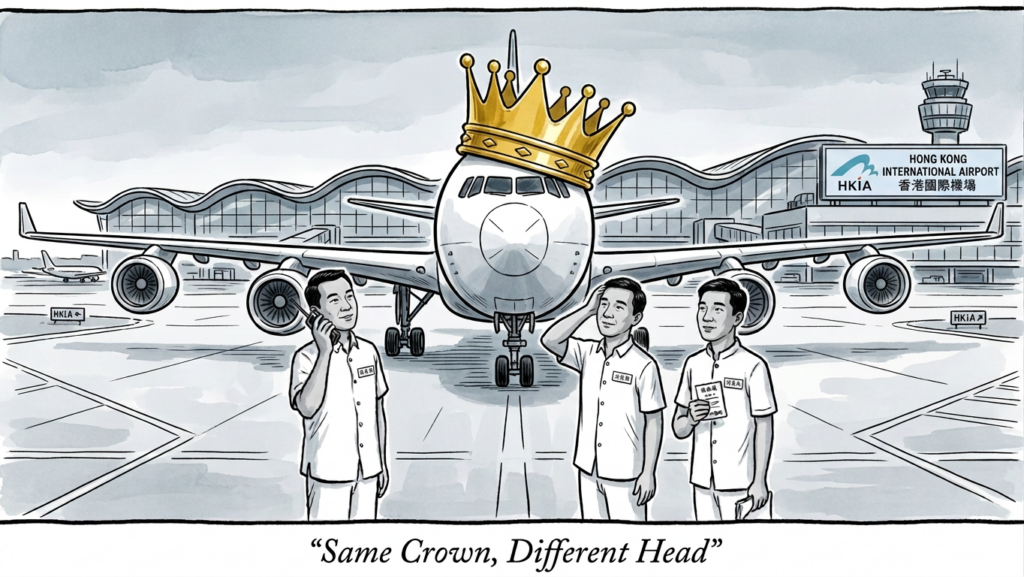
HKIA, rhe world’s busiest cargo airport, is still growing on a rolling basis, yet a sharp drop in outbound tonnage suggests the tariff hangover is starting to bite.
Hong Kong International Airport can still claim the title of the world’s busiest cargo hub, a distinction it has now held 15 times since 2010. Its 12-month rolling throughput stands at 5.16 million tonnes, up 3.2% year on year. But July’s numbers told a more complicated story, and forwarders routing high-value freight through the Pearl River Delta would do well to read the fine print.
Total cargo throughput in July fell 1.9% year on year to 422,000 tonnes, the first notable dip after months of steady growth. The headline figure, however, obscures a sharper divergence beneath it. Transshipments surged 14.5%. Imports climbed 2.9%. Exports, the segment most exposed to trade policy, dropped 8.4%.
That export figure deserves scrutiny. An 8.4% year-on-year decline in outbound air cargo from the world’s busiest freight airport is not a rounding error. It lands in a month when US tariffs on Chinese-origin goods remain at historically elevated levels following the trade war escalation that began in early 2025. North America was one of two regional markets, alongside the Middle East, that softened during the January-to-July period.
For the seven months through July, the cumulative picture remains respectable: 2.92 million tonnes, up 3.2% over the same stretch last year. Southeast Asia posted 14% growth. Europe delivered 11%. Those two corridors are doing the heavy lifting, compensating for the drag from transpacific and Middle Eastern flows and suggesting that HKIA’s trade mix is quietly rebalancing away from its traditional dependence on US-bound cargo.
Transshipment tells the real story
The 14.5% jump in transshipment tonnage is arguably the most important number in the release, and the one most directly relevant to forwarding strategy in the Greater Bay Area.
HKIA has been investing to position itself as the region’s consolidation and redistribution point rather than simply a point of origin for outbound freight. The Dongguan Logistics Park, which enables export screening and palletization in mainland Guangdong before cargo is ferried directly to HKIA airside, reported tonnage and value growth exceeding 90% year on year in the fiscal year ending March 2026. A permanent Phase 1 facility is expected to reach full operation in 2027, targeting annual capacity of one million tonnes.
The intermodal logic is straightforward: pull Greater Bay Area origin freight into HKIA’s catchment earlier in the supply chain, process it under Hong Kong’s customs and regulatory framework, and connect it to the airport’s network of around 140 airlines serving more than 220 destinations. Cargo that arrives from Dongguan by sea and departs by air through HKIA registers as transshipment. The 14.5% growth rate suggests the model is gaining traction.
For forwarders, this changes the math on Pearl River Delta routing. The alternative, trucking directly to Shenzhen Bao’an or Guangzhou Baiyun for a direct flight, saves a step. But neither mainland airport matches HKIA’s breadth of freighter connectivity or the frequency of belly capacity on long-haul passenger services. As long as that gap persists, the transshipment play has legs.
The export question
The risk is that July’s export weakness is not a one-month blip but the beginning of a pattern. Three factors are working against outbound volumes.
First, tariffs. US duties on Chinese goods show no sign of retreating to pre-2025 levels regardless of negotiation outcomes, and every percentage point of tariff pressure at the border translates into reduced air freight demand for time-sensitive but price-elastic goods.
Second, mainland competition. Shenzhen’s air cargo volumes grew 9% in 2025 to breach the two million tonne mark for the first time, with international and regional cargo alone topping one million tonnes. Guangzhou Baiyun, now operating five commercial runways after completing its Phase 3 expansion in late 2025, handled 2.44 million tonnes of cargo last year. And the pipeline keeps growing: Shenzhen has broken ground on a new North Cargo Area adjacent to its third runway that will add 1.8 million tonnes of annual handling capacity once complete. Both airports are closer to factory floors in southern China and charge lower handling fees. For commoditized freight, the gravitational pull toward mainland hubs will only intensify.
Third, trade rerouting. There is a reasonable case, though one that should be treated as analysis rather than documented fact, that some Chinese exporters are shipping goods to Southeast Asian manufacturing bases for finishing and re-export, a pattern that would inflate HKIA’s Southeast Asia transshipment numbers while deflating its direct export volumes to Western markets. The 14% Southeast Asia growth and the 8.4% export decline could be two expressions of the same underlying shift. The AAHK data does not break this out explicitly, but the directional fit is hard to ignore.
What to watch
HKIA’s crown is not under immediate threat. No other airport is close to matching 5.16 million tonnes on a rolling basis, and the infrastructure pipeline, including the three-runway system commissioned in November 2024 and the Dongguan intermodal link, gives it room to absorb growth that competitors cannot yet handle.
But the July data is a useful corrective to the assumption that the world’s busiest necessarily means the world’s fastest-growing. The airport’s future increasingly depends on transshipment volumes and intra-Asian trade lanes rather than the US-bound export flows that built its reputation. For carriers and forwarders planning capacity into 2027, the question is not whether HKIA remains the biggest cargo hub. It is whether its growth engine has permanently shifted from outbound exports to regional redistribution, and what that means for rates, routing, and terminal demand.
The crown still fits. It just sits at a slightly different angle than it used to.