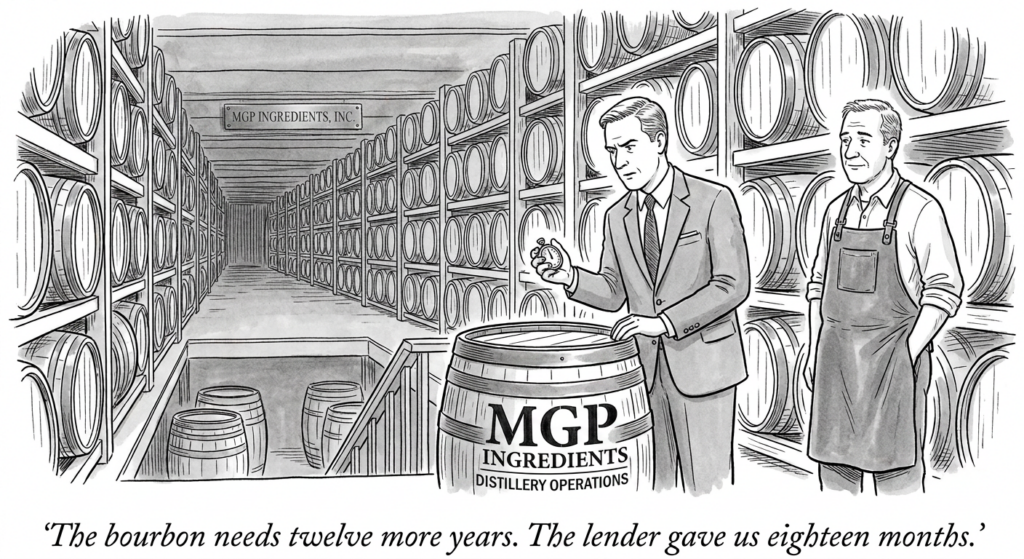
On August 6, 2026, MGP Ingredients quietly amended the terms of its two primary lending agreements, the revolving credit facility with Wells Fargo and the note purchase arrangement with PGIM, to change the way the company calculates a number that determines whether it stays in compliance with its debt covenants. The change allows MGP to add back up to $20 million in losses from uncollected customer receivables when computing Consolidated EBITDA, the metric that governs how much leverage the company is permitted to carry. The add-back runs through December 2027. Any receivables that are eventually recovered get deducted. The company described the move as precautionary.
Companies that are comfortably within their covenants do not, as a rule, renegotiate the definition of the number their covenants are measured against. They renegotiate it because they can see a wall approaching and would prefer to move the wall rather than slow down. The question with MGP is not whether the wall exists. The question is how close the bumper is.
MGP Ingredients (Nasdaq: MGPI) is a mid-cap spirits producer and specialty ingredient supplier headquartered in Atchison, Kansas. It operates three segments: Branded Spirits, which includes bourbon labels such as Penelope, Yellowstone, George Remus, and Rebel; Distilling Solutions, which produces whiskey and other spirits on contract for major and boutique brands; and Ingredient Solutions, which makes specialty wheat proteins and starches for the food industry. The Branded Spirits segment is the largest revenue contributor and the strategic centerpiece. It is also, at the moment, the problem.
In May 2023, MGP acquired Penelope Bourbon for $105 million in upfront cash, plus earnout consideration of up to $110.8 million contingent on performance through December 2025. The deal was financed on the revolver and was framed as a natural extension of MGP’s premiumization strategy, a way to add a fast-growing, margin-accretive whiskey brand to a portfolio that was already positioned at the premium-plus end of American bourbon. At the time, American whiskey was the growth story in spirits. Premiumization was the buzzword. MGP’s stock was trading near $95 a share, the business was generating healthy cash flow, and taking on acquisition debt to ride the category higher seemed like a reasonable bet.
The category did not cooperate. By late 2024, the American whiskey market had tipped into oversupply. Craft distillers and major producers alike had been laying down barrels for years during the boom, and the inventory was now maturing faster than consumers were drinking it. Distributor warehouses were full. Contract distilling volume, which had been a reliable cash generator for MGP’s Distilling Solutions segment, began falling sharply as customers delayed orders and worked through existing stock. In 2025, MGP’s full-year sales in the Ingredient Solutions segment dropped 7 percent, and the company recorded a $152.6 million goodwill and intangible asset impairment in the fourth quarter, a non-cash charge but a loud one, an acknowledgment that the expected future earnings from the Branded Spirits segment no longer justified the carrying value of the assets MGP had paid for.
Then came 2026. In the first quarter, consolidated sales fell 13 percent. Distilling Solutions revenue dropped 40 percent year over year as brown goods sales continued to collapse. MGP recorded another $115.7 million in goodwill writedowns, another $37 million in indefinite-lived intangible asset impairments in Branded Spirits, and a $26.9 million fixed asset impairment on equipment at its Lux Row distillery in Bardstown, Kentucky, one of two Kentucky facilities the company announced in April it was temporarily idling effective May 1, affecting 33 employees across both sites. Total non-cash charges for the quarter were $179.5 million. The GAAP net loss was $134.8 million, or $6.30 per share. Adjusted EBITDA, stripping out the impairments, was $15 million, down 31 percent. Over 30 low-performing brands were discontinued. Another 15 were slated for exit by year end.
On April 7, MGP announced it was temporarily shutting down distilling operations at both Lux Row Distillers in Bardstown and Limestone Branch Distillery in Lebanon, Kentucky, effective May 1. The company said it expected to resume production “when inventory levels support additional production,” which it estimated could be “as early as 12 months” after that date, a formulation that tells you more about the timeline than the company probably intended. Only the Lawrenceburg, Indiana plant, the company’s largest and oldest facility, would continue running. Warehousing, bottling, barrel programs, and visitor centers at the Kentucky sites stayed open, a distinction that mattered mostly for optics: the stills went dark, but the gift shops stayed lit.
MGP was not alone. Jim Beam had already gone quiet at its flagship Clermont distillery for the entirety of 2026, the first full-year production halt in recent memory for one of the most recognized names in American whiskey. Diageo, the world’s largest spirits producer, paused distilling at George Dickel in Tennessee and Balcones in Texas, and watched its share price sink to levels not seen in a decade after cutting global sales and profit forecasts, describing the demand environment as “unsatisfactory.” Brown-Forman, the company behind Jack Daniel’s, cut roughly 12 percent of its global workforce as it battled sharp declines across its portfolio. Pernod Ricard, maker of Absolut and Jameson, acknowledged it was navigating its worst downturn in over a decade, with its market capitalization sliding roughly 20 percent from its cyclical peak. Rémy Cointreau, the cognac house, absorbed a punishing 11 to 18 percent organic sales drop as high-end consumers pulled back. Kentucky’s bonded whiskey inventory sat above 16 million barrels, a record, and the carrying costs on that aging stock were compounding while demand moved sideways or down. The entire American whiskey complex was idling capacity at a pace not seen since the last glut cycle, and MGP, with its heavy exposure to contract distilling for third-party brands, was feeling it from both directions: its own inventory was bloated, and the customers who used to pay it to distill on their behalf had stopped calling.
The idling was framed as temporary, and maybe it will be. But temporary facility shutdowns in a structurally oversupplied market have a way of becoming indefinite. The 33 employees affected were told MGP would “support them through the transition,” which is the kind of language companies use when they do not yet know if the transition has a return date. And the write-down on the Lux Row equipment, $26.9 million on assets tied to distillation capacity the company no longer needed to run, was the balance sheet catching up with the operating reality: you do not impair equipment you expect to restart in twelve months.
What makes this cycle different from prior bourbon corrections is that it is not just a supply problem. The demand side of the American alcohol market is undergoing a structural reset that has no clear precedent in the modern era. According to Gallup, only 54 percent of U.S. adults now say they drink alcohol, unchanged from 2025 and down from 62 percent as recently as 2023. That is the lowest reading in the nearly ninety-year history of the survey, dating back to 1939. Among those who do drink, consumption is also falling: the average self-reported number of drinks per week dropped to 3.2 in 2026, down from roughly 4.0 across the prior five-year average. A majority of Americans, 51 percent, now believe that even one or two drinks a day is bad for their health, a belief that has essentially doubled since Gallup first asked the question in 2001.
The generational undercurrents are sharper. Younger adults have been drinking less for over a decade, but the trend has accelerated: among adults under 35, the self-reported drinking rate has fallen to roughly 50 percent, now below the rate for middle-aged and older cohorts, a reversal of the historical pattern. The drivers are layered. Gen Z and younger millennials have grown up in a culture that penalizes visible intoxication, prizes physical wellness, and treats sobriety as an identity rather than an absence. The booming adoption of GLP-1 medications, Ozempic and Wegovy chief among them, has introduced a pharmacological variable: clinical data and consumer tracking suggest these drugs dampen the brain’s reward response to alcohol, causing millions of users to cut back or stop drinking entirely without necessarily intending to. Cannabis legalization has introduced a competing social product, with low-dose THC seltzers increasingly positioned as the alternative that delivers a buzz without the caloric load or the hangover. And the price of drinking out has crossed a threshold that matters: the average cocktail in a major American city now pushes past $20, a number that makes abstention an economic decision as much as a lifestyle one.
None of these forces are cyclical. They are not inventory corrections waiting to rebalance. They are cultural, demographic, pharmacological, and economic shifts that, taken together, suggest the total addressable market for American spirits may be structurally smaller going forward than the one MGP underwrote when it paid $105 million for Penelope and built its premiumization thesis. The companies that survive will be the ones that either diversify aggressively into non-alcoholic alternatives, a segment projected to be an $11 billion-plus global market by the end of the decade, or that operate with balance sheets clean enough to absorb a prolonged contraction. MGP, at the moment, is doing neither.
In the second quarter, MGP reported $124.4 million in sales, down 15 percent. Adjusted EPS of $0.72 beat analyst expectations of roughly $0.49, which was good news on a relative basis but less impressive on an absolute one: the company was beating a bar that had been lowered repeatedly over the prior year. More revealing was a line buried in the press release noting that operating income had been impacted by “an increase in provision for credit loss related to a customer bankruptcy.” This is almost certainly the event that triggered the covenant amendment a week later. A customer went bankrupt. MGP couldn’t collect. The receivable loss, if left inside the EBITDA calculation, would tighten the leverage ratio at exactly the moment the company could least afford it.
Here is the math. As of June 30, 2026, MGP reported net debt of $351.8 million and a net debt leverage ratio of 3.5 times trailing twelve-month adjusted EBITDA, which implies TTM adjusted EBITDA of roughly $100 million. The standard covenant ceiling on net leverage is 4.0 times. MGP has already exercised its option for an Elevated Ratio Period, which pushes that ceiling to 4.5 times, triggered in connection with the Penelope earnout obligations. If $20 million in receivable losses were allowed to reduce EBITDA, the adjusted number would fall to roughly $80 million, and the leverage ratio would jump to approximately 4.4 times, above the standard covenant but still barely beneath the elevated ceiling. Without the add-back, the company would be operating with virtually no headroom. One bad quarter of EBITDA, one more receivable problem, and the ratio breaches.
The add-back is not, in other words, precautionary in the way that carrying an umbrella is precautionary. It is precautionary in the way that reinforcing the dam is precautionary when the water is already at the spillway.
Management’s full-year 2026 guidance, reaffirmed in July, projects consolidated sales of $480 to $500 million and adjusted EBITDA of $90 to $98 million. At the midpoint, $94 million, the net debt leverage ratio based on current net debt would be around 3.7 times, within both the standard and elevated ceilings. But that guidance assumes EBITDA is calculated with the add-back intact. It assumes no further receivable deterioration beyond the $20 million already carved out. It assumes the Distilling Solutions segment has bottomed. It assumes the brand rationalization pays off. It assumes a lot.
The receivables question is the most pressing and the least transparent. The press release identifies the losses as tied to “specified customers” who must be disclosed in writing to the administrative agent but are not disclosed to investors. The Q2 earnings release referenced a customer bankruptcy affecting operating income. That customer was Republic National Distributing Company (RNDC), once the second-largest wine and spirits distributor in the U.S., which filed for Chapter 11 bankruptcy on July 26, 2026. MGP recorded a $2.1 million provision for credit loss related to that bankruptcy, money it is unlikely to recover. But the amendment refers to “two customers” identified to lenders, meaning there is a second, unnamed significant customer also in distress. Who is that second customer? And if MGP’s distributors and retailers are under enough stress to go bankrupt or fail to pay, what does that say about the broader health of the spirits distribution chain? A $20 million receivable carve-out is not trivial for a company guiding toward $94 million in EBITDA. It represents more than 20 percent of the target. If additional customers stumble, the $20 million cap may not be enough.
The structural linkage between the two lending agreements also deserves attention. MGP amended both the Wells Fargo credit facility and the PGIM note purchase agreement simultaneously, applying the same modified EBITDA definition to both. Full lender participation was framed as a sign of support, and to some extent it is: the banking group agreed to the terms, which means they are not, at this point, positioning to force a default. But a shared EBITDA definition across two agreements also means that any future dispute over whether a particular loss qualifies for the add-back, or whether the $20 million cap has been exceeded, would ripple across both agreements at once. Cross-default provisions in syndicated facilities mean that a covenant breach under one agreement can trigger acceleration under the other. The amendment reduces near-term risk by widening the covenant corridor, but it increases structural fragility by tying both agreements to the same customized metric.
The market has noticed all of this, though it expressed its opinion not in a single dramatic selloff but in a long, grinding decline. MGPI traded at an all-time high of roughly $125 in late 2022. It is now around $16.85, a decline of more than 86 percent. The market capitalization has fallen from over $2.5 billion to approximately $370 million. The enterprise value, including net debt, is around $739 million. The trailing twelve-month net loss is approximately $241 million, heavily distorted by impairment charges, but the adjusted figures are not exactly reassuring either: TTM adjusted EBITDA of $100 million against $370 million in total debt. The Altman Z-Score sits at 2.26, below the 3.0 threshold that typically separates solvent companies from those at elevated bankruptcy risk. Analyst consensus remains Hold, with an average price target of $27 to $28, which would represent a 60 percent rally, the kind of upside target that tends to signal either deep conviction in a turnaround or an unwillingness to cut the number as fast as the stock is falling.
The bull case rests on the premise that 2026 is the trough. Management has said so. Distilling Solutions is expected to stabilize as industry inventories normalize. Branded Spirits is being streamlined, refocused on the premium-plus portfolio where margins are best. Ingredient Solutions is growing. The Penelope brand itself continues to perform within the premium-plus tier. If EBITDA recovers toward the high end of guidance and deleveraging takes hold, the covenant pressure dissipates, the stock re-rates, and the Penelope acquisition looks prescient rather than reckless.
The bear case is simpler. The Penelope deal loaded the balance sheet with roughly $216 million in total consideration at a time when the spirits cycle was peaking. The company has now written down over $330 million in goodwill and intangible assets across three quarters, an implicit admission that the acquired value is not what was projected. Cash flow is deteriorating: free cash flow was negative $52 million in Q2 alone, and the company ended the quarter with just $17.8 million in cash. The dividend, $0.12 per quarter, is still being paid, but the yield has swollen to nearly 3 percent not because the payout increased but because the stock collapsed beneath it. And now the company is renegotiating the math on its covenants to avoid a technical breach, which is the kind of thing that happens in the second act of a leveraged acquisition gone wrong, not the final chapter.
The honest answer is that it’s probably too early to know which narrative plays out. The amendment buys time. The lenders are cooperating. The core business, stripped of impairments and one-time charges, is still generating operating profit and positive, if shrinking, EBITDA. But the margin for error is gone. When a company changes the definition of the number that determines whether it’s in default, and does so three years into a transformative acquisition that has so far destroyed 86 percent of shareholder value, the appropriate response is not to take the “precautionary” framing at face value. It is to ask what the next amendment looks like, and whether there will need to be one.
None of this accounts for the product liability risk hiding inside the Luxco portfolio. I initially represented Yvette Digan, a 22-year-old exchange student who suffered severe burns over 30 percent of her body when Everclear, a 190-proof grain alcohol manufactured by MGP’s Luxco subsidiary, exploded at a fraternity gathering in Worcester, Massachusetts in May 2025. I have since turned the case over to a Massachusetts firm that will see it through trial, but I know the facts and the documents. That litigation now spans multiple federal and state proceedings naming both Luxco and MGPI itself as defendants, with claims including design defect, failure to warn, negligent marketing, breach of warranty, and alter ego liability seeking to pierce the corporate veil. One complaint seeks treble damages under Massachusetts General Laws Chapter 93A for willful and knowing conduct. At least nine people were severely burned in four separate Everclear flame jetting incidents between August 2024 and May 2025. None of this has been disclosed in any MGP filing, earnings call, or investor presentation. I have written about the litigation and the underlying facts in detail here.
What investors also cannot assess is whether MGP carries adequate product liability insurance to cover the potential exposure. No disclosure has been made regarding the existence, limits, or terms of any applicable policy. In isolation, that silence might not mean much. In context, it means quite a lot. This summer, the insurance market for corporate tort exposure went through a violent repricing after a Dallas County jury returned a $604 million verdict against C.H. Robinson in Lipe v. Lupus Superior on July 23, 2026, the first major product of the Supreme Court’s Montgomery decision stripping freight brokers of their federal liability shield. C.H. Robinson disclosed $155 million in insurance coverage tied to the verdict, roughly 25 cents on the dollar. Its stock dropped 30 percent. Two London-market underwriters exited the space entirely, and broker liability premiums across the industry surged 50 percent to triple digits overnight. The C.H. Robinson situation is not factually analogous to the Everclear cases, but the financial mechanics are the same: when a company’s tort exposure exceeds its insurance coverage, the gap lands on the balance sheet. C.H. Robinson at least disclosed its coverage. MGP has not disclosed the litigation, the insurance, or the gap, if there is one. For a company with $370 million in market capitalization, $351.8 million in net debt, and covenant headroom measured in fractions, even a modest uninsured judgment would not be modest.
The irony is precise. On the same Q2 2026 earnings call where management reaffirmed guidance and described premium-plus portfolio momentum, Everclear was specifically highlighted as a growth driver, with sales up 13 percent year over year. The company is actively marketing and growing revenue from a product that its subsidiary stripped of front-label fire warnings in 2018, that has been burning people across the United States, and that is now the subject of federal lawsuits alleging deliberate concealment of a known hazard. And they will not put the warning back. That single decision, or rather the refusal to reverse one, tells you more about the company’s financial position than any earnings call ever could. A company renegotiating its covenant math to avoid a technical breach while simultaneously accelerating sales of its most legally exposed product, and disclosing neither the lawsuits nor the status of its product liability insurance to investors, is a company whose risk profile cannot be modeled from its public filings. The debt is one wall approaching. The litigation is another. And the distance between them is shrinking.
MGP Ingredients bet its balance sheet on bourbon at the top of the cycle. The bourbon is still aging in the warehouse. The debt is aging faster.
I hold no position, long or short, in MGPI or any related security. This is not investment advice. This is a description of publicly available facts and filed court documents that I believe the market has not priced.