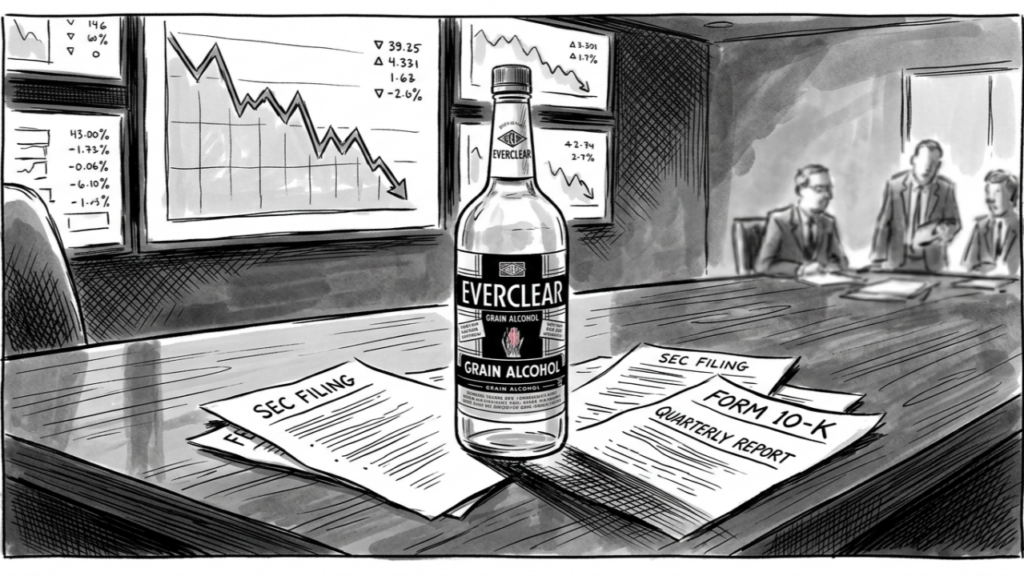
I know some of you who read me work at places that cover this sector. I see people from Morgan Stanley, Goldman Sachs, ClearBridge Investments, Man Group, Tudor, T. Rowe Price, Citadel, UBS, Evercore, and Bank of America in my connections. I see research analysts, portfolio managers, and fund professionals. If you cover consumer staples, spirits, or mid-cap equities, this post is for you. If you don’t, forward it to whoever does.
I hold no position, long or short, in MGPI stock.
Four weeks ago, a Dallas County jury returned a verdict exceeding $604 million against C.H. Robinson, a major freight broker. The stock fell sharply from a peak of $207 down to $145. The company disclosed $155 million in insurance coverage, about 25% of the award. Chief Legal Officer Dorothy Capers said the company “did not act negligently.” CFO Damon Lee called rising premiums “just another headwind.” The market did not care. Analysts called it an existential threat to the brokerage model.
C.H. Robinson did not design a product. It did not manufacture anything. It did not strip warnings from a label. It did not launch marketing campaigns encouraging dangerous behavior. It hired a carrier. That carrier’s driver got sick on the road. The driver called dispatch. Dispatch let him keep driving. Three people died. A jury saw those facts and returned a $604 million verdict against the company that simply brokered the load.
The lesson was simple and it was expensive. When the underlying facts are vivid, when the corporate conduct is deliberate, when the jury can see a human being destroyed by a decision made in a conference room, no amount of appellate lawyering saves you from the initial impact. The legal theories are the scaffolding. The facts are the building.
The facts at MGP Ingredients are worse. The MGPI undisclosed product liability risk as Everclear burns victims is a serious concern that should not be overlooked.
To understand why MGP Ingredients (NASDAQ: MGPI) is uniquely vulnerable here, you have to go back to April 2021. That was when MGPI acquired Luxco, Inc. for $475 million in cash and stock, a transformational deal intended to pivot an upstream bulk whiskey supplier into a branded consumer products powerhouse.
From day one, the market questioned the thesis. In October 2022, activist research firm Spruce Point Capital Management published a forensic short-sell report titled “Over A Barrel,” labeling the Luxco merger an “abysmal failure” and arguing that its promised synergies and growth benefits were not materializing. Spruce Point pointed to deteriorating earnings quality, aggressive accounting adjustments, and a heavy reliance on lower-end value brands just as consumer preferences shifted.
They were right about the trajectory, even if they missed the sleeping legal giant hiding inside Luxco’s portfolio.
Today, MGPI trades at an 86% discount from its all-time high of $125, sitting at a current price of $18.06 and a market capitalization of roughly $380 million. The core business has been hammered by the American whiskey glut and the collapse of its distilling solutions segment. Q2 2026 revenue came in at $124 million, down 14.5% year over year. The company lost $123 million in the first half of 2026 alone. Full-year guidance sits at $490 million at the midpoint, and even that number is built on a shrinking foundation. MGPI also faces a separate securities class action alleging that management concealed the depth of the whiskey oversupply from May 2023 through October 2024, during which time the stock shed 24% in a single day after Wells Fargo raised the alarm.
This is a company in trouble. And none of its known trouble accounts for what I am about to describe.
Has This Been Disclosed?
No.
I have reviewed MGPI’s most recent 10-K, its quarterly filings, its Q2 2026 earnings call transcript from July 29, 2026, and its investor presentations. None of these documents disclose product liability litigation arising from Everclear burn injuries. None mention the Digan lawsuit. None mention the Lopes lawsuit. None mention the pattern of burn incidents. None discuss the marketing practices now at issue in federal court. None quantify the company’s product liability insurance tower.
The question every analyst covering this stock should be asking is simple: Is this material?
A company whose parent-level market capitalization has shrunk to $380 million is facing a multi-plaintiff, multi-jurisdiction product liability campaign over Everclear grain alcohol, a product its Luxco subsidiary actively markets for use near open flames after deliberately removing warnings that told consumers not to do so, while people have suffered catastrophic burns and the incidents continue.
If that is not material, the word has no meaning.
Luxco manufactures and distributes Everclear, a 190-proof grain alcohol that is currently burning people across the United States.
Everclear is 95% ethanol. Its flash point is 57.2°F, meaning it produces ignitable vapors below room temperature. Its Safety Data Sheet classifies it as a Category 2 Flammable Liquid with the signal word “DANGER,” the highest hazard classification for consumer products. When poured near an open flame, it creates a phenomenon called “flame jetting,” where the fire propagates into the container and violently expels burning liquid up to 15 feet. The effect is indistinguishable from a flamethrower. The burning alcohol is nearly invisible, with a pale blue flame that adheres to skin and fabric, causing deep third-degree burns before victims even realize they are on fire.
This is not hyperbole. This is peer-reviewed science. It is also on video. Multiple explosions that produced the victims’ injuries were actually captured on video.
For decades, Everclear carried a prominent front-label warning in a large red rectangle: “CAUTION: DO NOT APPLY TO OPEN FLAME. KEEP AWAY FROM FIRE, HEAT AND OPEN FLAME. CONTENTS MAY IGNITE OR EXPLODE.”
In 2018, Luxco removed that warning. They reduced the safety language by 85% and moved what remained to a small rectangle on the back label. The words “DO NOT APPLY TO OPEN FLAME” and “CONTENTS MAY IGNITE OR EXPLODE” were eliminated entirely. Their master distiller, John Rempe, signed the TTB form certifying compliance under penalty of perjury.
Then they did something extraordinary. They kept the full warnings on their chemically identical products, Crystal Clear and Golden Grain, both 190-proof. Same liquid. Same company. Different labels. Different warnings. The product marketed to young consumers and promoted for DIY uses near flames lost its safety language. The products sold to a more traditional base retained theirs.
And they never installed a flame arrestor on the bottle, a device that other high-proof spirits like the former Bacardi 151 used to prevent exactly the kind of flame jetting that has now maimed their customers.
This is the part that should concern anyone modeling this stock’s future.
Luxco launched a campaign called “Make It Your Own,” promoting Everclear for use as a fuel, for cooking near gas stoves, for candle-making, for cannabis extraction. Their social media accounts posted content showing people using Everclear near open flames. One Instagram video depicted someone lighting an Everclear-fueled candle with a lighter. The safety disclaimer on that video was rendered in a font color nearly identical to the background, in a size that made it functionally invisible. The lawsuit alleges that Luxco “recklessly promoted Everclear for culinary and household uses where open flames from gas stoves, ovens, and candles are common,” with social media showing “Everclear poured into cooking pans near gas stove flames and used in fondue pots with open candle flames, often with the bottle inches from ignition sources.”
As of today, this marketing remains active. The “Make It Your Own” positioning remains on the website. The social media content remains live.
Ask yourself why. And then ask what yourself what insurance company would continue to offer the company coverage under these circumstances knowing the history of burn injuries and pending litigation.
The Wikipedia page for Everclear now contains a dedicated “Incidents” section. That should tell you something about how far this has traveled.
In the span of nine months from August 2024 through May 2025, at least nine people were severely burned in four separate Everclear flame jetting incidents nationwide, including two incidents in Massachusetts. The pattern includes a bar explosion in Dallas that left two patrons hospitalized for weeks with burns requiring skin grafts, a cooking fire in Lakeville, Massachusetts that burned a man and a child, a bar explosion in Binghamton, New York that injured three people including a college athlete who suffered severe facial burns, and the catastrophic fraternity fire at Worcester Polytechnic Institute in May 2025 that is now the subject of the litigation described below.
The acceleration is the pattern. The pattern is the product of removing the warnings and ramping up the marketing.
I initially handled the litigation on behalf of Yvette Digan. I have since turned the case over to a Massachusetts firm that will see it through trial. But I know the facts. I know the documents. And I know what is coming for this company.
The litigation against Luxco and MGPI now spans multiple proceedings, coordinated in a tightening net that directly implicates the parent company.
The first case, Digan v. Pharris et al., Case No. 4:25-cv-11448 (D. Mass., filed May 22, 2025), names the fraternity member who poured the Everclear, the local fraternity housing corporation Pi Tau Elders, Zeta Psi national, and Worcester Polytechnic Institute. It asserts negligence, premises liability, negligent supervision, negligent breach of assumed duty, and agency liability. It establishes the institutional chain: a fraternity that had designated risk managers, policies prohibiting open flames, and a university that regulated and promoted the Greek system while failing to enforce its own safety rules.
The second case, Digan v. Luxco, Inc., Case No. 4:25-cv-40091 (D. Mass., filed August 4, 2025), is a 43-page amended complaint asserting seven counts against Luxco: negligence by design defect, failure to warn, negligent voluntary undertaking, negligent marketing, breach of implied warranty of merchantability, breach of implied warranty of fitness for a particular purpose, and violation of Massachusetts General Laws Chapter 93A. The complaint seeks preliminary and permanent injunctive relief, including an immediate prohibition on the distribution and sale of Everclear 190-proof in Massachusetts until Luxco restores its pre-2018 front-label warnings, complies with the Federal Hazardous Substances Act, and ceases all marketing depicting the product used near open flames. The 93A claim is the one that should hold your attention. Under Massachusetts law, if a jury finds Luxco’s conduct was willful and knowing, damages are trebled. Triple whatever the jury awards on the underlying tort claims.
The third case is where the litigation metastasizes into something MGPI cannot contain at the subsidiary level. In March 2026, a state court complaint was filed in Worcester Superior Court, subsequently removed to federal court, naming MGP Ingredients, Inc. directly as a defendant, alongside Luxco, Total Wine & More (the Shrewsbury retailer that sold the bottle), Henry Pharris, six additional fraternity members by name, two WPI administrators personally, Worcester Polytechnic Institute, Zeta Psi, Pi Tau Elders, and a second fraternity, The Fraternity of Phi Gamma Delta and its Pi Iota chapter at WPI.
That second fraternity matters. The state court complaint alleges that the bottle of Everclear was purchased by a Phi Gamma Delta member, stored at the Phi Gamma Delta house at 99 Salisbury Street, and then carried to the Zeta Psi house at 32 Dean Street on the night of May 13, in violation of both fraternities’ policies prohibiting high-proof alcohol. The chain of custody now implicates two national fraternity organizations, two local housing corporations, a university, a retailer, a manufacturer, a distiller, and multiple individually named students and administrators.
The state court complaint asserts 23 counts. Against MGPI specifically, it alleges negligence in the manufacture, distillation, sale, and distribution of the 190-proof grain neutral spirits used in Everclear; breach of the implied warranty of merchantability; breach of the implied warranty of fitness for a particular purpose; violation of G.L. c. 93A; and agency and alter ego liability seeking to pierce Luxco’s corporate veil and hold MGPI directly responsible. The alter ego count alleges that following the April 2021 acquisition, Luxco “operated as an effectively controlled subsidiary of MGPI, with its operations, management, and product decisions subject to MGPI’s direction, oversight, and corporate governance structures.” It alleges that MGPI installed Luxco’s former CEO Donn Lux as Chairman of MGPI’s own board, integrated all Luxco personnel into MGPI’s management structure, and assumed “direct responsibility for the manufacture, sale, distribution, and marketing of all products within Luxco’s portfolio, including Everclear.” The complaint alleges that allowing MGPI to “use the corporate form as a shield” while it exercised “complete operational control” would produce “manifestly unjust results.”
The state court complaint also includes the parents, Lordever Digan and Grace Digan, asserting loss of consortium claims against all defendants. Yvette Digan, 22 years old and dependent on her parents for support, remains under active treatment with medical expenses approaching one million dollars.
And here is the detail that should keep Luxco’s general counsel awake: in the federal case, Defendant Henry Pharris, the fraternity member who poured the Everclear, filed a third-party complaint on September 5, 2025 against James Gikas, Andrew Mitchell, and Luxco, Inc. The person who poured the liquid is suing the company that made the fuel and stripped the warnings off the bottle. Pharris denies all liability and maintains that if he is found negligent, Luxco is a joint tortfeasor liable for contribution under M.G.L. c. 231B because it “failed to provide adequate warnings concerning the product, breached warranties of merchantability and fitness for a particular purpose and was otherwise tortiously liable.”
MGPI bought Luxco in April 2021. The label change happened in 2018. The “Make It Your Own” campaign was already running. The warnings were already gone. MGPI either knew what it was buying and accepted the risk, or it failed to conduct adequate due diligence on a product that the Massachusetts Department of Fire Services has publicly compared to gasoline. Either answer is bad. One is negligent. The other is worse.
C.H. Robinson hired a carrier. That is all it did. It did not design a product. It did not manufacture anything. It did not strip warnings from a label. It did not launch marketing campaigns encouraging dangerous behavior. It brokered a load. The carrier’s driver got sick. Dispatch let him keep driving. Three people died. A jury returned a $604 million verdict.
The facts at Luxco are categorically different. Luxco removed safety warnings from its product and then marketed that product for use near the exact danger it had stopped warning about. Luxco maintained full warnings on chemically identical products sold under different brand names. Luxco promoted Everclear as a fuel on Instagram while hiding the safety disclaimer in invisible text. Luxco obtained non-disclosure agreements from prior burn victims instead of warning the public.
C.H. Robinson’s conduct was negligent. Luxco’s conduct, as alleged and documented, was deliberate.
Forget whether MGPI’s product liability tower is adequate. The real question is whether any rational insurer would continue to provide coverage at all.
Standard commercial general liability and product liability policies contain exclusions for intentional conduct, knowing modification of product safety features, and willful disregard of known hazards. Underwriters assess risk based on the insured’s behavior. They look at claims history. They look at whether the insured has taken corrective action after incidents. They look at whether the conduct generating claims is ongoing.
Now consider what an underwriter reviewing this account would see: a company that deliberately removed front-label fire warnings from a 190-proof grain alcohol in 2018, that maintained those same warnings on chemically identical products sold under different names, that launched and continues to run a marketing campaign promoting the product for use near open flames, that has been the subject of at least nine catastrophic burn injuries in nine months, that has been sued in multiple federal and state courts with allegations of deliberate concealment, that, if it has reached settlements, has likely obtained non-disclosure agreements from prior burn victims rather than warning the public, and that has taken no corrective action whatsoever. The warnings remain stripped. The marketing remains live. The flame arrestor remains uninstalled. The product remains on shelves in its current configuration while the lawsuits multiply.
No reasonable insurer would continue to underwrite this risk. The conduct is not a past event that has been remediated. It is ongoing, deliberate, and generating new claims in real time. Every day the “Make It Your Own” campaign stays live, every day a bottle ships without the pre-2018 warnings, every day a consumer pours Everclear near a flame because the company told them to, the insurer’s exposure compounds. Underwriters do not insure companies that are actively manufacturing their own liability while refusing to stop.
If MGPI’s carriers have already issued reservation of rights letters, or if coverage has been denied outright on the basis that the underlying conduct was knowing and intentional, the company is exposed dollar-for-dollar to every verdict, every settlement, every trebled 93A award, with nothing between the plaintiffs and the balance sheet but a corporate veil that one of the pending complaints is already seeking to pierce.
And if MGPI has not yet disclosed the status of its product liability coverage to investors, that silence is itself informative. A company confident in its insurance position says so. A company that says nothing is a company that either does not know the answer or does not want shareholders to hear it.
In a post-C.H. Robinson market, the gap between liability exposure and available coverage is the number that moves stock prices. C.H. Robinson disclosed $155 million in limits against a $604 million verdict, and the stock dropped 30% in days. MGPI’s market cap is $380 million. If the insurance tower fails to respond, if carriers invoke exclusions for intentional conduct or failure to mitigate known hazards, equity holders are the insurance. Every dollar of uninsured liability comes directly out of a company that has already lost $123 million in the first half of 2026 and is shrinking by double digits quarterly.
The question is not whether MGPI has a policy. The question is whether any policy would pay on these facts. And the answer, for anyone who has ever sat across from an underwriter and tried to explain why the insured kept doing the thing that was generating the claims, is almost certainly no.
Under SEC regulations, a public company must disclose legal proceedings that are material to its financial condition. Item 103 of Regulation S-K requires disclosure of material pending legal proceedings. Item 1A requires disclosure of material risk factors. A pattern of burn injuries from a product the company continues to market, multiple federal lawsuits including one seeking injunctive relief and treble damages, a state court complaint naming the parent directly and seeking to pierce the corporate veil, and the absence of any disclosure regarding product liability insurance coverage raises a straightforward question: Has MGPI met its disclosure obligations?
The lawsuits are public. The incidents have been reported by the Boston Globe, the Worcester Telegram, the Dallas Morning News, multiple television stations, and the Insurance Journal. The Everclear Wikipedia page now documents the pattern. And yet MGPI’s July 2026 earnings call, investor presentation, and SEC filings contain no mention of any of it.
Is this material? Ask yourself: if you owned the stock at $18, would you want to know that the company itself has been named as a defendant in state court on an alter ego theory, that its subsidiary is the target of federal product liability lawsuits alleging deliberate removal of safety warnings, that at least nine people have been catastrophically burned since the label change, that the marketing creating the liability is still running, that the fraternity member who poured the Everclear is himself suing Luxco for making a defective product, and that no insurance coverage has been disclosed? If the answer is yes, it is material. And it has not been disclosed.
I am not telling you to short this stock. I hold no position. I am telling you that a material, undisclosed, unmodeled litigation risk exists at MGP Ingredients through its Luxco subsidiary, and now directly at the parent level through claims naming MGPI itself. I am telling you that the facts are more egregious than C.H. Robinson. I am telling you that multiple claims have already been filed, by multiple plaintiffs, in multiple courts, and more are likely. I am telling you that the marketing creating the liability is still running today while the company navigates an $18 stock price down 86%.
If the predictions pan out, this situation becomes uniquely dangerous for equity holders. No white knight will want to catch a falling knife that could turn into a falling broadsword.
I am telling you this because some of you cover this sector, and the analysts with price targets on MGPI have not mentioned Everclear once. Not in a note. Not on a call. Not in a risk section. If you work at one of the firms in my network that touches mid-cap consumer names, ask your coverage analyst about it. Ask investor relations about the product liability tower. Ask whether the Q2 call should have mentioned federal complaints alleging that a subsidiary is burning people while actively concealing the danger.
The product is still on shelves. The marketing is still live. The warnings have not been restored. And people are still burning.
I hold no position, long or short, in MGPI or any related security. This is not investment advice. This is a description of publicly available facts and filed court documents that I believe the market has not priced.