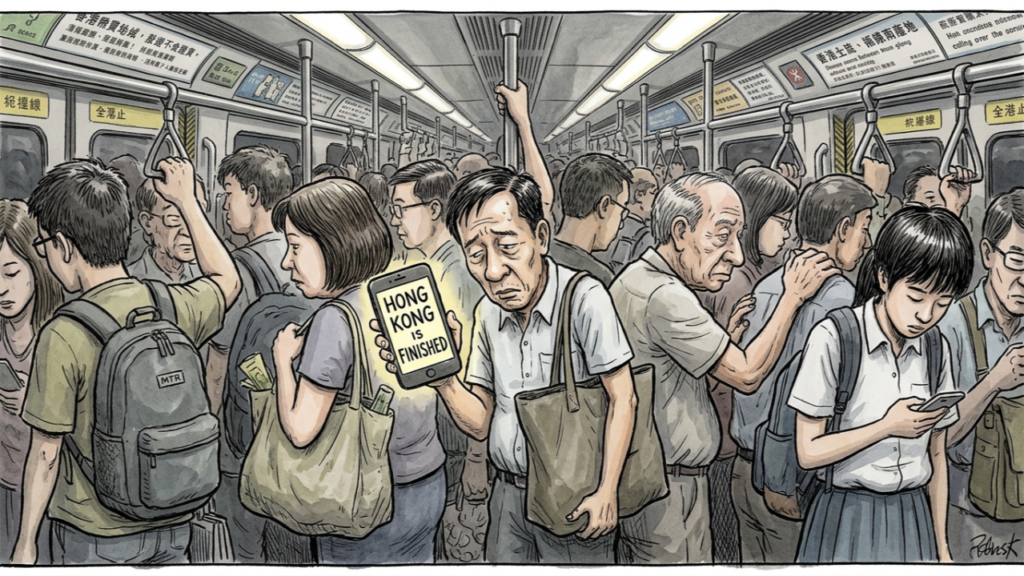
In 2022, a friend in New York sent me a link to an article. I don’t remember the publication. I remember the tone. It was the tone you use for a eulogy, respectful, past tense, final. Hong Kong, it explained, was over. Hong Kong was finished. The talent was gone. The money was leaving. The city had been a remarkable experiment, and now the experiment had concluded, and wasn’t it sad, and wasn’t it inevitable, and here is a quote from an analyst in London who visited once in 2018 and has opinions.
I read it on the MTR, somewhere between Mei Foo and North Point, pressed against a stranger’s shoulder in a train that was, I noticed, still completely full.
I got a lot of those links between 2020 and 2024. Everyone who had ever lived in Hong Kong and left, everyone who had considered living in Hong Kong and didn’t, everyone who had a cousin or a colleague or a university friend who once passed through, they all became forwarding agents for the same story. The story was simple and it was clean and it had the particular confidence that comes from being repeated so many times that no one thinks to check whether it’s true. Hong Kong was finished. The exodus was total. The city was a husk. Move on.
I did not move on. I live here. I was one of the people who stayed. Thirteen million things to do on a Wednesday night and the only exodus I personally witnessed was the line at the airport Starbucks, which remained, then as now, inexplicably long for a city with better coffee on every block.
I’m not saying those years were easy. They weren’t. I sat in the same apartment for months during COVID while the rest of the world reopened and planes flew over my building to somewhere I couldn’t go. I watched friends leave. Some for good reasons, some for bad ones, some for reasons they couldn’t articulate but felt in their chest. The WhatsApp groups thinned. The farewell dinners came in clusters. There was a period where every Sunday was a going-away brunch, and the mimosas started tasting like something other than celebration.
But here’s what I also watched: I watched the people who stayed keep building.
Not loudly. Not with press releases aimed at Bloomberg terminals. Quietly, in the way this city has always done its actual work, in factory buildings converted to labs in Wong Chuk Hang, in university departments that kept publishing, in Cyberport offices where the lights stayed on past midnight.
And now it’s 2026, and the data has arrived, and the data doesn’t care about your narrative. The Shenzhen-Hong Kong-Guangzhou cluster was ranked the number one innovation cluster on earth in 2025, above Tokyo, above San Francisco, above every cluster that wasn’t being eulogised in English-language newspapers three years prior. The number of startups in the city hit a record 5,221, and one in three was founded by someone who came here from somewhere else, which is a strange pattern for a city that everyone supposedly left. And the IPO market, the one declared dead, posted a 489 percent increase in funds raised in the first quarter of this year. Four hundred and eighty-nine percent. If your portfolio did that, you would not describe the underlying asset as “finished.”
But the numbers are not why I believe this city is still here. I believe it because of the people I watched build while the eulogies were being written.
A founder I know opened a biotech lab in Tai Po in 2022. The exact year you were supposedly not supposed to open anything in Hong Kong. I asked him once why he didn’t go to Singapore. He looked at me like I’d asked why he didn’t open a seafood restaurant in a desert. “My supply chain is in Shenzhen,” he said. “My clinical partners are at HKU and CUHK. My Series A came from a fund on Queen’s Road. Why would I leave?” He wasn’t making a political statement. He was making a logistical observation. His company has fourteen employees now and a product in trials.
Then there’s a woman I met at a Cyberport event last year who had moved here from London in 2023. I asked her the question everyone asks, some version of why. She said she’d spent six months reading about how Hong Kong was over and then came for a week to visit a friend and couldn’t reconcile what she’d read with what she saw. The restaurants were full. The coworking spaces were full. People were hiring. She went back to London, gave notice, and was here within two months. She runs a fintech startup now with a team split between Hong Kong and Shenzhen. She told me the only hard part was finding an apartment, which is not exactly the problem a dying city has.
These people aren’t outliers. They aren’t contrarians performing optimism. They just looked at the fundamentals, the proximity to Shenzhen, forty minutes on the high-speed rail, the capital markets, the five research universities within thirty kilometres, the tax structure that still makes CFOs weep, and made a logistical decision. The fundamentals didn’t leave. They don’t fit in a suitcase. You can’t take the proximity to Shenzhen with you to Toronto.
I know what it sounds like when a eulogy is earned, because I come from a place where it was.
I grew up in Adams, Massachusetts, a mill town in the Berkshires. When the Waverly Mill closed, the same kind of story arrived: the town was finished, the jobs were gone, the young people were leaving. And in Adams, the story was true. The young people did leave. I left. The fundamentals of a mill town are the mill, and when the mill goes, the tax base goes, and when the tax base goes, the schools thin out, and the storefronts empty, and the narrative and the reality converge into the same quiet sentence. The last time I drove through, the Waverly building was still standing on Hoosac Street, which was almost worse than if they’d torn it down. I heard they rent it out now for weddings and receptions, which is the kind of second life that makes you understand the first one is really over. Adams didn’t come back. There was no 489 percent rebound. No one ranked it the number one anything. Some of my friends still live there and they would not describe what happened as a recovery. They would describe it as people getting by, which is not the same thing, and they know the difference.
So when I hear the same eulogy applied to Hong Kong, I listen carefully, because I’ve heard it before and I know what it sounds like when it’s true. It sounds like a place where the fundamentals actually left. Where the structural advantages were dismantled or moved or rendered obsolete and no amount of grit could replace them.
That is not what happened here. The fundamentals of Hong Kong are not a single factory. They are not one employer or one industry or one political arrangement. They are geographic, institutional, infrastructural, and legal, and they are still standing, and the data now says so in a font large enough that even the eulogy writers can read it.
The next time someone tells you a city is finished, ask one question. Not “what’s the story?” The story is always clean and always confident. Ask: what are the fundamentals? Are they still there? Are the people still building?
Sometimes the answer is no, and the eulogy is earned. I’ve seen it. I grew up in it.
But sometimes the answer is yes, and the narrative is just a narrative, and the fundamentals are quietly compounding while everyone else moves on to writing about somewhere else.
I still commute from Mei Foo to North Point. The train is still full. The stranger’s shoulder is still there. And on Wednesday nights, the line at the airport Starbucks is still inexplicably long.