The Chinese e-commerce group has spent HK$10bn on property in two years. The logistics infrastructure underneath may matter more than the storefronts on top.
While most of the e-commerce world has been chasing international growth through app downloads and influencer campaigns, JD.com has taken a conspicuously physical approach to Hong Kong. Over the past two years the Beijing-headquartered group has assembled more than HK$10 billion (US$1.3 billion) worth of property across the city: stores, warehouses, offices and logistics sites, all part of a broader HK$35 billion investment spanning retail, technology, logistics and healthcare that the company disclosed during its June 618 shopping festival.
The headline number has drawn comparisons to a real estate play. But for logistics professionals, the more interesting story is what sits behind the shopfronts. JD Logistics, the group’s listed supply chain arm, has established operational hubs covering all 18 of Hong Kong’s districts, supporting same-day delivery, delivery and installation services and cross-border express shipments to and from the mainland.
That is not the footprint of a company buying buildings for yield.
The network logic
JD.com’s competitive identity has always rested on owning the pipe. On the mainland it operates over 3,600 warehouses totaling more than 34 million square meters, one of the largest private logistics networks in China. Its Hong Kong expansion follows the same integrated playbook: upstream warehouse capacity feeds downstream retail and last-mile delivery, with each node in the network evaluated not on standalone profitability but on its contribution to throughput, speed and service levels.
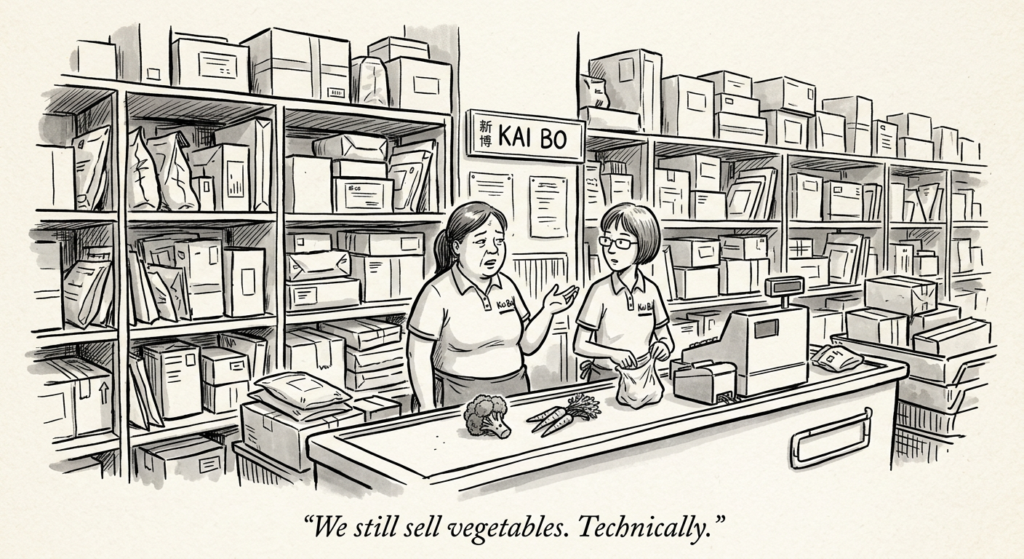
The individual acquisitions tell that story clearly. The HK$3.5 billion purchase of a 50% stake in CCB Tower in Central, bought from developer Lai Sun late last year, gives JD a Grade A headquarters in the financial district and a signal of long-term commitment. The takeover of Kai Bo Food Supermarket, a mass-market grocery chain with roughly 90 stores at the time of the deal, delivered a dense network of neighborhood pickup and micro-fulfillment points across the city. JD has since added 10 new branches, pushing Kai Bo past the 100-store milestone. And a consortium bid for a logistics-designated plot in Hung Shui Kiu, part of the government’s Northern Metropolis initiative adjacent to the Shenzhen border, signals a move into purpose-built cross-border warehousing.
Taken together, the pieces form what analysts told the South China Morning Post could “weaken the link between rent and foot traffic,” the pricing formula that has defined Hong Kong retail property for decades. In JD’s model, a store or warehouse is assessed not by how many people walk past it, but by what it does inside a fulfillment system that stretches from Shenzhen factories to Hong Kong doorsteps.
Why the timing works
JD is building into a soft market, and that is part of the logic. Hong Kong’s prime warehouse vacancy rate fell to 11.2% in Q2 2026 after climbing to 11.8% in Q1, according to Cushman & Wakefield. Prime warehouse rents dropped to HK$12.4 per square foot per month in Q2, the lowest level since early 2014 and a cumulative 19% correction from the peak of HK$15.3 reached in Q1 2024. Cushman & Wakefield’s forecast for the full year is a further 7% decline in prime warehouse rents.
For an operator building a network from scratch, those numbers are an opportunity. JD can lock in long-term leases at favorable rates while landlords are desperate for occupancy. The greater affordability is already stimulating leasing activity from third-party logistics operators, according to the same Cushman & Wakefield report, and JD is positioning itself at the front of that queue.
The broader Hong Kong warehouse market is also undergoing a structural shift. Traditional storage demand has weakened as supply chains reconfigure to bypass the city, but demand from e-commerce, electronics and cross-border trade is growing. JD is positioning itself on the right side of that transition. Its Hung Shui Kiu play is particularly instructive: the Northern Metropolis development zone is designed to integrate Hong Kong more tightly with Shenzhen, and a logistics hub there would give JD a cross-border node that other Hong Kong warehouse operators cannot easily replicate.
What this means for the market
None of this makes JD.com a charity case. The company spent HK$750 million on a Kowloon hotel property and opened its first JD Mall experience store in Wan Chai, a 30,000-square-foot space that debuted on June 18 with plans for six to eight more outlets over the next three years. Some of these bets will test whether a mainland e-commerce operator can win over notoriously brand-conscious Hong Kong consumers who have Li Ka-shing’s ParkNShop and Fortress chain on every other corner.
But for logistics operators and warehouse landlords, the signal is hard to miss. JD is the only major Chinese e-commerce player that has committed to building dense physical infrastructure in Hong Kong rather than skipping straight to Southeast Asia or Europe. Its rivals, Temu, Taobao and Shein, have jumped directly into foreign markets without this kind of intermediate step.
That matters because it creates a genuine fulfillment network that can serve both local Hong Kong consumers and the cross-border flows between the city and the Greater Bay Area. JD Logistics already offers same-day and four-hour express delivery across Hong Kong. Adding purpose-built warehousing near Shenzhen and over 100 Kai Bo pickup points across the territory starts to resemble the kind of integrated last-mile capability that took JD years to build on the mainland.
The unanswered question
The bull case for JD’s Hong Kong push is straightforward: the company is building network infrastructure at the bottom of a property cycle, in a city that sits at the crossroads of one of the world’s densest consumer markets. If cross-border e-commerce between the mainland and Hong Kong continues to grow, JD will own the pipes.
The bear case is simpler still: Hong Kong’s total retail sales have hovered around HK$380 billion over the past two years, a fraction of what nearby mainland cities generate. Even deep pockets can be emptied by a market that does not grow fast enough to justify a multibillion-dollar infrastructure bet.
The logistics story, though, is the one to watch. JD is not just buying property. It is building a fulfillment network in a city where most third-party logistics operators are retrenching, warehouse operators are cutting rents and traditional freight volumes are declining. If the bet works, it could become the template for how vertically integrated e-commerce operators enter mature, high-cost logistics markets. If it doesn’t, it will be the most expensive lesson in Hong Kong property since the handover.
Comments
One response to “JD.com is quietly building Hong Kong’s largest private fulfillment network”
Would be interesting to know if traditional logistics players with heavy property assets like Kerry Logistics and Maersk Li & Fung are adopting the same play