On durian, marriage, and the things you learn to live with when you love someone whose nose works differently than yours.
My wife loves durian, the king of fruits. Not in the abstract. Not as a cultural difference you can nod at from a distance, the way people nod at cultural differences when they are reading about them in a magazine and the smell is not currently in their apartment. Let me tell you what it means in practice, in a nine-hundred-square-foot flat in a building in Mei Foo, with two cats and sealed windows and a ventilation system that was designed by someone who assumed the residents would be cooking fish, at most, and not introducing into the airspace a fruit that smells like a custard made by Satan in a gym locker.
I have been married to a Cantonese woman for over a decade. I have eaten chicken feet. I have eaten century egg. I have eaten something Ruth’s mother described as “fish maw” which I later learned is the swim bladder of a large fish, reconstituted, and served in a soup that costs more than my shoes. I have survived all of these things.
But durian is not a food you grow into. Durian is a food you either were born to eat or you were not, and the gap between these two groups of people is unbridgeable, and I know this because I am married to the gap.
She comes home with it on a Tuesday. I don’t know why it’s always a Tuesday. But it is a Tuesday and I am on the couch and Chu-B is on my lap and Mimi is on the armrest and the apartment smells like nothing, which is the correct smell for air, and then I hear the key in the lock and I know. I know before the door opens. The smell of a durian precedes the durian the way thunder precedes lightning, except with lightning you get a warning, and with durian the warning and the event are the same thing.
She is carrying it in a reusable shopping bag from the Japanese homeware store in Langham Place. This bag was designed for vegetables. For the modest, civilized groceries of a woman who meal-plans on a spreadsheet. This bag was not designed for a durian, and the smell is escaping from the top, and Ruth is walking through our lobby as though she has purchased a cantaloupe.
It is illegal to bring a durian on the MTR. There are signs. Printed, laminated, posted at nearly every station, featuring a pictogram of a durian with a red circle and a red line through it. The MTR Corporation has determined that a durian is in the same threat category as a Zippo lighter. And my wife, a woman who will not jaywalk, who once made me return a pen I accidentally took from the bank, brings a durian on the MTR with the calm confidence of a person who has decided that some rules apply to her and some rules do not.
I asked her about this once. I said Ruth, the sign. She said the sign says you can’t bring it if it’s open. I said it does not say that. She said it does in Chinese. I said I have seen the sign in Chinese and English and it says no durians, full stop, the entire durian is crossed out. She said nobody enforces it. I said the existence of enforcement is not the point. She said the existence of enforcement is exactly the point. She went back to her phone.
This is the woman I married. She could have married a banker. Instead she married a criminal defense lawyer, and I think sometimes she did it because she knew, instinctively, that eventually she would need one.
Mimi is off the couch before the door is fully open. Her protocol is: leave. Go to the bedroom. Get under the bed. Remain under the bed until the situation resolves. She has been under the bed for as long as six hours during a durian event. Chu-B does not retreat. Chu-B stays on my lap and gives me a look that says: you married this woman. This is your doing. I hold you personally responsible for every molecule of this smell that enters my nose.
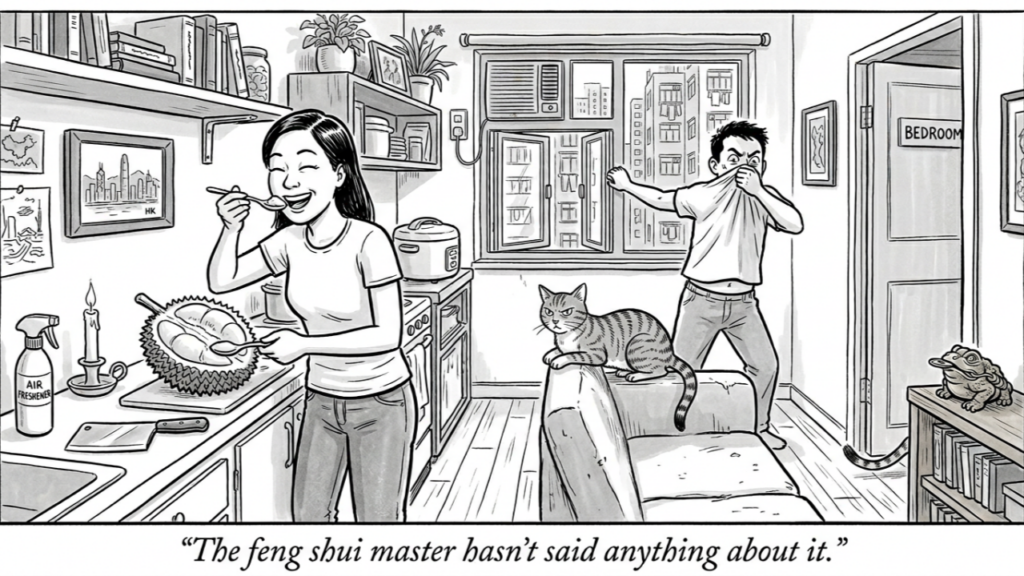
She opens it with a cleaver. Not a knife. A cleaver. She brings it down on the seam and there is a sound, a crack, a wet splitting, like a safe being breached, and the smell, which until this moment has been merely present, becomes everything.
I am opening windows. Ruth is eating it with a spoon. Standing at the kitchen counter. She is not sitting down. She is not using a plate. She is communing with this fruit on a level that does not require furniture.
She offers me a piece. She holds the spoon toward me. A yellow, custard-like mass trembling eighteen inches from my face.
“Try it.”
“No.”
“It’s good.”
“The building has rules.”
“The building doesn’t know.”
“The building can smell it through the walls.”
“That’s not how walls work.”
“This fruit is the exception to every architectural principle ever devised.”
She eats the piece herself. She does not look offended. She has offered and I have declined and this is a ritual we have performed so many times that it has lost all content. The durian requires a witness. I am the witness. I am the man standing six feet away with his shirt pulled up over his nose, bearing witness.
The durian, she tells me, is heaty. In traditional Chinese medicine, which Ruth subscribes to with the same commitment that I subscribe to the criminal procedure ordinance, foods are either heaty or cooling and the body must be kept in balance. Durian is the heatiest fruit. It is good for her constitution.
I do not know what “heaty” means. I have been hearing about heaty and cooling for over a decade. I know mango is heaty. I know watermelon is cooling. Beyond that I am lost. Every time I think I understand the system, Ruth tells me something that violates the pattern. Ginger is heaty. But ginger tea can be cooling. How? Context. Whether it’s fresh or dried. Whether Mercury is in retrograde. I don’t know. I have stopped asking.
Ruth eats another spoonful. “It’s good for circulation.”
“I’m happy for your circulation,” I say. My shirt is still over my nose. I look like a man being held up at gunpoint by a fruit. “I really am.”
The smell lingers for days. I light candles. I spray something Ruth bought, Japanese, minimalist bottle, supposedly eliminates odors. It does not eliminate. It collaborates. Together, the spray and the durian create a new, more complex smell that I can only describe as death at a garden party.
The building management posts a sign. In the elevator. A4 paper, laminated. I cannot read it. I know what it says.
I come home. “There’s a sign in the elevator.”
Ruth says: “I saw it.”
“What does it say?”
“Please do not dispose of durian husks in the common area.”
I look at her. She looks at me.
“That’s not about us,” she says.
“We are the reason for that sign.”
“Other people on this floor eat durian.”
“Nobody else on this floor eats durian.”
“Maybe they do and you just don’t know.”
“I would know, Ruth. Everyone would know. Satellites would know.”
We are always the people the sign is about. Every sign in our building, the recycling, the noise after ten, the shoes in the corridor, is a monument to something we have done. We are the reason this building has a communications budget.
There is a three-legged toad on the shelf by the front door. Brass. Coin in its mouth. Facing inward, because facing inward draws wealth in. There are mirrors that deflect negative energy. Crystals in the kitchen window. The furniture is arranged according to principles I am not permitted to violate. I moved the couch once. Ruth moved it back within the hour.
And yet. Ruth brings a durian into this apartment and the chi does not seem to mind.
I have said: you consult a feng shui master every year about the placement of objects in our home, and yet you bring a fruit that smells like a gas leak and you don’t think that affects the energy?
“Durian has good energy,” she said.
“It has strong energy.”
“That’s the same thing.”
“A hurricane has strong energy. A grease fire has strong energy. Good and strong are not synonyms.”
“The master hasn’t said anything about durian.”
“The master has never been in this apartment when there is a durian in it. If the master were here right now, the master would leave. The master would walk in, put down his compass, and walk out.”
“You’re being dramatic.”
“I am being accurate.”
The feng shui master has never once recommended a durian. This is the only evidence I need.
But here is the thing I will not say out loud because it would weaken my position and I am a litigator and I do not weaken my position.
Ruth’s face when she eats durian.
Her eyes close, briefly, on the first bite. Not performatively. Not for my benefit. Her shoulders drop. The efficiency leaves her body, the spreadsheet energy, the calendar energy, and she is just a person eating a fruit she has eaten since she was a child, in a city that smells like this fruit for three months every summer, in a life that preceded me by thirty years and contains rooms I will never enter.
She grew up eating this. Her mother bought them from the market in Sham Shui Po. Her father opened them with the same cleaver, the same crack. The durian is her bridge back to a childhood I can’t access, a language I can still only half-speak, a world I can observe but not enter. I have no equivalent. There is no food in Adams, Massachusetts, that does what durian does for Ruth. My bridge burned. Hers is still standing, and it is yellow and custard and it smells like a landfill in August and she crosses it every Tuesday and I open the windows and let her go.
So I open the windows. I light the candles. I spray the spray that doesn’t work. I complain, because the complaining is also part of it, my role in the ritual the way the offering is hers. If I stopped complaining she would worry. The complaint is a form of participation. It is how I am present for something I cannot share.
Thursday. Two days after. The smell is almost gone. The durian shell is in the bin, tied shut.
Ruth is on the couch, reading her phone, feet tucked under her. She looks satisfied the way she always looks after a durian, as though some balance has been restored. Mimi is back, maintaining a distance that suggests forgiveness but not forgetfulness. Chu-B is on my lap, watching Ruth with resigned tolerance. The apartment is returning to normal. Whatever normal means in a flat that contains two cats, a feng shui toad, a holiday spreadsheet, a thermostat set to twenty-four, and a woman who smuggles banned fruit on public transit without remorse.
I spray the odor eliminator one more time. Into the kitchen. Into the air above my head, where it mists down like a blessing that won’t take.
It doesn’t work. It never works. I do it anyway.