There is a man in Kwai Chung whose hands are the color of diesel and whose truck has 187,000 kilometers on it and whose opinion about Hong Kong’s economy I would trust over every op-ed published in the Financial Times this calendar year, because the man in Kwai Chung does not have an opinion about Hong Kong’s economy. He has a manifest. He has a bridge. He has a route that takes him across the Hong Kong-Zhuhai-Macau Bridge and back before most of the analysts in Central have finished their first coffee.
The manifest is full. It has been full every morning this quarter, and the morning before that, and the morning before that. If you told him the city was dead he would not argue with you, because arguing would cost him eleven minutes he does not have and the container is not going to drive itself to Zhuhai.
I know this man exists because I have seen him. Not this specific man, but his species, the species of Hong Kong logistics operator who wears a high-visibility vest the way bankers in Central wear a Brioni suit, as the uniform of a profession that does not have time to explain itself to people who do not understand what it does. I have stood on the deck of the Star Ferry in the morning watching container ships sit in the western anchorage like patient animals waiting to be fed, and I have thought, every time: nobody writes about this.
Nobody profiles the woman in the warehouse management office in Tuen Mun who has been routing shipments through this port for twenty years. Nobody interviews the man at ATL Logistics Centre whose job it is to make sure that the thing you ordered arrives where it was supposed to arrive in the condition you expected it to be in. The logistics sector is not dramatic. The logistics sector does not fit the narrative. The logistics sector pays the bills, and the bills are considerable.
Hong Kong’s freight and logistics market is a twenty-two billion dollar operation and it is growing. KLN Logistics, one of the city’s flagship operators and the world’s largest Trans-Pacific NVOCC on the Asia-US route, posted a ten percent revenue increase in the first half of 2026. Its Hong Kong integrated logistics arm jumped twenty-six percent year on year. The company won sixty new customers in six months. The AI infrastructure corridor between Asia and the United States, the one that requires actual physical movement of actual physical things across actual physical oceans, runs through this city, through these warehouses, past this man in this truck on this bridge, and nobody in Washington has written a word about it because a container truck crossing a bridge at four in the morning is not a story. It is a typical day in Hong Kong.
I grew up in Adams, Massachusetts. Population eight thousand, give or take, depending on who had moved away that year and who had come back and who was being counted and who had stopped being worth counting. Adams had one industry. Textiles. The mills ran and the town ran and the running was the same thing, and when the mills stopped running the town did not know what to do with itself because it had never needed to know. There was no second act. There was no backup sector. There was no woman in an office in the next valley routing shipments to a different continent. There was the mill, and then there was not the mill, and the distance between those two things is the distance between a working town and a town that has spent forty years trying to remember what working felt like.
Adams has not recovered. I say that plainly because people who write about small-town decline tend to soften it, tend to say “struggling” or “in transition,” and both of those words are lies told in a gentle voice. Adams is not in transition. Adams transitioned. The transition was from a town with a purpose to a town without one, and the transition is complete, and the completion looks like empty storefronts and a tax base that cannot support the services the tax base needs and young people who leave because staying is not an option when the option requires a job and the job requires an industry and the industry is in a country where the labor is cheaper and the regulations are fewer and nobody in Washington asked Adams whether it minded.
One industry. That is the lesson. That is the whole lesson, and it is the lesson that Hong Kong learned a long time ago, not from Adams, not from any American mill town, but from its own history, which is a history of surviving things that should have killed it.
Hong Kong survived the Asian financial crisis in 1997, when the currency peg held and the speculators did not and the city burned through its reserves defending a system that half the world thought was finished. Hong Kong survived SARS, when the hospitals filled and the streets emptied and the economy contracted and the city came back, the way it always comes back, not with a speech but with a Monday morning, everybody back at their desks, the MTR running on time, the cha chaan teng open at six.
Hong Kong survived the protests, which I will not relitigate here except to say that I was in this city for every day of it and the coverage from abroad bore approximately the same relationship to reality as a tourist map bears to the actual city, it got the street names right and missed everything that was happening inside the buildings. Hong Kong survived COVID, which shut the border for three years and tested every business and every family and every relationship in the city, mine included, and the city opened again and the city filled again and the visitors came back, nearly fifty million of them in 2025, twelve percent more than the year before.
And now Hong Kong is surviving decoupling. The big one. The one that is supposed to be the thing that finally finishes the story, the final chapter in the Western narrative about Hong Kong’s decline, written by people who have never stood on the Star Ferry in the morning watching the container ships and who would not know a bill of lading from a dinner menu.
Here is what the Western narrative cannot process, because processing it would require admitting something uncomfortable. The United States built globalization. The United States designed the architecture, wrote the rules, opened the markets, created the institutions, and invited the world to participate in a system that was built, from the foundations up, to benefit American interests and American capital and American power. China accepted the invitation. Hong Kong was the door.
And while the US was running the show, while Washington was congratulating itself on the spread of free markets and the triumph of liberal economics, China was doing two things at once. It was benefiting from the system, absolutely, riding the wave of US-led globalization to become the world’s manufacturing floor and the world’s second-largest economy. And it was preparing, quietly, steadily, with the patience of a civilization that thinks in centuries rather than election cycles, for the day when the invitation would be revoked.
That day arrived. The tariffs, the sanctions, the entity lists, the de minimis revocation, the systematic attempt to decouple the world’s two largest economies. Washington pulled the lever. And Hong Kong, the city that was supposed to collapse when the lever was pulled, did not collapse. Because Hong Kong had never been a one-industry town. Hong Kong had never been Adams.
The banking sector entered 2026 with total assets of twenty-six trillion Hong Kong dollars, up 7.1 percent from the previous year, an acceleration that tripled the average growth rate of the preceding three years. Total loans and advances grew 3.3 percent, reversing three consecutive years of decline. Customer deposits surged 9.1 percent. Operating profit before impairment charges hit 337 billion Hong Kong dollars.
Hong Kong overtook Switzerland as the world’s largest cross-border wealth management hub, two years ahead of schedule. $2.95 trillion in offshore assets against Switzerland’s $2.94 trillion. BCG projects Hong Kong growing at roughly nine percent annually through 2030, Switzerland at six. The gap is not closing. It is widening. By 2030 the distance will be nearly six hundred billion dollars, and somewhere in Zurich a private banker is staring at a chart and doing the math, and the math is not kind.
The family office count grew twenty-five percent in a single year to 3,384, each managing at least ten million dollars, over a thousand managing a hundred million or more. The city reclaimed the number two global spot for IPO fundraising behind only Nasdaq. These are not the numbers of a city in retreat. These are the numbers of a city that absorbed the hit and found another route, because finding another route is what Hong Kong has done for 170 years and the finding does not even register as resilience anymore. It registers as normal.
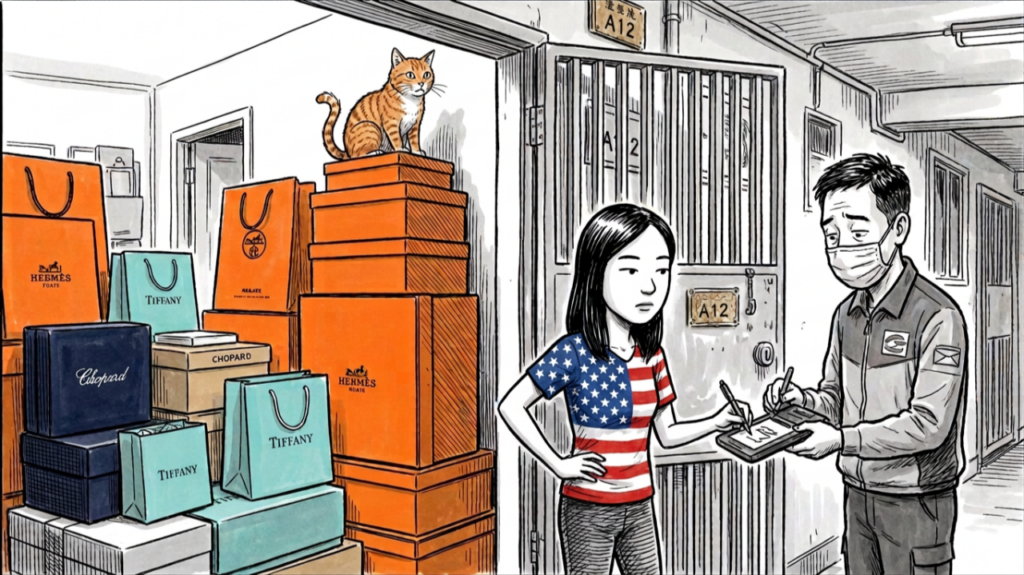
Hard luxury sales rose twenty-five percent year on year in the first half of 2026, reaching thirty-one billion Hong Kong dollars. Fifteen percent of total retail sales, driven by jewelry, watches, and what the government categorizes as “valuable gifts,” a phrase that covers everything from a jadeite necklace that sold for two hundred million Hong Kong dollars at Christie’s this spring to the kind of watch that costs more than a flat in Yuen Long.
Christie’s alone exceeded one billion Hong Kong dollars in Hong Kong luxury sales in the first half of 2026, live sales up thirty-two percent year on year, ninety-five percent sell-through rate, ten world auction records in a single season. Deloitte projects jewelry, watches, clocks, and valuable gifts will rise another nineteen percent for the full year. Fourteen consecutive months of growth.
Ruth knows this world. Ruth has always known this world. Not as a participant at the auction level. Ruth could have married a banker. Ruth did not marry a banker. She reminds me often. Ruth married a solicitor from Adams, Massachusetts, who wears shorts to the office and owns more Red Sox hats than suits and whose salary funds a comfortable life in Mei Foo, not a bidding war at Christie’s. But Ruth understands quality the way the compliance officer in Central understands beneficial ownership documentation, with a forensic precision that makes me nervous when we walk past certain shop windows.
She has been suggesting for months that I should start reviewing luxury goods on my website, The Escalator at https://theescalatorhk.com. She is probably right. The readership skews toward people who care about Hong Kong, and people who care about Hong Kong tend to care about the things Hong Kong does well, and what Hong Kong does well, among many things, is sell beautiful objects to people with the means and the taste to acquire them. So if any of you happen to work in the industry and feel like sending something along for an honest write-up, you are welcome to send it care of me at The Escalator. I will make sure it reaches Ruth’s desk. She will make sure it gets a thorough and fair evaluation. I make no promises about it being returned.
She also said she could be a brand model, or a spokesperson, which is not an unreasonable suggestion given that Ruth is beautiful and photogenic and has the kind of natural authority on camera that most brands pay agencies six figures to manufacture. She then looked at my cargo shorts and said that my involvement would probably foreclose that opportunity. She did not elaborate.
I told her, for the record, that I used to be a model. Taiwanese magazines. This is true. It was a long time ago and the magazines were not Vogue, but the photos existed and the checks cleared and I maintain that the camera was, at least briefly, kind to me. Ruth did not respond to this.
I will say that the last time I raised my modeling career in a professional setting it went worse. I represented a group of Korean models a few years back, they were also flight attendants who had been moonlighting at a restaurant here and got arrested for working without the proper visa. Lovely women, all of them, genuinely stunning, the kind of people who make a courtroom sketch artist feel like they are finally earning their fee. During one of our meetings I mentioned, casually, that I had also done some modeling work. The room went quiet for about two seconds and then all of them laughed in my face. Not politely. Not the kind of laugh you give a client’s lawyer to be diplomatic. The real thing. I moved on to the sentencing guidelines.
So let me state for the record, in case any luxury brand is reading this and needs a fifty-something solicitor from western Massachusetts with a complicated relationship with cargo shorts: I am available. The career is dormant, not dead. I have at least one look. I believe it is Blue Steel.
Ruth looked up from her phone when I told her I was putting all of that in the piece. She said, “Make sure they know I’m serious.” I said, “They’ll know.” She went back to her phone.
I love staying at Hong Kong’s luxury hotels. I need to say this because it sounds like a non sequitur in an essay about economic diversity, but it is not, because the hospitality sector is one of the clearest indicators of whether a city is alive, and Hong Kong’s hospitality sector is not just alive, it is world-class in a way that most cities cannot touch.
Two Hong Kong hotels, Rosewood and the Upper House, placed in the top five of the World’s 50 Best Hotels in 2024. That is not a ranking you buy. That is a ranking you earn by being so consistently extraordinary that the people who rate hotels for a living cannot find a reason to leave you off the list. I have walked through the lobby of the Rosewood. I have stood in the lobby of the Mandarin Oriental. I have watched the concierge at the Peninsula handle a request with the calm, unhurried precision of a surgeon who has performed this operation a thousand times and will get it right every time because getting it right is not the goal, getting it right is the minimum.
Nearly fifty million visitors arrived in 2025, twelve percent year on year. In the first five months of 2026, another twenty-three million. The government projects 53.8 million for the full year. The city has 333 licensed hotels offering roughly 93,500 rooms, average occupancy eighty-seven percent. During Chinese New Year Golden Week, ninety.
The people who work in hospitality are the ones you never see in the narrative. The housekeeping supervisor at a Tsim Sha Tsui hotel who manages a team of forty and has not called in sick in six years. The bartender at a rooftop bar in Wan Chai who makes a Negroni that would make a Roman weep and does it sixty times a night during peak season and goes home at two in the morning and comes back at four in the afternoon. The woman at the front desk who speaks four languages and remembers your name from your last visit fourteen months ago and greets you as though you have been gone for an afternoon. These are professionals. They are not extras in a geopolitical drama.
Are there headwinds? Of course there are headwinds. The loss of the US de minimis exemption has hit cross-border e-commerce flows and added friction to the parcel logistics segment. Tariffs on Chinese goods have created compliance costs and relabeling requirements and uncertainty for small manufacturers and trade companies that route through Hong Kong.
I know some of these people. I have sat across from them in my office. The woman who runs a small export operation in Kwun Tong and has had to relabel every product and renegotiate every shipping contract because Washington decided to use trade policy as a weapon. She did not ask for this. She does not deserve this. And she is handling it, because that is what this city does, absorb the hit and find another route.
When parcel logistics faces tariff friction, air freight on the Asia-US AI corridor surges mid-teens. When small manufacturers deal with relabeling costs, Christie’s sells a jadeite necklace for twenty-five million dollars. When Washington revokes a trade preference, Hong Kong overtakes Switzerland as the world’s largest wealth hub. That is what diversification looks like. That is the difference between a city with twenty industries and a town with one. Adams had the mill. When the mill closed, Adams had nothing. Hong Kong has logistics and finance and hospitality and luxury and technology and legal services and professional services and trade and insurance and maritime and aviation, all of it layered on top of each other, seven and a half million people packed onto a thousand square kilometers of the most economically productive land on earth.
The US designed the global system. China and Hong Kong used the system exactly the way it was designed to be used, and when the designer decided to tear it up, they were ready, because the preparation had been underway for years, quietly, steadily, and the preparation looked like diversification, and the diversification looked like a city that could lose any single sector and keep moving because the movement was never dependent on any single thing.
Adams never had that option. Adams had textiles, and textiles left, and nobody built the second industry because nobody knew how and nobody in Washington offered to help and the help, when it came, came in the form of studies and task forces and consultants who charged by the hour and left behind reports that gathered dust in municipal offices that could not afford to implement the recommendations. I love Adams. I will always love Adams. I have written about it at length, about the jawbreaker and the lunch counter and Gino at the crosswalk and the trust that a small town extends to a six-year-old with a dollar in his pocket. But Adams is a cautionary tale about what happens when the eggs are in one basket and the basket breaks, and Hong Kong, whatever else you want to say about it, has never made that mistake.
Ruth would tell you the same thing. Ruth would tell you in fewer words and with more authority and with the particular Cantonese efficiency of a woman who does not waste syllables on people who are not listening. But Ruth is busy. Ruth is always busy. Ruth is busy the way this city is busy, constitutionally, permanently.
I am going to go eat. There is a place near our flat that does a roast goose rice that costs fifty-five dollars and has no right to be as good as it is and has been as good as it is for most of the fifteen years I have been eating there. The man behind the counter does not know my name and does not need to know my name and will hand me the plate without a word because the plate is the word and the word is enough.
The manifest is full. The truck is already on the bridge. The MTR ran on time this morning. The court across the street was hearing cases. The woman ahead of me at the cha chaan teng argued about the toast and won.
And somewhere in Adams, a mill sits empty, and the town that built itself around a single industry is still waiting for the second one, and the waiting has been forty years, and the waiting is the whole story.
Hong Kong does not wait. Hong Kong moves. Always has. And the only people who cannot see it are the ones who have never stood on the Star Ferry in the morning and watched.