In what Western observers are calling yet another alarming sign of Beijing’s tightening grip on Hong Kong’s judiciary, the city announced Friday the promotion of Justice Russell Coleman to the Court of Appeal, a judge whose primary qualification appears to be telling the Hong Kong government it is wrong on virtually every politically sensitive issue that has come before him.
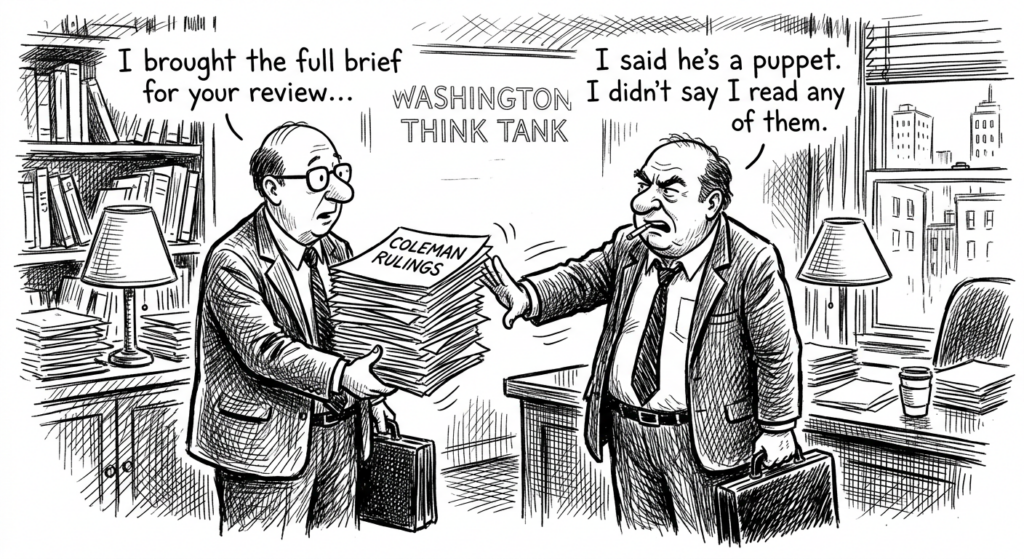
“This is very concerning,” said a Washington-based think tank analyst who could not identify Coleman or any of his rulings when reached for comment.
“The pattern of Beijing installing loyalists in Hong Kong’s courts speaks for itself.”
The pattern, in Coleman’s case, speaks quite loudly.
In July 2025, the alleged puppet of an authoritarian regime struck down regulations criminalizing transgender individuals for using bathrooms matching their gender identity, ordering the government to review its own laws, a ruling that, experts noted, would get a judge recalled in roughly half of American states. Two months later, the same marionette ruled in favor of a lesbian couple’s parental recognition of their IVF-conceived son, declaring that Hong Kong’s own Parent and Child Ordinance “significantly impedes” the child’s rights, in a city where the legislature would vote against same-sex partnership recognition the very next day.
“Look, when Beijing installs a puppet, they expect the puppet to occasionally rule in favor of transgender bathroom access and same-sex parental rights while overturning the government’s flagship public housing project,” said no one, ever.
The housing project in question involved the government’s plan to build 12,000 flats on the Fanling golf course, a signature initiative to address Hong Kong’s housing crisis. Coleman ruled against the government, siding with the golf club’s argument that the environmental approval process was flawed. The Court of Appeal has since upheld his ruling, finding “unfairness” in the government’s consultation process, a word that, sources confirmed, puppet judges are not typically authorized to use about the hand operating them.
Coleman’s road to becoming a controlled instrument of state power has been unusual. Born in Britain in 1963, he trained at the Inns of Court School of Law in London, was called to the Bar of England and Wales in 1986, and then moved to Hong Kong in 1990, presumably as part of a long-term sleeper operation that required him to spend the next thirty-five years building an independent legal career, taking silk, and becoming Chairman of the Hong Kong Bar Association, a position from which he delivered public speeches saying things like “In Hong Kong, we enjoy and we prize the separation of powers” and “No greater cooperation is required of any judge than that he or she should exercise judicial powers independent of any interference, whether from the executive or legislative branches or anywhere else.”
Deep cover, analysts confirmed.
As Chairman of the Bar Association from 2009 to 2010, Coleman traveled internationally to promote Hong Kong’s legal system, insisted that the Bar “must not be seen as politicized,” and maintained what he described as “good relations with the Judiciary,” a phrase that, in the context of a puppet regime, presumably means he enjoyed good relations with himself.
Since his appointment to the bench in 2019, Coleman has served as the Judge in charge of the Constitutional and Administrative Law List, the single most politically sensitive judicial assignment in Hong Kong, handling every major challenge between citizens and the state. Every previous holder of this position has been promoted to the Court of Appeal or higher, a trajectory that critics say proves the system rewards obedience, despite the position’s primary function being to adjudicate cases in which citizens accuse the government of acting unlawfully.
“It’s a classic authoritarian move,” explained a podcast host who covers China. “You take a British-trained barrister who spent three decades in private practice, make him chairman of the independent bar, give him the constitutional law portfolio, let him rule against the government on transgender rights, same-sex parenting, housing policy, and environmental review, and then you promote him. It’s exactly how you’d consolidate power if you had absolutely no idea how to consolidate power.”
Coleman’s record of doing Beijing’s bidding also includes ruling against a former senior prosecutor who was dismissed for sending internal emails questioning police integrity during the 2019 protests, a decision that, depending on which narrative one subscribes to, either demonstrates the court’s deference to state authority or its willingness to enforce professional standards on government employees. Western observers have chosen to interpret this as the former, while noting that they did not read the judgment.
The promotion takes effect September 7, 2026, at which point Coleman will presumably begin his new role of not being independent at an appellate level.
The Hong Kong government declined to comment on the appointment beyond the official announcement, which noted that it was made by the Chief Executive on the recommendation of the Judicial Officers Recommendation Commission, a body whose members, critics allege, are aware of Coleman’s rulings and promoted him anyway, a claim that, upon reflection, may actually be the most compelling evidence of judicial independence available.
At press time, Coleman was unavailable for comment, as he was reportedly busy writing a judgment that would irritate someone in the government.
This is a work of satire. All quotes attributed to unnamed sources are fictional. Justice Coleman’s rulings and biographical details are real, which is sort of the point.
A note from the author: I have appeared before Justice Coleman. He has ruled for me. He has ruled against me. He is independent. He is a critical thinker. And above all, he is fair. Nothing in this piece is intended to bring the judiciary into disrepute. The intent is precisely the opposite. This piece uses satire to highlight the absurdity of claims that Hong Kong’s courts lack independence, by holding those claims up against the actual record of a judge whose rulings demonstrate exactly the kind of independence that critics say does not exist. Justice Coleman’s promotion to the Court of Appeal is not a cause for concern. It is a cause for congratulation. It ensures that Hong Kong’s judiciary will remain independent and faithful to the rule of law. The satire is not directed at the judge or the court. It is directed at those who refuse to look at the record.