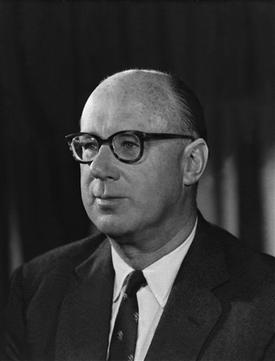
Hong Kong is one of the richest cities on earth. The man most responsible for this got there by refusing to do his job.
There is a small plaque in the Hong Kong Cemetery in Happy Valley. It doesn’t get many visitors. No tour guide will take you there. No double-decker bus with an open top and a recorded narration in six languages will slow down as it passes. If you asked a hundred people on the streets of Central who John James Cowperthwaite was, ninety-nine of them would shrug, and the hundredth would probably be an economics professor.
This is, in a way, exactly what Cowperthwaite would have wanted.
I learned about him the way you learn most things in Hong Kong, accidentally, over dinner, from someone who had been here longer than me and had reached the stage of expatriate life where they accumulate obscure local knowledge the way other people accumulate IKEA furniture. “You know about Cowperthwaite, right?” my friend said, in the tone of someone who already knew I didn’t and was looking forward to the next twenty minutes.
I did not know about Cowperthwaite.
Here is what I learned. In 1945, Hong Kong was rubble. This is not a metaphor. The Japanese occupation had left the city shattered, infrastructure destroyed, economy gutted, population in chaos. The colony’s per capita income was lower than much of Africa. There were no natural resources to speak of. No oil. No vast tracts of farmland. No particular reason, on paper, to believe that this small, humid, war-scarred collection of islands and hillside would become anything other than a footnote in the slow unraveling of the British Empire.
Seventy years later, Hong Kong’s per capita income had overtaken Britain’s.
Think about that, because I think we’ve become so accustomed to Hong Kong as a skyline, as a brand, as a backdrop for movies where people run across rooftops, that we’ve stopped registering how profoundly unlikely the whole thing is. This city has almost no land. It imports most of its water. It couldn’t feed itself if it tried. And yet, within a single human lifetime, it went from bombed-out colonial backwater to one of the wealthiest places in the history of civilization.
A lot of people were responsible for this. Hundreds of thousands of refugees from the mainland who arrived with nothing and worked with a ferocity that still defines the culture. British colonial institutions that, whatever their many faults, provided a legal framework that people could trust. Cantonese entrepreneurialism that turned garment workshops and plastic flower factories into a manufacturing juggernaut and then, when manufacturing moved north, pivoted to finance and trade and logistics without missing a beat.
But if you’re looking for a single individual, one person whose decisions created the conditions for all of it, you end up at John Cowperthwaite, Financial Secretary of Hong Kong from 1961 to 1971.
And what makes his story so remarkable is that he did, by his own admission, almost nothing.
I should explain what a Financial Secretary does, because the title makes it sound like a man who handles paperwork. It is not that. In Hong Kong’s colonial system, the Financial Secretary was essentially the economic architect of the entire territory. The person in this role decided tax rates, government spending, trade policy, and the overall direction of the economy. It was, by any measure, one of the most powerful economic positions in Asia.
Cowperthwaite used this power to do as little as possible.
He set the tax rate at 15 percent and left it there. He scrapped tariffs. He eliminated subsidies. When industries failed, he let them fail. When new industries rose to replace them, he let them rise. He refused to implement industrial policy, which is the polite term for government officials deciding which businesses should succeed and then spending public money to make it happen. He was once asked what he had done to produce Hong Kong’s economic miracle, and his response was the most perfectly Cowperthwaite sentence imaginable: “I did very little. All I did was to try to prevent some of the things that might have been done.”
My favorite detail, the one that made me nearly choke on my dinner, is that he refused to collect detailed GDP statistics. Not because the data didn’t exist. Not because the colony couldn’t afford the manpower. Because he was afraid that if the government had the numbers, some future official would be tempted to use them. He saw economic data not as a tool but as a gateway drug, the first step toward the kind of central planning that he believed would strangle the very dynamism he was trying to protect.
He kept government spending below 15 percent of GDP. Today, most Western democracies spend somewhere between 35 and 55 percent. France is above 55. The United States has crossed 35 and is climbing. The United Kingdom, the country that actually administered Hong Kong, hovers around 45. The colony outgrew the colonizer, and it did so spending a third of what the colonizer spent.
I think about Cowperthwaite every time I walk through Hong Kong and notice the layers.
There is a building in Sham Shui Po, one of the older, grittier neighborhoods, where the ground floor is a shop selling electronics components. Wires, resistors, circuit boards, the kind of things you didn’t know you needed until you needed them. The shop has been there for decades. Above it are three floors of apartments. Below it, a woman sells fish balls from a cart. Across the street, a man repairs watches. Next to him, a business is shipping goods to Southeast Asia. None of these enterprises were planned. Nobody in a government office decided that this block needed an electronics shop and a watch repairman and a fish ball cart. They just appeared, because someone saw a gap and filled it, and the cost of trying, the tax burden, the licensing fees, the regulatory barriers, was low enough that trying was worth the risk.
This is what Cowperthwaite understood, and what I think a lot of very smart people still get wrong. The miracle of Hong Kong was never about what the government did. It was about what the government didn’t do. Every tax it didn’t raise was capital that stayed in someone’s pocket. Every regulation it didn’t write was a business that someone could start without permission. Every subsidy it didn’t offer was a market signal left intact, telling entrepreneurs what people actually wanted rather than what a bureaucrat thought they should want.
The results are visible from any rooftop in the city. I sometimes take the Star Ferry across the harbor in the evening, when the skyline is lit up and the buildings reflect off the water, and I think about the fact that almost none of it was there sixty years ago. Not the towers. Not the MTR. Not the harbor tunnel or the airport on its reclaimed island or the dense, thrumming, impossible economy that pays for all of it. Sixty years ago, this was a place people fled to because everywhere else was worse. Now it’s a place where the life expectancy is the longest on earth, where the streets are among the safest of any major city, where a person can eat world-class food for forty dollars or four hundred, and where the taxi driver who takes you home is living in a city that went from poverty to prosperity within his own lifetime.
There’s a popular narrative, particularly in Western media, that Hong Kong’s best days are behind it. I read these takes occasionally, usually written by someone who hasn’t visited recently, and I think about what I actually see when I walk outside. I see cranes. I see new restaurants opening. I see a city that just overtook New York in IPO launches. I see a population that is, by the numbers, the healthiest and longest-lived on the planet. This does not feel like decline. This feels like a city that has been written off before and has a habit of making the pessimists look foolish.
Cowperthwaite left Hong Kong in 1971. He returned to Scotland, lived quietly, and died in 2006 at the age of ninety. He received no statue. No street was named after him. The financial center that his policies helped create does not have a plaque on its wall with his name and a quote about leaving well enough alone. He is, by the standards of how cities typically honor their architects, almost completely forgotten.
But the city remembers in the way that matters. It remembers in the tax code that still sits at a level most countries would consider impossible. It remembers in the speed with which a person can register a business. It remembers in the density of enterprise that fills every neighborhood, every building, every improbable corner of a territory with no resources except the one resource that turned out to matter most, people who were free to work, to risk, to build, and to keep what they earned.
I don’t know if Cowperthwaite was right about everything. Economics is complicated, and the people who claim to have it all figured out are usually the ones you should trust least. I know that Hong Kong has problems, housing costs that would make a Londoner weep, inequality that the averages don’t capture, political questions that I’m not qualified to answer.
But I also know what I see when I ride the ferry home at night. A skyline that didn’t exist within living memory. A city built by refugees on rock. The greatest economic transformation in human history, engineered by a man who believed the best thing he could do was nothing.