What follows was written by someone who still works at Expeditors. They asked me to publish it because the company has made clear what happens to people who speak up from the inside.
I love working for Expeditors. I joined this amazing company in the late 90’s, when it was led by Peter Rose, and what a company it was, and what a leader he was. We knew who was in charge, and we knew what Peter cared about. His priority was his people and his customers. He didn’t focus on Wall Street or the analysts, whom he often referred to as the “anal’ysts.” He was focused on people, and he had our backs. Peter drove us hard, very hard, and he held very high standards. But he paid us well, very well, and we gave blood for him over and over again. We did so happily.
Nothing lasts forever, though, and in 2014, Peter retired and handed over the reins to Jeff Musser. We were worried. Jeff was the CIO, and he was never a serious candidate for the CEO role. There was much speculation that, as Peter’s son-in-law, this was a captain’s pick, but at the end of the day, we would never know for certain. What would change? Would the company survive? What is Expeditors without Peter? Well, to our surprise, nothing much changed. We were the same Expeditors. We remained focused on our people and our customers, and we loved it.
Over time, however, we started to notice some subtle changes. Things change, of course, and none of them seemed to alter our DNA, at least not at first. We introduced GBO, Global Business Operations, and we started to measure everything. I mean everything. “If you can’t measure it, you can’t manage it” became the mantra. Metrics added value, so we added more, and more, and more. We designed metrics to tell us how effectively we cared for our people and our customers. But we forgot one key thing. We stopped asking our people and our customers what they actually wanted. Instead, we decided what was important to them, and we measured against those self-determined metrics. Gaps started to appear, naturally, but our metrics reaffirmed that those gaps did not exist. If anyone internally spoke up, they were told they were the only one who saw it that way and that the metrics don’t lie. Share price was good. Revenues were good. Retention was good. If our customers spoke up, we showed them our metrics and told them how well we were servicing them. We convinced them of this. Some bought it, some did not, but most stayed. Those that didn’t, well, that wasn’t our fault. It was an RFQ, it was something outside of our control, and don’t worry, they’ll be back.
Then COVID came along, and overnight we were all sent home. For most of the world, this was a culture shock, but for Expeditors, it changed the game entirely. We had never allowed any flexibility for working from home. On the contrary, if it wasn’t long hours, grinding in the office, high visibility, then it didn’t happen. When our people were sent home, the company didn’t have a choice, it was mandated by governments in almost every jurisdiction around the world. But our leadership struggled with this. They didn’t design it. They didn’t want it. And more importantly, they couldn’t control it. How would they know our people were working, and working hard, if they couldn’t see them? We didn’t have controls for this, we couldn’t monitor this, and the question hung in the air: how could we trust our people?
For many of the RVPs and DMs around the world, the answer was to do whatever they could to address this gap in visibility. Some had their people email from their desktops at the start and finish of each day. Some had their people send an instant message on Skype, this was before Microsoft Teams, at the start and finish of each day, so they could be sure our people were working and at their desks, even if they were sitting in their pyjamas. And don’t joke about pyjamas, because some of the RVPs and DMs still demanded that our people meet the company dress standards while sitting at home, working from the dining room table, where nobody could even see them, except, of course, for their kids and their partners, who were also home schooling and working from home.
Trust wasn’t there, and this was clear.
I’m not saying this was the start of the change in our business, but this is the turning point that most people noticed, and the turning point from which our culture has never rebounded. The company was desperate to get us back to the office as early as legally permitted in each jurisdiction. In many locations, overzealous DMs forced people back even earlier than that, looking for ways to justify why presence in the office was an essential service, and pressuring their people to attend.
Just as things started to return to the post-COVID normality, we were hit with a major cyberattack in February 2022. Unlike COVID, which was a worldwide event that impacted every human on the face of the earth, the cyberattack was personal. It was an attack on us, on Expeditors, on our people, and on our customers. We stood up, together, and we showed the best of what Expeditors and our culture is about. We worked as a team, and we worked hard, in the most testing of circumstances, and we did it for each other. Many of us were doing it from home again, forced to work remotely to reduce the strain on our systems as they were progressively cleansed and brought back online. But the same theme emerged once more. As with COVID, as soon as we could be allowed back to the office, we were forced back. The lack of trust was unmistakable. When circumstances demanded it, we were capable of working from home and running our business from home. COVID produced stellar financial outcomes, to name just one of the metrics. But as soon as they could get us back, it had to happen, and it had to happen now.
Despite all of this, we were still Expeditors. Unlike many of our competitors, we did not lay off anyone, and this period was no different. In fact, we hired more people, and we excelled.
But there was a hangover. In 2023, Jeff decided we didn’t need those new hires anymore. We had hired too many, according to Jeff. And so the directive came out: remove two thousand people, and remove them quickly. The directive was clear, do whatever is required to make it happen. For many of us, this was the first fundamental, material change that we could see. We had been feeling the changes for many years, but they kept telling our people that we were wrong. At an individual level, “you are the only one that feels like that,” so we believed them. But this time was different. Many of us saw Jeff’s email with our own eyes, and that is despite the best efforts to ensure we never did. To the exclusive few who received it, DMs and above, the email was locked down. It could not be forwarded. It could not be printed. No screenshots. It could not be projected onto a screen. But we saw it. And why did we see it? Because even the DMs were rattled. This was not the company we had worked for all these years, and we were all in shock. This was the moment the company, which had been progressively changing in the dark for many years, broke in the light, for us all to see.
Last year, when Jeff retired and the keys were handed to Dan Wall, we felt safe. Dan is a people person, while Jeff was not. Dan was well known to all, the jovial knockabout who made good. We didn’t know if he was capable of being the CEO, but we were certain that we had a top bloke at the helm and that our culture would be safe. We were even hopeful that some of the glory days under Peter might return. But we were wrong, and it did not last long.
From day one, Dan announced in one of his first communications that he would visit fifty districts per year. In his first four years, that would see him in two hundred districts. Sounds ambitious? Yes, maybe even a little naïve that he would think he’d have the time, but who were we to question it? We were enthused to hear it. In Jeff’s ten-plus years as CEO, we never saw him once. We’d seen Peter a number of times. Dan knows what’s important, and he was getting after it. Or so we thought. Soon enough, it became fifty districts per year, but some of them would be virtual. Really? Why not just make it three or four global calls and take care of it all in one week?
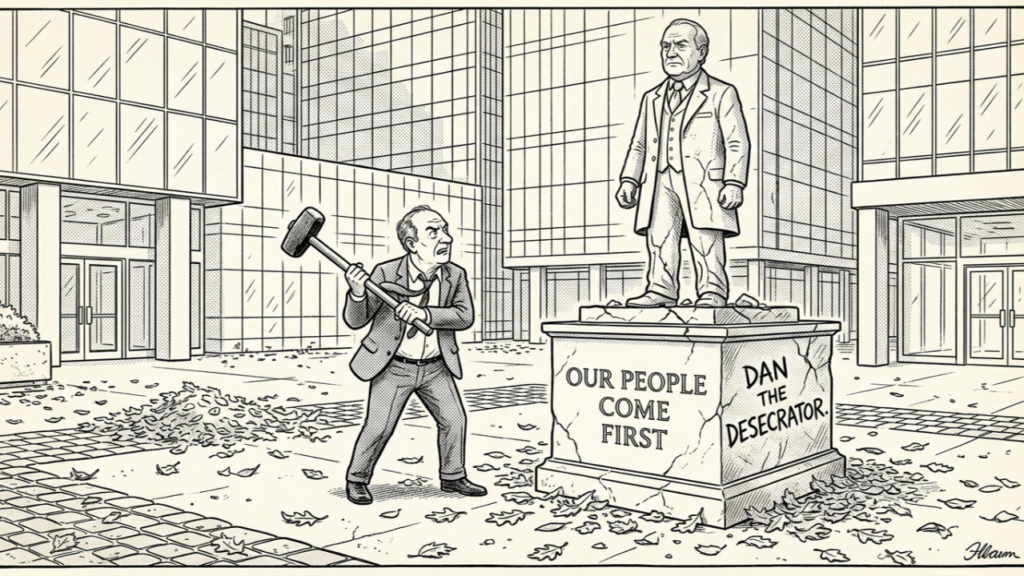
Then came that fateful day in June. The layoffs. What Jeff did or did not do in 2023 was one thing, and I’m pretty damn sure it did happen, we removed roughly two thousand people globally, in questionable circumstances at best, but what Dan did in June 2026 was historic in so many ways. Firstly, to my 230 loyal colleagues who contributed so much over so many years, I am sorry, and I am saddened that this happened to you. It is clear now that it could have happened to any of us, and maybe it still will, but it happened to you. In a company that at its core lived on the well-known, communicated, and undisputed fact that we had a no-layoff policy, you have every right to feel wronged. You were.
For the roughly twenty thousand people who remain: you and I could be next. That’s the thing now. We will never know if and when it might happen to us, just as our former 230 colleagues never knew. Tomorrow could be my last day at Expeditors. As could the next day, or the day after that, or the day after that. Our company has changed now, and it has changed forever. I’d like to think this was a very tough decision for Dan, but at the end of the day, he made it. And this is his legacy. Founded in 1979, it took us forty-seven years to get here, but only one decision to end it all. That legacy belongs to Dan, and no matter what happens from today and beyond, that is the legacy he will always be remembered for.