On Daytona Beach, Jack Nicholson’s face, and why a man who cannot read Chinese carries a tamper-proof legal numeral on one arm and two sets of street lamps on the other.
There is a tattoo shop on every block off Atlantic Avenue in Daytona Beach. Not one every few blocks. One per block, minimum, wedged between a t-shirt store selling garments that no adult should wear in public and a bar whose happy hour starts at ten in the morning and whose sad hour, by the look of the clientele, started considerably earlier. These are not artisan studios. These are not places where a man named Gabe consults with you about the symbolic interplay between Eastern calligraphy and Western iconography. These are places where a laminated sheet of flash art hangs in the window like a diner menu, offering a selection of eagles, skulls, hearts, anchors, tribal bands, and cartoon characters, all available for application to your body by a man in a tank top whose credentials consist of having once practiced on a grapefruit and who will tattoo whatever you want, wherever you want it, for forty dollars and a handshake, no appointment necessary, no “ragrets” included.
I was in my early twenties. I was in Daytona for reasons that were excellent at the time and that I cannot now reconstruct with any specificity, which is itself a testament to the quality of those reasons. I had been drinking. This is not an excuse. It is a context. A context that explains why a young man from Adams, Massachusetts, walked into a tattoo shop off the strip and announced, with the confidence of a person who had given the matter approximately forty-five seconds of thought, that he wanted Jack Nicholson’s face tattooed on his leg.
Not any Jack Nicholson. Not the charming Jack from Something’s Gotta Give. Not the sunglassed, courtside Jack, cool and inscrutable. No. I wanted the Jack from The Shining. The “Here’s Johnny” Jack. The axe-through-the-door Jack. The Jack whose face, frozen in a rictus of homicidal glee, would live permanently on my calf, visible every time I wore shorts, which, as anyone who knows me in Hong Kong can confirm, is every day of my professional life.
In retrospect, if I was going to put a Nicholson on my body, it should have been Melvin Udall from As Good As It Gets. The obsessive, abrasive, socially catastrophic novelist who insults everyone he meets, barges into lives uninvited, and somehow, despite a complete absence of charm or self-awareness, ends up being loved anyway. I did not see it at the time, because I was twenty-two and drunk and thought I was the axe-through-the-door guy. I was never the axe-through-the-door guy. I was always Melvin Udall. The Shining Jack breaks down doors with an axe. Melvin Udall breaks down doors by simply showing up and refusing to leave. One is a horror movie. The other is my life.
The needles were in the autoclave.
An autoclave is a machine that sterilizes equipment using high-pressure steam. It is the thing that separates a tattoo studio from a hepatitis distribution center. The needles were in it, which meant they were not available, which meant I would have to wait, which meant I had time to think, which is the one thing a man in my condition should not have been given. But in this particular instance, the thinking worked. I thought about the needle. I thought about the ink. I thought about Jack Nicholson’s face living on my leg for the rest of my natural life. I thought about explaining it to my mother, who would see it when I went in our pool and would tell someone at the post office, and by 7:45 the next morning all of Adams would know that her son had come home from Florida with a homicidal maniac on his calf. I got up. I walked out. The autoclave saved me. It is the only time in my life that a medical sterilization device has functioned as a guardian angel.
For the next twenty-some years, I carried the want without the ink. The desire did not leave. It sat in the back of my mind the way all unfulfilled impulses sit, quietly, persistently, with the patience of a thing that knows its time will come. I told Ruth about it. I told Ruth about it the way I tell Ruth about most things, which is repeatedly, at unpredictable intervals, with varying degrees of specificity, until the thing I am describing has been so thoroughly discussed that Ruth knows it better than I do and has already formed a plan to deal with it, because Ruth is a woman who does not tolerate unresolved narratives in her household, and an unresolved tattoo is a narrative that needs resolution or it will keep talking, and she has had enough of things that keep talking, chief among them me.
“I want something symbolic,” I told her. “Something that means something.”
“You wanted Jack Nicholson with an axe,” she said.
“I was young.”
“You wanted a horror movie on your leg.”
“I’ve grown.”
The look. The Ruth look. The look that says I am going to solve this problem for you because if I don’t you will solve it yourself and the solution will involve a laminated menu and a man in a tank top and I will have to look at it for the rest of my life.
Ruth found Gabe Shum.
The Artist
In a city where the highest aspiration of most young men is a corner office in a tower on the harbor, where success is measured in basis points and square footage and the watch on your wrist, Gabe Shum chose needles and ink.
Gabe is the owner of Freedom Tattoo, a studio in To Kwa Wan that is, by reputation, one of the most respected tattoo operations in Hong Kong and in Asia. He has tattooed David Beckham. He has tattooed LeBron James. He is the founder of the Hong Kong China International Tattoo Convention. He has been at this for over thirty years. He is not a man in a tank top in Daytona Beach.
What I admire most about Gabe is the path. His father drew. His father ran a textile factory in Ghana called Freedom Textiles, which is where the name came from, because when you are young and your father names something Freedom, the word sticks to you like a philosophy. Gabe got his first tattoo at sixteen and knew immediately that this was the thing. Not finance. Not property. Not the path that Hong Kong lays out for its children with the efficiency of a conveyor belt and the subtlety of a train schedule. He wanted to make art on skin.
When he came back to Hong Kong in 1998 to open his first shop, the tattoo scene was still very much associated with triad culture. Getting a tattoo in Hong Kong in 1998 did not signal that you were a person of artistic sensibility. It signaled that you were a person whose associates might have opinions about your continued respiration. Gabe changed that. Not by arguing about it. By doing the work. By inking at a level that made the art undeniable, by opening the door so wide that the old associations couldn’t hold.
He named his shop Freedom Tattoo. In a city of finance, in a culture of conformity, Gabe built a temple to self-expression and named it the only thing it could be named. Freedom. Because that is what his father called the factory in Ghana, and that is what ink on skin has always been, and that is what Gabe sells, one appointment at a time, to anyone brave enough to sit in the chair and say: put something permanent on me that tells the truth.
Ruth told me to consult with him. I did. And what came out was not Jack Nicholson with an axe.
The Right Arm
The tattoo on my right arm is a number. Just a number. Twelve.
Not the word. Not the English. Not “Adam 12.” Just twelve. One character. And unless you read traditional Chinese, you would never know what it means, which is part of the point, and also part of the joke, and also part of the reason Ruth rolls her eyes every time someone asks about it, because the explanation is longer than any reasonable person would expect for a single number, and I am not a reasonable person, and neither is the explanation.
The nickname came first. Adam 12. People started calling me that in Adams because of the television show, Adam-12, the Jack Webb police drama that ran on NBC from 1968 to 1975, in which two LAPD officers patrolled Los Angeles in their black-and-white unit, call sign One-Adam-Twelve. If your name was Adam, and you existed in a small town where nicknames were assigned with the permanence of baptismal names and the precision of a government filing system, you were going to be called Adam 12. This was not optional. This was civic infrastructure.
There was also, for a period during adolescence, a secondary interpretation of the number twelve that I will address with the discretion of a man who has been a licensed attorney for longer than he has been funny. The number twelve was, at one point, associated by certain adolescent comedians with a claim about my anatomy. This claim was false. It was extravagantly, heroically, anatomically false, in the way that all such claims made by or about fifteen-year-old boys are false, because fifteen-year-old boys do not traffic in truth, they traffic in aspiration, and twelve inches is not a measurement, it is a manifesto. I will say no more about it. Ruth has opinions. Ruth’s opinions are not printable. We are moving on.
The nickname was Adam 12. But I didn’t need “Adam” on my arm. I am Adam. The arm is attached to me. Tattooing my own name on my own body would be like labeling a drawer that’s already open. The number was the thing. The twelve. The twelve carried the nickname, the childhood, the town, the anatomy joke, the whole ridiculous mythology of a boy in Adams who got a call sign from a cop show and wore it for the rest of his life. The name was already there. It was born into me. The number was the thing that was given.
What Gabe did with that number was the thing that made the twenty-year wait worth it. He did not tattoo “12” in English. He did not tattoo it in simple modern Chinese, the two clean strokes of 十二 that any schoolchild could write on a napkin. He tattooed it in the traditional formal Chinese numeral, the ancient, ornate, complex-character form, the kind of script you find on Hong Kong legal documents and banking instruments, on checks and contracts and deeds, anywhere the number matters too much to be simple and the stakes are too high for alteration. These are the characters that exist because someone, centuries ago, decided that the simple version of a number could be changed by any forger with a brush and a motive, and that certain numbers needed to be written in a form so complex, so deliberate, so layered with strokes that no one could add to them or subtract from them without detection. They are, in other words, the tamper-proof version. The legal version. The version that holds up in court.
I am a lawyer. I practice law in Hong Kong. I cannot read Chinese. This is the kind of detail that would seem disqualifying if you did not understand how Hong Kong works, which most people do not, including, on certain days, me. Hong Kong’s legal system operates in English. Its courtrooms argue in English. Its precedents are written in English. A man can practice law in this city for decades without reading a single Chinese character, and I am that man, and I carry on my arm a character I cannot read, in a script I do not know, from a legal tradition that runs parallel to the one I practice in but in a language I never learned. I walk into courtrooms every day with a number on my arm that belongs to the very legal culture of the city I serve, written in a form designed to be unalterable, and I cannot tell you what it says without asking someone. The symbolism is either perfect or absurd. It is probably both. A boy from Adams got a nickname from a cop show, and forty years later a tattoo artist in To Kwa Wan wrote that nickname in the formal legal script of a city whose law the boy grew up to practice in a language the character was never written in. If that is not a metaphor for my entire life in Hong Kong, I don’t know what is.
One character. One flowing piece of calligraphy. Dense and intricate and unmistakably Chinese. Not the version you scribble on a receipt. The version you carve into stone. The version you put on a contract when the number cannot be wrong, when the amount cannot be disputed, when the figure must survive scrutiny and time and anyone who might try to change it. The version that says this number has weight, this number has history, this number has been written this way for centuries by people who understood that some things are too important to abbreviate.
A childhood nickname from a town of eight thousand, encoded in the ancient calligraphic tradition of a city of seven million. The boy and the man. The mother and the father.
Adams was the mother. Protective, present, suffocating in the way that all good mothers are suffocating. The hand on your collar. The voice at the post office. The cop who drove you home instead of arresting you because he knew your father. Adams held you. Adams watched you. Adams made sure you were known and accounted for, and if you did something stupid, Adams would find out by morning.
Hong Kong was the father. The absentee father. The father who wasn’t there for the first act but showed up later, after you were already formed, and said: do whatever you want. Hong Kong did not hold me. Hong Kong did not watch me. Hong Kong handed me seven million strangers and a legal system with horsehair wigs and said figure it out. And the indifference, magnificent and terrifying, was its own kind of freedom.
One character. Two cities. One nickname that carried both.
The Left Arm
The second tattoo is bigger. It lives on my left arm.
I told Gabe what I wanted. I told him about Mt. Greylock, the highest point in Massachusetts, 3,491 feet, a mountain that presides over Adams with the quiet authority of a thing that was there before any of us and will be there after all of us. I told him about the War Memorial Tower on top, the 93-foot granite tower built in 1932, the tower whose beacon sits enclosed in a glass sphere, visible for seventy miles, a light that shines over the Berkshires every night. I grew up under that light. Every kid in Adams grew up under that light. You could see it from the backyard, from the school parking lot, from anywhere in town that had a clear line to the mountain. It was the North Star of a place that didn’t need a compass because the mountain was always there and the light was always on.
I told him about Notre Dame. Not the one in Paris. The one on Park Street. Notre Dame du Sacré Coeur, the church where I was baptized. The church where my father was baptized. The church where his father was baptized. Three generations standing at the same font, in the same nave, under the same ceiling. In a mill town where everything closed, the church stayed open. The mills shut down. The stores moved out. The population shrank. But Notre Dame kept its doors unlocked and its lights on, and if you grew up Catholic in Adams, which was not optional in the way that being Catholic in a French-Canadian mill town was never optional, Notre Dame was the fixed point. Not the mountain. The mountain was geography. Notre Dame was identity. The mountain told you where you were. The church told you who you were.
I told him about the Hong Kong skyline. The impossible, magnificent wall of glass and steel and ambition that rises from Victoria Harbour, the skyline that Ruth grew up under the way I grew up under the beacon.
And I told him about the lamps.
There are old-fashioned street lamps on Park Street in Adams. The kind with the cast-iron posts and the yellow light that makes everything look like a memory even while it is still happening. I walked under those lamps my entire childhood. Every Friday night, every Saturday morning, every time I moved through that town on my way to wherever the night was taking me. I walked under them without looking up. Without thinking about them. Without any awareness that the light falling on me was the light of a particular place at a particular time and that someday I would be eight thousand miles away missing a light I never knew I was memorizing.
I never imagined they would end up on my body. You do not think about these things at fifteen. At fifteen the lamps are just lamps and the light is just light and the town is just a town and you have no idea that you are inside something you will spend the rest of your life trying to get back to.
Ruth told me about the gas lamps on Duddell Street.
Four lamps. The last gas-powered street lamps in Hong Kong, installed on a flight of granite steps built in 1883, declared a monument in 1979. Ruth walked past them as a child, in Central, on the steps between Queen’s Road and Ice House Street, the same way I walked under the lamps on Park Street. Without looking up. Without knowing she was memorizing them. Without knowing that decades later she would describe them to a man from Adams and he would recognize them immediately. Not because they looked the same, though they did. The old iron. The warm light. The persistence of a thing that refuses to go dark. But because they meant the same thing. Home. The light you grew up under. The version of the place that was already disappearing while you were still inside it.
The lamps represent the two of us. Duddell Street and Park Street. The girl who walked past gas lamps on granite steps and the boy who walked under cast-iron posts on a mill town main street, both looking straight ahead, neither looking up, neither knowing that the light was the thing that would connect them.
I told Gabe all of this. The mountain, the church, the skyline, the lamps. I told him what the pieces were. He was the artist who put them together. Gabe designed the tattoo the way a composer writes a score, taking the notes I gave him and arranging them into something I could not have arranged myself, because I tell stories in paragraphs and Gabe tells them in ink, and ink requires a discipline that paragraphs do not, because a paragraph can be edited and a tattoo cannot.
The mountain anchors the piece, rising up my arm the way Greylock rises over Adams. The church sits within it, because that is where churches sit in mill towns, in the valley, in the shadow of the thing that was there before God, with its steeple reaching upward as if to remind the mountain that height is not the only measure of permanence. The skyline of Hong Kong faces it from across the arm, glass and steel answering granite and stained glass, Ruth’s city and my city regarding each other the way they always have, with mutual incomprehension and absolute respect. The lamps line the base, Park Street and Duddell Street side by side, the way they exist side by side in our marriage, two sets of lights from two childhoods that never overlapped until they did.
Above the beacon on Mt. Greylock, at the highest point of the tattoo, at the top of the mountain and the top of the tower and the top of everything, Gabe placed three letters.
R.H.C.
Ruth Hon Clermont.
I did not ask for those letters to be there. I told Gabe about Ruth. I told him what she meant. He put her where she belonged. Above the beacon. Above the light. Because Ruth was the beacon. Ruth was the thing I could see from eight thousand miles away. Ruth was the light that told me where I was.
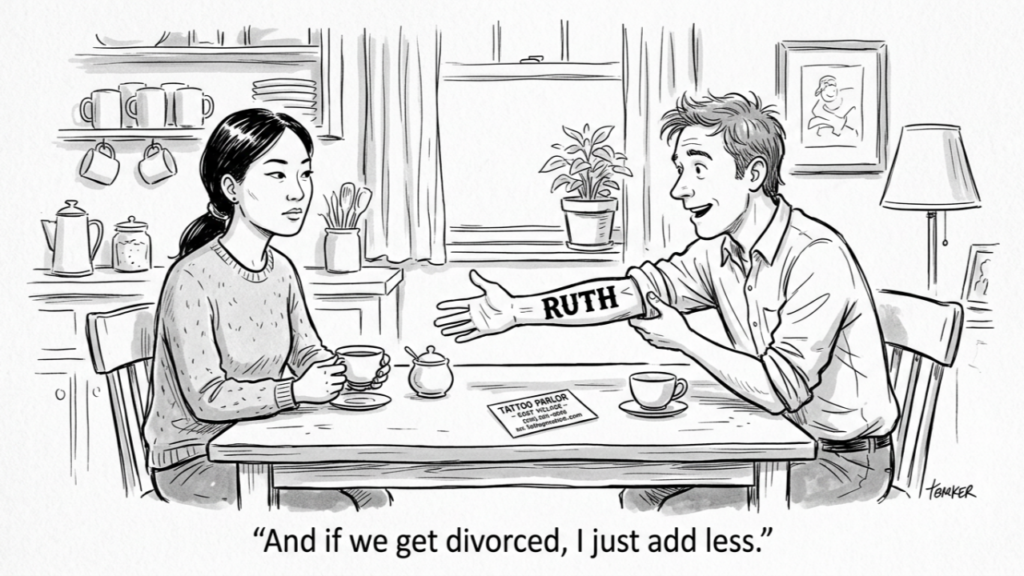
I had told her, before the tattoo, that I wanted to get her name inked on my body. Her name. Ruth. Somewhere visible. Somewhere permanent.
The look. The chopstick look. The look that precedes a verdict.
“What if we get divorced?” she said.
“Then I’ll add less.”
She did not laugh. She picked up her tea. She put it down. She picked it up again.
“Ruthless,” she said, finally. “You would walk around with Ruthless on your body.”
“Only if things went badly.”
“Things are always going badly. You are wearing shorts to a law firm.”
What Gabe put was not Ruth. What Gabe put was R.H.C. Three letters. Above the beacon. Above the mountain. Above the church. Above everything. You cannot add “less” to initials. This was, depending on your perspective, either a design flaw or an improvement in the contingency plan. But you can reframe initials. You can tell people they stand for something else. And in Hong Kong, in the law, R.H.C. already stands for something. The Rules of the High Court. Cap. 4A. The procedural bible of civil litigation in this city, the three letters on the spine of the book that every litigator in Hong Kong reaches for more often than any other, the rules that govern how disputes are filed and heard and resolved in the Court of First Instance. If things go badly, I do not need a cover-up. I do not need a laser. I simply tell people I am so devoted to civil procedure that I had it permanently inscribed above a granite mountain on my forearm, which, given that I already wear shorts to hearings and carry an unreadable legal numeral on the other arm, would surprise exactly no one. I would be the only solicitor in Hong Kong with the Rules of the High Court tattooed on his body, and honestly, given the state of some of the applications I’ve seen filed, more people should consider it.
Ruth does not find this funny. Ruth finds very little about contingency planning for divorce funny, which is reasonable, but Ruth is also the woman who asked the question in the first place, and a man is entitled to have an answer ready. My answer is: the Rules of the High Court, Your Honor. Cap. 4A. I rest my case.
The Moral
People ask me what the tattoos mean. Strangers, sometimes, on the MTR, when a sleeve rides up and the ink is visible.
I tell them the right arm is a number. Just a number. Twelve. Written in the formal script of Hong Kong legal documents, the tamper-proof characters, the ones that cannot be altered, because a boy’s nickname from a mill town in Massachusetts deserved to be written in a form that would hold up in court, and because the man that boy became spends his life in courtrooms in the city whose calligraphic tradition made the character possible, in a language he cannot read, which is either the best metaphor for expatriate life ever committed to skin or the worst planning in the history of tattoos.
I tell them the left arm is home. Both homes. The mountain and the skyline. The church in the valley and the lamps on the street. Notre Dame, where three generations of my family were baptized in the same nave, sitting in the shadow of Greylock the way it always sat, permanent and stubborn and still there after everything else closed. The lamps on Park Street and the lamps on Duddell Street, two sets of lights from two childhoods eight thousand miles apart, drawn together on one arm because that is what marriage does, it takes two geographies and makes them a single country, and the country is called Ruth, and the beacon at the top of the mountain is her initials, because she is the light I navigate by, and she has been since the day I met her, and she will be until the ink fades, which is never, because Gabe does not do work that fades.
Everyone carries their homes on their body. Not everyone puts them in ink. But everyone carries them. The way you walk is Adams or Hong Kong or wherever the lamps were. The way you talk is the town that taught you. The way you bow your head without thinking is the church that taught you to bow it. Somewhere on your body, visible or not, is the place you came from and the place you ended up and the light that guided you between them.
Mine is just easier to see. Because Gabe put it there. Because Ruth found him. Because an autoclave in Daytona Beach saved me from Jack Nicholson, and twenty years of wanting saved me from myself, and a master in To Kwa Wan turned the story of my life into something that fits on two arms and will last as long as the skin lasts, which is longer than the mills and shorter than the mountains but long enough.