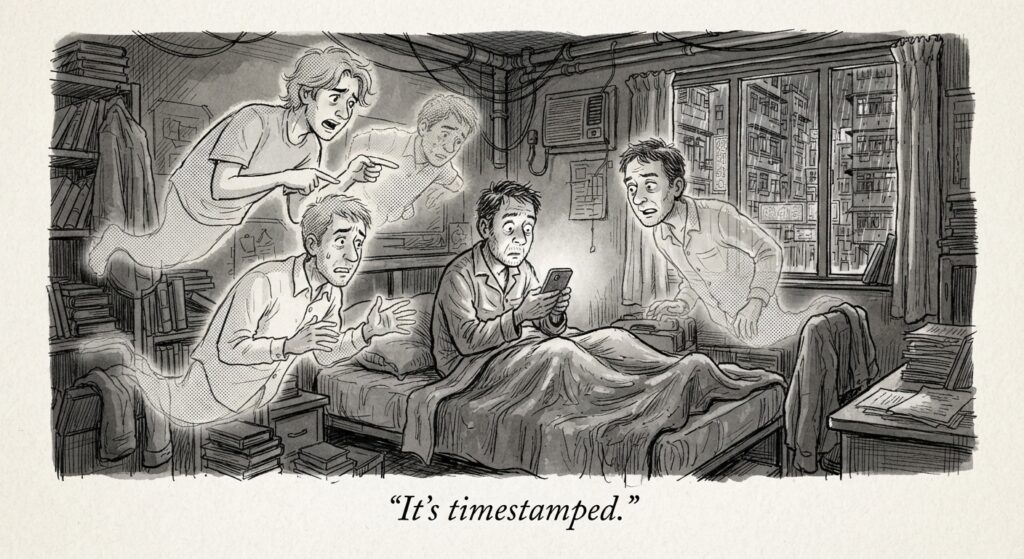
There is a WhatsApp group from 2015 that a friend of mine will not let die. Forty-one members. Nine of them have left Hong Kong. Two of them are dead to each other over a rent dispute nobody can now fully reconstruct. Every so often, usually around Chinese New Year, somebody scrolls up.
“What did you find?” I asked her once, after she sent me one at midnight with no context.
“You, in 2015. Talking about your associate.”
“I don’t even remember saying that.”
“Doesn’t matter,” she said. “It’s timestamped.”
That’s the whole argument, really. It’s timestamped. The thing you said before some of the people currently reading it could legally drink gets forwarded back into the room, and for the rest of the night you are the person you were at twenty-six, permanently, whether or not you have spent the eleven years since becoming somebody else entirely.
This is not only a Hong Kong problem. It is everywhere. But Hong Kong runs it with unusual efficiency, because Hong Kong keeps everything: the group chat, the forum post, the old caption, the photo from the wedding you’d rather forget attending. All of it filed, searchable, and ready to be produced at the exact moment it will do the most damage.
I have watched this end careers. I have watched it end friendships over sentences written before the people reading them owned a credit card. I have watched a fifty-year-old man handed, without warning, in front of his own staff, a version of himself he had not been in twenty years.
The screenshot does not care how long ago you took it.
The screenshot has no statute of limitations.
It is not interested in who you have become. It is only interested in who you were at the exact moment the shutter closed, and it intends to hold you there for the rest of your life.
Muhammad Ali said something once that gets quoted constantly and understood almost never. “The man who views the world at 50 the same as he did at 20 has wasted 30 years of his life.”
Read that again. It is not a comfort. It is an accusation. It assumes a person is supposed to change. Not be forgiven. Not be rebranded. Actually, fundamentally, unrecognizably become someone else over the course of three decades. That premise has almost no home in public life anymore. Not because people stop changing. They don’t. They change constantly, quietly, invisibly. It’s that we built a machine, the tweet, the clip, the screenshot, whose entire function is to prevent anyone from getting credit for it. Say the wrong thing once and the file never closes. It just gets forwarded, again, on a schedule nobody controls but everybody understands.
Ali offers a different template. His greatness was never that he avoided being wrong. It was that he was wrong, loudly, on the record, in front of the whole world, and then, in full view of that same world, took himself apart and built somebody new.
The early Ali was a racial separatist. Say that plainly. It is not a footnote to slide past on the way to the good part. It is the starting point that makes everything after it mean something.
1964. Fresh off beating Sonny Liston for the heavyweight title. Cassius Clay stands at a press conference in Ghana and says the only way Black Americans will ever get respect is to build a separate nation. He mocks the NAACP. He calls the Civil Rights Act “counterfeit,” his word, and says it “won’t change the heart of the slave owner.” This is not a slip. As a devoted member of the Nation of Islam, he argues for racial separation in public, repeatedly, on the record.
His 1968 speech at the University of Wisconsin is titled, with no irony at all, “The Black Muslim’s Solution to Racism.” He condemns interracial marriage in that speech. People boo him. In 1966 he tells an interviewer, flatly, “I don’t think full integration can work.” He tells Sports Illustrated that white America wants to see him hug a white woman, or endorse whiskey, or bleach his skin, while he is out there “promoting Black supremacy.”
From forty plus years out, it is very easy to crop that into a screenshot and call the case closed.
But context is not an excuse, and understanding is not absolution. Those are two different things, and the screenshot only knows how to hold one of them.
Ali was born in Louisville, Kentucky, in 1942. Segregated schools. A father denied the vote. A fourteen year old named Emmett Till, murdered in Mississippi for allegedly whistling at a white woman, two years before Ali turned professional. The Nation of Islam’s separatism did not arrive from nowhere. It was a defensive ideology, forged in the specific furnace of American racial terror, an extreme answer to a country that had spent centuries insisting the answer to “are you fully human” was no.
That does not make the rhetoric acceptable. It makes it comprehensible. And comprehension is the first move the screenshot refuses to make.
April 28, 1967. Ali refuses induction into the United States Army at the Houston Military Recruiting Office. Called forward four times. Refuses each time. Same day, the New York State Athletic Commission strips his boxing license. The World Boxing Association follows. Then almost every state commission in the country. He is twenty-five years old. He is undefeated. He is the heavyweight champion of the world. He is banned from his own profession by dinner.
June 20, 1967. An all-white Houston jury convicts him of draft evasion after twenty-one minutes of deliberation. Twenty-one minutes to decide the rest of a man’s twenties. Five years in prison. A $10,000 fine.
The line that defines the era, “I ain’t got no quarrel with them Viet Cong,” was actually spoken in Miami in February 1966, months before the induction refusal, after hours of press questions, delivered wearily, almost as an aside, according to Robert Lipsyte, who was in the room reporting for the New York Times. Ali may not have even coined the sharper version that followed him for the rest of his life, “no Viet Cong ever called me nigger.” It was already moving through the counterculture. But he made it his. The logic inside it was surgical. The people I am being asked to kill have never done anything to me. The people who have done something to me, who segregated my schools, denied my father his vote, called me boy, are the ones asking me to go fight. The war is on the other side of the world. The war is also at home.
Martin Luther King Jr. made the same argument, later. Ali made it first, from a position of maximum exposure, with everything he owned riding on it. He had everything to lose. He lost it. He did not take it back.
Here is the part that matters for the argument about growth. Ali did not retreat into an echo chamber. He couldn’t. There was no algorithm built to shelter him with agreement. During his exile from boxing, April 1967 to October 1970, nearly four years, he went to college campuses. Dozens of them. He stood in hostile auditoriums and debated students who thought he was a traitor, journalists who doubted his sincerity, ordinary Americans who disagreed with every word out of his mouth. A diary page from April 1969 shows him booked at Randolph-Macon College in Ashland, Virginia, for a $1,000 fee. That was the economy of his exile. City to city, campus to campus, paying his legal bills one hostile Q and A at a time, in rooms full of people who had not been pre-screened for agreement.
No mute button. No block feature. Just a man in a room with people who thought he was wrong, making his case to their faces.
That friction did two things at once. It forced an entire country to confront its own hypocrisy, a nation fighting for freedom abroad while denying it at home. And it forced Ali to sharpen his own thinking, because you cannot recite Nation of Islam doctrine to a room of skeptical twenty year olds and expect to walk out unchallenged. He had to listen. Actually listen. Listening, over four years, changes people.
In 1975, Elijah Muhammad died. His son, Warith Deen Mohammed, took over most of the Nation of Islam and publicly renounced his father’s separatism, steering the movement toward Sunni orthodoxy. Ali followed him there. He converted to Sunni Islam and turned, in the words of the people watching it happen, into something closer to a universal ambassador of hope and dignity than a spokesman for any one race.
The point is not which sect he joined. The point is that he stood up and said, on the record, in public: I was wrong. Not “I apologize for the remarks I made.” Wrong. He had once called white people devils. Later, after the Hajj in Mecca, he said he had seen “people of all colors and races, from blue-eyed blondes to black-skinned people, treating each other like brothers.”
Try to picture that happening now. A public figure admitting, genuinely, structurally, not through a statement drafted by three people and tested on a fourth, that the entire architecture of his own worldview had been wrong. Not the tone. Not the delivery. The architecture. He was echoing something Malcolm X had arrived at just before his assassination, that color does not make a man a devil. And admitting that meant admitting that Muhammad Ali, the most famous Black man alive, had been wrong about something that mattered.
That’s the piece missing from how we talk about people now. Real growth is not a video statement built to survive a news cycle. It is the slow, private, unglamorous work of realizing you were wrong and outgrowing the person who wasn’t. It takes a kind of nerve that has almost no home in public life anymore, because public life punishes exactly that admission. Say you were wrong, and the record of your saying it becomes the newest exhibit against you. Say you changed, and somebody will find the old version of you and demand to know why you were ever allowed to exist.
Ali did not care. By then there was nothing left to threaten him with. His title, gone. His license, gone. Most of his money, gone. All that was left was his own conscience, and he had decided he was done lying about it.
The legal ending gets flattened into one sentence: the Supreme Court overturned his conviction. The actual mechanics are more interesting, and more useful, for anyone trying to understand how institutions actually handle dissent.
Clay v. United States reached the Supreme Court in 1971. The question was narrow. The Justice Department had recommended denying Ali’s conscientious objector claim on three separate grounds. That he wasn’t opposed to war in general. That his objection was political rather than religious. That he wasn’t sincere. The Appeal Board denied the claim without saying which of the three it relied on. The Court held that because it was impossible to know which ground the Board had used, and because the government itself had already conceded two of the three grounds were invalid, the conviction could not stand. Eight to zero. Justice Marshall recused himself.
The Court never said Ali was right about the war. It said the government hadn’t followed its own rules. That distinction is the whole essay, compressed into one paragraph. The ruling vindicated his process. It never touched his politics. It never answered his actual claim, that he should not be asked to die for a country still treating him as less than a citizen. The moral question stayed open on the page. Ali spent the rest of his life answering it anyway, not in legal briefs, but in the shape of the man he chose to become.
Here is what a well-timed screenshot actually costs a person. Not a reputation, in the abstract. A job offer, rescinded by email, three sentences long, no explanation required by law. A wedding invitation, quietly withdrawn, the RSVP card that never gets mailed back. A father who stops calling on Sundays because somebody forwarded him a post from nine years ago and he has decided he no longer knows you. A twenty year friendship, ended in a group chat, in about the time it takes to type one word.
None of it comes with an appeal. None of it asks what you meant, or what you have done since, or whether you would say it again today, knowing what you know now. It asks one question only. Did you say it. Yes. Case closed.
Ali’s version of that question was asked by an all-white jury in Houston in twenty-one minutes. And the honest answer is that his growth never got him acquitted of anything in the court of public opinion at the time. It got him hated for years before it got him loved. That’s the part people skip. The forgiveness did not arrive on a schedule. It arrived after two decades of a man standing in rooms full of people who wanted nothing to do with him and staying anyway.
Atlanta, 1996. A trembling hand raises a torch and lights the Olympic cauldron. Parkinson’s has taken most of the steadiness out of him. Billions are watching. This is the same country that once stripped him of his title, his license, and his freedom of movement, and here he is, on its biggest stage, being loved by it in front of the entire planet.
Not despite what he had been. Because of what the world had watched him become. A racial separatist turned into a symbol of universalism. A man stripped of his title turned into the man lighting the flame. A man once called unpatriotic turned into a national fixture that a stadium full of strangers stood and cheered for.
That transformation needed two things, and neither one works without the other. First, Ali had to be willing to grow somewhere people could actually watch him do it. Not disappear until the anger cooled. Stand in the light and let strangers watch him change his mind in real time, in public, over years. Second, the world had to leave him room to do it. Not unconditional forgiveness. Just space. Messy, high-stakes, face-to-face space, for the argument to actually happen.
The screenshot offers neither of those things. It offers a verdict and calls it a conversation.
That’s the real failure of the screenshot economy. It isn’t that it demands accountability. Accountability is fine. Plenty of rooms are overdue for it. The failure is that it offers no exit. It takes “you were wrong” and quietly files it as “you are wrong,” present tense, permanent, no update pending, ever. Once the file exists, you get two choices. Go silent, or spend the rest of your life playing the part you got caught in, because everyone around you has already decided that’s the whole movie.
Ali found a third door. Take yourself apart in public and put yourself back together, not to satisfy an audience, but because he had actually, structurally changed. At fifty he saw the world differently than he had at twenty. He had not wasted those thirty years.
What breaks the cycle isn’t a smarter apology format. It’s the return of the thing the screenshot was built to avoid: messy, high-stakes, face-to-face friction. Not the group chat digging up your 2015 self for sport, but an actual room, an actual argument. You were wrong. Tell me why. I will watch you change, over time, and I will hold you to it. That takes something from everyone in the room, not just the person who got caught. It takes the willingness to say, out loud, in front of people who can see your face while you say it: I used to believe something false, and I don’t anymore, and I will stand here while you decide whether you believe me.
Ali was not a saint. He was something rarer, and more useful than a saint. A man willing to be, in public, in front of everyone with a phone and a long memory, a person still becoming somebody better.
And somewhere tonight, in a WhatsApp group with forty-one members, somebody is scrolling up, eleven years into a friendship, about to decide that the version of you from 2015 is the only one that counts.