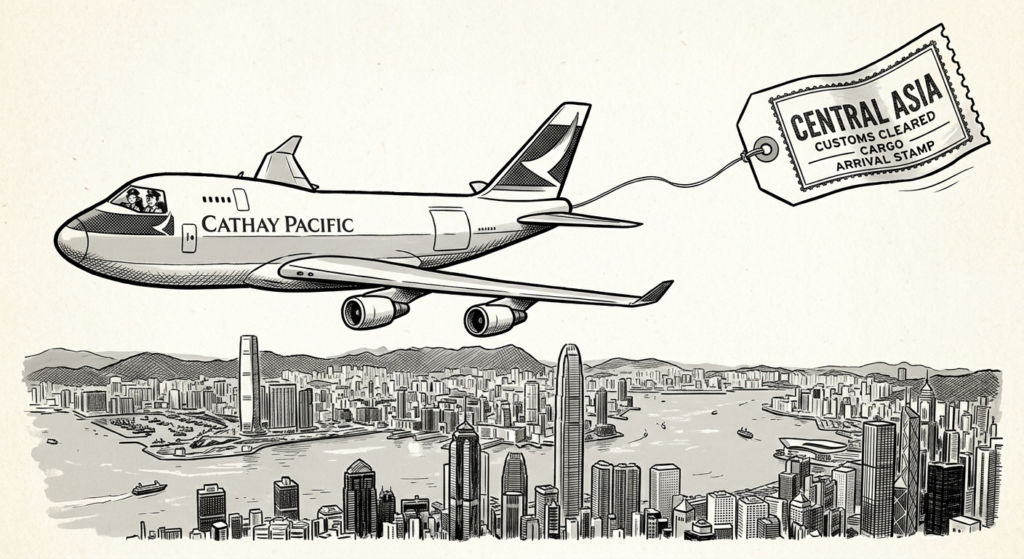
Airport Authority Hong Kong chairman Fred Lam said this year that Central Asia could become the “next Middle East” for Hong Kong air cargo, a new corridor to Europe as conflict and tariffs disrupt the roughly 13 percent of the city’s European cargo that has historically transited the Middle East. The numbers behind the pitch are still small. Cargo arriving from Kazakhstan and Uzbekistan totaled just over 3,300 tonnes in the first five months of 2026, up nearly fivefold from about 700 tonnes a year earlier. Cathay Pacific will launch direct Hong Kong-Almaty flights on January 9, 2027, three times a week on an Airbus A330-300, its first destination in Central Asia.
What Hong Kong Signed
During Chief Executive John Lee’s trip to Kazakhstan and Uzbekistan in late May and early June, Hong Kong signed a civil air services agreement with Uzbekistan permitting airlines from both sides to operate new routes. The visit also produced a cluster of memoranda of understanding, including the Belt and Road Office with Kazakhstan’s Ministry of Artificial Intelligence and Digital Development, InvestHK with the Astana International Financial Centre, and the Hong Kong Stock Exchange with the Astana International Exchange and AIFC Authority. In total, the government counted 96 cooperation agreements and MoUs signed during the trip, worth more than $1.65 billion.
That figure dwarfs the actual trade it is meant to build on. Hong Kong’s total merchandise trade with Kazakhstan in 2023 came to roughly $250 million, a small fraction of the headline figure from a single five-day visit. Whether these agreements convert into shipped cargo and booked freight, rather than remaining memoranda, is the open question underneath the whole pivot.
Hong Kong and Uzbekistan confirmed a mutual 30-day visa-free arrangement during the visit, extending what had been a 10-day allowance. Arrangements with Kazakhstan and Kyrgyzstan remain on a shorter basis for now. Uzbekistan-based Fly Khiva Group has operated cargo flights to Hong Kong since August 2024, and the number of European and Central Asian carriers serving Hong Kong has grown from 17 to 29.
Airport Authority officials project cargo volume from Kazakhstan and Uzbekistan could exceed 10,000 tonnes annually once the Almaty route and further expansion take effect. That would still be a fraction of Hong Kong International Airport’s 5.07 million tonnes of total 2025 cargo throughput, but a meaningful new lane for an airport pushing to fill capacity on its recently completed three-runway system.
The Compliance Blind Spot
Hong Kong is not building this corridor in a regulatory vacuum. The US Bureau of Industry and Security has repeatedly named Kazakhstan, Kyrgyzstan, and Uzbekistan among the jurisdictions most commonly used to transship restricted goods toward Russia, alongside Hong Kong itself.
The Center for Global Civic and Political Strategies, a Washington, DC research group, found in a May 2026 report, Russia’s Sanction Evasion Research 2025-2026, that flows of high-priority dual-use goods, including capacitors, transceivers, ball bearings, and automated machine tools, from Kazakhstan, Kyrgyzstan, and Uzbekistan to Russia grew further in 2025. The report attributes much of this to the fact that Kazakhstan and Kyrgyzstan share open, largely uninspected borders with Russia through the Eurasian Economic Union. Western electronics can enter Kazakhstan as declared civilian goods and then legally re-export to Russia without triggering additional customs scrutiny at the border. OFAC and the State Department have separately designated individuals and entities in Kazakhstan and Kyrgyzstan, as well as in Hong Kong, in sanctions actions tied to Russia’s military-industrial supply chains.
None of this means the new Hong Kong-Kazakhstan or Hong Kong-Uzbekistan cargo lanes are being used for sanctions evasion. It means Hong Kong is deliberately expanding direct, high-volume freight connectivity into precisely the jurisdictions that US and European enforcement agencies have flagged as the weakest links in the Russia sanctions regime, at the same time Hong Kong-based entities already appear in those same enforcement actions. For an air cargo hub whose government has spent the past year building out a Global Shipping Business Network and Port Community System explicitly to demonstrate data transparency, a new cargo corridor into two of the most frequently cited transshipment jurisdictions in Western sanctions enforcement deserves scrutiny before the volume grows, not after an enforcement action forces the question.
What This Means for Shippers and Compliance Teams
Freight forwarders and logistics providers weighing new Almaty or Tashkent lanes should treat this route the way compliance teams treat any new high-growth, low-transparency corridor, with enhanced end-user and end-use screening on dual-use and electronics shipments rather than default reliance on a carrier’s own documentation.
Exporters of medical equipment and other categories Hong Kong trade officials have flagged as opportunities in the region should confirm their own export classifications hold up under both the US Export Administration Regulations and Hong Kong’s strategic commodities export control regime, given how easily “civilian use” declarations have masked diversions elsewhere in the same corridor.
Insurers underwriting cargo on these new routes should factor the region’s documented sanctions-evasion exposure into pricing, since a shipment later tied to a designated end user could complicate claims regardless of the shipper’s original intent.
What to Watch
Watch whether Hong Kong or Central Asian authorities announce any enhanced export screening measures alongside the new routes, since none have been publicly detailed so far. Watch whether the Almaty route actually launches on schedule in the first quarter of 2027 and whether Airport Authority Hong Kong’s 10,000-tonne projection holds. And watch whether US enforcement agencies, which have already named Hong Kong alongside Kazakhstan and Kyrgyzstan in Russia-related designations, begin treating a growing direct Hong Kong-Central Asia air cargo lane as a new area of interest. If a designated entity or a diverted dual-use shipment surfaces on this corridor before Hong Kong publishes any enhanced compliance framework, expect the story to shift quickly from opportunity to liability.