LinkedIn added an “AI slop” button a month or so ago.
If you click the three dots on any post, there is now an option that says, verbatim, “Seems like AI slop.” You press it, the post vanishes from your feed, and your flag trains LinkedIn’s algorithm to suppress similar content. Forty-one percent of long-form LinkedIn posts are now flagged as fully AI-generated by detection services. LinkedIn’s chief product officer called it a top priority. They are ramping up classifiers. They are blocking hundreds of thousands of automated comments daily. They are very serious about this.
They also, until recently, had a button called “Enhance Post” that would rewrite your words with AI for you.
They removed it.
I want to make sure you followed that. LinkedIn spent years marketing a tool that rewrote your posts with artificial intelligence, which contributed to forty-one percent of their platform becoming artificial intelligence, and then added a button so users could report each other for using artificial intelligence, and then quietly retired the tool that started the problem, and replaced it with a proofreading feature that, in their words, “corrects grammar without changing your voice.”
That is the funniest thing I have read in months. That is a city selling matches and then forming a volunteer fire brigade.
Meanwhile, Anthropic, the company that makes Claude, announced on August 11 that all Claude-generated text will now carry an invisible watermark. Imperceptible to the human eye. Embedded at the model level. Travels with the text when you copy and paste it. Cannot be opted out of. May survive editing. The stated reason is the EU AI Act, which requires AI companies to mark synthetic content so machines can identify it.
The internet lost its mind. Writers who use Claude as a proofreader said this was an outrage. A radio host posted that he’d switched from Grammarly to Claude for copyediting and now his own words would carry a machine’s fingerprint. Reddit called it “hugely problematic.” People declared the end of “the era of unprovable AI writing,” which is a phrase that tells you everything you need to know about why they were upset.
Here is what I keep thinking about: the watermark means that intelligence agencies, platforms, employers, and anyone with the right detection tool can now identify whether Claude touched your text. This is presented as novel. But anything you post on the internet is already attributed to you. Your metadata, your IP address, your writing patterns, your device fingerprint, these have been readable for years. The watermark does not create surveillance. It just makes one particular tool’s involvement legible to machines. If you were already posting under your own name, nothing meaningful changed. If you were using AI to pretend to be something you are not, something changed. Whether that bothers you probably says more about what you were doing than what Anthropic did.
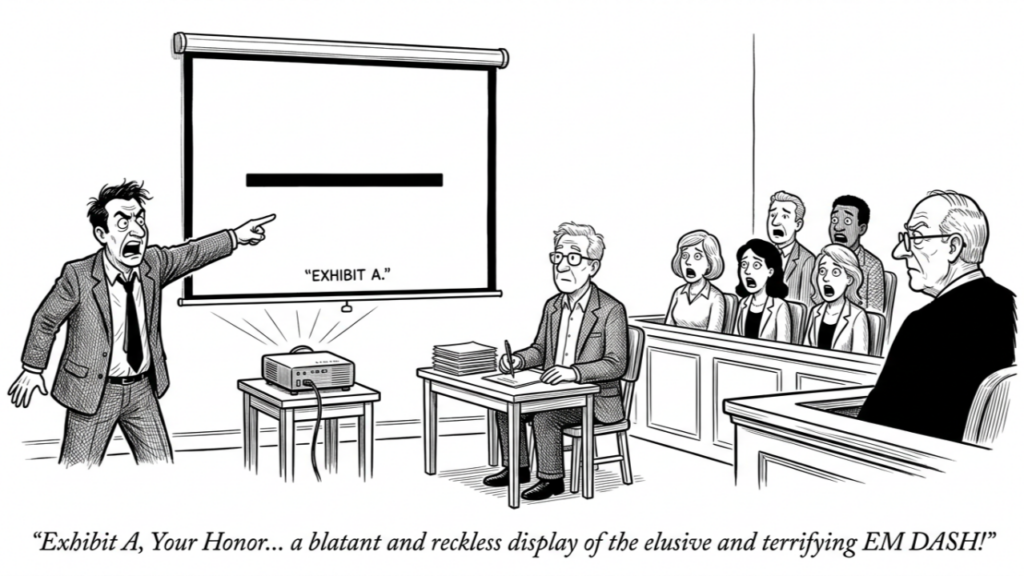
Then there is the em dash.
Professional writers are now avoiding the em dash — this thing, right here, the long dash — because AI uses it too often and readers have started treating it as a tell. A study found em dash usage on LinkedIn went from two percent of posts in 2022 to over fifteen percent in 2025, tracking the rise of AI tools almost exactly. Students are deleting them from essays. A professor hauled a student into office hours because his paper had too many. The student produced three years of Google Docs revision history proving he wrote every word himself. He just liked Emily Dickinson.
We have arrived at a place where punctuation is evidence of fraud. Where a dash that has existed since the invention of the printing press now requires a defense. Where writers are sanitizing their own voices to avoid being accused of not being themselves.
This brings me to the newest rhetorical weapon in public discourse: “This is AI.”
It has replaced “you’re wrong” as the dismissal of choice. You do not need to engage with an argument if you can simply declare it was not made by a human. It is the ad hominem for the age of language models. It attacks the origin rather than the substance. And it is almost always deployed without evidence, because the accusation itself is the point. Once someone says it, the conversation is over. You are now defending your humanity instead of your argument.
A man on my LinkedIn, an engineer named EUR ING Chris M. Nixon, put it better than I could. He wrote that he does not give a hoot who or what generated something, and will not waste time being concerned about it for the sake of being concerned. What he cares about is whether the work is suitable, accurate, credible, appropriate, and relevant, irrespective of who or how it was produced, and irrespective of what title or qualifications the author claims to have. Good ideas, he said, are judged for what they are and how robust they are to scrutiny, and are good or bad irrespective of where they come from.
He got one like.
That is roughly my position. And here it is, stated plainly, because I think you deserve to know how the thing you are reading gets made:
I use AI.
I do not use it to create. I use it the way any decent writer uses an editor: to cut, to tighten, to ask whether a paragraph is earning its keep. I use it to research. I use it when I am stuck on a transition and need someone to tell me the sentence is not working. On some pieces I do not use it at all. On others I use it heavily. The King of Kowloon piece, I used it to check dates, to verify names, to make sure I had the right MTR station. The words were mine. The obsession was mine. The hours staring at a draft at midnight while Ruth slept were mine.
I also use it for the least romantic part of writing, which is being found. Titles, headings, meta descriptions, the things a search engine wants to see before it will show a piece to anyone. I am not proud of that, exactly, but a piece nobody can find is a piece nobody reads, and I would like the red minibus to reach the people who would enjoy it. That is dissemination, not creation.
Lately I run every article through Claude before it goes up, partly for the edit and partly as a gesture. Claude now embeds an invisible watermark in the text it writes, a statistical pattern in word choice that marks it as AI-touched. I have been told this keeps my work out of future training data. I cannot verify that, and I do not know how much of the mark survives when Claude has only trimmed my sentences. But I do not want my original thoughts used for training, so I do it anyway. It is a gesture, not a guarantee. I would rather make the gesture than shrug.
I have used spellcheck for twenty years without public shame. I have used grammar check without confession. I have used a thesaurus, a dictionary, an encyclopedia, a research librarian, and once, in law school, a classmate who was better at Bluebook citations than I was. Nobody demanded I disclose those. Nobody asked whether my brief was “authentically mine” because someone else caught a misplaced comma.
But now, because the tool is newer and scarier and called artificial intelligence instead of spell check, we are supposed to treat it as a moral question rather than a practical one.
I have been accused of using AI on pieces I wrote in 2019. I have been accused of using AI on pieces I wrote longhand in a notebook on the Star Ferry. The accusation is not about detection. It is about dismissal. It is easier to say “a machine wrote this” than to engage with what was written.
Here is what I know. I am a lawyer. Lawyers who write on the internet are usually selling something. They write to obtain business. They write to demonstrate expertise so that someone with a problem will pick up the phone. I do not write to obtain business, which I suppose is in itself unusual. Nobody reads a piece about the red minibus and thinks, “I should hire this man for my corporate restructuring.” Nobody finishes an essay about char siu and calls my office. If anything, the writing probably costs me clients. A partner at a firm once told me I would be taken more seriously if I posted less. I told him I did not write to be taken seriously. I wrote because I found it interesting.
It turned out that some of you also found it interesting. That was the surprise. That was never the plan.
Ruth read this piece over my shoulder and said, “You know they’re going to say this one was AI-written too.”
I said I know.
She said, “And you used Claude to edit it.”
I said I did.
She said, “So technically they’d be partly right.”
I said there’s a difference between a tool touching your words and a tool replacing your thoughts.
She said, “And the search engine thing? And the watermark thing?”
I said yes to both.
She said, “So it’s editing, and marketing, and a small protest.”
I said it was all of the above.
She thought about it for a second. Then she said: “You know what your problem is? You’ve been using spellcheck for twenty years and you still can’t spell restaurant on the first try. Maybe the tool isn’t the issue.”
She is right. The tool was never the issue.
The issue is whether there is a person on the other end who actually has something to say. The rest is just ink.
Comments