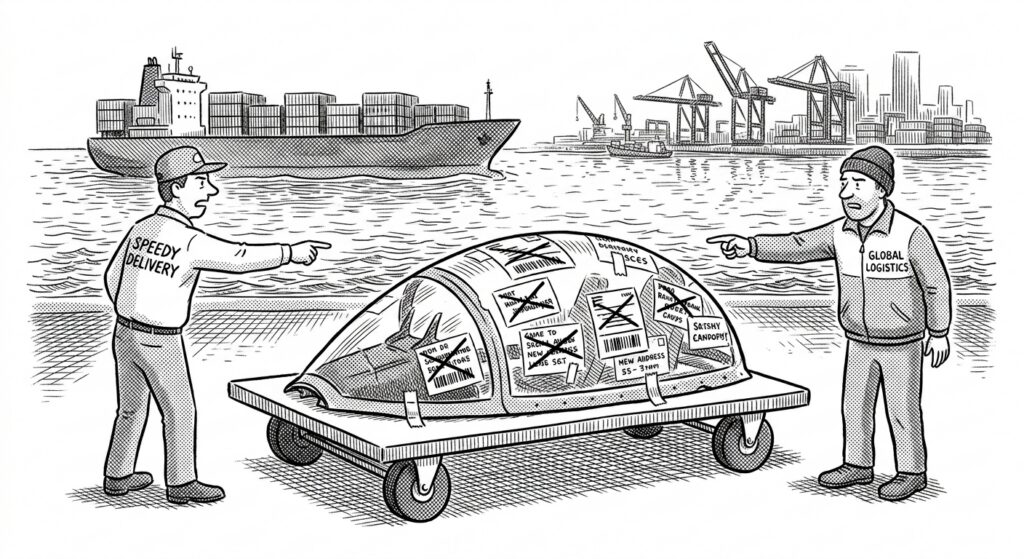
UPDATE (September 25, 2026, 3:45pm HKT): Sources have confirmed that CEVA acted as the freight forwarder and selected UPS, who mistakenly sent the parts via Hong Kong. The diversion was a result of an error and not an intentional diversion by a foreign actor.
Here is a fact everyone reporting this story seems to agree on: a cockpit canopy and a weapons-bay door from an Australian F-35, carrying radar-absorbing stealth coating, left Australia in late May, stopped somewhere it shouldn’t have, and ended up in the hands of the Chinese government. Here is a fact almost nobody reporting this story can agree on: who was actually carrying it.
Bloomberg’s sources say UPS. The Nightly’s sources say Ceva Logistics. Politico, which broke the story on September 18, nearly four months after the parts left Australia, describes the carrier only as “an intermediary working for Lockheed Martin” and declines to go further. Australian Defence Magazine flagged the contradiction between Bloomberg and The Nightly directly and said it doesn’t know which one is right. A senior logistics source told my own outlet flatly that Ceva doesn’t have the military aerospace credentials for this kind of cargo and called the claim “a basic mistake.” Nobody has retracted anything. The story has simply kept running with two different carriers named in it, for four months, without anyone apparently finding this strange enough to stop and check before publishing the next piece.
I want you to think about that for a moment, because it’s the whole story, and almost none of the coverage is actually about it.
The Part Everyone Skipped
If reporters four months into a story still can’t agree on whose custody the parts were in, that’s not a footnote. That’s the story. A stealth fighter’s canopy is not a package that gets lost between a corner store and a delivery van. It moves through named handlers, tracked manifests, and a chain of custody built specifically so that at any hour of any day, someone can say with certainty exactly whose hands it’s in. Four months on, we don’t have that. We have two competing leaks, neither confirmed, both treated by different outlets as settled fact.
And yet the word doing the actual work in nearly every headline isn’t “unclear” or “disputed.” It’s “diverted.” The Chinese government “has taken possession.” Bloomberg’s own framing, echoed everywhere downstream, presumes an active choice was made, by someone, to route sensitive cargo through Hong Kong. Read the primary reporting closely and that presumption evaporates. Nobody has said the diversion was deliberate. Nobody has said it wasn’t a routing error, a keystroke, a cost-driven subcontracting decision three layers down a logistics chain nobody at Lockheed was watching closely enough. The Pentagon says it’s working to retrieve the parts and add safeguards, the language of a process failure, not an infiltration. Lockheed calls the parts low risk. Australia’s own defence minister said Tuesday his understanding is that nothing sensitive was involved. The most alarming fact in the entire story, the stealth coating on both parts, comes from unnamed Bloomberg sources, not from Lockheed, not from the Pentagon, not from anyone willing to put their name on it.
I’ve written before about how a story doesn’t need a single false sentence to leave you with a false impression, it just needs the right word placed early enough that you stop checking the ones that come after it. “Diverted” is that word here. It tells you someone chose this, before anyone has established that a choice was made by anyone at all.
Why This Story Landed on Such Fertile Ground
None of this happened in a vacuum, and I don’t think it’s an accident that a story built almost entirely on unnamed sourcing found such an eager audience the moment it broke. China has spent the last year normalizing exactly the kind of posture that makes “Beijing wanted this” the default read on anything that goes missing near its borders. The PLA’s Justice Mission 2025 drills over New Year’s rehearsed a full maritime blockade of Taiwan, the largest such exercise since August 2022, deliberately pushing into Taiwan’s contiguous zone in a way analysts flagged as a real, consequential shift rather than routine posturing. Taiwan ran its own largest-ever Han Kuang exercises in August, for the first time explicitly drilling against a PLA blockade scenario. Reasonable people are watching this relationship and expecting the worst. That’s not paranoia, that’s a rational response to a genuinely escalating military picture.
But a genuinely tense environment is exactly the environment where an unverified claim travels fastest, because it doesn’t have to overcome skepticism, it just has to confirm what everyone already suspected. “China got stealth technology” doesn’t need evidence to feel true right now. It needs a headline. The Justice Mission drills are real. The Han Kuang drills are real. Whether anyone at all deliberately routed a jet canopy through Hong Kong is, four months later, still not established by a single named source in any outlet I’ve read.
Hong Kong Has Been Here Before
This isn’t even the first time this exact scenario has played out at this exact airport, and the earlier version is worth remembering precisely because of how it actually ended.
In November 2016, Hong Kong Customs seized nine Singapore Armed Forces armored vehicles as they passed through the city on a commercial APL vessel, returning from training in Taiwan. The seizure fed a wave of coverage treating the incident as a deliberate signal from Beijing over the Taiwan link, exactly the kind of intent-first framing this story is getting now. The case ran for three years. When a Hong Kong court finally ruled in 2019, it took a narrow, almost anticlimactic view: APL and its captain were convicted of a licensing violation, fined a combined HK$99,000, roughly what a decent flat in this city rents for in two months, with a suspended sentence for the captain. Not the dramatic geopolitical set piece the initial coverage implied. A paperwork failure, adjudicated as one.
If the F-35 story resolves the same way, and there’s no particular reason yet to think it won’t, we’ll have spent four months, and counting, treating a shipping error as an intelligence operation, because the shipping error arrived at a moment when everyone was primed to believe the worse version.
Reading This One With the Lights On
I’m not asking anyone to conclude Hong Kong or China did nothing wrong here. I don’t know that, and neither, four months in, does anyone quoted on the record. What I’m asking is the same thing I asked about a bookstore story a few weeks ago: notice which word arrived before the evidence did, and ask what’s actually been established versus what’s just been repeated confidently enough, by enough outlets, that repetition started doing the work proof was supposed to do.
Ruth read the Loadstar piece over my shoulder and asked the only question that actually mattered, the one somehow missing from a month of coverage: “If they don’t know who was carrying it, how exactly do they know China took it on purpose?” I didn’t have a clean answer for her, because there isn’t one on the record yet. There’s a canopy, a disputed carrier, a four-month gap between the shipment and the public finding out, and a headline that decided the ending before the chain of custody had one.
Hong Kong didn’t create this weakness. As I put it in the original piece, it just supplied the stage. Everyone reporting on what happened next supplied the rest.
Here’s the part I keep waiting for someone else to say out loud, and nobody has: even if Beijing has the canopy, I’m not particularly worried about it, and the reasons why have almost nothing to do with this shipment.
Start with what China already has. The Loadstar piece itself mentions this almost in passing, as background, when it deserves to be the headline. Documents Edward Snowden gave to Der Spiegel back in 2015 described Chinese hackers pulling terabytes of F-35 program data over the preceding years, radar signatures, engine schematics, maintenance protocols, the kind of material a stray canopy simply cannot compete with in volume or detail. A single damaged part, four years late arriving at any lab that wanted it, tells Chinese engineers something they’ve likely known since before this canopy was manufactured. That’s not a reason to shrug off sloppy custody controls. It is a reason to stop treating this one incident as the moment China’s understanding of the F-35 changed.
Then there’s the part of this story that should embarrass the program more than any diversion could: the plane already runs on Chinese-made components. In 2022 the Pentagon briefly halted acceptance of new F-35s after discovering a cobalt-samarium magnet from a Chinese supplier had made it into the alloy powering the jet’s turbomachine pump, then reversed course and issued a waiver rather than rip the fleet apart, and Reuters reported other magnets from the same country of origin were already installed elsewhere in the aircraft with nobody proposing to remove them either. A fighter jet built partly from the industrial base of the country it’s meant to deter is a stranger story than anything happening in a Hong Kong warehouse, and it got a fraction of the coverage.
Which gets at the actual point. China doesn’t need to steal stealth coating to do serious damage to the West. It would only need to stop selling us things. Rare earth refining, the unglamorous industrial step that turns raw ore into the magnets, motors, and specialty alloys modern life quietly depends on, is overwhelmingly concentrated in China, not because nobody else has the ore, but because nobody else built the refining capacity while China spent thirty years doing exactly that. Your phone was very likely assembled in a Chinese factory. So was your television, most of your laptop, and a meaningful share of whatever you’re wearing right now. None of that requires a single stolen document. It requires Beijing deciding, one morning, that the export licenses stop. A jet canopy sitting in a warehouse is a much smaller threat than a container ship that simply doesn’t leave port, and almost nobody writing about the canopy is writing about the ship.
I’d rather everyone spent a fraction of the energy currently going into “who diverted the F-35 parts” on the much less cinematic, much more consequential question of what happens the day China decides it no longer needs our business as much as we need theirs.
Comments