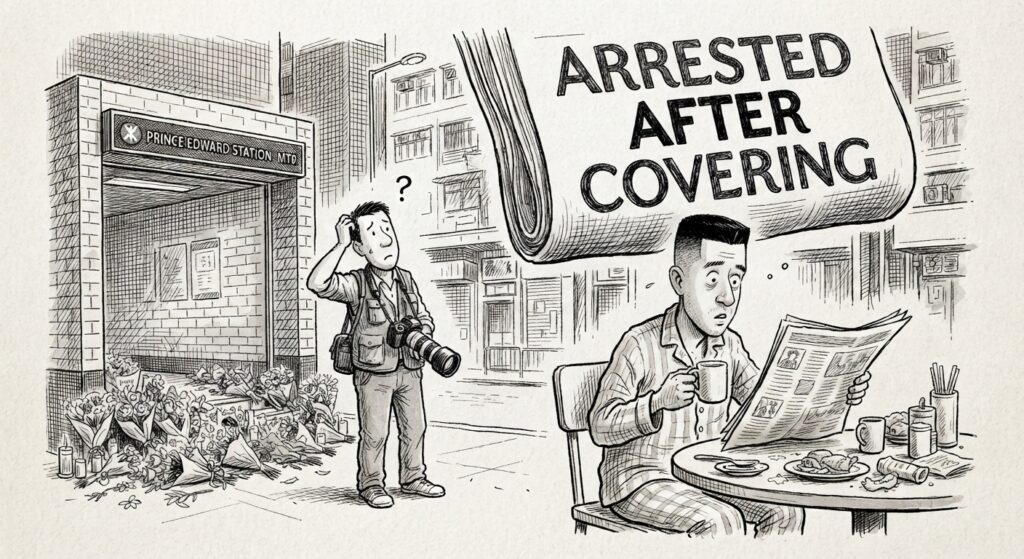
I read the New York Times over milk tea on Tuesday morning, which was my first mistake. “Hong Kong Journalist Arrested After Covering Gathering Linked to 2019 Protests,” the headline said, above Sui-Lee Wee’s byline. Ruth glanced over at my phone and once again asked which Hong Kong they were describing this week. Fair question. The one I live in, as of this writing, has not charged the man with anything.
Start with the headline, because the headline is the only part most people will ever read. Not “arrested for covering a gathering.” The Times is more careful than that. “Arrested after covering a gathering.” The word after does the work. It plants cause without asserting it, the way a lawyer plants a thought in a jury with a question he knows will draw an objection. You cannot unhear it. By the time you reach the article, you already know what happened: a journalist did journalism, and the state came for him.
Now read what the police actually alleged, because the statement is public, short, and apparently opened by almost nobody quoting the headline. On October 1, police said they had arrested eight people between September 3 and September 30 for “doing an act that has a seditious intention” under section 24 of the Safeguarding National Security Ordinance. On the evening of August 31, the statement says, people stood outside Prince Edward MTR station “holding bouquets and shouting seditious slogans,” and were suspected of “spreading false information and attacking the Hong Kong Special Administrative Region Government with lies, as well as smearing the Police Force.” The thirty-seven-year-old man arrested on Wednesday morning, identified by local newspapers as Tang Ho-wing, founder of the online outlet Boom News, was one of the eight. He was released on bail shortly after midnight on Friday. He has not been charged. Each of those sentences matters. The headline contains none of them.
And what was the gathering for? Here the Times goes quiet. The August 31 anniversary marks the night in 2019 when riot police stormed Prince Edward station, and it survives as an anniversary because of one specific claim: that people were beaten to death inside the station that night. That claim is the whole reason for the flowers. It is also, seven years later, a rumor that has never had evidence behind it. I did not take that from a government press release. I took it from the Hong Kong Free Press, which nobody accuses of carrying water for the police, and which wrote this week that rumors of civilian deaths emerged “despite there being no evidence for such claims and consistent denials from police.” The Times piece never mentions the death rumor at all. Not to endorse it, not to debunk it, not even to explain that it is why people stand outside that station every August with bouquets. A reader in Manhattan learns that a journalist covered “a gathering linked to 2019 protests.” He never learns what the gathering believes.
Watch, too, what the Times does with the 2019 night itself. The article states, flatly and in the reporter’s own voice, that riot police “indiscriminately used batons and pepper spray against protesters and commuters inside trains.” Indiscriminately is the contested word in that sentence. It is the allegation, not the finding. Hong Kong Free Press, covering the same history in the same week, attributed the same description to critics and noted that police denied it. One outlet presents a disputed characterization as a claim and names the claimant. The other presents it as settled fact, inside a story about how Hong Kong punishes people for departing from the official version of events. You are allowed to notice that.
To be fair to the Times, the article does quote the police statement. The quote is there, midway down, after the press watchdogs and before the journalism union’s disbelief. The summary line hedges its sourcing: “according to local media and watchdog groups.” Nothing was fabricated. It was arranged. The allegation was quoted the way a chain restaurant prints the calorie count: present, accurate, and positioned so you never look at it. This is the technique I wrote about in You Already Made Up Your Mind About Hong Kong. The machine runs on selection and order, not invention.
The day after the article ran, the government answered it. On October 2, Secretary for Security Tang Ping-keung wrote to the Times that the piece “conflated criminal acts endangering national security with lawful exercise of press freedom,” and that “this case has nothing to do with press freedom.” His letter says the arrestee “is suspected of spreading false information and slandering the HKSAR Government including the Police with lies.” Suspected. The government’s own letter uses the word, because no charge has been laid and everyone on both sides of this is, for now, describing a suspicion. The letter also assures the press that journalists “have nothing to worry if they act within the boundaries of the law and in accordance with the tenets of responsible journalism,” and I will be honest: that sentence does not comfort me. Governments should not be grading the tenets of journalism. My answer to pressure on the press is disclosure, not bans.
I have also argued that Regina Ip was right about Article 23, and I still think so. A law on the books means charges, trials, and verdicts rather than rule by mood. But a law is a charge sheet and a courtroom, not a headline. If the police have evidence that Tang did something other than film a gathering, they should charge him and show it. If they do not, they should say so. An arrest is an allegation with handcuffs. I will not defend an allegation I have not seen. I will also not convict the police, in the opposite direction, on the strength of a headline that had decided the story before the statement was read.
So what do we actually know? A journalist with about two hundred thousand followers across his platforms was arrested at seven on a Wednesday morning, held for almost two days, and released on bail without charge. The Hong Kong Journalists Association says he is the first journalist arrested for sedition under the 2024 law. That is serious. It deserves scrutiny, the real kind, the kind that reads the police statement before writing the headline. What we do not know is what evidence the police hold. Neither does Sui-Lee Wee. Neither does the HKJA. The only honest sentence available to any of us right now is “we don’t know yet,” and “we don’t know yet” does not get read aloud on the morning podcasts.
Ruth finished her tea and gave her verdict, shorter than mine as usual. “One of those documents is an accusation,” she said, “and the other is a mood. Guess which one got the headline.”
She is wrong about one thing. Both documents are sitting in public. The police statement is on a government website. The letter is a published PDF. The rumor underneath it all is seven years old, and the evidence for it remains zero. The Times did not hide any of this. It simply filed it where you would not look, beneath a headline that told you what to think before you arrived.
The flowers outside Prince Edward station get cleared away every year. The rumor comes back anyway. It does not need evidence. It needs a headline.
Comments