Happy Birthday, Meme Queen: Regina Ip Was Right About Article 23 and Outlasted Everyone
I have never actually met Regina Ip.
This is not for lack of trying. A few years ago, I attended an event held by the Russian consulate for Russia Day, which is either a holiday celebrating the founding of the Russian Federation or a celebration of the continued existence of vodka in institutional settings, depending on whom you ask. Ip was there. I saw her across the room. I made my way through the crowd. And by the time I reached her side of the room, she had vanished. Gone. Like she’d been extracted by a security detail or absorbed directly into the wallpaper. I was left standing near the canapé table holding a drink and wondering whether I had hallucinated the entire thing. This is, it turns out, a common experience. The woman is a phantom. She materializes, she says something extraordinary, and then she disappears before you can process what just happened.
Jason Y. Ng, the lawyer and author, published a piece on Hong Kong Free Press in 2016 called “My One Minute with Regina Ip.” He met her at a restaurant. There was a queue. There was a dispute over who had arrived first. Her companion was rude. Ip was not. Ng wrote that she “might have even passed for a nice lady,” and that she was careful not to say things like “Do you know who I am?” He said that if she ever ran for Chief Executive, she wouldn’t be running against other candidates. She’d be running against herself. And that was the toughest battle in the world.
He was right. She ran. Twice. Lost both times. And then she won anyway, because the office she holds now, Convenor of the Non-official Members of the Executive Council, is arguably more powerful than the one she kept failing to get elected to, and she got it without needing the public’s permission. That is not a story about luck. That is a story about patience.
Here is the thing about Regina Ip that nobody in the Western press has the honesty to say.
She was right.
In 2003, she proposed Article 23. National security legislation. Required by Article 23 of the Basic Law. Not optional. Not a power grab. A constitutional obligation. She said Hong Kong needed it. Half a million people marched against her. The pan-democrats called her a tyrant. The press called her the Iron Lady, and they meant it as an insult. She resigned. Her boss Tung Chee-hwa resigned shortly after. She flew back to Stanford. She earned a master’s degree. She came back. She ran for LegCo. She lost. She ran again. She won. She served seventeen years.
And then in 2020, after the firebombs and the airport shutdowns and Joshua Wong sitting in front of Marco Rubio asking Congress to sanction his own city, Beijing imposed the National Security Law. A version far more expansive than anything Ip had proposed in 2003. A version that exists specifically because the moderate legislation she tried to pass was blocked by the same people who spent the next sixteen years creating the conditions that made a harder law inevitable.
If the 2003 version had passed, there would have been no political vacuum. No escalation. No perceived weakness for Beijing to respond to. No justification for intervention from above. The people who marched against Regina Ip in 2003 are the people who produced the political environment of 2024. She told them this would happen. They called her a fascist. She went to Stanford, got a degree, came back, and waited. Twenty-one years later, Article 23 passed anyway. In March 2024. And Regina Ip, seventy-three years old at the time, said on HKFP’s own podcast: “I think the sooner we complete enactment of Article 23 legislation the better.” She was smiling. You could hear it.
Ruth Bader Ginsburg spent decades dissenting before the culture caught up to her. She wrote opinions that went nowhere in the 1990s and watched them become law twenty years later. She was a judicial meme before judicial memes existed, not because she was flashy, but because she was relentless. She was small and precise and absolutely immovable, and eventually the world turned in her direction and she was still standing there, exactly where she had always been, with her collar on and her opinions sharpened.
Regina Ip is Hong Kong’s version of this. Not in ideology. In temperament. In the sheer biological stubbornness of outlasting every single person who tried to end her career.
Consider the timeline.
2003: Half a million people march against her. She resigns in disgrace.
2007: She returns to Hong Kong and runs for LegCo. She loses to Anson Chan.
2008: She runs again. She wins.
2012: She runs for Chief Executive. She cannot get enough nominations. Her campaign lasts nine days.
2017: She launches another CE bid. Analysts say she lacks “passion” and “personal touch.” She fails to secure 150 nominations again.
2018: She starts posting studio portraits of herself in cheongsams and festive outfits on Instagram. She tells reporters this requires engaging with people who mock her “with a thick skin.”
2019: Protesters surround her on the street in Causeway Bay. Riot police have to shield her from the crowd. NBC films the whole thing.
2020: She writes an op-ed in the New York Times titled “Hong Kong Is China, Like It or Not.” The National Review, the Spectator, HuffPost, and CBS all attack her.
2022: She is appointed Convenor of the Executive Council by John Lee. She defends dynamic zero-Covid. She is wrong about this. Nobody is perfect.
2023: Her social media team accidentally posts “Hell No Hong Kong” parody memes to her official Instagram account. She calls it an “embarrassing, careless mistake.” HKFP literally uses the words “meme queen” in the headline.
2023: She opens the Gay Games. Anti-LGBTQ lawmakers call for her resignation. She gives a speech about the courts upholding equal rights and says, “Thumbs up for our independent courts.” She does not resign.
2024: Article 23 passes. Twenty-one years after she tried the first time. She wins.
2025: She steps down from LegCo after seventeen years. An unofficial age limit from Beijing reportedly pushes out all legislators over seventy. She tells reporters not to speculate and says she will “continue to serve society with her expertise and policy research.” She remains Convenor of the Executive Council.
2026: In March, ComplexCon Hong Kong invites her to do a fan meet alongside Blackpink’s Jennie and Yeat. Signed photo cards. A hi-bye event. The organizers call her “a true icon in Hong Kong.” She is seventy-five years old. She is the Convenor of the Executive Council. She is handing out autographed photo cards at a streetwear festival next to a rapper from Portland, Oregon.
2026: In May, she hosts the third annual Global Prosperity Summit through her think tank, Savantas Policy Institute, co-organized with the Shanghai Institutes for International Studies and the European Chamber of Commerce. She delivers the welcome remarks. She calls Hong Kong “an oasis of stability, connectivity and opportunity.” Ambassador Han Zhiqiang flies in from Beijing to deliver the keynote. She is not retired. She is running geopolitical conferences.
2026: In June, she signs a diplomatic book of condolence at the Thai consulate as Convenor. In April, she appears on TVB commenting on energy policy and government accountability after the Tai Po fire. She is everywhere and nowhere, which is, as I have established, her signature move.
Her name means “queen” in Latin. I checked.
Here is what I find funny about all of this. Not funny in the sense that I am laughing at her. Funny in the sense that the universe has a sense of irony and sometimes it is very, very patient.
The people who marched against her in 2003 are gone. Some are in exile. Some are in prison. Some have simply moved on and do not talk about politics anymore. The pan-democratic movement that defined itself in opposition to her has ceased to exist as an organized political force. The press that caricatured her as an authoritarian villain now writes headlines about her meme status. The young people of Hong Kong, the generation that was supposed to hate everything she represents, are lining up for her photo cards.
She didn’t win by being likable. She didn’t win by moderating. She didn’t win by reinventing herself in some calculated way. She won by being exactly who she has always been, for so long, that the world eventually got bored of being angry at her and started finding her entertaining instead.
She once told a reporter that Hong Kong emigrants had “no money, skills or education.” Seven thousand people had just left for the UK. She said that. Out loud. In public. And nothing happened to her, because by that point the people who would have been outraged had already emigrated.
She is a member of the Hong Kong Golf Club. She does not play golf. She lobbied against turning the Fanling golf course into public housing. The public wanted the housing. The government overruled her. Secretary for Development Bernadette Linn said in August 2022, despite lobbying by Ip and the club, “The government, at this moment, is still fully committed to implementing this project and we have not changed our mind.” She remained a member of the club. This is a woman who plays the long game even on her recreational memberships.
She lied about visiting the Liaison Office in 2016. She got caught. She survived it. She studied the Elizabethan poet Philip Sidney at the University of Glasgow. Her mother was an actress. She was the first woman appointed Secretary for Security in Hong Kong’s history. She is messy and blunt and contradictory and entirely, unapologetically herself, and that, it turns out, is the only thing you actually need to become a meme queen in a city that spent two decades trying to destroy you.
The irony is structural. The press that attacked her built the legend. The protesters who heckled her created the drama. The caricature became the brand. Every single person who tried to make her irrelevant contributed to the mythology that now makes young people line up to get a signed photo card from a seventy-five-year-old politician at a hip-hop festival. She did not build the meme. Her enemies built it for her. She just refused to leave.
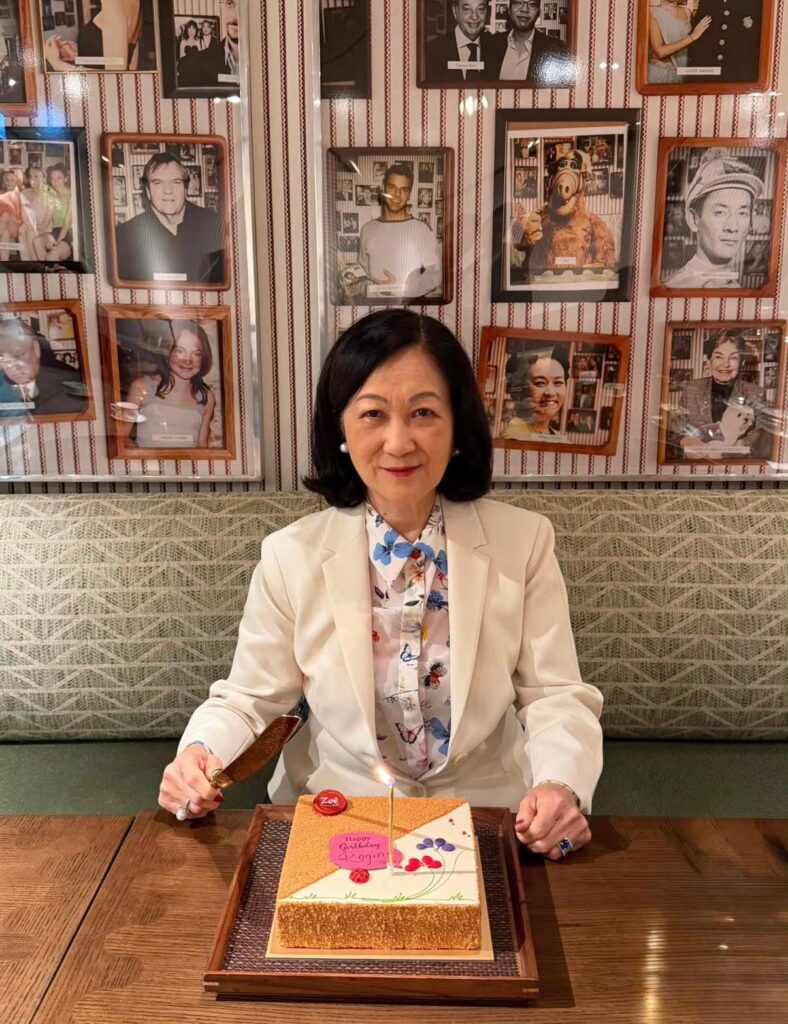
Her birthday is August 24. One day from now. She turns seventy-six. I imagine she will post a cheongsam photo. I imagine fifty thousand people will like it. I imagine somewhere, in a flat in London or Toronto or Vancouver, someone who marched in 2003 will see it on their feed and feel something complicated.
I hope I meet her eventually. I imagine she will say something outrageous. I imagine I will not have time to respond before she vanishes again. That seems to be how it works.
Happy birthday, Regina.