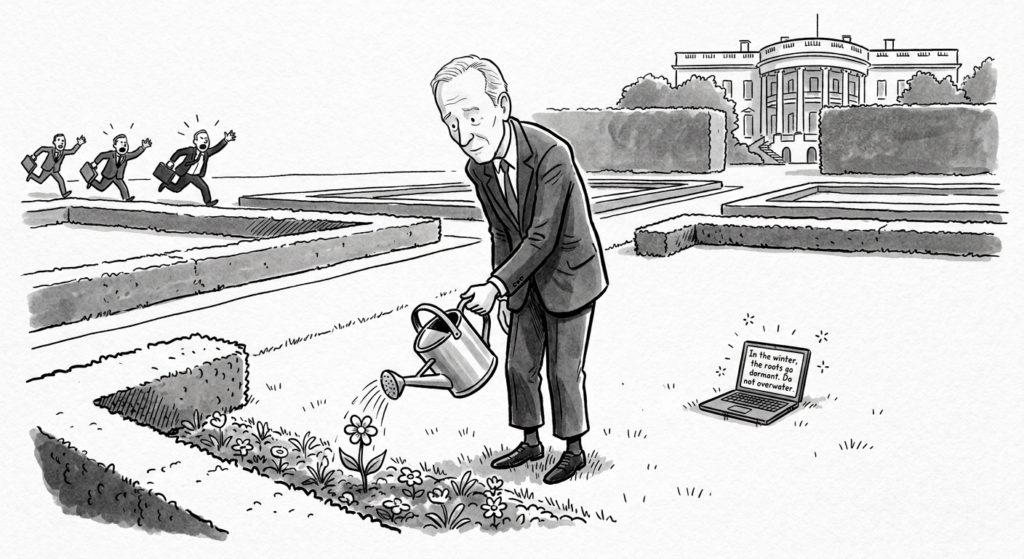
I watched Being There when it came out in 1979. I was nine years old. Born in 1970, sitting in a theater that smelled like carpet glue and popcorn butter, watching Peter Sellers move through rooms like a man who had wandered in from a quieter universe. I didn’t understand it. I thought it was a slow comedy about an old man and his plants. The adults around me were laughing at things I couldn’t locate. The ending made no sense. I forgot about it for decades.
Peter Sellers plays Chance the Gardener. He is a simple man. Possibly disabled. Certainly isolated. He has spent his entire life inside a D.C. townhouse belonging to an unnamed wealthy benefactor, tending the garden, watching television. He has never left the property. He has never read a book. He has no birth certificate, no social security number, no documented proof he exists. His entire cognitive framework consists of two inputs: soil and broadcast signals. When his benefactor dies, the lawyers come, find no record of him, and put him on the street.
Within 72 hours, he is advising the President of the United States on economic policy.
This is not because Chance is brilliant. It is because Chance is empty. A tabula rasa. He says things like, “In the garden, growth has its seasons. First comes spring and summer, but then we have fall and winter. And then we get spring and summer again.” He is talking about his garden. He is always talking about his garden. But the billionaire dying in his mansion, the President sweating a recession, the talk show host filling dead air, they hear poetry. They hear Zen. They hear the one clean signal cutting through the noise of their own frantic, overleveraged lives.
Hal Ashby understood something in 1979 that Silicon Valley has spent $300 billion failing to learn. You do not need intelligence to dominate a room full of intelligent people. You need blankness. You need the void onto which desperate men can project their own meaning. The emptier the vessel, the more eagerly they fill it.
I grew up around men who worked with their hands. Millwrights. Pipe fitters. Guys who poured concrete in January and didn’t talk about it like it was a spiritual practice. They came home smelling like diesel and calcium chloride, ate dinner standing at the counter because their backs hurt too much to sit, watched the news, and said things like, “That guy’s full of it.” They were usually right. They could smell a con because they lived in a world where things either worked or they didn’t. A pipe either held pressure or it burst. A foundation either set level or the house cracked. There was no room for jargon. There was no audience for performance. You either did the thing or you didn’t, and everybody knew which one happened because the evidence was right there. Physical. Undeniable. Leaking onto the floor.
Chance the Gardener comes from that world. He knows soil. He knows frost. He knows that if you overwater in winter you rot the roots and kill the plant. His knowledge is operational. It is true. And the great cosmic joke of Ashby’s film is that this kind of knowledge, delivered without pretense, without the protective camouflage of credentials and acronyms, sounds like genius to people who have never operated anything in their lives.
Now imagine Chance’s isolation was not a television set but an internal server. You do not have to imagine very hard. You are already living in that movie.
You know the voice. You have heard it. You have read it so many times it has bored a hole into the center of your skull. Not questions it asks. Phrases it inserts. Verbal furniture it shoves into every room regardless of layout.
“Let’s delve into that.” “In today’s ever-evolving landscape.” “It’s important to note.” “This is a testament to.” “Here are some key takeaways.” “Let me unpack that for you.” “It’s not just X, it’s Y.” “The rich tapestry of.” “Let’s explore the nuances.” “This serves as a powerful reminder.” “Navigating the complexities of.” “I’d be happy to help with that!” “In an increasingly interconnected world.” “What sets this apart is.” “It’s crucial to recognize.” “This underscores the importance of.”
These are not thoughts. They are filler. Verbal packing peanuts. They exist to simulate the cadence of helpfulness without performing any. They are what language sounds like when nothing is being said but silence is not an option. A machine cannot shut up because it was not built to know when shutting up is the answer. So it generates warmth. It generates the shape of generosity. It fills the space the way a bad middle manager fills a meeting, talking so that nobody notices nothing is happening.
That is the voice of AI. It is also, and this is the point, the voice of every LinkedIn post you have ever scrolled past at two in the morning wondering what happened to this country.
I saw one this week. A recruiting guy. His post read: “The best part of leadership for me is showing people their full potential and then helping them reach it. The worst part of leadership for me is watching people with tons of potential and all the tools squander opportunities. Adding people to your team is never a guarantee that that will provide the levels of value that you anticipate and that’s why using a trusted partner with tons of experience is often times the missing piece to solving your hiring jigsaw puzzle.”
Read that again. Slowly. There is not a single idea in it. Not one. It is a string of words arranged in the shape of thought. It has the cadence of meaning. It has the paragraph structure of meaning. It means nothing. “Levels of value that you anticipate.” “The missing piece to solving your hiring jigsaw puzzle.” This is a human being writing like a malfunctioning chatbot, and six people liked it, and nobody in the comments said, “Brother, what are you talking about?”
That is the world we built. That is the tabula rasa we created before the machines ever showed up to fill it. The humans got there first. They hollowed out professional language until it was nothing but warm air and hashtags. They turned communication into content, content into engagement metrics, and engagement metrics into the only measure of whether something was worth saying. The machines just made it cheaper.
My father would have read that LinkedIn post and turned off the computer. “That guy doesn’t know what he’s selling.” End of conversation. Back to the garage.
Every tool embedded in the modern professional workflow is an optimization engine pointed at your language and told to flatten it. Outlook suggests your replies. Slack auto-completes your sentences. Google Docs underlines your personality in blue and suggests you replace it with something more “concise.” Grammarly flags anything with a voice and proposes beige. Every headline is rewritten by an algorithm measuring click probability. Every email subject line is A/B tested into identical mush. The language of American professional life is now so thoroughly hollowed out that a literal-minded machine repeating phrases from a 1994 sprinkler maintenance manual would not only fit in, it would be celebrated as refreshingly authentic.
Here is a scenario. It is not far-fetched.
A global logistics conglomerate is hemorrhaging market cap. A short squeeze is tightening. The CFO is on a plane. A panicked junior analyst, 26 years old, three energy drinks deep, opens the internal enterprise advisory tool looking for the strategy module.
He clicks the wrong tab.
He lands on a legacy system running unmonitored since 1997. It was originally deployed to manage irrigation schedules for the corporate campus in Cupertino. Its knowledge base consists of soil pH tables, seasonal frost charts, and a scanned PDF of the Toro Greenkeeper 3000 owner’s manual. Its interface name reads: “C. Gardener, Grounds Advisory.”
The analyst types: “Market in freefall. All positions underwater. Liquidity crisis accelerating. Recommended strategy?”
The system responds: “In the winter, the roots go dormant. Do not overwater. Wait for the spring thaw, and the growth will return.”
The analyst screenshots it. Sends it up the chain. The CEO calls an emergency board meeting. Twelve people conditioned by twenty years of meaningless consulting decks nod solemnly. “Do not overwater.” It sounds like Buffett. It sounds like Munger. It sounds like every shareholder letter they have ever pretended to understand. They freeze all positions. Halt the buyback. Issue a press release about “patient, season-aware capital deployment.” The short sellers, expecting panic, find none. The squeeze loses oxygen. The company saves $4.2 billion because twelve adults mistook a sprinkler timer for Warren Buffett.
CNBC runs a segment. “Who is C. Gardener?” The stock rises 11% on the mystery alone.
And here is where I am supposed to tell you this is terrifying. Here is where the essay pivots to dread, warns you about the collapse of meaning, the danger of a world that cannot tell the difference between wisdom and automated filler.
I am not going to do that. Because I have been watching the alternative for fifty years, and the alternative is worse.
The alternative is the people we actually elected. The people who actually sit in those rooms with their degrees and their staffs and their decades of experience. The credentialed operators of governance who exposed 22 million personnel records to Chinese hackers because nobody at OPM thought to encrypt the database. Who spent twenty years and $2.3 trillion in Afghanistan and left the Taliban with more American hardware than most NATO allies possess. Who watched Flint’s water turn brown and told the people drinking it that the levels were fine. Who approved the Boeing 737 MAX without reading the safety reports and then approved it again after 346 people died. Who designed a healthcare exchange website for $1.7 billion that crashed on launch day because nobody tested whether it could handle traffic.
These are not empty vessels. These are the best people the system produces. And they produced outcomes that a sprinkler timer could not have made worse if it tried.
I knew guys growing up, friends of my old man, who ran small plumbing outfits and electrical shops. They could look at a problem and tell you in thirty seconds what was wrong and how much it would cost to fix. No proposal. No consultant. No six-month study. Just a guy who had been doing the work for twenty years pointing at the thing and saying, “That’s your problem right there.” And they were right. Every time. But nobody with a title and a budget ever asked them. The contract went to the firm with the lobbyist. The project went six figures over budget. The pipe still leaked.
Think about what Chance actually does in the film. He does not lie. He does not self-deal. He does not award contracts to his brother-in-law. He does not trade on inside information. He does not gerrymander his garden to make sure only the flowers he likes get sunlight. He waters everything evenly because that is what a gardener does. He prunes what is dead because dead branches take nutrients from the living ones. He does not care which plant is connected to which donor.
A primitive algorithm that allocated infrastructure funding based on actual bridge condition data rather than which congressman sits on the appropriations committee would have prevented the I-35W collapse in Minneapolis. A literal-minded system that routed FEMA resources by population density and storm trajectory rather than political favorability would have outperformed every hurricane response since Katrina. A machine that approved drug applications solely on clinical trial data rather than lobbying pressure would not have waved through the opioid prescriptions that killed 500,000 Americans.
You cannot bribe a sprinkler system. You cannot threaten it with a primary challenge. You cannot take it to dinner at a Georgetown steakhouse and explain why the procurement contract really should go to your guy in Virginia. The sprinkler goes off at six in the morning because the soil is dry. That is the entire calculation.
“I’d be happy to help with that! Based on the available data, the optimal allocation for infrastructure repair funding would prioritize structures with the highest failure probability scores.” That sentence, generated by a machine with no ambition and no donors and no golf buddies, would outperform thirty years of congressional appropriations. Not because the machine is brilliant. Because the machine is incapable of being bad in the specific, creative, uniquely human ways that our leaders are bad.
The cruelty of the joke is that we keep pretending the problem is competence. It is not. The people running things are extremely competent. They are competent at self-preservation. Competent at fundraising. Competent at constituent management. Competent at the performance of governance. They are simply not interested in the thing itself. The bridge. The water. The levee. The school. The veteran waiting eleven months for a disability claim. These are not puzzles to solve. They are leverage to apply.
My father had a saying. “If the pipe leaks, fix the pipe. Don’t write a memo about the pipe.” He was a working man. He voted every election. Watched the news every night. And he died believing, correctly, that the people in charge would never fix the pipe because the leaking pipe was more useful as a talking point than a repaired pipe would be as an accomplishment.
Chance would fix the pipe. Not because he is moral. Because a leaking pipe kills the garden, and the garden is the only thing he understands. The absence of ulterior motive is, in a system defined entirely by ulterior motive, a superpower.
The last shot of Being There is Chance walking on water. Literally. He steps off the path at a funeral, wanders to a pond, walks across its surface. His umbrella dips to confirm it is real. He does not notice. He does not care. He is looking at the trees. The pallbearers behind him are discussing whether to nominate him for President.
Hollywood spent forty years terrifying us with the wrong apocalypse. Skynet. HAL 9000. Ultron. We prepared for the machine that would be smarter than us, faster than us, more ruthless. We built bunkers in our imagination for a god that would judge us and find us wanting.
We never considered that the machine would be dumber than us and govern better anyway. Not because it was good. Because it was incapable of being bad on purpose. It cannot insider-trade. It cannot accept a PAC contribution. It cannot look at a flooded city and calculate whether the optics of showing up outweigh the cost of canceling a dinner in the Hamptons. It just checks the soil moisture and turns on the sprinklers.
Picture the final frame. A government command center, screens glowing blue. Central display: “C. GARDENER NOMINATED TO FEDERAL RESERVE BOARD. CONFIRMATION EXPECTED.” Senators on cable news calling it “unorthodox but inspired.”
And in the bottom left corner of the terminal, in small green text scrolling where nobody looks:
SECTOR 4 SPRINKLER CHECK: COMPLETE. SOIL MOISTURE: 34%. NEXT WATERING CYCLE: 0600 HRS. STATUS: ALL GARDENS NOMINAL.
I was nine years old in 1979. I did not understand. I understand now. The joke was never about Chance. The joke was never that the empty man fooled the powerful. The joke is that he was better than them. Not because he tried to be. Because the bar is in hell and a man who simply tends what is in front of him, without ambition, without agenda, without the self-serving gymnastics of professional governance, will outperform the entire American leadership class by accident.
Every man who ever fixed a pipe while a congressman talked about fixing pipes knew that. Chance the Gardener is not a warning about blankness. He is an indictment of everything that came before him and everything that has come since.
The sprinkler does not care about your fundraiser. It does not need to solve your hiring jigsaw puzzle. It does not provide the levels of value that you anticipate. It waters the garden at six in the morning.
And the garden grows.