His own officers caught him. That detail matters more than anything else in this story. The blue-collar beat cops, the ones who actually operated the cruisers and drove the routes and knew what days the chief was and was not in the building, looked at the digital ledger and noticed the numbers did not match reality. They gathered evidence. They contacted the State Police. They did the thing that institutions are supposed to do and almost never actually do, which is correct themselves from the inside out. In a department of eighteen, somebody looked at a spreadsheet and said: this is wrong, and I am going to say so, even though the man doing it is my boss.
There is something admirable in that. Something worth pausing over. These were not whistleblowers in the dramatic sense. They were not leaking documents to a reporter or testifying before Congress. They were cops in a small town who noticed that their chief was billing for hours he was not working and decided they were not going to pretend otherwise. That takes something. In a department of eighteen, there is nowhere to hide. Everyone knows everyone. Everyone sees everyone. Reporting your boss in a department that small is not anonymous. It is personal, and it carries a personal cost, and they did it anyway.
I told Ruth about it. She asked one question. “How long was he there before they caught him?” I said over a year. She said, “So the town paid a man a hundred and fifteen thousand dollars a year to not know the streets, and then paid him nineteen thousand more to not be on them.” She went back to her phone. That was the whole conversation. Ruth does not require a second sentence when the first one is a verdict.
The reason Ruth’s summary lands so cleanly is that Adams used to know the difference between a cop who worked the streets and a cop who filled out forms about working the streets. The town had both kinds over the years, but for a long time, it mostly had the first kind. Guys whose authority came not from a contract or a credential but from the simple fact that they lived here, walked here, knew the names of the people they were policing, and would see those people at the grocery store on Saturday morning regardless of what happened on Friday night. That is not nostalgia.
That is a system. An informal one, unwritten, never codified in any municipal handbook, but a system nonetheless, and it worked because it was built on the most basic mechanism of accountability a community can have: proximity. You cannot steal from people who know your face. You cannot lie to people who know your car. You cannot vanish into bureaucratic anonymity in a town where your mother goes to the same church as the woman you just pulled over.
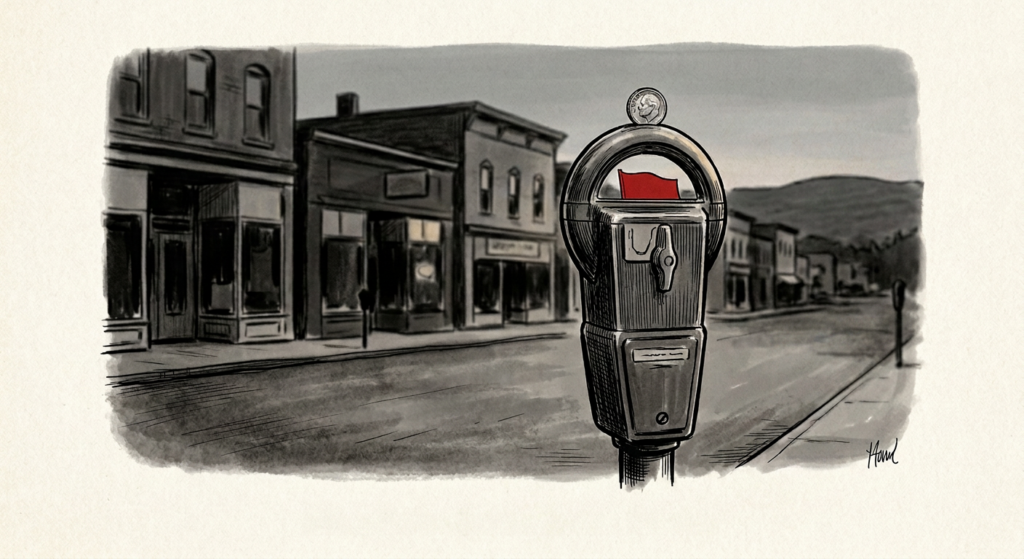
Marco Demastrie walked the Park Street beat. That was his route, his stretch, his responsibility in the most old-fashioned sense of the word. After business hours, he checked doors. Not with a compliance form, not with a body camera uploading footage to a cloud server in Virginia. He walked the block and he pulled handles and he made sure the town was locked up for the night. He moved kids off the wall. He wrote parking tickets. He wrote them fairly and he wrote them constantly and he did not lose sleep over it because the law was the law even in a town with one traffic light, and everyone knew Marco’s position on the matter, which was that the meter is the meter and your opinion about the meter is not his problem.
There is a story about Marco that I think about every time someone uses the phrase “community policing” in a meeting as though it were an innovation. He wrote a woman a ticket. She was unhappy about it. She was, in fact, furious. The meter was broken, she said. It would not take her coin. It was defective. She could not have paid even if she wanted to, and she wanted to, and this was unjust, and she intended to speak to someone. She was a Karen before the taxonomy existed. Marco reached into his pocket. He took out a dime. He put the dime in the meter. He turned the handle. It worked perfectly. He walked away. End of argument. End of appeal. End of whatever speech she had been preparing for the Select Board meeting. That is what it looks like when a cop knows his beat down to the individual parking meter. You cannot buy that with a three-year contract. You cannot import it from South Carolina. It grows here or it does not exist.
Keith Erdeski was another one. I know this firsthand because I was on the wrong end of his jurisdiction one night in high school, a night that began with drinking in the woods off Camp Hamlin Road and ended with the kind of clarity that only arrives when cheap beer wears off and the temperature drops below the point where your choices become very simple very quickly. A few of us took a wrong turn and ended up at the reservoir. Jason and Paul disappeared into the trees. I did not. I did not because I had done the math, and the math was this: a two-mile walk back to Adams in the bitter cold was considerably worse than anything Keith Erdeski was going to do to me. I stood on the road and I flagged him down.
He stopped. He did not arrest me. He did not write anything down. He did not call my parents or initiate a juvenile contact report or refer the matter to a supervisor for further review. He put us in the car and he drove us back to town and he dropped us off at Grampy’s, which is now a 7-Eleven but was Grampy’s then, and that was the end of it. The ride was the lecture. The cold was the punishment. Keith understood that a kid who has been drinking in the woods and is frozen enough to wave down a police cruiser has already absorbed whatever lesson the system was going to deliver that evening. He used judgment. Not policy, not protocol, not a framework developed by a seven-member panel. Judgment.
The kind that only exists when the cop and the kid and the kid’s family and the town itself are all part of the same fabric, when everyone involved knows that this interaction is not an isolated incident in a database but a thread in something ongoing, something that will continue at the gas station tomorrow and at the football game next week and for the next forty years of living in the same place.
That is what a small town is, when it works. Not a Norman Rockwell painting. Not a tourist brochure. Not a vague campaign promise about values and tradition. A small town, when it works, is a place where the consequences of your actions are delivered by someone who knows your name, and the accountability runs in both directions, and the whole arrangement depends on everyone staying.
Staying is the contract. Not a three-year deal with a salary and a signing bonus and a traffic grant nobody audits. The actual contract, the unwritten one, the one that matters, is that you live here and so do they and neither of you is leaving, so you had better figure out how to share the street. Marco figured that out. Keith figured that out. Everyone who grew up in a town like Adams knows what it feels like to be on both sides of that arrangement, to be the one getting the ride home and, years later, to be the one shaking your head at the kids on the wall. The roles rotate. The town remains. That is the whole point.
In Hong Kong, in 1973, a Chief Superintendent of Police named Peter Godber slipped out of the colony with more than four million dollars in bribe money. He had been running a syndicate. Everyone knew. The system knew. The system was the syndicate. People took to the streets. The government formed the Independent Commission Against Corruption, the ICAC, in 1974, and what followed was one of the great institutional purges of the twentieth century. One hundred and nineteen officers forced out. Twenty-four held on conspiracy charges. Running fistfights between ICAC agents and furious policemen in the streets of Central District. It took a decade, but Hong Kong went from one of the most corrupt police forces in Asia to one of the cleanest municipal governments on earth. The difference was not money. The difference was not technology. The difference was that someone, somewhere, decided the rot had become intolerable.
Adams is not Hong Kong. Nineteen thousand dollars is not four million. An eighteen-officer department in the Berkshires is not the Royal Hong Kong Police Force. But the mechanics are identical. A man in a position of trust discovers that the paperwork protects itself. That the grant language is hollow. That “traffic safety” is a phrase that means nothing and covers everything. That if you say you worked, the system believes you worked, because the system was not designed to verify anything. It was designed to file. To process. To check boxes and move money. The system does not protect the public. The system protects the paperwork.
And here is where the comedy turns structural. While the Adams Select Board holds solemn bureaucratic meetings to build candidate screening frameworks and seven-member panels and potential timelines for appointing the next leader of their department, while the machinery of municipal self-correction grinds forward at the speed of government, Cheshire walks into the room and takes their best sergeant.
Cheshire. The next town over. Population three thousand. The town whose own police chief, Michael Alibozek, was arrested in November 2025 in the parking lot of Hoosac Valley Middle and High School for soliciting sex from an undercover state trooper. The man told investigators he went on the website to “get girls off the street.” To set them straight. He was helping. He was, in his own telling, performing a public service, right there in the school parking lot at 9:45 on a Thursday night.
So Cheshire needs a new chief too. And rather than build a framework or form a committee or seek public input on the leadership qualities the community would like to see in its next police leader, Cheshire simply interviews Adams Police Sergeant Matthew Wright on a Friday afternoon and hires him on the spot. Unanimously. Four board members. Handshakes. Done. Adams is still designing the filter. Cheshire has already moved on without them.
I think about small towns differently than most people who write about them. Most commentary on small-town America falls into one of two modes: elegy or condescension. Either these places are dying and noble, or they are dying and deserve it. Neither frame is honest. What actually happens in a town like Adams is more interesting than either narrative allows.
What happens is that people stay. They stay knowing that their police chief stole from them. They stay knowing that the next town over’s police chief was arrested in a school parking lot. They stay knowing that the sergeant they trusted just left for a better job. They stay and they go to the Select Board meetings and they sit through the frameworks and the panels and the timelines, and they do it because this is where they live. Not because they are trapped. Not because they are too poor to leave. Not because they are clinging to some romantic vision of what the town used to be. Because this is where they live, and someone has to show up.
That is the thing about small-town corruption that never makes the national story. It is not the scale. Nineteen thousand dollars is nothing in the federal register. It would not merit a paragraph in a Hong Kong courtroom.
But in Adams, nineteen thousand dollars is someone’s whole year. In Adams, the cop who stole it was not some faceless bureaucrat in a tower. He was the guy whose name was on the press release about keeping your streets safe. The betrayal is not abstract. It is personal in a way that large-scale corruption never is, and the recovery is personal too. You do not form a commission. You do not launch an ICAC. You sit in a meeting room in the town hall and you try, again, to hire someone decent. And you hope that this time, maybe this time, you hire someone who will walk the beat the way Marco walked it. Someone who carries a dime. Someone who knows which meters work and which ones don’t. Someone who will drop a kid off at Grampy’s instead of filing a report. Someone from the town. Someone who stays because this is where they live, not because it pays $115,172 a year and comes with a grant nobody checks.
Adams has one traffic light. It does not need a man from Spartanburg to tell it how traffic works. It needs a cop who knows which doors to check after dark. It always did.