On the closeness of small towns, the arithmetic of loss, and what it means when the obituary page starts reading like your yearbook.
There is a number that sits in the back of your mind when you’re young, a number so large and so abstract that it might as well be a coordinate on a star chart. You don’t think about it. You don’t calculate it. You certainly don’t do the math on a Tuesday morning in a high-rise apartment in Kowloon while your wife eats congee and your phone buzzes with a message from someone back home that begins with the words I don’t know if you heard.
The number is your age. Not your age now. Your age at the end. The age at which you stop being a person who does things and become a paragraph in the Berkshire Eagle, formatted in the house style, posted between a woman from Cheshire who was ninety and a man from North Adams who was seventy-three, and read by people who knew you when you were just a kid sitting in a classroom at Hoosac Valley High School with your entire life ahead of you like an unopened envelope.
Fifty-six. That’s the number. That’s the age at which two members of the Hoosac Valley Class of 1988 stopped being people I could theoretically run into at the post office or the Daily Grind or the parking lot of the pharmacy, and became names on a screen, read 8,000 miles away, in a city that has never heard of Adams and wouldn’t know what to do with it if it had.
I have been putting off writing this. I don’t write pieces like this. I write about the absurdities of cross-cultural marriage, about crocheted phalluses in shop windows and men who keep Chinese bridal sedan chairs in their garages next to K-cars. I write about my field of work. I write things that are, by design, funny, or at least trying to be, because funny is controllable and funny keeps its distance and funny does not require you to sit with anything long enough for it to actually hurt. This is not one of those pieces. I have been avoiding not just the writing but the thinking, the sitting-with-it, the quiet arithmetic that happens when you read a name you recognize in the obituaries and your brain, before you can stop it, does the subtraction and arrives at a number that is too close to your own. I don’t want to write this. But the thing about a small town is that it doesn’t let you look away. It never has. So here we are.
Kurt Scholz died unexpectedly on March 31st. Ali Maher died after a long battle with cancer sometime around the same window. Both were fifty-six. Both were from the same town, the same school, the same graduating class. Both left behind families, and work they were proud of, and people who loved them, and the particular kind of void that a person leaves when they exit a community small enough that their absence is not statistical but structural, a missing piece in a puzzle that only has 8,000 pieces to begin with.
I need to be honest about something. Kurt and Ali were not in my inner circle. In a school the size of Hoosac Valley, graduating classes were not large enough to have truly separate social orbits, there were no strangers, only varying degrees of familiarity, but they were not the guys I was rolling pumpkins down hills with at midnight or eating crab rangoons out of a snowbank with at 2 AM. We shared hallways, classrooms, the same Friday night parties, the same teachers who had taught our parents and would go on to teach the children of people who hadn’t yet figured out they’d never leave. We were friendly in the way that everyone in a small town is friendly, which is to say, genuinely, but within the unspoken architecture of who you eat lunch with and who you nod to across the cafeteria.
But here’s the thing about a small town, and it’s the thing that people from cities, even people from a city of 7.4 million like the one I live in now, never fully understand: the cafeteria doesn’t matter. The lunch table doesn’t matter. The inner circle, the outer circle, the people you drove around with on Saturday nights and the people you only saw at pep rallies, none of those distinctions survive graduation. They dissolve. They were never real to begin with, not in any way that holds up against time and distance and the slow, relentless algebra of getting older. What remains, the only thing that remains, is that you were there. Together. In the same small place, at the same small moment, breathing the same Berkshire County air, and that this makes you connected in a way that cannot be replicated or explained to anyone who did not grow up in a town where you cannot buy a loaf of bread without seeing someone’s mother.
In Hong Kong, I live in a housing estate with 40,000 people. I have been here for years. I do not know my next-door neighbor’s name. I could not tell you who lives two floors above me, or what they do, or whether they have children. If one of the 40,000 residents of Mei Foo Sun Chuen were to die on a Tuesday, I would not hear about it on Wednesday, or Thursday, or ever. The density is extraordinary and the intimacy is zero. You can press your ear to the wall and hear someone’s television, but you will never know their story. That is the bargain of the big city: proximity without connection, volume without meaning. Forty thousand strangers, stacked vertically, each one a mystery to the person on the other side of eight inches of concrete.
Adams is the opposite. Adams is 8,000 people who know everything about each other and pretend they don’t, except at the Daily Grind, where they pretend they don’t know and then tell you everything anyway, sourced and annotated, available with a side of home fries by 7:45 AM. In Adams, a death is not a data point. A death is a conversation at every counter, a name spoken at every bar between every church, a ripple that moves through the town the way weather moves through the valley, slowly, completely, touching everything.
Kurt Scholz built a business. Old New England Property Maintenance, thirty years of it. Thirty years of showing up, of doing the work, of building something with his hands and his name and the kind of ethic that used to be so common in towns like Adams that nobody thought to praise it, because it was simply what you did. You worked. You showed up. You took care of things. He also had a career in banking, at Greylock Federal Credit Union, and at other institutions in the county, because in a small town you don’t get to be one thing. You are several things, sequentially or simultaneously, and nobody thinks this is unusual because their father was the same way and their grandfather before that. He was a father, above everything, to Olivia and Christopher. He loved Cape Cod. He died unexpectedly, which is a word that means his family woke up one morning in a world that still had him in it and went to bed in one that didn’t, with no warning and no preparation and no chance to say the things you always assume you’ll have time to say because fifty-six is not the age at which people are supposed to stop being here.
Ali Maher left Adams and became an engineer, a mechanical engineer, Worcester Polytechnic Institute, Class of ’95, and spent twenty-five years in the kind of career that most people will never know exists but that quietly undergirds the machinery of the country. Ford Motor Company. General Dynamics. American Rheinmetall Vehicles. He helped design and build war tanks. His obituary said he was “tough as the mighty war tanks he helped design and build,” which is the kind of line that could sound like boilerplate in someone else’s death notice but which, if you knew Ali, if you remembered the kid from Adams with the unshakable sense of humor and the self-proclaimed pyromaniac’s love of fireworks, reads as simply, precisely true. He fought cancer the way he apparently did everything else: with discipline, humor, and a stubbornness that the disease could consume but never actually defeat. He was in Belleville, Michigan, when he died, but his parents are still in Adams, because in Adams, the parents are always still in Adams. That’s how it works. The kids leave. The parents stay. The town holds.
I did not attend either funeral. I was here, in Mei Foo, in Kowloon, on the other side of the planet, reading about it on my phone the way I read about everything that happens in Adams now, at a delay, through a screen, with the particular ache of a man who left a small town and has spent the years since discovering, slowly and then all at once, that the small town never left him.
There is a moment, and I think every person from a small town who has moved away experiences it, when the obituary page shifts. For years, decades, the names belong to the old. The grandparents. The great-aunts. The retired mill workers and church ladies and men who sat on benches on Park Street and watched the world walk by. You read those names with respect but without alarm. The order of things is holding. The math makes sense. People who were old when you were young are dying at ages that feel, if not welcome, at least comprehensible. The architecture of mortality is intact.
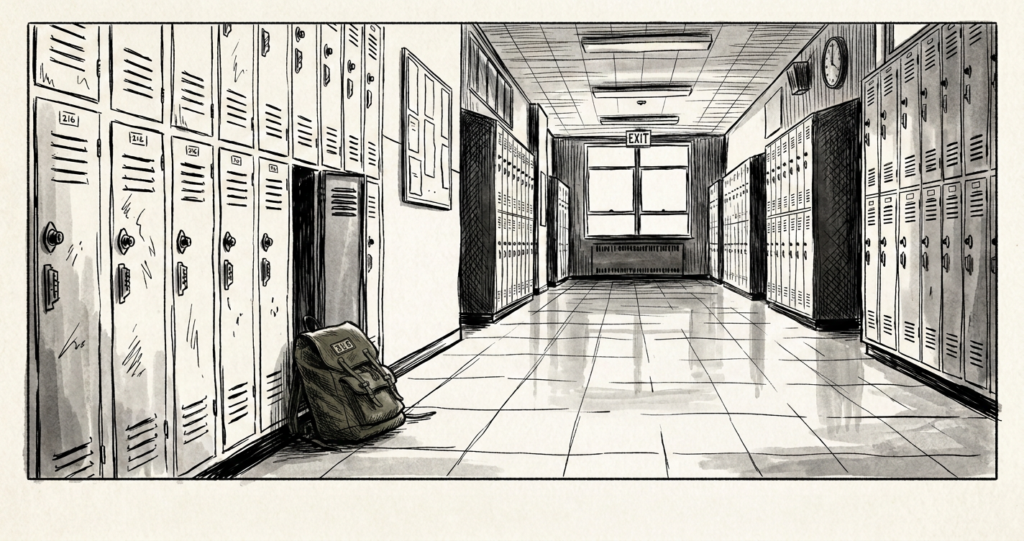
And then one day it isn’t. One day the name on the screen is someone you sat next to in biology. Someone who was at the same high school dance. Someone who was seventeen the last time you really knew them, because that’s how small-town memory works, it freezes people at the age you last shared a hallway, and every encounter after that is just an update applied to the original file, which remains, stubbornly, permanently, a teenager in a Hoosac Valley corridor in 1987, carrying a backpack, late for something, alive.
Fifty-six. I am somewhere in the vicinity of that number myself. The Class of ’88 is somewhere in the vicinity of that number collectively, all of us, scattered now across states and time zones and lives that would have been unimaginable to the kids we were when we walked out of that building for the last time and drove off in whichever direction our particular combination of ambition, accident, and circumstance pointed us. Some stayed. Some left. Some, like me, ended up so far away that the town exists now primarily as a story I tell my wife over dinner, a series of dispatches from a place she navigates with the quiet, squinting skepticism of a woman who still cannot believe that an entire town once mobilized against a change to their house numbers.
But the distance doesn’t matter. That’s what I keep learning, and what Kurt’s death and Ali’s death taught me again in the way that loss always teaches, not gently, not gradually, but with the blunt, rude immediacy of a phone buzzing on a Tuesday morning with a message that begins I don’t know if you heard.
In Hong Kong, 40,000 people live in my housing estate. I know none of them. In Adams, 8,000 people live in my hometown. I know, in some sense, all of them. And when two of them die in the same month, at the same age, from the same class, the math doesn’t feel like math anymore. It feels like the town is calling, across 8,000 miles and thirteen time zones, to say: these were yours. These belonged to you. Not because you were close. Not because you ate lunch together. But because you were there, in the same small place, at the same small moment, and that was always enough.
Ruth asked me, the other night, why I was quiet. I told her two guys from my high school class died. She asked if they were close friends. I said no, not really, not in the way she meant. She looked at me the way she looks at me when Adams is doing something she doesn’t entirely understand, which is most of the time.
“But you’re sad,” she said.
“Yeah.”
“Why?”
I thought about it. I thought about Hoosac Valley, and Park Street, and the Daily Grind, and the churches on every corner and the bars between every church, and the way you can’t buy a loaf of bread in that town without running into someone who will tell you exactly what they think about whatever happened last Saturday. I thought about Kurt Scholz showing up to work for thirty years and Ali Maher building tanks in Michigan and both of them being fifty-six, which is not old, which is not the age at which the math is supposed to stop working, which is the age at which you are supposed to be in the middle of things, not at the end of them.
“Because it’s a small town,” I said. “And in a small town, everyone’s your friend. Even the people who weren’t.”
She didn’t say anything for a while. Then she picked up her chopsticks.
“That’s not how it works in Hong Kong,” she said.
No. It isn’t. In Hong Kong, you can live next to someone for twenty years and never learn their name. In Adams, you can leave for twenty years and they’ll still know yours. They’ll know your mother’s name. They’ll know your grandfather’s name. They’ll know exactly what you did last Saturday, even if last Saturday was in 1987 and you were seventeen and late for something and alive in the way that only seventeen-year-olds are alive, which is to say: completely, recklessly, without the faintest suspicion that the number at the end might be fifty-six.
Rest easy, Kurt. Rest easy, Ali. Adams remembers. Eight thousand miles away, so do I.