I email the Hong Kong government the way other people text a friend who always texts back. I send the message, I wait, and I am honestly surprised on the rare occasions nothing comes, which is how I used to feel about the sun.
The first reply is a robot, polite and prompt, confirming that my message has been received. The robot’s job is to pat me on the head. Then, if the matter deserves it, a person writes. Someone has read my email, sorted it and decided whether it is a problem that can be solved. If it can, they work on it. I do not need the head of a department to answer my email about a bin. I need a human being to read it, which is a standard I did not realize was low until I lived somewhere that met it.
Because I am a lawyer, I put this standard to work every week, and it has not let me down yet.
Take registering a deed. When I have a question about how a document should be presented to the Land Registry, I ask it, and a person answers the question I asked, not the one they wish I had asked. I still read the reply twice, looking for the catch, the way you check the bill in a restaurant that has been unusually kind to you.
Corporate questions work the same way. A client’s company has an entry on the register that looks odd, and I want to know whether it is odd or merely looks odd. I write to the Companies Registry. Someone reads it, works out whether it is a question or a complaint, and tells me which, which is more than most of my clients manage.
Immigration is the one I handle most often for clients, and the one where I most expected to be answered with silence, since the stakes are high and the system is large. I send a question about what a particular kind of case requires. Someone at the Immigration Department tells me. It is not always the answer the client wanted. I have learned to treat a clear no as a service, because a client can plan around a no, and cannot plan around a maybe that lasts indefinitely.
Americans will recognize our own standard advice, which is to ask whether I have tried turning it off and back on. I would love to see that tried on the federal government. Unplug it, count to thirty, plug it back in.
I had already said as much in print. In Why I Love Hong Kong: Ten Reasons to Love It, I called Hong Kong’s tax system “the Marie Kondo of tax systems” and wrote, “It sparks joy.” I also wrote that I could not believe I had written it. When my income changed and I called about the amount I was being asked to pay up front, the problem was sorted within 48 hours. After that, I could.
I had missed one thing. I assumed the responsiveness was a personal relationship between me and the government. It turns out to be a utility, like water, and like water it can come through the ceiling.
My downstairs neighbor had water on his ceiling and a theory about where it came from. The theory was us. As I confessed in The Drip, the theory was correct. We had bought him a fruit basket, which in Mei Foo is treated as a legal instrument, and it had not settled the matter.
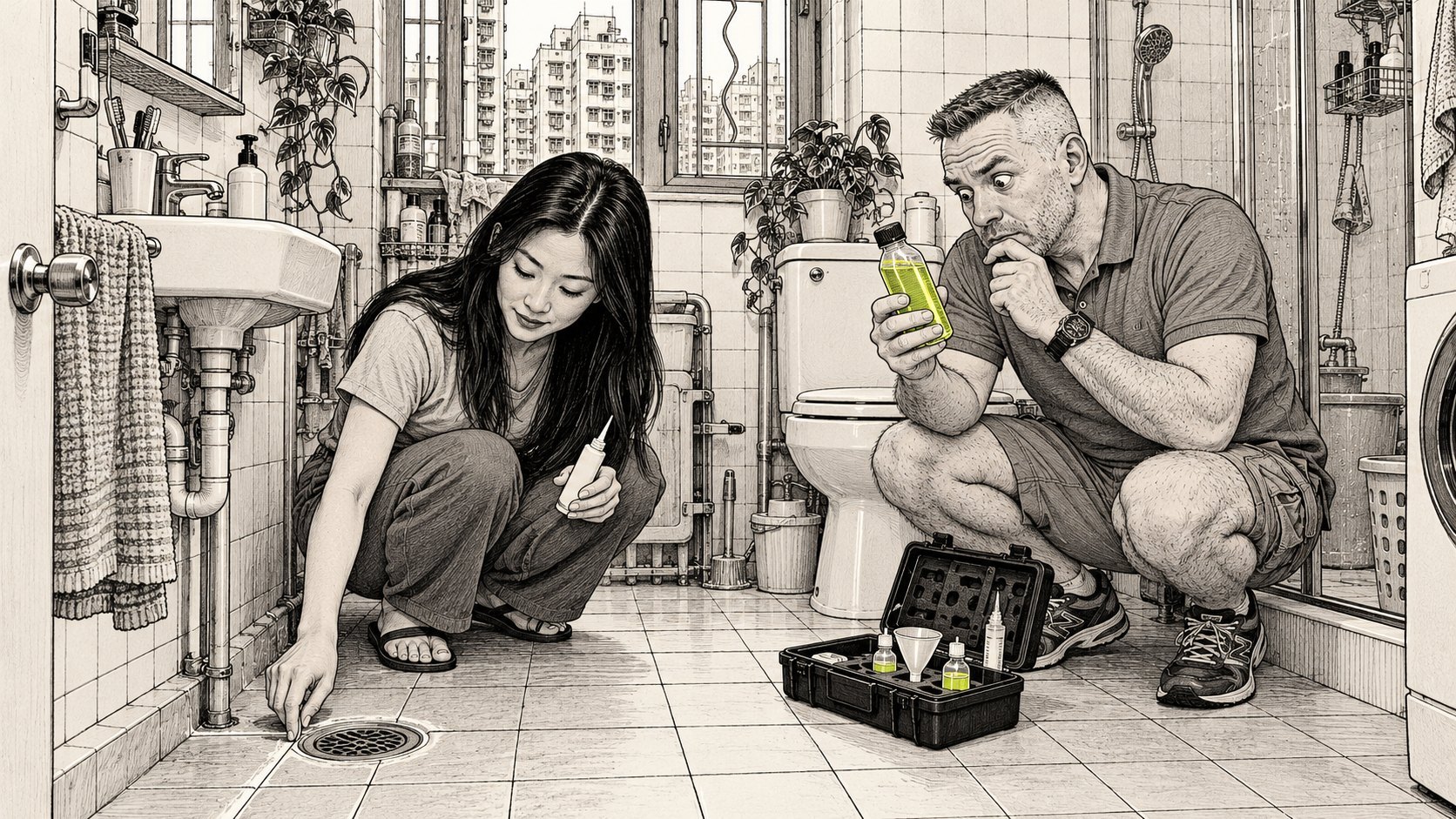
Then Ruth took over. She spent forty-five minutes in the bathroom with a tube of something, and she fixed it. When the neighbor came back, she told him the water had not come from us. Then she told him to call the hygiene department.
I can follow most of that. I can follow the repair, and with some effort I can follow the denial. The last step lost me. I have spent my career trying to keep the government out of my clients’ bathrooms. Ruth sent for it.
It came. A seepage complaint that neighbors cannot settle goes to a Joint Office set up by the Food and Environmental Hygiene Department and the Buildings Department. They arrived with fluorescent dye, put it into our pipes and drains, and watched. The test came back clean. We passed.
A clean test is a narrow thing. It found no leak that day. It does not show that nothing had ever leaked, and in our case something had, a fact the dye was too polite to raise. Ruth had repaired it first. A government official stood in our bathroom with a bottle of glowing dye and no leak to find.
Ruth fixed the leak in forty-five minutes. The government came later with fluorescent dye to confirm it. Being more efficient than the Hong Kong government is pretty damn impressive.
Comments