For those of you just joining us, I recently wrote a piece about what it’s like to travel with my wife. It covered a young man named Kevin whose faith in love was destroyed in a parking garage, a businessman who carried backup pants in his briefcase like a prophet who knew the flood was coming, and a woman who was anointed in champagne by a bottle my wife hadn’t even touched yet. (Part I is here.)
The response was overwhelming. Mostly from people telling me their own stories, which I appreciated, and partly from people telling me I should be “more supportive,” which tells me they’ve never sat next to my wife on a flight with an open beverage.
But several of you asked: surely there’s more?
There is always more.
The Gucci Incident
Ho Chi Minh City, Vietnam
My wife suggested Vietnam. I was thrilled. She’d been reading about it, she said. Wanted to experience the culture. The food. The history. And then, almost as an afterthought, she mentioned that she really wanted to visit “the Gucci tunnels.”
I looked at her.
“The what?”
“The Gucci tunnels. It’s supposed to be amazing. Everyone talks about it.”
I let this sit for a moment. I turned it over in my mind the way you turn over a strange noise in your engine, slowly, carefully, with a growing sense that something is deeply, fundamentally wrong.
“Do you mean… the Cu Chi tunnels?”
“That’s what I said. Gucci.”
“Cu Chi.”
“Right. Gucci.”
Reader, I want you to understand something. The Cu Chi tunnels are one of the most significant historical sites in Vietnam. They are an extensive underground network used by the Viet Cong during the Vietnam War, a war fought against, among others, the United States of America. The tunnels are preserved as a memorial. The tour is, shall we say, pointed in its historical perspective. It is not, and I cannot stress this enough, a luxury retail experience.
It is not, and I cannot stress this enough, a luxury retail experience.
My wife, I am now fully convinced, heard “Cu Chi” at some point, mentally autocorrected it to “Gucci,” and spent the days leading up to the trip imagining an underground shopping complex where she’d emerge with handbags.
I did not correct her in time. This is my cross to bear.
But the tunnels are not even the main issue.
The main issue is what my wife chose to wear that morning.
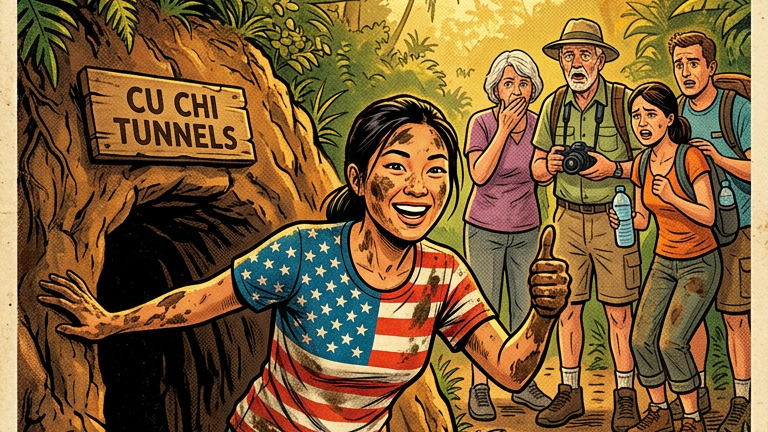
She came out of the hotel room in a T-shirt with an American flag on it. Not subtle. Not a small logo on the pocket. A full, chest-spanning, stars-and-stripes, could-be-seen-from-low-orbit American flag T-shirt. The kind of shirt you’d wear to a Fourth of July barbecue if you wanted the neighbors to know exactly where you stand.
I stared at her.
“You’re not wearing that.”
“What? It’s comfortable.”
“We are going to the Cu Chi tunnels. In Vietnam. Where they will spend three hours telling us, in detail, about American bombs falling on Vietnamese villages. You cannot wear that shirt.”
“It’s fine. Nobody’s going to care.”
Everybody cared.
The tour began with a short film. If you’ve never seen it, I’ll summarize: it is not a balanced documentary. It is not a “both sides have a point” kind of production. It is a film in which the United States is the villain, the tunnels are the triumph, and the heroes are the villagers who outwitted the American military using ingenuity, bamboo, and an unwillingness to be bombed into submission. It is, from the Vietnamese perspective, completely fair. From the perspective of a woman wearing a flag of the losing side like she’s the team captain, it is catastrophic.
We sat in a dim screening room on wooden benches while the narrator described, with great specificity, the destruction of villages, the spraying of Agent Orange, and the resilience of the Vietnamese people. Every few minutes, the film would cut to archival footage of American military operations, and I could feel, physically feel, the other tourists’ eyes sliding toward my wife’s shirt.
She sat very still. I think it was the first time she realized this was not, in fact, a Gucci outlet.
When we emerged from the screening room, the guide led us through the jungle to the tunnel entrances, pointing out booby traps that had been designed, he was very specific about this, to catch American soldiers. Punji stick pits. Trap doors. Rotating spike plates. Each one explained with a cheerful enthusiasm that suggested he genuinely enjoyed this part of the tour.
My wife, in her American flag shirt, nodded along politely. She was smiling. She was making eye contact with the guide. She was, to anyone observing from a distance, a woman who appeared to be fully endorsing the narrative while dressed as the opposition.
A French couple nearby kept looking at her, then at each other, then back at her, with expressions that cycled between horror and admiration. An Australian backpacker took a photo. I don’t know if he was photographing the tunnel entrance or my wife. I suspect my wife.
At one point, the guide invited tourists to climb down into one of the tunnels. They were tight. Claustrophobic. Designed for people significantly smaller than me. My wife went in, American flag and all, and I stood above ground watching her disappear into a tunnel that had been built specifically to evade people wearing that shirt.
She emerged five minutes later, sweating, dirt on her knees, grinning like she’d just completed a mud run.
“That was amazing,” she said.
“You look like a prisoner of war who escaped.”
“Do you think there’s a gift shop?”
There was, in fact, a gift shop. It sold war memorabilia, communist propaganda posters, and replica Viet Cong sandals made from old tires. My wife bought a magnet.
She did not buy Gucci.
She has never admitted she thought it was Gucci. She will deny it if you ask her. But I know. I know because when we pulled up to the entrance and she saw the sign, a military-style memorial arch surrounded by jungle and not a single display window, her face did something it only does when reality has diverged sharply from her expectations. It’s a micro-expression. A tiny flicker of recalibration. I’ve seen it at restaurants when the “tapas” turn out to be organ meats, and I saw it at Cu Chi when the “Gucci” turned out to be a war museum.
At least she let them know whose side she was on.
The Jackfruit Incident
San Francisco International Airport
This one predates the marriage. We were still dating, which means I was still operating under the delusion that the chaos was temporary and would stabilize once we “settled in.” I was wrong, obviously, but I didn’t know that yet. I was young. Hopeful. Not yet on a federal watchlist.
For my birthday, my wife, then girlfriend, based in Hong Kong while I was based in the US, arranged for us to meet in Thailand. Neutral ground. A romantic trip. It was genuinely wonderful. The beaches, the food, the temples. She planned it beautifully. It was one of those trips where you think, “This is it. This is the person. Everything is perfect.”
Everything was perfect.
Until I landed back in the United States.
I was walking through customs at San Francisco International Airport with the relaxed confidence of a man with nothing to declare. Tanned. Rested. Still thinking about pad thai. And then a uniformed officer stepped into my path.
He was from the Department of Agriculture. I didn’t even know that was a thing with officers. I thought agriculture was handled by people in labs with soil samples, not by a man standing in an airport corridor with a badge, a stern expression, and, I want to emphasize this, a .357 Magnum revolver strapped to his hip.
A .357. For fruit.
“Sir, are you carrying any fruits, vegetables, or plant materials?”
“No,” I said. Confidently. Because I was not carrying any fruits, vegetables, or plant materials. I had packed my own bag. I knew what was in it. Clothes, toiletries, a birthday gift from my girlfriend, and nothing that had ever photosynthesized.
He looked at me the way a man with a .357 looks at someone he doesn’t believe.
“Sir, I want to make you aware that it is a federal crime to make a false declaration to a Department of Agriculture officer. I’m going to ask you again. Are you carrying any fruits, vegetables, or plant materials?”
Now, there’s something about the phrase “federal crime” that recalibrates your confidence very quickly. I felt a small, cold pebble of doubt form somewhere in my stomach. But I pushed through. Because I knew what was in my bag. I had packed it myself.
“Officer, I’m not stupid. I do not have any fruit.”
He nodded slowly. “You don’t mind if I take a look, then.”
“Of course not.”
He reached for my bag. Unzipped it. And there, laid out on top of my clothes with the care and presentation of a department store display, not tossed in, not hidden, but arranged, were multiple packages of jackfruit.
Jackfruit.
Carefully wrapped. Neatly stacked. Sitting on top of my folded shirts like they were the centerpiece of a tropical fruit bouquet that someone had lovingly assembled while I wasn’t looking.
Which, as it turns out, is exactly what had happened.
My wife, my girlfriend, my future co-defendant, had, at some point during the trip, decided that the most romantic birthday surprise she could give me was smuggled agricultural products. She had gone to a market, selected the jackfruit, wrapped each piece individually, and placed them in my suitcase while I was in the shower or asleep or otherwise not supervising my own luggage, which I now realize I should have been doing at all times and will do for the rest of my life.
I looked at the jackfruit. I looked at the officer. I looked at the .357.
“I have no idea how those got in there.”
He did not believe me. His face made that very clear. But I think something in my expression, the genuine, unmanufactured bewilderment of a man who has just discovered he’s been turned into an unwitting fruit mule by the woman he loves, must have registered as authentic, because after a lengthy and detailed lecture about agricultural import regulations, biosecurity, invasive species, and the various federal statutes I had nearly violated, he let me go.
I called my girlfriend from the terminal.
“Did you put jackfruit in my bag?”
“Oh! You found it! Happy birthday!”
“I found it because a man with a gun found it.”
“What?”
“I was stopped by an armed federal officer because of your jackfruit.”
“They have guns? For fruit?”
“Apparently, yes. Big ones.”
She thought this was hilarious. She was not the one who had been standing in a customs corridor trying to explain to a man with a revolver why his bag was full of contraband produce.
I am convinced, fully, deeply, irreversibly convinced, that this incident put us on a list. Not a normal list. A federal fruit and vegetable surveillance list. The kind of list where your name comes up on a screen every time you scan your passport, and somewhere in a back office a man in a Department of Agriculture windbreaker looks at his colleague and says, “That’s the jackfruit guy.”
I have no proof of this. But I have evidence.
Years later, after we were married and she was applying for her US green card, we attended her immigration interview. Standard process. Documents, questions, the usual bureaucracy. And at one point the officer pulled up her file, scrolled through something on his screen, and said, with the flat affect of a man reading a footnote he finds mildly interesting:
“It says here you had an apple seized at San Francisco International Airport approximately ten years ago.”
Ten. Years. Ago.
An apple. A single apple. Seized a decade prior. And it was still on her record. Still flagged. Still following her through the federal system like a tiny, fruit-shaped shadow.
My wife looked at me. I looked at her.
“See?” I said. “We’re on the list.”
She didn’t argue. For once, she didn’t argue.
Somewhere in a government database, there is a file on my wife. It contains one seized apple and one jackfruit incident linked to her known associate, me. We are, as far as the United States Department of Agriculture is concerned, a pattern.
Closing Thoughts
People have asked me, after the first piece, whether I exaggerate. I don’t. I don’t need to. My wife generates material faster than I can write it down. I am not a creative writer. I am a stenographer for chaos.
If the first article taught you anything, it should have been this: carry backup pants, and never leave a drink unattended near my wife.
If this one teaches you anything, let it be this: check your bag. Check it twice. And if your wife suggests visiting somewhere that sounds like a luxury brand, Google it before you go.
The moral of traveling with my wife is not that things go wrong. Things go wrong for everyone. The moral is that things go wrong in ways that are so specific, so perfectly calibrated for maximum awkwardness, that they can only be explained by either divine comedy or the fact that the universe has identified my wife as its favorite straight man and me as the audience.
We’re planning another trip. She hasn’t told me where yet.
God help us all.
And God help whoever’s sitting near us, walking us to our rental car, or standing between us and customs with a .357 and a question about produce.
And Kevin, if you’re reading this, I hope you kept the Tucson, buddy. I really do.