A Torts Hypothetical Walked Into the Bar Exam
In law school, there is a class you take called Torts. Everyone takes it. It is not optional. And inside that class, usually somewhere in the first semester, you arrive at one of the most provocative questions the American legal system has ever asked itself: Is there a duty to rescue?
The answer, you learn, is no.
Not a qualified no. Not a mostly-no-with-exceptions. Just no. In the common law tradition of virtually every American jurisdiction, you have no legal obligation to help another human being who is dying in front of you. You can watch a child drown in two feet of water and walk away, and the law will not touch you. You can see a man collapse on the sidewalk and step over him. You can hear someone screaming for help and put in your earbuds. The law does not require you to be decent. It does not require you to be brave. It does not even require you to be present, in any meaningful sense, to the suffering of the person next to you.
This is the no-duty-to-rescue rule, and it shocks every first-year law student who encounters it. It is supposed to shock you. That is the point. The professor lays out the hypothetical and waits for the outrage, because the outrage is the lesson. The lesson is that the law and morality are not the same thing, and that the distance between them is sometimes a canyon.
And every year, the same debate follows. Someone in the back of the room asks why we don’t just pass a law requiring people to help. A few states have, sort of. Minnesota says you have to provide reasonable assistance if you know someone is in grave physical danger. Vermont and Rhode Island have something similar on the books. But most of the country has never gone there, and in the classroom, most students end up agreeing that it is probably right not to try.
Not because we are heartless. Because we are lawyers, or we are learning to be, and lawyers understand that legislating morality is a treacherous business. Where do you draw the line? How much risk are you required to assume? What counts as an emergency? What counts as help? The hypotheticals multiply, the edges blur, and by the end of the discussion most of us have talked ourselves into the same comfortable conclusion: we don’t need a law for this, because who would actually fail to come to someone’s aid? The duty-to-rescue debate is an interesting intellectual exercise, but in the real world, if a person is gasping for air and turning blue on the floor in front of you, nobody needs a statute to tell them what to do.
That was the assumption. That was what we all believed.
Well. Here we are.
On July 30, 2025, Mary Jane Jung, a 36-year-old Fordham Law School graduate, was taking the morning session of the New York State Bar Examination at Hofstra University’s David S. Mack Sports and Exhibition Complex. Shortly before the scheduled lunch break, she gasped for air. She cried out. She lost consciousness, fell out of her chair, and her skin turned blue on the floor of the exam hall while over six hundred other test-takers sat around her.
What happened next is the subject of lawsuits filed last week, and the allegations read like the kind of hypothetical a Torts professor would be embarrassed to use because no student would believe it.
According to the complaint and multiple eyewitness accounts, when other candidates tried to help, proctors told them to be quiet and sit down. One eyewitness told ABC7 that when students tried to wave over a proctor and said a person had fainted, the proctor responded: shut up, and continue with the exam. Candidates did not have their phones. They had surrendered them per exam rules. They could not call 911 themselves. The complaint alleges Hofstra did not summon emergency services with the urgency the situation required. No one in the room asked whether there was a doctor, a nurse, or an EMT among the six hundred people sitting there. The exam did not stop. The clock did not stop. Everyone was told to keep working.
Think about that for a moment. A woman was in cardiac arrest. She was not breathing. She was turning blue. And the institutional response, from the people charged with administering the gateway examination to a profession that holds itself out as a guardian of justice, was: keep your head down and bubble in your answer on negligence.
One eyewitness told ABC7 he believes it was more than seven or eight minutes before anyone came to administer CPR. Hofstra and the chair of the New York State Board of Law Examiners dispute this, saying public safety officers responded within about two and a half minutes and provided CPR and defibrillation until paramedics arrived. What is not in dispute is that the exam did not stop. When the scheduled lunch break arrived, candidates were told to leave. One eyewitness described being instructed to step over her on the way out. Then they were told to come back an hour later and finish the afternoon session. No one told them whether the woman on the floor was alive or dead.
Jung survived. She has not come out of this intact. Her lawsuit alleges the cardiac arrest was accompanied by hypoxic injury, meaning her brain was deprived of oxygen during the delay. She has been diagnosed with ventricular fibrillation. She has had a defibrillator surgically implanted in her chest. She continues to experience memory loss and cognitive impairment. Her complaint alleges that these injuries are permanent.
And here is the detail that should follow you home. A list of results from the July 2025 New York bar exam includes Mary Jane Jung’s name among those who passed. She passed. She suffered cardiac arrest, sustained a brain injury, and still passed the bar exam that the proctors would not pause to save her life.
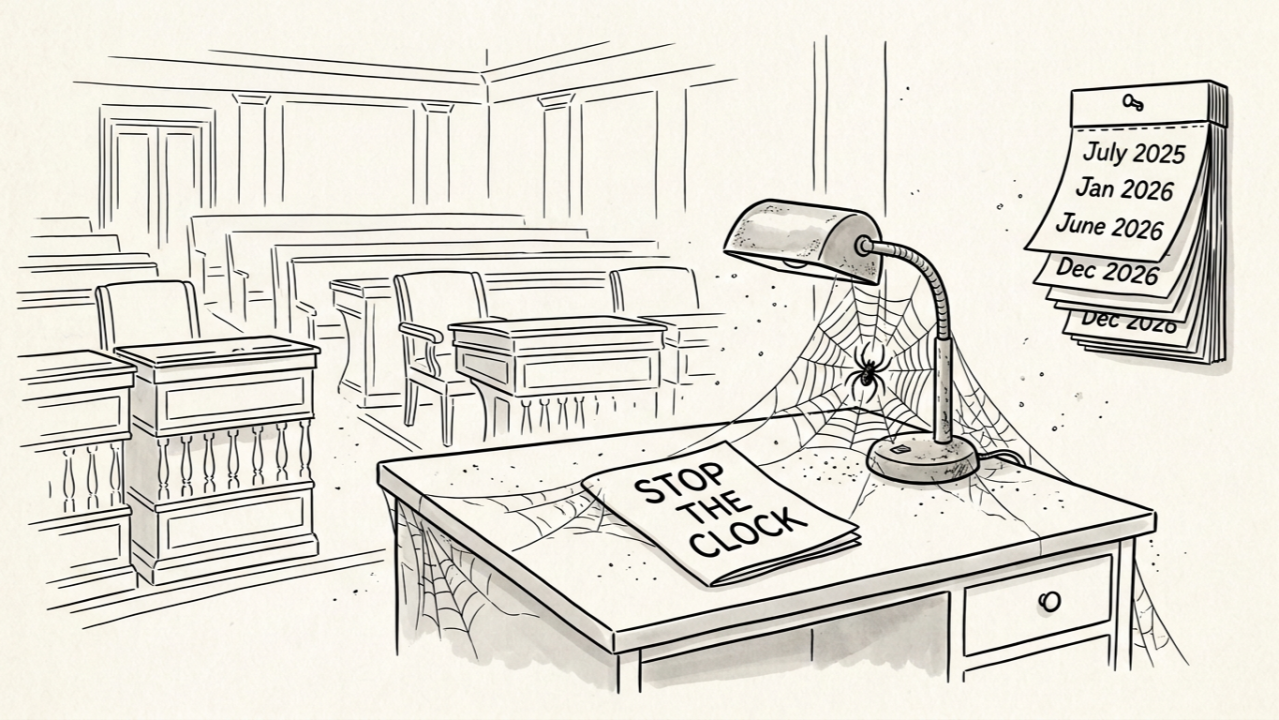
Two weeks after the incident, Assemblymember Rodneyse Bichotte Hermelyn introduced the Clock Should Stop Act, a bill that would require bar exam proctors to pause the exam for medical emergencies, allow proctors to use their cell phones to call 911, and provide accommodations to test-takers who witnessed the emergency. The bill’s legislative-intent section recounts Jung’s collapse in clinical detail. The Senate version passed on May 19, 2026, by a vote of 58 to 1. It was delivered to the Assembly and referred to the Judiciary Committee, which is chaired by Charles Lavine, the same assemblyman who in August 2025 sent a letter to the Board calling the response “disorganized, delayed, and lacking in clear protocol.” The bill has been sitting in his committee ever since.
It has been over a year. The bill that says “stop the test and call 911 when someone is dying” has not become law. The system that produced this outcome has not changed. And the institution that prides itself on testing whether candidates possess the minimum competence to practice law revealed, in the space of a single morning, that it does not possess the minimum competence to protect human life in its own examination room.
I keep thinking about that Torts class. I keep thinking about the no-duty-to-rescue hypothetical and the confidence with which we all dismissed it. We were so sure. We were so sure that the debate was academic, that the hard case would never actually present itself, because no reasonable person in a room full of aspiring lawyers would ever watch someone die and do nothing.
We were wrong. Not about the people. The candidates tried to help. They stood up. They waved. They shouted. They begged the proctors to call for help. The candidates behaved exactly the way we all assumed human beings would behave when they see another human being in distress.
The institution told them to shut up and keep testing.
That is the lesson. It is not a lesson about individuals. Individuals, left to their own moral instincts, will generally do the right thing. The lesson is about systems. Systems do not have moral instincts. Systems have protocols. And when the protocol says the exam must continue, the exam continues, even if someone is dying on the floor, even if every person in the room knows it is wrong, even if the very test they are taking includes a question about the duty of care.
We spent all that time in law school debating whether the law should require people to be decent. We wondered whether you could legislate morality. We concluded, most of us, that you probably shouldn’t try, because decent people will do the decent thing without being told.
What we never considered is that you might need the law not to compel decency in individuals, but to prevent institutions from actively obstructing it.
A room full of future lawyers tried to rescue Mary Jane Jung. The institution that will decide whether they are fit to practice law told them to stop.
You want to know whether there is a duty to act? Ask the people who stood up. They already answered the question. They answered it before anyone had to ask.
The system needs to catch up to the people it claims to serve. Because right now, the only thing the bar exam proved on July 30, 2025, is that the candidates were ready.
The institution was not.