The Trophy Case
How Hong Kong’s legal awards industry misleads the public.
It starts with an email. It always starts with an email.
“Dear [Name], we are pleased to inform you that your firm has been shortlisted as a finalist for the [Prestigious-Sounding Noun] Awards in the category of [Practice Area You May Or May Not Actually Do].”
The first time you get one, you feel something. A little swell of pride, a brief, warm moment where you think, maybe someone noticed. Maybe the years of late nights and early mornings and difficult clients and difficult opposing counsel have finally been recognized by an independent panel of distinguished professionals who spent weeks carefully evaluating the field and determined, through a rigorous and transparent process, that you are among the very best.
Then you scroll down and see the pricing.
A table for ten at the ceremony, which is always at a five-star hotel. Always. The email never says “Holiday Inn Ballroom C.” It says Grand Hyatt. It says Fullerton. It says JW Marriott. The table costs somewhere between seven and twelve thousand US dollars, depending on the prestige of the trophy and the thread count of the napkins. There is also a sponsorship package, which comes with your logo on the event program, a full-page profile in a glossy publication that will be “widely distributed to our community,” and, presumably, a warm feeling that no amount of money should be able to buy but apparently can.
You are also told that the judging process is completely independent. This is stated several times. In fact, in my experience, the more often the word “independent” appears in the email, the more likely it is that someone will soon ask for your credit card details.
I know this because, despite having not practiced family law in the United States for more than fifteen years, I recently received a message informing me that my firm had been shortlisted for a family law award in New York. This was interesting for several reasons, not least because I do not have a firm in New York, and if I did, I would hope someone might have mentioned it to me.
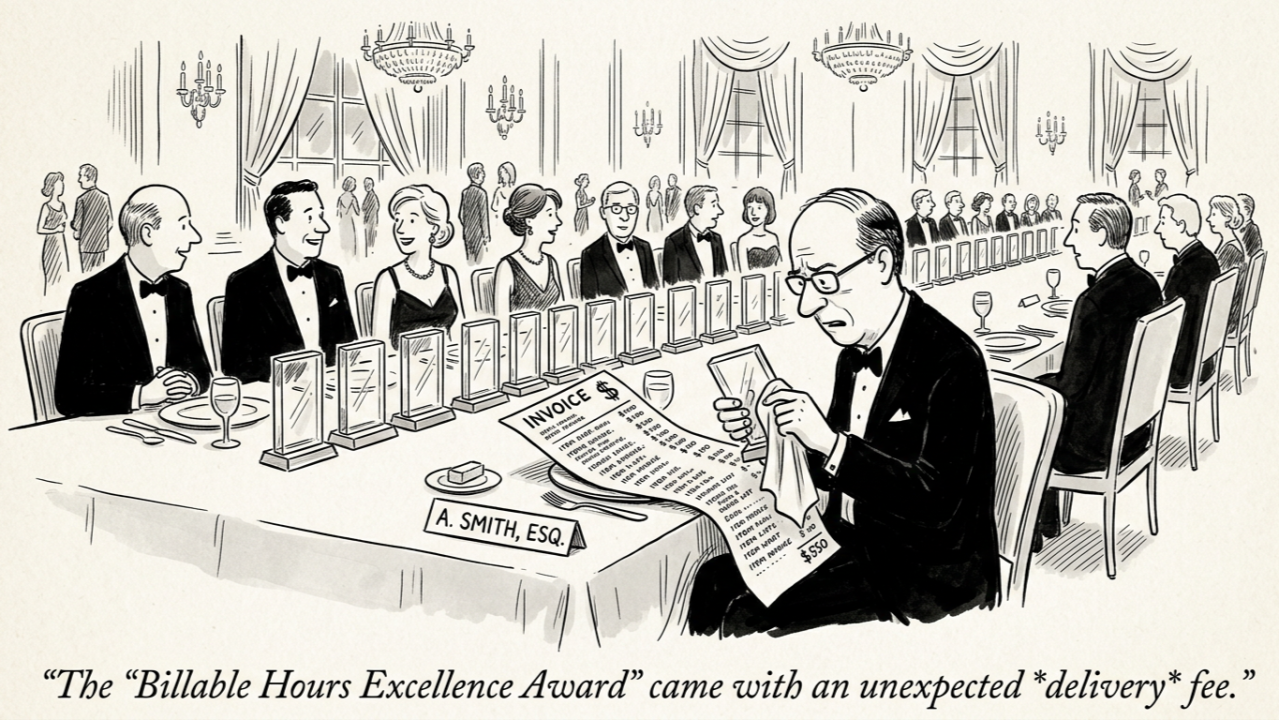
In the fine print, two things caught my eye. First, the organization clarified that winners are chosen based on “the overall strength of nominations, supporting evidence, and independent research.” Second, it noted that there is no obligation to attend the gala dinner, but that winners who do not attend may collect their trophy later or arrange delivery. Which is a very elegant way of saying: the award is yours whether or not you buy the chicken.
I forwarded the email to my colleague with one line: “See, I can buy an award and I do not even have to practice there.”
And that is what set me off, because the thing is, we cannot do this ourselves. I cannot create a website tonight called the Global Excellence in Matrimonial Distinction Awards, email ten firms in Central, and then sell them a table at the Four Seasons in exchange for a crystal obelisk and a flattering paragraph about their commitment to client service. Well, technically I could. But if I did, everyone would immediately understand that I was running a racket. The only reason this works when established publishers do it is that they have letterhead, a ballroom, and the confidence of institutions that have never once been told to calm down.
But here is the loophole, and it is the size of a five-star hotel ballroom. I can nominate someone else. I can nominate any lawyer I like. I can nominate a friend, a former colleague, a person whose website I found at two in the morning, or, if I am feeling civic-minded, the one lawyer in town who actually returns phone calls and explains things in plain English. I can also, in some cases, nominate myself by having someone else send the email. The forms do not usually ask the only question that matters, which is: compared to whom, and according to what measurable standard?
The public does not know this. A person searching for a divorce lawyer at midnight after finding out that their spouse has been moving money through a cousin’s company in the British Virgin Islands sees a row of badges and assumes they mean something. Best Family Lawyer. Top Private Client Adviser. Elite Practitioner. Recommended by Leaders in Law. The language varies. The implication does not. Someone official has looked at the field and concluded that this person is excellent.
And here is what frustrates me most. There is no such thing as the “best” lawyer in Hong Kong in the abstract, any more than there is a best surgeon, best teacher, or best parent. There are lawyers who are excellent at cross-border asset tracing, lawyers who are brilliant in court but terrible at client communication, lawyers who are humane and strategic and worth every cent, and lawyers who are famous because they have a good photographer. There are also lawyers who are very good at being nominated for things.
One firm I have been watching, and I use the word “watching” the way a person uses it when observing a raccoon work its way into a locked rubbish bin, has won eleven awards in a single year from one of these organizations. Eleven. At a certain point, the question is not whether the firm is excellent. The question is whether the awards body has confused legal analysis with wholesale distribution.
I have been on the other side of that firm. I have read their filings. I have corresponded with them. I have seen how they litigate. I am not naming them here because this is not about one firm. It is about a system in which the appearance of excellence can be bought, borrowed, packaged, and displayed in a sidebar while ordinary people, who do not know how these things work, are expected to treat the badges as evidence.
Another prominent firm in the private client space has stacked up awards from a publication that openly sells sponsorship packages tied to the ceremony. Again, I am not saying every winner is undeserving. Some of them are excellent. Some of them are probably too busy to care. But the structure itself is rotten. If the same company that profits from the event is also the one conferring the prestige, then the prestige is not independent. It is inventory.
One organization’s FAQ puts it with a clarity so beautiful it almost reads as satire: awards are free to enter, but winners may wish to capitalize on their success by purchasing promotional opportunities. There it is. The whole machine in one sentence. The hook is recognition. The product is monetized visibility.
And that is the model.
An organization, usually a publishing company or media group or events firm with a polished website and a serious font, creates a category structure broad enough to catch half the profession. It invites nominations. It announces shortlists. It names winners. It hosts a gala. It sells tables, profiles, sponsorships, logo placements, reprint rights, and social media packages. The winners get a badge for their website and a trophy for the reception desk. The organizer gets revenue. Everyone gets content. The public gets misled.
But the problem, and it is a real problem, not a rhetorical one, is about the people who are not in the room. The clients. The families. The spouses trying to figure out who can be trusted with their children, their money, their future, their immigration status, their business, their freedom. They are asked to infer quality from symbols that often reflect marketing budgets more than merit.
That is the harm. Not to the lawyers who skip the ceremony. To the public. To the person who thinks a trophy means rigor. To the person who assumes a badge means scrutiny. To the person who does not know that a nomination can come from anyone, that a shortlist can be built from thin evidence, and that a gala dinner invoice can sit quietly in the background like a stagehand dressed in black.
Someone once nominated a dog for one of these awards in the United States. The dog won. I think about that often, partly because it is funny, and partly because it is clarifying. The dog did not expose a flaw in one publication. The dog exposed the business model.
Now, to be fair, and I am always fair even when I do not want to be, there are directories and rankings that do serious work. Some conduct extensive interviews, verify matters, speak to peers and clients, and make real efforts to distinguish between reputation, competence, and puffery. But those systems are labor-intensive, imperfect, and expensive to run. They are not built around selling a ballroom table and a commemorative plaque.
I mentioned all of this to Ruth. She asked how much the membership costs. I told her there is usually no membership, just the dinner, the sponsorship, the profile, the badge, the package, the package upgrade, and perhaps a strategic advertorial if you really want to lean into the theatre of it all. She said, “So it is basically a school fundraiser with better wine.”
She is right about the wine.
She is wrong about skipping the ceremony, because the ceremony is not about the wine. It is about the photograph. It is about the badge. It is about the LinkedIn post the next morning announcing that the firm is “honoured” and “humbled” and “delighted” to have been recognized for its “unwavering commitment to excellence,” which is a phrase that should now be taxed by the syllable.
And the checks keep clearing. And the trophies keep coming. And every September or October or November, another crop of badges blooms across the websites of firms that would like you to believe the market has spoken.
I will not be at the table. But I will know who won. I always do. It has been that way for years. The inbox fills. The logos multiply. The crystal accumulates. Somewhere in a ballroom, someone says the word “independent” into a microphone while the chicken goes cold.
Maybe next year they will make it an even dozen. The trophy case probably has room.