I live in Hong Kong, which means I live inside a five-hour circle of entirely different worlds. I have written about this before, how I can eat congee in Sheung Wan at breakfast and stand in a Shinjuku crosswalk by dinner, how the proximity of fifteen countries within a five-hour flight radius changes the way you think about weekends, about distance, about what counts as far away. I have done this more times than my wife thinks is reasonable.
But Japan keeps pulling me back, and not for the reasons most people expect. Not for the temples. Not for the ramen rankings. Not even for the trains, which arrive so precisely on time that you could set a Swiss watch by them and the Swiss would not complain. Japan keeps pulling me back because it is the only hyper-modern country on earth that has figured out how to let the past live inside the present without turning it into a museum or a theme park. And because every time I go, I recognize something I used to have.
I was born in the 1970s. I grew up in Adams, Massachusetts, a small town in the Berkshires where everyone knew everyone and the businesses on Park Street had been there longer than most of the people walking past them. The diner where the waitress called you honey. The hardware store where the owner could tell you which screw you needed by looking at the thing you were trying to fix. The barber who did not need to ask how you wanted it cut because he had been cutting your hair since you were six. That town taught me what it feels like when a place has memory built into it, when the buildings and the people and the rhythm of a street all know each other.
When I moved to Hong Kong, I found some of that same texture, just in a different language. Small shops run by one person who knew your name. Noodle stalls where the uncle had been making the same dish for thirty years and had no interest in discussing his brand strategy. Watch repairmen. Cobblers. Dai pai dongs where the wok had more history than most corporations. That Hong Kong is mostly gone now. The landlords came. The chains came. The rents tripled and then tripled again, and one by one the old places closed, not because they failed, but because the economics of staying small became impossible in a city that only values getting big. I walked past a storefront in Wan Chai last year that had been a family-run congee shop for decades. It is a chain pharmacy now. Nobody held a funeral.
Ruth, who has been reading these pieces longer than most of you and has never once agreed with me quietly, told me I was being dramatic. She said Hong Kong still has plenty of character, I just need to look harder. I told her the last place she recommended turned into a Sasa two weeks after she recommended it. She did not respond to that, which is how you know you have won an argument with Ruth, because the silence only lasts until her next message.
Then you fly five hours to Tokyo and walk through Shimokitazawa on any given afternoon and you see what it looks like when a city decides the small is still worth keeping. There is New York Joe Exchange, a vintage store built inside an old public bathhouse, where you browse racks of military jackets and nineties band tees beneath the original tiled walls. The name itself is a joke, a pun on “nyu-yoku-jo,” the Japanese word for bathhouse. On the first Sunday of every month, everything is half price, and the line forms before the doors open.
Down the street is Flamingo, where a buyer flies to the United States regularly to handpick American vintage from the forties through the eighties. Around the corner is a shop called Monk, which is not large, but the product density is staggering, and the owner has an opinion about every piece on the rack. Ask him about a particular jacket and you will get a fabric history, a provenance lecture, and a story about the factory that closed decades ago, delivered with the quiet pride of someone who believes that knowing things deeply is not a waste of time. In Hong Kong, that man would have been priced out of his lease three years ago and replaced by a bubble tea franchise. In Shimokitazawa, he is still there. He will probably still be there in ten years.
Head a few stops down the Chuo Line to Koenji and the temperature changes. If Shimokitazawa is curated, Koenji is feral. The shops are edgier, the prices are lower, and you are as likely to stumble into a store that specializes entirely in military surplus as you are one that looks like a time capsule from 1974, with clothes piled in baskets, prices scribbled on handwritten signs, and the promise of a two-hundred-yen gem buried somewhere inside. I walked into a record shop there on a side street, having spotted a sandwich board from the sidewalk, and found myself in a room the size of a bedroom surrounded by jazz vinyl organized by instrument. Not by artist. By instrument. Trumpet in one bin. Piano in another. This is a country where the clerk behind the counter will clean a record with a lint-free cloth while you wait, reseal it in plastic after you listen, and if you decide not to buy it, say “cancel” with a small bow as if you have done nothing wrong, because you have not.
That record shop is not an outlier. Tokyo alone has well over a hundred vinyl stores, and the jazz ecosystem is a world unto itself. Disk Union operates dedicated jazz locations across the city, entire floors sorted by subgenre, and their Shinjuku branch is an eight-story monument to physical music where you could lose a full afternoon on a single floor and walk out with a 1967 Blue Note pressing in near-mint condition because Japanese collectors take care of their records the way most people do not take care of their children. The vinyl does not end up there by accident. It ends up there because Japan wanted it more.
This is not an accident of personality. It is baked into the culture at the molecular level. The Japanese have a word, monozukuri, which translates loosely as the art of making things, but that translation does not capture the weight of it. Monozukuri is closer to a covenant between the maker and the object. The shokunin, the master craftsman, builds something with the expectation that it will outlive him. A bag. A bowl. A chair. These are not products. They are small acts of faith in the future. And when an entire society builds things that way, you do not end up with landfills. You end up with vintage shops, because the raw material keeps surviving.
Nowhere is this clearer than in Kasama, a small city in Ibaraki Prefecture about ninety minutes north of Tokyo, where a sake brewery called Sudo Honke has been operating since 1141. That is not a typo. Eleven forty-one. The Second Crusade had not yet begun. The Sudo family were samurai who decided to put down their swords and brew sake instead, and fifty-five generations later, they are still at it. The current head of the family, Genuemon Sudo, runs the brewery on the same land, using water from the same wells his ancestors dug nearly nine hundred years ago. The family motto, passed down across every one of those fifty-five generations, is five words: sake, rice, soil, water, tree. The idea is simple. Good sake requires good rice. Good rice requires good soil. Good soil requires clean water. Clean water requires the protection of trees. So the family’s oldest rule, older than most countries, is: never cut the trees around the well. In 2011, after the Fukushima nuclear disaster, the brewery feared the water in their ancient wells had been poisoned and they would have to close forever. They tested the water. It was clean. They kept brewing. Because of course they did.
Try to imagine that story in Hong Kong. A family business lasting fifty-five generations. The thought is almost funny. In Hong Kong, fifty-five months feels like an achievement. The rent cycle is a meat grinder. The moment a neighborhood gets interesting, the landlords notice, the rents spike, and the people who made it interesting are the first to go. Sham Shui Po was full of fabric merchants and street-level hawkers who gave the neighborhood its soul. Now the soul is being priced per square foot. Hong Kong does not lose its old places because they fail. It loses them because success in one form triggers eviction in another.
But culture alone does not explain why Japan still has what Hong Kong has lost. That part is architecture. Japanese cities were not designed by highway planners who believed everyone should drive forty minutes to a box store. They were designed by people who walked, and they are still designed for people who walk. The streets are narrow. The buildings are narrow. The shops are narrow. The math works precisely because the ambition is small.
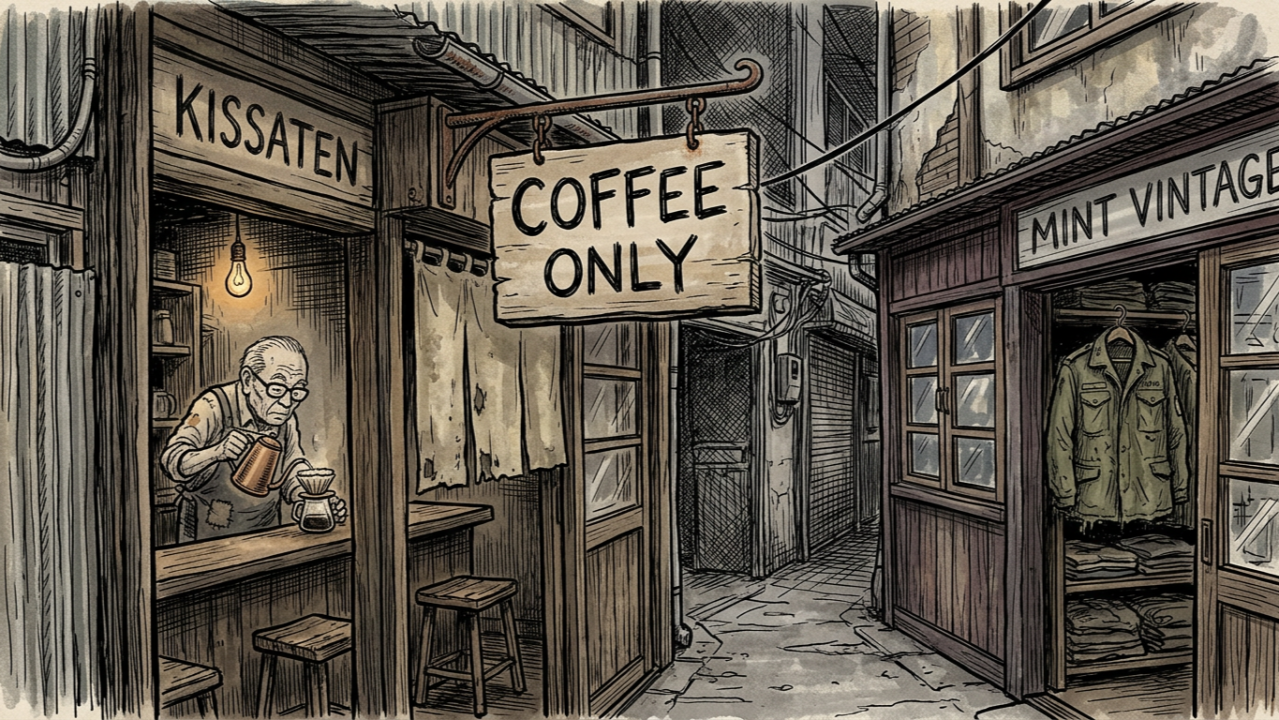
This is the part that cities like Hong Kong get wrong over and over again. They zone for scale. They build for chains. They court the flagship tenants and the luxury brands and then wonder why the street-level character evaporates like steam off a wonton cart. Japan kept the micro-business alive not through policy, but through geometry. The buildings are so small that Starbucks literally cannot fit inside most of them. And so an old man keeps roasting his own coffee in a kissaten the size of your living room, serving it in the same ceramic cups he has used for decades, and nobody asks him when he plans to franchise.
The kissaten is the part of Japan I think about most when I am back in Hong Kong, sitting in a lobby that was renovated six months ago and will be renovated again next year. At their peak in 1981, there were over 154,000 kissaten in Japan. By 2021, the number had fallen to around 58,700, mostly because the owners aged out and had nobody to take over. Japan is not immune to loss. But the ones that remain are extraordinary.
In Ginza, there is a kissaten called Café de L’Ambre, founded in 1948, where a sign outside the door reads “Coffee Only” and means it. No lattes. No pastries. No Wi-Fi. Just coffee. The founder, Ichiro Sekiguchi, was a man who stumbled across old green beans one day, roasted them on a whim, and was so stunned by the flavor that he spent the rest of his life aging coffee the way others age wine. He ran the café until his death in 2018 at the age of 103, and his team still serves the coffee exactly the way he taught them, some of it brewed from beans aged for decades, poured through flannel filters into small porcelain cups. The grinder behind the counter is from 1948. The method has not changed because nobody who works there believes it should.
In Shinjuku, Tajimaya Coffee House has been run by three generations of the same family since 1964. The grandfather started a business at that exact spot after the war, selling suitcases and everyday goods to the salarymen and drifters and entertainers who all converge in that neighborhood. In 1964, the year of the Tokyo Olympics, he converted it into a coffeehouse. The current owner, Mitsuo Kurata, still roasts every batch in-house and offers more than sixteen varieties, because his grandfather did not believe in serving only one kind of coffee any more than he believed in serving it fast. The café sits at the edge of Omoide Yokocho, the narrow lantern-lit alley of tiny bars that Shinjuku locals call Memory Lane, and if you climb the creaky wooden staircase to the second floor you will find yourself in a low-ceilinged, attic-like room with antique stained-glass lamps, pendulum clocks, and the sound of jazz drifting up from somewhere below. In Hong Kong, a place like that would have been gutted for a co-working space by now.
A kissaten does not renovate. A kissaten just deepens. The wood gets darker. The leather gets softer. The menu does not change because the owner does not believe it needs to. You walk in and order a hand-dripped coffee poured through a flannel filter that takes four minutes, not because the owner is being precious, but because that is how his teacher taught him, and that is how his teacher’s teacher taught him before that. Flannel-drip coffee was pioneered in Japan. Pour-over was perfected in Japan. The entire third-wave coffee movement that now fills Brooklyn and Melbourne with twenty-dollar lattes owes a direct debt to these small, dark, wood-paneled rooms where someone has been pouring cups of coffee one at a time for forty years.
The food tells the same story, only louder. Jiro Ono started working in a restaurant at the age of seven. He became a sushi chef at twenty-five. In 1965, he opened Sukiyabashi Jiro, a ten-seat sushi bar in the basement of a building near a subway station in Ginza. He won three Michelin stars in 2007 and became the first sushi chef ever to do so. He served Barack Obama, but only after telling the government the restaurant was fully booked, and they would have to come later in the evening. He gave a one-word answer: work.
Down in Azabu-Juban, Sarashina Horii has been making soba noodles by hand since 1789, the same year George Washington was inaugurated as the first President of the United States. The current operation is the ninth generation of the Horii family. The noodles are pure white because they use only the heart of the buckwheat seed, a technique that traces back to the restaurant’s founder, a textile merchant from Shinshu named Nunoya Tahei who was encouraged by his feudal lord to stop selling cloth and start making soba, because his noodles were that good. The soba gained favor with the Tokugawa shoguns and later the Imperial household. Over in Kanda, Yabu Soba has been serving since 1880, and the line still wraps around the building. They rebuilt it and reopened in October 2014. Because of course they did.
And here is the irony that makes all of this even more interesting. Japan is also the country that gave the world Uniqlo, a brand so efficiently uniform that you could dress the entire planet in the same grey crewneck and nobody would notice. The Japanese wear Uniqlo on Monday. On Saturday, they go to Shimokitazawa and spend three hours hunting for a 1967 military field jacket that nobody else on the train will be wearing. The vintage scene is not a rejection of the mainstream. It is the release valve.
Japan teaches you something if you pay attention. Progress and preservation are not opposites. You do not have to bulldoze the past to build the future. You can run one of the most technologically advanced societies on earth and still leave room for the man who has been making the same tonkatsu in the same six-seat restaurant for forty years, or the family that has been brewing sake from the same well for nearly nine centuries, or the woman running a denim shop the size of a parking space who believes that a well-made jacket is not old, it is unfinished.
I think about this every time I land back at Chek Lap Kok and ride the train into a skyline that looks slightly different than it did last month. Hong Kong is my home. I love it the way you love something you are watching change into something you do not entirely recognize. It was simply replaced, one lease at a time, by a city that is newer, shinier, and somehow less interesting.
Japan showed me what it looks like when a place decides that the old man and his folding table are not in the way of progress. They are the point of it. That the measure of a great city is not how fast it can replace itself, but how much it is willing to carry forward. A well that has given clean water for nine hundred years. A cup of coffee poured the same way since 1948. A man who turned one hundred and said the secret was one word.
I will keep booking that five-hour flight. Not because Japan is exotic. Because Japan remembers what Hong Kong is trying to forget.