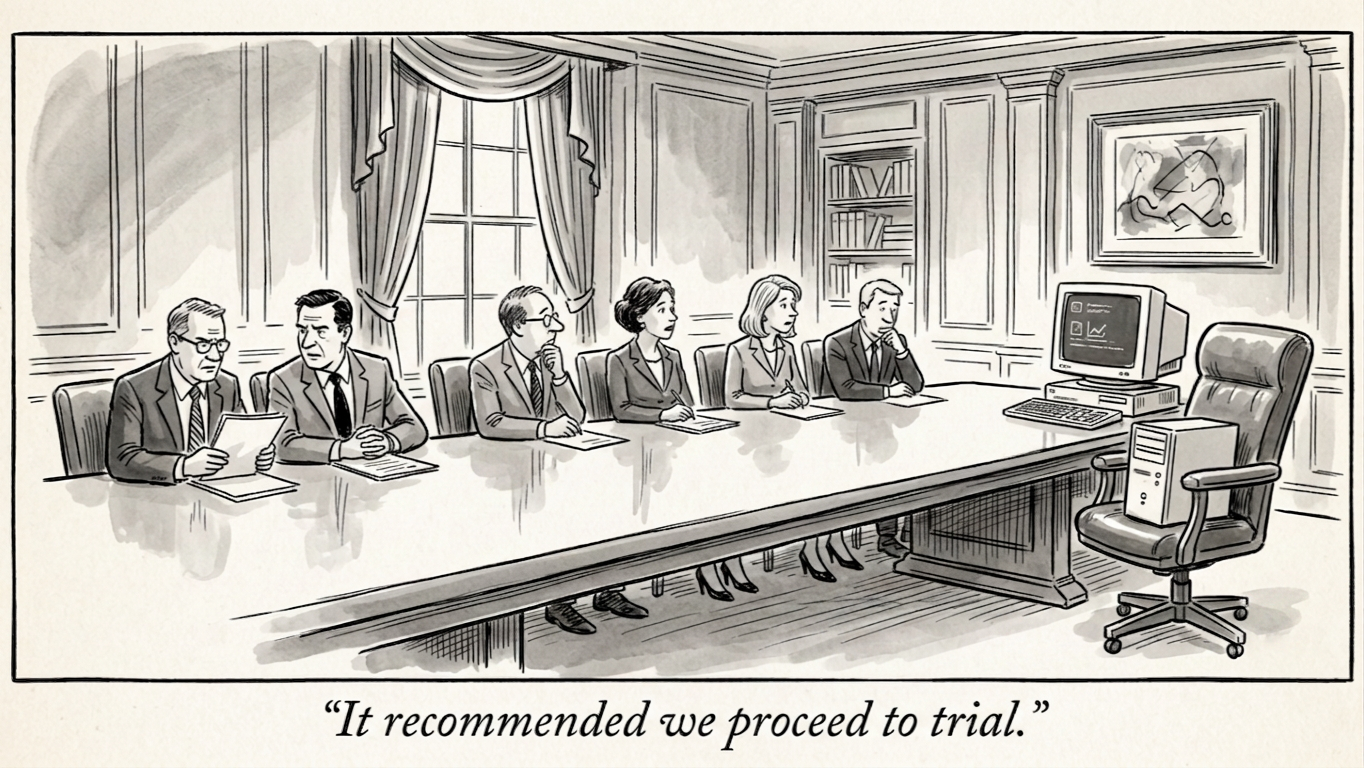
A computer likely told them not to settle.
I spent years as a trial attorney in the United States. I tried, mediated, and arbitrated hundreds of personal injury cases. And I can tell you with near certainty what happened in the C.H. Robinson case before the jury ever sat down.
A computer likely told them not to settle.
On March 25, 2021, a tractor-trailer operated by a small carrier called Lupus Superior rear-ended stopped traffic on Interstate 20 in Mississippi. The crash triggered a multi-vehicle fire that killed three people, Jennifer Lipe, Benjamin Brewer, and Rhoderick Coleman. The driver, Gorgonio Gonzalez, also died. All three victims left behind children.
Everyone is writing about AI. About how C.H. Robinson’s artificial intelligence infrastructure, its hundreds of AI agents, its 450-person engineering team, its 40% productivity gains, became evidence of control over the driver. And that is a fair point for the future of the industry. But it has almost nothing to do with this case. The accident happened in March 2021. ChatGPT did not exist yet. C.H. Robinson’s AI buildout came later. The technology that matters in this case is much older, much quieter, and much more dangerous.
Since the late 1980s, insurance companies in the United States have used computerized claims evaluation software to calculate the settlement value of personal injury claims.
Since the late 1980s, insurance companies in the United States have used computerized claims evaluation software to calculate the settlement value of personal injury claims. The most well-known system is called Colossus. Most major carriers use some version of it. The software takes inputs, diagnosis codes, treatment duration, medical costs, jurisdiction, and produces a settlement range. Adjusters are typically prohibited from settling above the range the computer generates. The system works reasonably well for routine claims. Soft tissue injuries. Minor rear-end collisions. The cases that make up the vast majority of an insurer’s book.
It does not work well for cases where three parents burned to death in their cars on an interstate while their children grew up without them.
No algorithm can calculate moral outrage. No software captures the moment a jury sees photographs of burned-out vehicles and then learns that the driver told his company he was too sick to drive, and they let him keep going. No computer accounts for the fact that at two in the morning on the day of the crash, the driver secretly drove four hours off-route, 164 miles north of where he was supposed to be, then falsified his logbooks to hide it. No claims evaluation tool has a field for “the carrier had 26 crashes, seven fatalities, and fifteen injuries on its federal safety record, and the broker hired them anyway.”
Settle.
This is the kind of case that any experienced trial attorney looks at and says one word. Settle.
Zero comparative fault on any of the victims. Catastrophic injuries, the worst kind, burn deaths. Children left behind. A carrier with a horrific safety record. A driver who was visibly unfit to drive. A broker that arguably had the power to pull him off the road and chose not to. You could not design a worse set of facts for a defense. There is no closing argument in the world that makes a jury feel good about C.H. Robinson’s position in this case. You are simply handing twelve people a calculator and a reason to be angry.
C.H. Robinson disclosed $155 million in per-occurrence liability and excess coverage for this period, subject to a $5 million deductible.
C.H. Robinson disclosed $155 million in per-occurrence liability and excess coverage for this period, subject to a $5 million deductible. That structure matters more than people realize. Under a deductible or self-insured retention arrangement, the insured company often manages the claim internally within that first $5 million layer. The excess carriers above do not fully engage until it becomes clear the claim will blow through the retention. That creates a dangerous window. The company managing the early stages of the claim may not have the litigation experience, the emotional distance, or the risk tolerance that a seasoned coverage attorney would bring. And by the time the excess carriers take over and appellate counsel gets involved, the case may already be entrenched in a litigation posture. Positions harden. Plaintiff demands increase. The window for a reasonable settlement narrows or closes entirely.
We know from C.H. Robinson’s own CEO that the company and its insurers declined to settle based on the plaintiffs’ demands.
We know from C.H. Robinson’s own CEO that the company and its insurers declined to settle based on the plaintiffs’ demands. We know they had appellate counsel present at trial. That tells you something important. By the time this case went to a jury, the defense believed they had viable appellate issues, likely around the borrowed employee theory and whether a freight broker can be held vicariously liable for a carrier’s driver. They may well be right on the law. But being right on the law and being smart about risk management are two very different things.
Here is what nobody is saying about the role of computers in this case.
The jury found C.H. Robinson only 23% at fault. The driver got 45%. Lupus Superior got 32%. On paper, that looks like a defense win on the negligence question. But the plaintiffs had already threaded the needle. They convinced the jury that the driver was acting as a borrowed employee of C.H. Robinson, that the broker exercised enough control over the shipment, the schedule, the penalties for late delivery, that the driver was effectively working for them.
Here is what nobody is saying about the role of computers in this case.
C.H. Robinson’s insurance carriers almost certainly ran this claim through some version of computerized evaluation software. That software almost certainly produced a number. And that number was almost certainly a fraction of what the jury awarded. The computer looked at comparable verdicts, medical costs, loss of earnings, wrongful death ranges by jurisdiction, and it produced a rational, defensible, mathematically supportable figure. And that figure gave the carriers confidence that the plaintiffs’ demand was unreasonable, that trying the case was the right business decision.
But there is something that every trial attorney knows and every computer misses.
But there is something that every trial attorney knows and every computer misses. Juries are not rational when children lose their parents to fire. They are not interested in comparable verdict data when they see photographs of what a gasoline fire does to a human being inside a car. The computer evaluated the claim. The computer was wrong. Not because the math was bad, but because the math was irrelevant.
Lupus Superior carried $750,000 in liability coverage, the federal minimum. They are judgment-proof.
Lupus Superior carried $750,000 in liability coverage, the federal minimum. They are judgment-proof. Every dollar of this verdict above that amount falls on C.H. Robinson and its insurance tower. Even if this settles on appeal for a quarter of the verdict, it will likely consume most or all of the $155 million in available coverage. And the insurance market will reprice every freight broker’s liability program in America based on this single result.
The accident happened before AI was a thing in freight. But computers have been making settlement decisions in the insurance industry for nearly forty years.
The accident happened before AI was a thing in freight. But computers have been making settlement decisions in the insurance industry for nearly forty years. And in this case, a computer almost certainly told a room full of very smart people that they could try a case that should never have been tried.
That was the real accident. It just happened in a conference room instead of on a highway.
That was the real accident. It just happened in a conference room instead of on a highway.