The Longest Ride in the City
The Central–Mid-Levels escalator is eight hundred meters long. It carries seventy-eight thousand people a day. It bisects thirteen streets, traverses a hundred and thirty-five meters of elevation, and has been running since 1993. It goes downhill until ten in the morning. Uphill after ten. The city decided this three decades ago and nobody has ever seriously questioned it because it is correct. In the morning you go to work. After ten you go home. The city looked at the mountain and the harbor and the seven million lives in between and said: we will move you. Just stand still. We will do the rest.
Stand still. We will do the rest.
I have tried to explain this escalator to people who do not live here. It does not go well.
The problem is that every city has escalators. Every city has moving walkways. You say “outdoor escalator” and people picture the thing at the airport that moves you from Terminal B to Terminal C while a recorded voice asks you to stand to the right, and they think they understand, and they do not understand, because what Hong Kong has done is not an escalator in the way that an aircraft carrier is not a rowboat. They are both on water. The similarity ends there.
I tried to explain it to my friend from law school when he visited. I said the city built a conveyor belt through the center of its own chest and then organized its entire life around it. He said “like a people mover?” and I said no, not like a people mover, a people mover is a horizontal tube in an airport that smells like carpet cleaner and exists so that businessmen don’t have to walk four hundred meters to their gate. This is a machine that climbs a mountain through the middle of restaurants and apartment buildings and temples and watch repair shops and the entire social history of a city for over half a mile and it is open to the sky and it is free and it has been running every single day for thirty years and it replaced what was previously the only method of getting from the harbor to the Peak, which was walking up a hill so steep that the British who colonized this place looked at it in 1841 and said “the Chinese can live up there.”
“Does anywhere else have one?”
The answer is: sort of, in the way that other cities have sort of landed on the moon.
Medellín built one. In 2011, Colombia installed six outdoor escalators up a hillside in Comuna 13, which is a neighborhood whose previous transportation infrastructure consisted of running from people who were trying to kill you. The escalators are beautiful. They transformed the neighborhood. They are three hundred and eighty-four meters long and they connect a former war zone to the rest of the city and they are, by every measure, an engineering and social triumph. They are also less than half the length of Hong Kong’s and they do not run through the commercial heart of a global financial center. They run through a neighborhood where, fifteen years before the escalators were installed, the murder rate was so high that the hillside was essentially ungoverned. Medellín’s escalators said: you deserve to be connected to your own city. Hong Kong’s escalator said: we are going to build a conveyor belt through the most expensive real estate on earth because the bankers are tired of walking uphill after lunch. The ambitions are not the same.
Chongqing built one this year. Nine hundred and five meters, technically longer than Hong Kong’s, clinging to the side of a mountain in Wushan County, which is a remote area in the Three Gorges region where the previous method of reaching the top was a one-hour climb that the locals had been doing since the Tang Dynasty. It is extraordinary. It is also in the middle of a mountain in a county that most people in China have never visited. It is not running through a neighborhood where a two-bedroom flat costs four million U.S. dollars and a Frenchman in horse-colored shoes is checking his phone eleven times in ninety seconds. Context matters.
Spain has built some. Santander, Bilbao, Vitoria. Short segments. Fifty meters here, eighty meters there. Solving what urban planners call “the last-mile problem,” which is the polite way of saying old people cannot walk up hills and the city would prefer they not die trying. Italy has a few. Perugia has one inside a hill, which is technically impressive and also sounds like something from a Bond villain’s real estate portfolio. Genoa has some. Naples has some. They are all short. They are all solving a specific topographical problem in a specific neighborhood for a specific population, and they are all, with respect, not what Hong Kong did.
What Hong Kong did was look at the central corridor of one of the most densely populated, most expensive, most commercially vital strips of urban land on earth, a strip that contains wet markets and Michelin-starred restaurants and temples and nightclubs and schools and a watch repair shop and several hundred thousand people who need to move between sea level and the Mid-Levels every single day, and said: we are going to build one escalator. One direction at a time. No room for two. It will reverse at ten. Everyone will use it. The grandmother with the fish and the banker with the bag and the domestic helper with the stroller and the schoolboy with the textbook. One machine. One direction. One city.
One machine. One direction. One city.
And it worked. It has worked for thirty-three years. Seventy-eight thousand people a day. No fare. No ticket. No app. You step on. It moves. You step off. The city solved public transportation on a vertical hillside the way it solves everything: with brutal, elegant, space-constrained efficiency and absolutely no interest in what anyone else thinks about it.
Ruth asked me once why I take the escalator. I told her it was for the exercise. She looked at me the way you look at a man who has just described a conveyor belt as exercise, which is to say she looked at me the way Ruth looks at most things I say, which is with the particular patience of a woman who has been married long enough to know that correcting this would take longer than tolerating it.
The truth is I take it for the people.
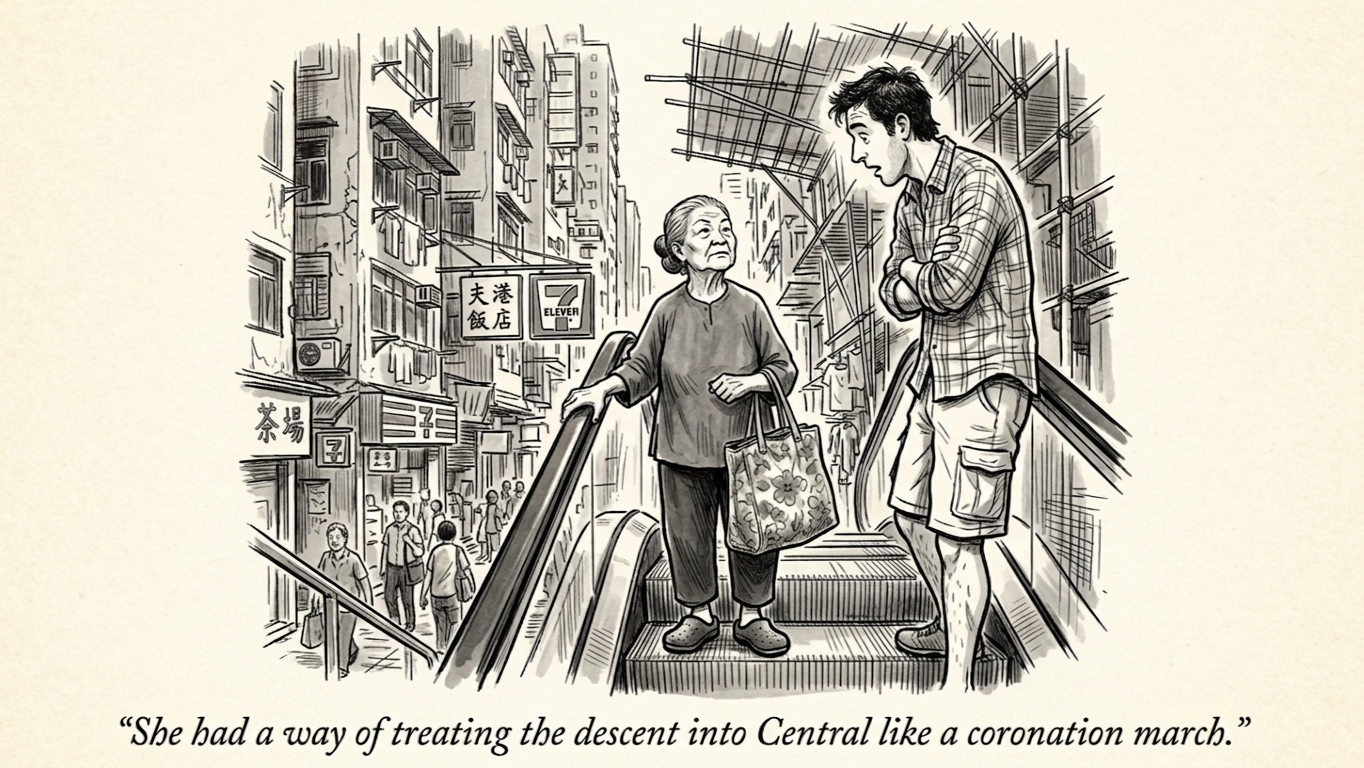
At Queen’s Road Central, a woman gets on every day at approximately quarter past ten. She is the first person on after the escalator switches direction, and I am convinced she has been standing there waiting for it to turn the way a captain waits for the tide. She is somewhere north of seventy. She is four foot ten in shoes that appear to have been manufactured during a previous government. She carries a vinyl shopping bag with a floral print that has faded to the point where the flowers are now suggestions, ghosts of flowers, the memory of a pattern. She rides the escalator uphill to the way a warship enters a harbor: slowly, with absolute authority, and with the understanding that everything in her path will move.
I have never spoken to her. I have been behind her perhaps two hundred times. She smells like Tiger Balm and certainty. She has never once looked at a phone. She has never once looked at another person. She looks straight ahead with the fixed gaze of a woman who decided where she was going in 1974 and has not revised the decision. She gets off at Cochrane Street and disappears into the wet market and I imagine, I have always imagined, that the fishmongers see her coming and straighten up the way soldiers straighten when a general enters the room. She is the woman the wet market was built for. Everyone else is visiting.
Three stops later, a man gets on who I have privately named Gerald. He is not named Gerald. He is almost certainly named something like Maximilian or Jean-Christophe, because he is French in the way that only a man who works in finance in Hong Kong can be French, which is to say expensively. His shoes are the color of a horse you cannot afford. His shirt is open one button past the point of professional credibility. He carries a leather bag that costs more than the floral woman’s entire apartment and he holds it with the practiced casualness of a man who wants you to know he is not thinking about the bag while making absolutely certain you have seen the bag.
Gerald gets on at Cochrane Street and gets off at Staunton Street, which is approximately ninety seconds, and in those ninety seconds he checks his phone eleven times. I have counted. Eleven. I counted because Ruth once told me I check my phone too much, and I wanted evidence that other people were worse, and Gerald is worse, and I have been carrying this information in my chest for six months waiting for the right moment to deploy it, and the right moment has not arrived because Ruth does not consider “a Frenchman I’ve named Gerald” to be a valid benchmark for personal behavior.
Between Cochrane and Shelley there is a section where the escalator passes through a corridor of old buildings and the air changes. It gets thicker. Greener. The tiles on the walls are smaller and older and the color of jade that has given up. There are plants on balconies that nobody waters but that refuse to die, because this is Hong Kong and even the plants are stubborn in ways that would embarrass the plants in other cities. In this section, every morning, a man sits on a stool outside a shop that repairs watches. He is the only person left in Hong Kong who repairs watches. This may not be true but it feels true. He wears a magnifying loupe on his forehead like a third eye and he holds pieces of time in his fingers and he never, not once, has he looked up at the escalator. Thousands of people pass him every day. He does not see them. He sees the watch. I admire this man more than I admire most people I have met professionally, and I include in that assessment several judges.
At Elgin Street the French women appear. They are always in twos. They always have yoga mats. They are always discussing a man who has done something unforgivable, and the tone suggests the offense could be anything from infidelity to choosing the wrong Beaujolais. I do not speak French. I do not need to speak French. The body language is its own language, and the language is: Gilles is finished.
A domestic helper rides up every morning between Elgin and Caine Road with a toddler in a stroller and a paper bag from Wellcome and a phone pressed to her ear. She is speaking Tagalog and her voice has the particular music of a woman who is telling someone she loves a version of her day that is not the version she is living. The version she is telling is fine. The version she is living is a stroller up a hill in a city that is not hers, carrying groceries for a family that is not hers, and she will do this six days a week and on the seventh she will sit on cardboard in Statue Square with her friends and she will laugh in a way I have never heard her laugh on the escalator. I know this because I have seen her on Sundays, and on Sundays she is a different person, a person the escalator has never met, and I sometimes wonder which one is real, and then I realize that asking which one is real is the kind of question a man who has never worked a domestic contract in a foreign country would ask.
At Mosque Street there is a man who sells juice from a cart that may or may not have a license. He has been there for as long as I have been riding the escalator. He has a face like a topographical map of a life I will never know and hands that move with the speed of a dealer in Macau. He makes sugarcane juice. The sound of the press is the sound of that section of the escalator, the way certain birds are the sound of certain forests, and if they ever take his cart away the escalator will lose something it does not know it has.
A boy in a school uniform rides up every morning reading a textbook and mouthing the words. He has a backpack the size of a filing cabinet. He is twelve, maybe thirteen. He is learning something that will be on an exam that will determine which school he goes to, which will determine which university he goes to, which will determine which firm he goes to, which will determine whether his mother’s friends at dim sum produce the slight involuntary stiffening of the posture that passes for respect in this city. He does not know this yet. He knows the textbook. He mouths the words. He will ride this escalator six days a week for five years and then he will leave for a university in a country where nothing works this well and he will not understand why he is angry until he comes home and steps back on.
And at Conduit Road, where the escalator reaches its highest point, a woman gets off every morning in shoes that could cut glass. She carries a bag that is not a bag but a statement, and the statement is: I have arrived, in every sense of the word, and the arriving is not a subject I wish to discuss. She does not look down. Nobody at Conduit Road looks down. Looking down is not what Conduit Road is for. Conduit Road is for looking out, at the harbor, at the view, at the city spread below like a proof of concept. The view from Conduit Road says: this worked. Whatever you think of it, however it was built, whoever was broken in the building of it, this worked. And the woman in the shoes that could cut glass walks into a building with no sign on the door and the escalator keeps going without her because the escalator does not need anyone. Everyone needs the escalator.
Eight hundred meters. Twenty minutes if you ride the whole thing. Most people don’t.
And in those twenty minutes, the woman with the floral bag and the man with the horse-colored shoes and the watchmaker with the third eye and the French women and their doomed Gilles and the helper and her two lives and the juice man and the boy with the filing cabinet on his back and the woman in the lethal shoes all stand on the same machine, moving in the same direction, at the same speed, and none of them see each other. Not really. Not the way you see a person when you understand that the six minutes between Queen’s Road and Conduit Road contains an entire civilization, stacked vertically, riding the same conveyor belt, pretending they are the only ones moving.
No other city on earth has this. Medellín has courage. Chongqing has ambition. Spain has civic engineering. Hong Kong has the thing itself: a single machine that carries an entire cross-section of a civilization up a hill every day, for free, in the open air, through the middle of everything, hiding nothing.
Seventy-eight thousand people a day. For thirty-three years. One direction at a time.
The city said: stand still. We will do the rest.
And it does. It does the rest. Every single day. Whether you are watching or not.
I am watching.