I wrote a post about Hong Kong. I ranked ten things I love about it and I put them in order and I called the order correct and I said I would not be taking questions. This was a mistake. Not the post. The post was fine. The mistake was writing a definitive list about a place I share with a woman who has opinions about lists and opinions about definitiveness and opinions about my opinions and whose opinions, I have learned across twenty-two years of marriage, are not opinions at all but corrections delivered with patience, the way a teacher corrects a child who has spelled a word almost right, close enough to show effort, wrong enough to require intervention.
Ruth read the post. She read it the way she reads everything I write, which is to say she read it once, completely, without expression, in the way a structural engineer reads a blueprint, not for pleasure but for flaws. She put her phone down. She looked at me. She said: “It’s fine.” In marriage there are many words that mean what they say and “it’s fine” is not one of them. “It’s fine” is a door that looks closed but is not locked. “It’s fine” is the first sentence of a conversation that will last several days. “It’s fine” is Ruth’s way of telling me that she has found the flaws and she is going to let me live with them for a while before she points them out, because Ruth believes that the anticipation of correction is more educational than the correction itself, and she is right, she is usually right, she is almost always right, and the “almost” in that sentence is a courtesy I extend to myself so that I can continue to function as a person.
Twenty minutes later she said: “You left things off.”
I said I know, it was a top ten, you have to leave things off, that is how lists work, you pick ten and the rest are implied.
She said: “The things you left off are better than the things you put on.”
I said that is a matter of opinion.
She said: “Yes. Mine.”
The post went viral. I am using the word “viral” loosely because I am a solicitor in Mei Foo and not a person who should be using the word “viral” about anything, but forty-seven thousand people read it, which is roughly eight times the population of Adams, Massachusetts, a town I bring up only because it shares my name and because Ruth, upon hearing the number, said “an entire town of Adams read your post about not being able to find your way through your own lobby,” and I said the town is not full of people named Adam, it is named after Samuel Adams, and she said “I know who it is named after, Adam, the point is that a town’s worth of people now know you cannot navigate a building you have lived in for over a decade,” and I said that is not the point of the post, and she said “it is the point people will remember,” and she was right, she was right because my inbox was full of people asking about the lobby, not a single person asked about the skyline or the harbour, they asked about the lobby, the lobby has become my identity, the lobby has eclipsed twenty years of legal work, and Ruth predicted this, Ruth predicted this with the calm certainty of a woman who has been predicting my failures with perfect accuracy since 2002.
Forty-seven thousand people is also more people than have ever cared about anything I have had to say about anything in my entire life, and I know this because Ruth pointed it out. Ruth said: “More people read your LinkedIn post than have ever read a single contract you have drafted.” This was meant to be humbling. It was. It was also, quietly, the closest Ruth has come to a compliment about my writing, because embedded in the insult was the admission that people had in fact read it, and Ruth does not acknowledge things that are not real, so by acknowledging the number she was acknowledging the achievement, and I will take that, I will take that and put it in the drawer where I keep small victories, the drawer that does not close properly, the drawer Ruth has asked me to fix, the drawer I will never fix because fixing it would require admitting it is broken and I am not ready to have that conversation about a drawer or about anything else the drawer might represent.
I looked at Ruth. I smiled. The smile of a man who has been married long enough to know when he is about to be told everything he did wrong by the person whose approval he wanted most. She saw the smile. She did not return it. Returning the smile would be an endorsement and Ruth does not endorse prematurely. Ruth waits until all the evidence is in. Ruth is still waiting. I am still smiling. We have been in this standoff for twenty-two years and I am losing and I do not mind.
She had a list. Of course she had a list. Ruth does not make lists on paper. Ruth’s lists exist fully formed in her mind, organized by severity and cross-referenced by how wrong I am about each item, and she delivers them aloud with the calm pacing of a woman who has all evening and intends to use it.
She said: “You didn’t mention Causeway Bay.”
I didn’t mention Causeway Bay. I didn’t mention Causeway Bay because Causeway Bay is Ruth’s and I have learned, through experience, through error, through twenty-two years of being in the wrong place at the wrong time holding the wrong bag, that there are parts of Hong Kong that belong to me and there are parts that belong to Ruth and Causeway Bay belongs to Ruth the way the sea belongs to the moon. It is hers. She moves through it and it responds to her. I have watched her walk from Hysan Place to the side streets behind Jardine’s Crescent with the focus and efficiency of a woman conducting a military operation, and the operation is shopping, and the objective is everything, and the everything is specific and non-negotiable and involves shops I cannot find twice and women behind counters who know her name and her size and what arrived on Tuesday and what will arrive on Thursday and what she looked at three weeks ago and did not buy and which they have held for her because they know she will come back, because she always comes back, because Causeway Bay is not a shopping district for Ruth, it is a network, it is a web of relationships disguised as commerce, and she is at the center of it, and I am at the periphery of it, standing near a pillar, holding four bags, checking my phone, waiting, always waiting, and the waiting is fine because there is always something to eat within forty-five seconds of anywhere you stand in Causeway Bay, which is its own miracle, which should have been on the list.
She said: “You mentioned food but you mentioned it wrong.”
I did mention food. I mentioned food and I was proud of mentioning food because the food in Hong Kong is extraordinary and I said so and I thought I had covered it and Ruth said I had covered it the way a tourist covers it, from the outside, as a consumer, as a man who eats. She said: “You mentioned the food. You did not mention Sunday brunch.” I said Sunday brunch is food. She said Sunday brunch is not food. She said Sunday brunch is the week ending and the two of us sitting down and the city going quiet enough to hear each other, or quiet enough for Ruth to hear me, because Ruth says I only talk properly on Sundays, she says the rest of the week I talk like a solicitor and on Sundays I talk like a person, and I do not know if this is a compliment or an insult and I have decided not to ask. She has a preferred table. The preferred table is non-negotiable the way certain UN resolutions are non-negotiable, which is to say she will accept an alternative under extreme duress but she will note the compromise and she will remember it and reference it at a later date in a context I will not see coming. We sit. We order. Ruth has opinions about what I should order and I order what Ruth thinks I should order because the food arrives and it is better than what I would have chosen and this has been happening for twenty-two years and I have never once selected my own meal and I have never once been disappointed and I do not know what this says about me and I do not want to know. Sunday brunch is not food. Ruth is right. It is not food. It is proof of something continuing.
She said: “You didn’t mention the Sevens.”
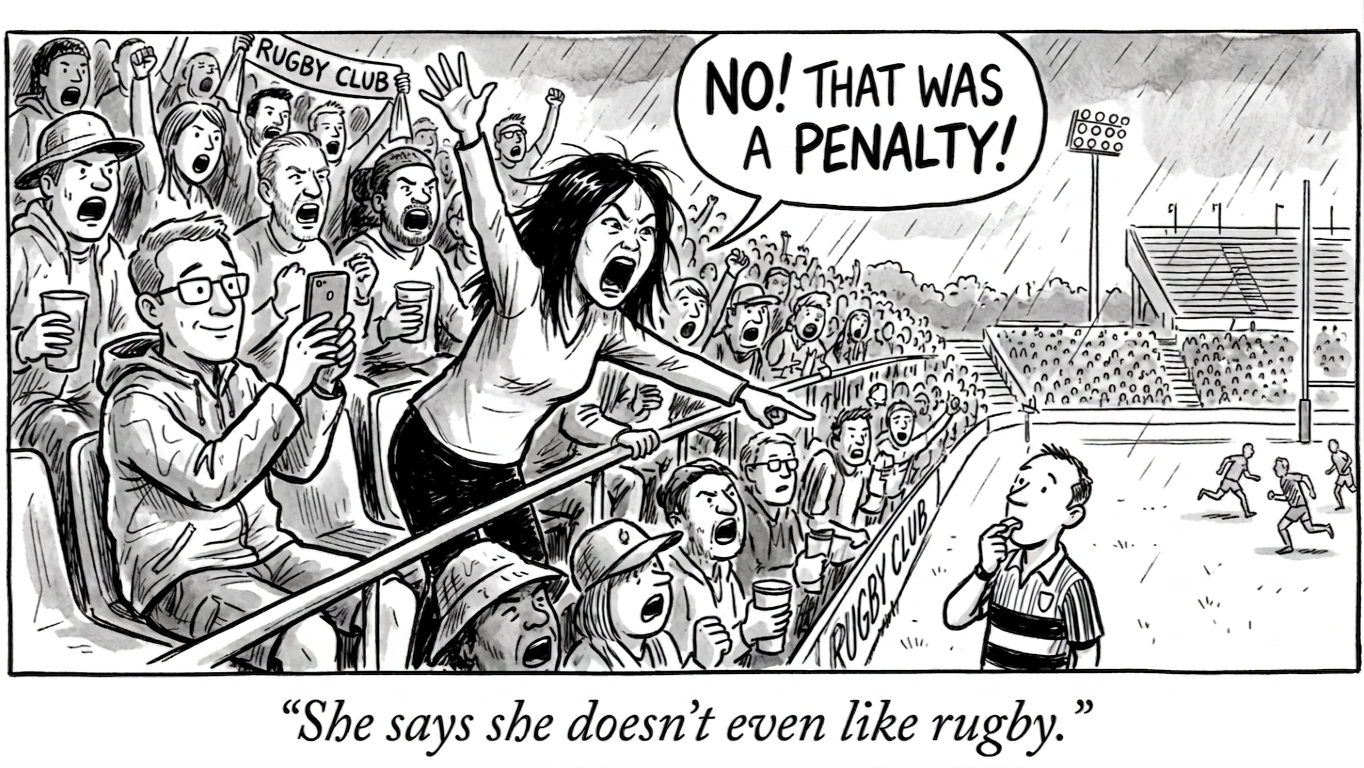
I did not mention the Sevens. The Hong Kong Sevens is not Ruth’s idea. The Hong Kong Sevens has never been Ruth’s idea. The Hong Kong Sevens is my idea in the way that certain annual traditions are one person’s idea and the other person’s tolerance, and Ruth tolerates the Sevens the way she tolerates most of my enthusiasms, which is to say she attends, she observes, she allows the experience to happen around her, and then at some point during the second day, at some point that I can never predict and she will never explain, something shifts, some gear engages, and Ruth is in it. Ruth is standing. Ruth is clapping. Ruth is telling a stranger from Sydney that his analysis of the Fiji defense is incorrect and the stranger is agreeing with her because people agree with Ruth, people sense that disagreeing with Ruth is not a social option, and she is alive with it, she is electric with it, the noise and the color and the chaos and the particular madness of forty thousand people in a stadium watching seven-minute matches and treating each one as though civilization depends on the outcome, and Ruth, who did not want to come, who never wants to come, who agrees to come with the resigned air of a diplomat attending a function in a country she does not recognize, is having the time of her life and will deny this later. She will deny it in the taxi home. She will deny it the next morning. She will deny it until I mention it again the following year when I am trying to convince her to go, and she will say “I don’t know why you think I enjoyed it” and I will say nothing because I have photographs, I have photographs of Ruth screaming at a referee, and the photographs are in a folder on my phone labeled “Insurance” and Ruth does not know about this folder and if she finds out about this folder I will not survive the discovery but the folder is worth the risk, the folder is worth everything, because the Sevens is Hong Kong at its loudest and its least serious and its most joyful and Ruth in the middle of it is my favorite version of a city I love in every version.
She said: “You didn’t mention the minibus.”
I did not mention the minibus. The red minibus. The vehicle that has no fixed schedule and no particular interest in your safety and no speed it considers too fast for a residential street and yet is, somehow, the most honest form of transport ever devised, because the minibus does not pretend. The MTR pretends. The MTR pretends it is a system, with maps and announcements and a woman’s voice telling you the next station as though the next station is in question, as though the train might decide otherwise, as though there is suspense. There is no suspense. The minibus is suspense. The minibus is suspense because you do not know when it will come and you do not know if it will stop and when it does stop and you get on you do not know if the driver has heard you say your stop and you do not know if he will remember and you do not know if he will brake gradually or suddenly and you hold on and you hope and you shout “有落” and the bus lurches to the kerb and you are alive, you are deposited on a street you mostly recognize, and you are alive, and being alive after a minibus ride is its own small celebration, and Ruth says I am being dramatic, and Ruth is wrong, Ruth is wrong about this one thing, this single thing, and I will hold this one instance of Ruth being wrong the way a man lost in the desert holds a cup of water, carefully, preciously, aware that it may be the last one.
She said: “You didn’t mention the escalator.”
The Mid-Levels Escalator. The longest outdoor covered escalator system in the world, which is a fact I am including because it is the only fact I have ever cited that has impressed no one, not once, not a single person has heard me say “longest outdoor covered escalator system in the world” and responded with anything other than mild disinterest or, in Ruth’s case, the observation that I ride it going the wrong direction at the wrong time more often than any person she has ever known, which is true, which is a design problem, or a scheduling problem, or an Adam problem, the escalator goes up in the morning and down in the evening and I am somehow always going against it, always walking down while it carries everyone else up, always late for the shift, the great tidal shift of the escalator that the rest of Hong Kong understands instinctively and that I have failed to internalize after more than a decade of living here. But the escalator is not about direction. The escalator is about standing still and watching a city happen around you, the restaurants and the graffiti and the laundry hanging from windows and the cats in doorways and the old men playing chess and the smell of something cooking that you cannot identify but that you want, you want whatever it is, and you are moving through it without walking, the city is delivering itself to you, and this is Hong Kong’s great gift, this is what Hong Kong does that nowhere else does, it moves you through itself and asks nothing in return except that you pay attention, and I did not put it on the list, I did not put it on the list.
She said: “You mentioned the wet market.”
I did mention the wet market. I mentioned it as a joke. I mentioned it in passing, as local color, the way expats mention wet markets, with a wink, as if to say look how local I have become, I go to the wet market, aren’t I brave, aren’t I integrated, and Ruth said “that is exactly the problem,” because I had treated the wet market as a curiosity when it is a cornerstone, I had treated it as content when it is life, and she was right, and the difference between mentioning something and understanding something is the distance between me and Ruth, a distance I have been trying to close for twenty-two years, and I am closer than I was, and I am not close enough, and I may never be close enough, and the trying is the point.
She said: “You didn’t mention yum cha.”
I did not mention yum cha. I mentioned dim sum. I mentioned dim sum because I am an expat and expats say dim sum and what I should have said was yum cha because yum cha is not the food, yum cha is the act, yum cha is the gathering, yum cha is the reason the food exists. Ruth’s family does not go for dim sum. Ruth’s family goes for yum cha. The difference is the difference between saying you went for a meal and saying you went to church. Yum cha is Sunday morning at a round table with a lazy Susan and a pot of tea that is never empty because someone is always refilling it and the someone who refills it is performing an act so small and so ordinary that you do not notice it until you are the one who does it and then you realize it is not small at all, it is the whole thing, the refilling of the tea is the point, the paying of attention to someone else’s cup is the point, and I learned this from Ruth’s mother who once watched me let Ruth’s teacup sit empty for thirty seconds and looked at me with an expression that did not require translation, and I have not let a teacup sit empty since, not once, not in twelve years, and Ruth has never mentioned this and Ruth’s mother has never mentioned this and the not-mentioning is its own form of approval and I will take it.
She said: “You didn’t mention the bamboo scaffolding.”
I did not mention the bamboo scaffolding. I did not mention it because I have lived here long enough that I no longer see it, which is both the problem and the proof that I belong, because the bamboo scaffolding is the most extraordinary thing in Hong Kong that no one in Hong Kong considers extraordinary. A building needs work. Forty floors of glass and steel need a new face. And what does Hong Kong do. Hong Kong sends men up the side of the building with bamboo and nylon ties and in two days the entire structure is wrapped in a lattice of grass, a skeleton of a thing that was alive last year in a forest somewhere, and inside this skeleton men are working, men are suspended forty floors above a city of seven million people held up by a plant, held in place by knots tied by hands that learned the knots from hands that learned the knots from hands that go back further than anyone can remember, and this is not a metaphor, this is Tuesday, this is just what happens, and no one looks up. I used to look up. I used to stand on the pavement and stare at the scaffolding with my mouth open like a man seeing a magic trick and Ruth would say “Adam, walk” the way you say it to a dog that has stopped to smell something, and I would walk, and I would stop looking up, and now I do not look up, and the not-looking-up means I live here, and the not-mentioning-it means I have failed to see the thing that should be seen, the thing that says more about Hong Kong than any skyline, because the skyline is the building and the scaffolding is how the building gets built, and how a place builds things tells you everything about the place, and Hong Kong builds things with grass and knots and trust and I left it off the list.
She said: “You didn’t mention the cha chaan teng.”
I did not mention the cha chaan teng. I did not mention the cha chaan teng because I mentioned food and I thought food covered it and Ruth said food does not cover it because the cha chaan teng is not food, the cha chaan teng is an institution, the cha chaan teng is a way of being. The cha chaan teng is a place where you sit down and a man puts a cup of milk tea in front of you that you did not order because he knows what you order and he knew it before you sat down and if you take too long looking at the menu he will take the menu away because the menu is a formality and formalities waste time and time is the one thing the cha chaan teng does not waste. The cha chaan teng is not rude. Ruth has explained this. The cha chaan teng is efficient and efficiency at that speed looks like rudeness to someone who grew up in a country where the waiter asks how your day is going, and my day is going fine, and no one in a cha chaan teng will ever ask and this is a relief, this is a profound relief, to be served without performance, to be fed without conversation, to be known without being spoken to. I once tried to make small talk with the man behind the counter at our cha chaan teng and he looked at me the way you look at a door that has suddenly tried to become a window, with confusion and a mild concern for structural integrity, and Ruth said “do not talk to him, Adam, he is working, you are a customer, these are roles, respect the roles,” and I respect the roles now, I have come to love the roles, the roles are the cha chaan teng and the cha chaan teng is Hong Kong and I left it off the list because I am, as has been established, a fool.
She said: “You didn’t mention T8.”
I did not mention T8. Typhoon Signal Number Eight. The signal that means the city stops. The signal that means the office closes and the ferries halt and the markets shutter and Hong Kong, which never stops, stops. Every expat knows T8 as a day off. Every local knows T8 as something else. Ruth knows T8 as the day you tape the windows and fill the bathtub and check on the neighbors and call your mother and make sure the old woman three floors up has water and candles, because the power might go, because it has gone before, because it went in the typhoon of whatever year it was that Ruth remembers and I do not because Ruth remembers typhoons the way I remember football results, by year and severity and what was damaged and what survived. T8 is not a holiday. T8 is the day Hong Kong reminds you it is built on a rock in the South China Sea and the sea does not care about your skyline or your property prices or your LinkedIn post and you are a guest of the weather and the weather has not read your lease. I watch the typhoon from inside. Ruth watches the typhoon from inside while doing seven things that need to be done in case the typhoon does what typhoons do, and the difference between watching and preparing is the difference between living somewhere and being from somewhere, and I live here, and Ruth is from here, or near enough to from here, and the gap between those two things is T8, the gap is the bathtub full of water that I would not have thought to fill.
She said: “You didn’t mention the herbal tea shop.”
I did not mention the herbal tea shop. I did not mention the herbal tea shop because I do not understand the herbal tea shop. I have lived in Hong Kong for over a decade and I do not understand how an entire civilization has organized itself around the principle that the body is either too hot or too cold and that the solution is a tea that tastes like the earth is angry at you. Ruth sends me to the herbal tea shop the way a general sends a soldier on a mission, with specific instructions and no tolerance for deviation. She tells me what to order based on symptoms I did not know I had. She says “you are yeet hay” and I say “I feel fine” and she says “you are yeet hay, your lips are dry, go get the twenty-four flavour tea,” and I go, because I have learned that arguing with Ruth about the internal temperature of my body is not an argument I can win, not because she is louder but because she is operating from a system of knowledge that is older than Western medicine and more certain than anything I learned in school and the twenty-four flavor tea tastes like a punishment but my lips are no longer dry and I do not know what this means and I am afraid to ask.
She said: “You didn’t mention mahjong.”
I did not mention mahjong because I cannot play mahjong. I cannot play mahjong despite having been taught mahjong by Ruth’s mother on four separate occasions, each occasion ending with Ruth’s mother looking at Ruth and saying something in Mandarin that Ruth will not translate but that I have come to understand means “he is hopeless but he is yours.” The sound of mahjong is the sound of Hong Kong after dark, the clatter of tiles on a table behind a closed door, the laughter, the shouting, the particular joy of a game I do not understand played by people who have been playing it since before I was born and who will be playing it after I am dead and who do not need me to understand it, they need me to sit quietly and bring tea and stay out of the way, and I do, I sit quietly and bring tea and stay out of the way, and this is my role, and my role is enough, and the sound of the tiles is enough, and being near it is enough.
She said: “You didn’t mention the ferry.”
The Star Ferry. I did not mention the Star Ferry. I put the skyline and the harbour on the list and did not mention the thing that moves you across the harbour so you can see the skyline, which is like writing about a painting and not mentioning the museum. The Star Ferry is seven minutes. The Star Ferry costs less than a bottle of water. The Star Ferry does not care about who you are or where you came from or how long you have been here or whether you belong. You pay and you sit and the city opens up on both sides of you like a book and for seven minutes you are between places, between Kowloon and Hong Kong Island, between going and coming, between who you were on one side and who you will be on the other, and the harbour smells like diesel and salt and the benches are wooden and the engines groan and none of it has been optimized or renovated or made into a brand experience and this is why it is perfect and this is why I forgot it, because I forget the things that are perfect, I only remember the things that are complicated, and Ruth remembers everything, and the difference between us is the difference between the list I wrote and the list I should have written.
She said: “You didn’t mention the people.”
I did not mention the people. I mentioned the MTR and the skyline and the noodles and the harbour and the hiking and the noise and I did not mention the people, which is like writing about the ocean and not mentioning water.
I did not mention the shopkeepers who know your order before you open your mouth, who have known your order for years, who would be offended if you changed your order because the order is not a transaction, it is a relationship, and changing it would be a renegotiation of terms that were settled long ago by people who take terms seriously.
I did not mention the security guards who work the night shifts in the lobbies of buildings all over this city, who sit behind desks in uniforms and who know every resident by their walk, by their posture, by the sound of their footsteps on the tile, who nod on the bad days and say your name on the good days and who make a lobby feel like a border crossing into a country where you are known and expected and allowed.
I did not mention the aunties, the aunties of Hong Kong, who are not your aunties and are everyone’s aunties, who press fruit into your hands and comment on your weight and tell you that you look tired and ask if you are eating enough and do not wait for an answer because the answer does not matter, what matters is that someone asked, and the asking is Hong Kong, the asking is the whole city in one sentence from a woman who has known you for ten years and has never once learned your name and does not need to.
I did not mention the taxi drivers who know every street by feel and who refuse payment when they decide the fare is a kindness and not a service, who say things in Cantonese that your wife translates as “this is what we do” and then will not translate anything else, because some things do not survive translation, some things exist only in the language they were said in and the silence that follows.
I did not mention the dai pai dong regulars who sit at the same table at the same time every evening and who have made room for you without being asked and who include you in a conversation you cannot fully follow but can fully feel, the warmth of being near people who have decided you belong, not because you earned it, not because you applied for it, but because you showed up, again and again, and showing up is the application and the approval and the membership, and Hong Kong grants it quietly, without ceremony, without paperwork, just a nod, just a chair, just room at the table.
I did not mention the old men in the parks at dawn, and the women moving through tai chi with the slow certainty of people who know something about stillness that I will spend my whole life trying to learn.
Ruth was right. Some of the things I left off were better than the things I put on. The things I left off were Causeway Bay and Sunday brunch and the Sevens and the minibus and the escalator and the bamboo scaffolding and the cha chaan teng and yum cha and T8 and the herbal tea shop and mahjong and the Star Ferry and the people, the people, the people who are not a list, who are the reason the list exists, who are the reason I tried to leave and couldn’t, who are the lobby and the fruit on the door handle and the umbrella in the typhoon and the nod and the tea and the silence in a taxi on a Thursday night.
I looked at Ruth. I smiled again. She did not return it. She said: “Write that one.”
So I did.
She will say it’s fine. It won’t mean fine. But it won’t mean not fine either. It will mean she is reading it again, once, completely, without expression, looking for the flaws. And she will find them. She always finds them. And I will be grateful, because the flaws she finds are the places where I stopped paying attention, and Ruth never stops paying attention, not to the list, not to the city, not to me, and that is the thing I will never put on any list because it is too big for a list, it is too important for a number, it is the whole point of every number, and she knows it, and I know she knows it, and she knows I know she knows it, and neither of us will say it out loud because we are married and married people do not say the biggest things out loud, they put them in drawers that do not close properly and they leave them there and they are enough.