For those of you following along, this is the third installment in what has become, against all planning and good judgment, a series. The first piece covered Kevin, a young rental car agent in Boston whose soul left his body in a parking garage; a businessman whose briefcase contained a spare pair of pants and, apparently, the quiet wisdom of a man who had seen the future; and a woman who was hit by champagne from a bottle my wife had merely spoken to. The second piece covered the Cu Chi tunnels, which my wife believed were a Gucci outlet; a jackfruit smuggling operation I did not consent to; and the revelation that the United States federal government maintains, somewhere in its systems, a permanent file on my wife indexed under “produce.”
People keep asking if I exaggerate. I keep telling them I don’t. And then something happens that makes the previous stories look restrained, and I have to sit down and write another one.
These three stories are older. They predate Hong Kong, predate the flights, predate the international incidents.
These three stories are older. They predate Hong Kong, predate the flights, predate the international incidents. These are origin stories. Proof that the chaos was always there, baked into the foundation, long before we ever crossed a border or boarded a plane. Back when the stakes were smaller but the signs were already unmistakable.
The Federal Court Incident — Springfield, Massachusetts
Before I moved to Hong Kong and became the man you now know as a cautionary tale wrapped in frequent flyer miles, I was a lawyer in Massachusetts. A young one. The kind of young where you still iron your shirt the night before and check your briefcase three times and rehearse your opening remarks in the car like you’re preparing for a Broadway debut that absolutely no one bought tickets to.
Most of my cases were in state courts. Local stuff. Courts I could find with my eyes closed, courthouses I’d walked into so many times the security guards waved me through. But every once in a while, a case would get removed to federal court, and when that happened in western Massachusetts, it meant driving to Springfield.
Now, Springfield is not a city I frequented. I’d been to the federal courthouse there a handful of times, enough to have a vague, directional sense of where it was. Not a confident sense. Not a “I could draw you a map” sense. More of a “I’ll know it when I see it” sense, which, as you are about to learn, is not the same thing as actually knowing where you’re going.
This was before GPS was in every pocket. Before your phone could tell you, in a calm and faintly judgmental voice, to make a legal U-turn. This was the era of maps. Paper maps. The kind you unfolded across your steering wheel at a red light and tried to read while the person behind you honked, and you squinted at a web of tiny lines and thought, “I think that’s a highway, or possibly a river.”
I had a map. I had a case file. I had a court appearance that was time-sensitive in the way that all federal court appearances are time-sensitive.
I had a map. I had a case file. I had a court appearance that was time-sensitive in the way that all federal court appearances are time-sensitive, which is to say: if you are late, the judge does not ask why. The judge does not care that you hit traffic, or that construction on I-91 added twenty minutes, or that your wife is in the passenger seat and has taken control of the navigation. The judge cares about one thing: were you there when he called your case. If you were, fine. If you weren’t, God help you, because the judge won’t.
I want to be very clear about what kind of nervous I was. This was not casual unease. This was young-lawyer, federal-court, don’t-be-late, your-career-is-a-seedling-and-the-judge-is-a-lawnmower nervous. The kind of nervous where your hands are slightly damp on the wheel and you’re doing the speed limit not because you’re a rule follower but because getting pulled over right now would end you.
My wife was with me that day. I don’t remember exactly why. She may have had errands in the area. She may have wanted to come along for the ride. She may have simply sensed, on some primal level, that there was an opportunity to insert herself into a high-stakes situation and make it worse. Whatever the reason, she was there, and she had the map.
I asked her to navigate. A simple, reasonable request. Read the map, tell me where to turn. Left here, right there. Get me to the federal courthouse in Springfield. That’s it. That’s the entire mission.
She accepted the role with the confidence of a woman who had never once doubted her ability to do anything, regardless of whether she had ever actually done it before. This is one of my wife’s most defining characteristics. She does not hesitate. She does not hedge. She looks at a map the way a general looks at a battlefield, with total authority and, as it turns out, not nearly enough reconnaissance.
As long as we didn’t deviate. As long as we went directly, efficiently, and without incident to the courthouse.
We were making good time at first. Highway was clear. I was keeping an eye on the clock, running the math in my head, calculating arrival time minus parking minus walking minus the elevator minus the security line. Tight, but doable. As long as we didn’t deviate. As long as we went directly, efficiently, and without incident to the courthouse.
“Take this exit,” she said.
I took the exit.
“Left at the light.”
I turned left.
“Now go straight for a while.”
I went straight. But something felt off. I’d been to this courthouse before. Not many times, but enough. And the route she was taking me on didn’t feel right. The streets were getting narrower. More residential. The kind of streets where you see chain-link fences and triple-deckers, not the kind where you see a large federal building with columns and a flag.
“Are you sure this is right?” I asked.
“I know how to read a map,” she said.
This is a sentence my wife delivers with such conviction that it temporarily overrides your own lived experience. She says it the way a surgeon says “I’ve done this before.” You believe her. You believe her because the alternative, that you are hurtling through an unfamiliar city with a navigator who is confidently guiding you in the wrong direction while a federal judge waits for you with a gavel and a contempt citation, is too terrible to accept.
So I kept driving.
“Right up here,” she said.
I turned right.
“It should be right around here.”
And then she said the words.
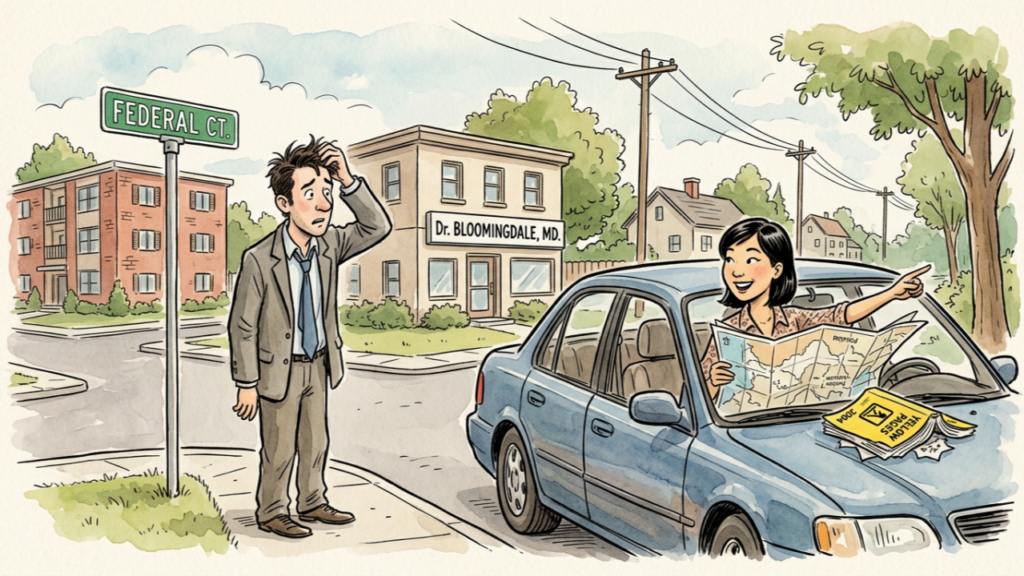
“There. Federal Ct.”
She pointed. I looked. And there it was. A sign, on the side of the road, that read, and I will remember this until the day I die, “Federal Ct.”
It was not the federal court.
It was Federal Court. As in, the street. As in, a residential road. As in, an apartment complex in Springfield, Massachusetts, where people lived and, presumably, did not adjudicate matters of federal civil procedure.
I pulled over. I stared at the sign. I stared at my wife. I stared at the apartments, which had window units and a small parking lot and absolutely zero resemblance to a United States District Courthouse.
“This is an apartment complex.”
“It says Federal Court.”
“It says Federal C-T. Court. The street. Not the court. Not the building where a judge is currently wondering where I am.”
She looked at the sign again. She looked at the map. She looked at me. And then she did the thing she always does, the thing that is both maddening and, in retrospect, almost admirable in its consistency: she did not concede the error. She recalibrated.
“Well, it’s a confusing name for a street.”
I did not have time to litigate the naming conventions of Springfield’s residential roads. I grabbed the map, found the courthouse myself, and drove there in what I can only describe as a state of focused, white-knuckled, legally-motivated panic. I made it. Barely. I walked into that courtroom with seconds to spare, slightly sweating, heart rate elevated, briefcase in one hand and whatever remained of my composure in the other.
The judge didn’t notice. The case proceeded. Nothing catastrophic happened, professionally speaking.
But in the car afterward, I looked at my wife, and I said, with the measured calm of a man who has just survived something:
“You are never navigating again.”
She shrugged. “We got there.”
“We got to an apartment complex.”
“And then we got to the court.”
This is the logic. This is what I live with. The destination was wrong, but eventually a destination was reached, and therefore the navigation was, in her view, a success with a minor detour. She’s not wrong, technically. We did ultimately arrive at the courthouse. The same way a ship that hits an iceberg and then limps into port has technically completed the voyage.
I don’t use paper maps anymore. I use GPS. Three GPS systems, actually. Phone, car, and a backup app, because I have learned, through experience, that when my wife is involved, redundancy is not paranoia. It is survival.
The Bloomingdale’s Incident — Chestnut Hill, Massachusetts
This one is from the same era. Same version of me: younger, more trusting, still laboring under the assumption that when my wife said she’d looked something up, she had, in fact, looked it up correctly.
We were visiting the Boston area at the time, and one Saturday my wife announced that she wanted to go shopping. Specifically, she wanted to go to Bloomingdale’s. More specifically, she wanted to go to the Bloomingdale’s near the Chestnut Hill Mall.
Now, I had lived in and around Boston for years. I knew Chestnut Hill. I knew the mall. I knew the stores in and around it. And I did not know of a Bloomingdale’s anywhere in that vicinity. Filene’s, yes. Macy’s, sure. But Bloomingdale’s? I was fairly certain there wasn’t one.
I said as much.
“I don’t think there’s a Bloomingdale’s near Chestnut Hill.”
“There is. I looked it up.”
“Where did you look it up?”
“The Yellow Pages.”
The Yellow Pages was the Google of its time, if Google were made of paper, weighed eight pounds, and couldn’t tell the difference between a department store and a dermatologist.
The Yellow Pages. For those of you under thirty-five, the Yellow Pages was a large book, approximately the weight of a cinder block, that arrived on your doorstep once a year and contained the phone numbers and addresses of every business in your area, organized alphabetically by category. It was the Google of its time, if Google were made of paper, weighed eight pounds, and couldn’t tell the difference between a department store and a dermatologist.
Which, as you are about to discover, is the central issue.
I questioned her. I expressed doubt. I suggested that maybe she had misread the listing, or that maybe the Bloomingdale’s she’d found was in a different part of the city, or that maybe, just maybe, the Yellow Pages had led her astray. She was unmoved. She had looked it up. It was near Chestnut Hill. She was certain.
Her certainty, as always, was absolute. My wife does not do tentative. She does not say “I think” or “maybe” or “I’m not sure, but.” She says “it’s there,” and she says it with the full weight of a woman who has never, not once, allowed contradictory evidence to dilute a first impression.
So we drove to Chestnut Hill.
We drove around the mall. We drove past the mall. We drove in widening circles around the general Chestnut Hill area like a search helicopter looking for a downed aircraft, except instead of an aircraft we were looking for a department store that I was increasingly certain did not exist.
Ten minutes. Twenty minutes. Thirty minutes of my Saturday, circling blocks, scanning storefronts, my wife in the passenger seat leaning forward with the intensity of a bird-watcher who’s been told a rare species was spotted nearby.
“It has to be here. I saw the listing.”
“Maybe the listing was wrong.”
“The Yellow Pages aren’t wrong.”
“The Yellow Pages are a book. Books can be wrong.”
“Just keep driving.”
And then I saw it.
A sign. On the side of a building. Not a large sign. Not a department store sign with backlit lettering and window displays and mannequins in seasonal outfits. A small, professional sign. The kind of sign you’d find on a medical office, which is what it was, because the sign read:
Dr. Bloomingdale.
A doctor. The Bloomingdale’s my wife had found in the Yellow Pages, the one she had confidently identified as a shopping destination near Chestnut Hill, the one she had insisted we drive thirty minutes to find, was a physician. A single human being with an unfortunate surname, practicing medicine in an office that contained, I can only assume, examination rooms and tongue depressors and absolutely no handbags.
I pulled over. I pointed at the sign. I didn’t say anything. I didn’t need to. The sign said everything.
My wife stared at it.
I stared at her.
The silence was long. It was the kind of silence that contains an entire marriage. The kind where one person is trying very hard not to laugh and the other person is trying very hard not to admit what has just happened and both people know, with absolute clarity, that this moment will never, ever be forgotten.
“That’s not—”
“It is.”
“But the Yellow Pages said—”
“The Yellow Pages said Bloomingdale. Near Chestnut Hill. And here he is. Dr. Bloomingdale. Near Chestnut Hill. The Yellow Pages were not wrong. You just didn’t read far enough to notice that the listing was for a human being and not a retail chain.”
She sat there for a moment. Processing. Recalibrating. Running through, I imagine, the five stages of grief, but for shopping.
“Do you think he has a nice waiting room?”
I laughed. I couldn’t help it. She started laughing too, which is one of the things that has kept this marriage alive, the fact that she can, eventually, always laugh at herself, even when the evidence is a medical office sign and a wasted half hour and a husband who will never let her forget this as long as they both shall live.
We drove to an actual department store. She bought something. I don’t remember what. I do remember that for the rest of that year, every time we drove past Chestnut Hill, I would gesture toward the general area and say, “Want to stop at Bloomingdale’s? I think Dr. Bloomingdale might be running a sale on flu shots.”
She never laughed at that. But she never told me to stop, either, which in our marriage is basically the same thing.
The Fire Incident — Somewhere on a Massachusetts Highway
This one still comes back to me in flashes. Not because I’ve repressed it. Because my brain, I think, is still trying to process the sheer physics of what happened and reconcile it with the fact that I got in the car with this woman again afterward.
I want to preface this by saying we are not smokers. Neither of us. This is important context, because what follows involves a cigarette, and I don’t want anyone thinking this was a regular occurrence. It was not. This was a one-time, never-to-be-repeated event, brought about by the fact that someone, a friend, a coworker, I don’t even remember who, had given my wife a pack of clove cigarettes to try. Clove cigarettes. The kind that smell like a candle shop and taste like someone set fire to a potpourri bag. The kind that college students smoked on porches in the nineties to seem interesting. Nobody’s vice. Nobody’s habit. Just a novelty, a curiosity, a little pack of flavored chaos that someone handed my wife, which in hindsight is like handing a toddler a box of matches and saying, “See what you think.”
We were driving somewhere. I don’t remember where. It doesn’t matter. What matters is that my wife was in the passenger seat, the windows were cracked, and she had decided that today was the day she was going to try one of these clove cigarettes. She lit it, took a few puffs, decided she’d had enough of the experience, and in one smooth, casual motion, flicked it out the window.
This is a thing people did. People flicked cigarettes out of car windows every day. Thousands of people. Millions, maybe. And the cigarette would hit the road and spark and roll into a gutter and that would be the end of it. That’s how it works for normal people. For people who exist in a universe governed by predictable aerodynamics and reasonable outcomes.
My wife does not exist in that universe.
My wife does not exist in that universe.
The cigarette left her fingers, hit the airstream, and instead of sailing away into the road behind us like every other cigarette ever thrown from a moving vehicle in the history of automobiles, it caught the current, curved, and blew directly back into the car through the rear window.
Not the window she threw it from. The rear window. The cigarette effectively made a U-turn in midair. It defied trajectory. It defied logic. It flew backward, with purpose, like a tiny orange missile that had locked onto a target, and landed on the back seat of my car.
I did not see this happen. My wife did not see this happen. No one saw this happen, because no one was watching the back seat, because no reasonable person monitors their back seat for incoming projectiles while driving at highway speed.
What I did see, a minute or two later, was smoke.
Not a lot at first. Just a wisp. The kind of thing you notice in your rearview mirror and think, “Is that fog? Exhaust? Am I imagining things?” And then the wisp became a curl, and the curl became a plume, and the plume became the kind of thick, unmistakable, something-is-actively-burning smoke that eliminates all ambiguity.
“Do you smell that?” my wife said.
I smelled it. I was already pulling over. The car was filling with the acrid, chemical stink of upholstery doing something upholstery was never supposed to do, which is combust. Mixed, I should add, with the faint sweetness of clove, which made the whole experience smell like a Christmas market that had gone horribly wrong.
The back seat was on fire. Not engulfed. Not a towering inferno. But genuinely, actually, no-this-is-not-a-drill on fire.
I pulled onto the shoulder, threw the car into park, and turned around. The back seat was on fire. Not engulfed. Not a towering inferno. But genuinely, actually, no-this-is-not-a-drill on fire. A small but committed flame was eating its way through the fabric, and the foam underneath was melting and smoking with the enthusiasm of something that had been waiting its whole life for this opportunity.
I jumped out. My wife jumped out. I opened the rear door and did what any reasonable person would do when confronted with a fire in a confined space, which is to say I panicked productively. I beat at it with something, a jacket, a towel, whatever was within reach, and after what felt like five minutes but was probably thirty seconds, the fire was out.
The back seat was scorched. A blackened, melted crater sat in the middle of the upholstery like a small volcanic event had occurred in my sedan. The car smelled like a burnt chemistry experiment with a hint of Indonesian spice market. Wisps of smoke curled from the wound in the fabric, and tiny orange embers glowed along the edges like the fire was thinking about making a comeback.
I stood on the shoulder of the highway, slightly out of breath, jacket in hand, staring at the damage. My wife stood next to me, also staring.
“Did your cigarette do that?”
“It went out the window.”
“It came back in the window.”
“How?”
“I don’t know how. Wind. Physics. The fact that the universe has chosen me specifically as the person who has to deal with these things. But your clove cigarette went out the front window, re-entered through the back window, and set my car on fire.”
She looked at the scorch mark. She looked at the window. She looked at me. I could see her trying to work out the aerodynamics, running the simulation in her head, and arriving at the same conclusion I had, which is that there was no reasonable explanation for what had just happened, and yet it had happened, because with her, things like this simply happen.
“That shouldn’t be possible,” she said.
“And yet.”
“That’s a weird wind pattern.”
“It’s not the wind’s fault.”
“You can’t blame me for wind.”
“I can blame you for throwing a lit cigarette out of a moving car, which I feel is a fairly direct line of causation.”
“It wasn’t even a real cigarette. It was a clove cigarette. Someone gave them to me.”
“Well, you can tell that to my back seat, which is now a crime scene.”
She didn’t respond to that. She just stared at the back seat with the expression of a woman who was, for perhaps the first time, confronting the possibility that she might be cursed. Not in a fun, quirky way. In a your-cigarette-just-performed-a-U-turn-at-sixty-miles-an-hour-and-committed-arson way.
We got back in the car. The smell lingered for weeks. A haunting blend of scorched foam and clove that hit you the moment you opened the door, like climbing into a car that had been hotboxed by a very confused shaman. The scorch mark never fully came out. Every time someone sat in the back seat for the rest of that car’s life, they’d shift slightly, look down, and say, “What happened here?” And I’d say, “My wife,” and they’d nod slowly, the way people nod when they don’t fully understand but can tell from your tone that no further explanation will make it better.
She never smoked another clove cigarette. Not because of the fire. Not because of my back seat. She just didn’t like them. But I maintain, privately, that somewhere in her subconscious, some part of her remembered the day a novelty cigarette she didn’t even enjoy staged a rebellion, reversed course at highway speed, and tried to burn my car to the ground from the inside, and thought, “Maybe I shouldn’t try new things.”
I, for the record, would support that conclusion.
A Note on Early Warning Signs
I think about these stories sometimes. Not because I need to, the scorch mark in the back seat reminded me daily for years, but because they represent something important. They are the foundation. The load-bearing walls of a life that would eventually include champagne corks as weapons, jackfruit in the overhead bin, and navigational decisions in foreign countries that would make a GPS weep.
People meet someone and they look for signs. Green flags, red flags, the little early indicators that tell you who a person is and what your life will look like if you hitch yourself to them. I had signs. I had a woman who turned a routine drive to federal court into a tour of a residential neighborhood. I had a woman whose clove cigarette defied the known laws of aerodynamics to commit arson on my upholstery. I had a woman who saw the word “Bloomingdale” on a building and could not be convinced, by any force of logic or reason, that it was not a department store.
These were the signs. They were clear. They were unambiguous. They were written in scorched fabric and wrong turns.
These were the signs. They were clear. They were unambiguous. They were written in scorched fabric and wrong turns and the confused face of a doctor whose last name was about to be taken in vain.
And I married her anyway.
Not despite these things. Not because I didn’t notice. I noticed. I was there. I was the one pulling over on the highway to beat out a clove-scented fire with my own jacket. I was the one standing in front of an apartment complex in a suit, holding a briefcase, trying to explain to opposing counsel why I was late. I was the one sitting in a parked car outside a medical office, watching my wife squint at the sign and slowly, painfully arrive at a truth she did not want to accept.
I married her because, and I need you to understand that I say this with the full weight of a man who has lived through everything you’ve read in Parts I, II, and III, life with her is never, ever boring. Chaotic, yes. Unpredictable, absolutely. Occasionally on fire, literally. But never boring.
And if you’ve been following this series, you already know that. You know that this woman operates on a frequency the rest of us can’t quite tune into, a wavelength where cigarettes fly backward, where every wrong answer is delivered with total confidence, and where the journey from Point A to Point B will always, without exception, include a detour through Points Q, W, and a place that doesn’t exist on any map.
I wouldn’t trade it.
Most days.
Most days.
Some days I think about the back seat and I waver. But most days, I wouldn’t trade it.
There will be a Part IV. Because of course there will. The stories don’t stop. They have never stopped. They will not stop until one of us is gone, and even then, I suspect she’ll find a way to get lost on the way to my funeral and end up at a stranger’s wedding, and she’ll stay, because the cake looks good, and she’ll tell everyone she was supposed to be somewhere else but the GPS took her here, and honestly? It’ll be the best story anyone at that wedding has ever heard.
That’s just who she is.
God, I love that woman.