HONG KONG
Or: How a City of Seven Million People Decided That English Was a Buffet and Grammar Was Not Invited
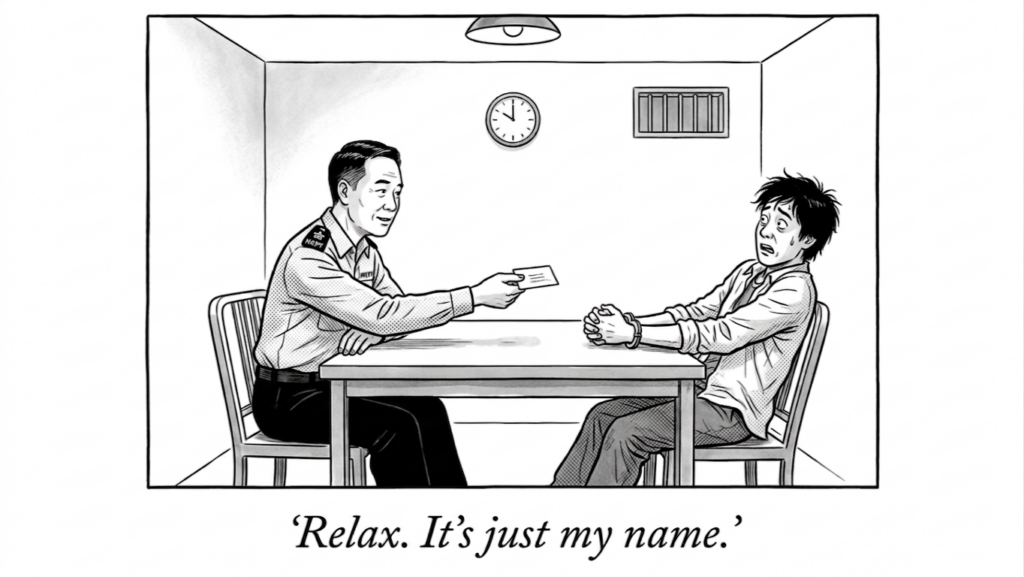
According to multiple internet posts, none of which I have been able to independently verify, all of which I desperately want to be true, there is a policeman in Hong Kong named Satan.
Satan Woo.
That is, allegedly, his name. The name on his badge, the name on his business card, the name that presumably appears on official police correspondence, the name that a suspect hears when Satan Woo enters the interrogation room and introduces himself in a way that, in any other city, would constitute a psychological operation. Somewhere in Hong Kong, a man has been arrested, and the arresting officer has looked him in the eye and said, “I’m Satan,” and the man has had to decide, in real time, whether this is a name or a confession.
I cannot prove Satan Woo exists. But I can tell you that in a city where the Secretary for Justice was named Rimsky, after the Russian composer, and the Secretary for Food and Health was named York Chow, which sounds less like a government official and more like a command you’d give a golden retriever in Manhattan, a policeman named Satan is not even the strangest thing that happened at the office that day.
I have lived in Hong Kong for over a decade. I am a solicitor. I have practiced law on two continents. I have seen things in courtrooms that would make reasonable people reconsider the social contract. But nothing in my legal career has prepared me for the names.
If you have never lived in Hong Kong, I need to explain something that no guidebook covers and no orientation session includes, because the people running the orientation sessions are named things like Bobo and Fungus and they do not see the issue. In Hong Kong, almost everyone has an English name. This is a legacy of British colonization, which left behind many things, the rule of law, an excellent tramway, a lingering opinion about queuing, but whose most enduring contribution to daily life is the fact that seven million Cantonese-speaking people have, over the course of a century, been asked to select an English name for themselves, often as children, often without guidance, and often with results that suggest the dictionary was opened at random, in the dark, by someone who had been spun around three times.
The upper-class families give their children English names at birth, the way the British do, and these names are normal. These are the Jameses and the Elizabeths and the Charlottes. They are fine. They are not interesting. They are not why I am writing this.
I am writing this because of everyone else.
In Hong Kong, if your parents did not give you an English name, you get one later. Sometimes at school, where a teacher who is responsible for thirty-five children and has neither the time nor the inclination to deliberate will simply assign names from a list, which is how you end up with a classroom containing a Winston, a Phyllis, a Benson, and, in one documented case, a child named Februar. Not February. Februar. As if someone had started spelling the month and simply lost interest, or run out of ink, or been interrupted by a fire drill and never gone back to finish. There is also, elsewhere in the city, a Decemb. These two people are walking around Hong Kong with names that are not names but abandoned spelling attempts, and nobody has corrected them, because in Hong Kong the English name belongs to you the way a tattoo belongs to you: even if it’s misspelled, it’s yours, and nobody has the authority to fix it, and after a while you stop noticing.
Sometimes you choose your own name. This is where things go sideways, because a twelve-year-old Cantonese-speaking child choosing their own English name is essentially being asked to perform a task for which they have no training, no context, and no one to tell them that the word they have selected is not, in any English-speaking country on earth, a name. It is a noun. It is an adjective. It is, in one case I will get to shortly, a photosynthetic process.
The results are magnificent.
There is a personal trainer in Hong Kong named Calorie Ng. A personal trainer. Named Calorie. A woman whose entire professional life is dedicated to the elimination of the thing she is named after. Every time a client books a session with Calorie, they are, in a sense, hiring their enemy. Every time Calorie hands someone a meal plan, she is, nominally, asking them to reduce her. She is a woman at war with her own name, and she has chosen to fight that war publicly, in lycra, five days a week.
There is a film director named Fruit Chan, who directed a movie called Made in Hong Kong, which is the most Hong Kong sentence I have ever written and I have written several.
There is an office secretary named Fanny Pong, and I am not going to say anything further about Fanny Pong because I am a solicitor and I have a duty of restraint, but I will say that the air in that office must have been thick with unspoken jokes and that every new hire’s first day must have been a test of character that no HR orientation could prepare them for.
There is a general manager of an IT company named Goggles Pang. There is a woman who works at a trading company named Lovely Chan. There are, scattered across the civil service and the professions and the wet markets and the MTR, people named Hippo, Kinky, Cactus, Treacle, Devil, Whale, Echo, Something, yes, Someone is named Something, which means that at some point in this person’s life a teacher called roll and said “Something?” and a child raised their hand and said “here” and both of them meant it, and a woman named Cinderella who I can only hope leaves every party before midnight out of a sense of contractual obligation to her own name.
The professionals are the best
because the names exist in direct tension with the seriousness of the job.
The legal profession, which in most countries is a place of grave formality and surnames and letters after names that take longer to say than the name itself, is in Hong Kong a place where you can be represented by a lawyer named Bunny. There is a Bunny. There is also a Magnum, a Ludwig, and a John Baptist, who is either a lawyer or a figure from the New Testament and whose closing arguments I would pay to attend either way. The Secretary for Justice, the top legal officer in the entire city, was, for years, a man named Rimsky Yuen. Named after Rimsky-Korsakov. The Russian composer. The man who wrote Flight of the Bumblebee was the namesake of the man who ran Hong Kong’s justice system, and nobody blinked, because in Hong Kong a man named after a nineteenth-century Russian composer telling you what the law is just an average day.
And then there are the Yip sisters.
Chlorophyll Yip and Photosynthesis Yip. Sisters. Their father was a botanist. I need to say that again. Their father was a botanist, and he named his daughters after the process by which plants convert sunlight into energy. He looked at his firstborn child, a human girl, and he thought: Chlorophyll. And then he had another daughter, and rather than reconsider his approach, he doubled down. He went bigger. He named her after the entire process. Chlorophyll is the pigment. Photosynthesis is the system. Together they are a biology textbook with school fees.
A brief aside. I grew up in Adams, Massachusetts, and every year at Hoosac Valley High School we had a spelling bee. Names like Chlorophyll and Photosynthesis would have eliminated ninety percent of the entrants before the first round, not as words to be spelled, but as signatures on the registration form. Half the class couldn’t spell “February.” These two girls were walking around with their father’s dissertation on their driver’s licenses.
I say half the class couldn’t spell February, and I am now forced to consider the possibility that some of them moved to Hong Kong and named children, because Februar, whom I mentioned earlier, and who is real, and who is walking around this city with a name that looks exactly like a fifth-grader’s answer right before the buzzer, is spelled precisely the way Kyle Tatro would have spelled it on a test in 1987 before putting his pencil down and saying “close enough.” Decemb, too. Decemb is what happens when you give up on a word with two syllables left to go. My classmates in Adams got red ink for that. In Hong Kong, they get business cards.
Somewhere in Hong Kong, Chlorophyll Yip is introducing herself at a dinner party and someone is asking her to spell it, and she is spelling it, and the person is nodding slowly and is too polite to ask the question that everyone in the room is thinking, which is: what is your father’s name and did anyone try to stop him.
This is a city where you can be arrested by Satan, prosecuted by Rimsky, represented by Bunny, cross-examined by Magnum, trained by Calorie, directed by Fruit, and have your complaint handled by a man named Jasper who has no memory of this conversation. You could be born as Chlorophyll, grow up next to Photosynthesis, go to school with Februar and Decemb, work for Goggles, report to Lovely, and never once, not once in your entire life, would anyone in Hong Kong think any of this was unusual.
In London, if you introduced yourself as Calorie, people would assume it was a nickname. In New York, they’d assume it was a brand. In Hong Kong, they write it on your business card and offer you tea.
The reason nobody blinks is that the English name in Hong Kong occupies a category that does not exist anywhere else in the English-speaking world. It is not quite a name. It is not quite a nickname. It is a social tool, a professional convenience, a gift from a teacher or a choice from a dictionary or, in the case of the Yip family, an act of botanical imperialism. It belongs to you, but it does not come from the same place that names usually come from. It does not come from family. It does not come from tradition. It does not come from the careful, agonized deliberation of parents who have spent nine months debating whether the child is a James or a Jonathan and what each choice says about their hopes and their class and their relationship to the monarchy. It comes from a Tuesday afternoon in Primary 3, when a teacher points at you and says “you’re Bunny” and you are Bunny, forever, on every email and every contract and every business card and every wedding invitation for the rest of your life, because the teacher said so, and that is that.
And because the name is chosen without the weight that English-speaking cultures place on names, without the history, without the family resonance, without the fear of getting it wrong, the choosing is free. Gloriously, anarchically, beautifully free. You can be anything. You can be a month. You can be a month that you didn’t finish spelling. You can be a chemical compound. You can be Satan. The field is open. The dictionary is a menu. And no one, absolutely no one, will tell you that you have chosen wrong, because in Hong Kong the English name is yours the way your shoes are yours: you picked them, they fit, and anyone who doesn’t like them can look at something else.
I once asked a colleague named Dolphin how she chose her name. She said she liked dolphins. I asked if she had considered other animals. She said she had considered Penguin but it didn’t feel right. She said this with the gravity of a person who had genuinely weighed the relative merits of being named after two different animals and had arrived at a considered decision, and I nodded, because what else do you do, and I went back to my office and I sat down and I thought: I live in a city where a woman named Dolphin once almost became Penguin, and this is the most normal thing that has happened to me today.
Ruth, my wife, has a running list. She keeps it on her phone. She adds to it the way other people add to grocery lists, silently, privately, with a small flash of satisfaction when a new one lands. Last month she was at the bank and her teller was named Chlorinda, which is not the strangest name on the list but which Ruth insists belongs there because “it sounds like a cleaning product that also sings opera.” I cannot argue with this. I have tried. She is right.
She was with me the day we met Kinky. We were at a different bank, Hong Kong has a lot of banks and apparently all of them are staffed by people whose parents lost a bet, and the woman at the window smiled and said, “Hi, I’m Kinky, how can I help you today?” I genuinely did not know if she was introducing herself or describing her sexual identity. I froze. My brain, which has been trained in contract law and cross-border regulatory compliance, simply refused to process the sentence. Ruth did not freeze. Ruth looked at me with an expression I can only describe as a person who has just been handed a gift they did not ask for but have wanted their entire life. She was already reaching for her phone. Kinky is on the list. Kinky is near the top of the list.
I think about what Albert, back in Adams, Massachusetts, would make of all this. Albert, who was likely named Albert because his father was named Albert and his father’s father was named Albert and the question of what to name the child was never a question at all but an inheritance, like the hardware store itself, like the shelves, like the inventory, like the knowledge that you are Albert and you will always be Albert and Albert is not a choice but a fact, the way gravity is a fact, the way the Berkshires are a fact, the way being from Adams is a fact that you carry with you whether you wanted it or not. Albert would find Chlorophyll Yip genuinely distressing. Not offensive. Not funny. Distressing. In the way that a man who has never had a choice about his name would find it distressing to learn that an entire city treats names the way he treats socket wrenches: you look at the options, you pick the one that fits, and if it doesn’t work you pick another one and nobody keeps a record.
The freedom is the point.
But here is what Albert would not understand, and what I have come to understand only after a decade of Dolphins and Goggles and Saturdays at dim sum where the waiter is named Oxygen and nobody looks up from their congee: the freedom is the point. The absurdity is the point. In a city that runs on rules and hierarchies and the specific, crushing pressure of being told from birth which school and which degree and which career path and which road on the map that has one road, the English name is the one place where the system has no opinion. The one place where a botanist can name his daughters after cellular processes and a twelve-year-old can name herself after a marine mammal and a policeman can, for reasons that will never be explained and should never be investigated, call himself Satan. It is the only truly free act in a city that bills for everything else. The name costs nothing. The name answers to no one. The name is yours.
And if the name is Calorie, and you become a personal trainer, then the name is also, in a way that only Hong Kong can produce, the funniest thing that has happened today.
Only in Hong Kong can you walk into a police station, ask for Satan, be told he’s in a meeting with Bunny, and have no one in the building think you are joking. Only in Hong Kong can two sisters named after photosynthetic chemistry walk into a parent-teacher conference and the teacher’s only concern is their math skills. Only in Hong Kong can you be prosecuted by a man named after the composer of Flight of the Bumblebee and sentenced by a judge named Bobo or BiBi and have the whole thing reported in the newspaper by a journalist named Cactus and have the newspaper edited by a man named, and I am not making this up, I am never making any of this up, I do not have to, that is the entire point, a man named Something.
This is the city. This is the naming of things. This is a place where seven million people have, collectively, over the course of a century, decided that English is not a language but a toy box, and the toy box is open, and nobody is watching, and if you want to reach in and pull out Satan or Photosynthesis or Fanny Pong, that is your business and your business alone, and the rest of us will write it on your business card and offer you tea and never, not once, ask why.
Because in Hong Kong, the answer to “why” is always the same.
Because it fit. Because it was forty dollars. And because nobody said I couldn’t.
Comments
2 responses to “The Naming of Things”
I can assure you Satan, the now-retired police officer, does exist – a good friend of mine for 30+ years and a lovely man, who just sent me your blog. You missed another police officer named Jesus and yet another one who chose the name Kaiser!
Then there was the senior police officer interviewing a new young Chinese lady clerk when asked her name she replied “Vagina” he replied “You mean Virginia”, she said “No. Vagina”. He called in his lady executive officer and said to the clerk “Please tell us your christian name” and again the same response “Vagina”. A very horrified executive office was told “Please have a word with her, I think she has a misunderstanding of the English language!”. A few minutes later the pair reappeared and the executive officer advised the ‘misunderstanding’ had been corrected! The clerk then advised her christian name was “Virginia”!
Jesus is your friend, unless you are under arrest in Hong Kong.