On ghosts, property values, and the woman at the desk in Orlando who was not supposed to be there.
The dead walk among us.
In Hong Kong, the seventh lunar month is when the gates of the underworld open and the dead walk among us. This is not a metaphor. This is not a seasonal decoration. This is the operating assumption of a city of seven million people who have built an entire infrastructure around it, the way other cities build infrastructure around snowplows or flood drainage, except the thing being managed is not weather. It is the dead. The dead are hungry. The dead have needs. The dead have, apparently, kept up with inflation, because the paper money you burn for them comes in denominations of ten million dollars, which suggests that the afterlife has an economy and that economy is Zimbabwe in 2008.
The rules of the seventh month are not suggestions. Do not swim at night. The ghosts are in the water, and they will pull you under, which is the kind of rule that sounds like folklore until you remember that this is a subtropical city where the water is already trying to kill you with jellyfish and the ghosts are, at worst, a redundancy. Do not pick up money you find on the ground. The money is an offering for the dead, and if you take it you are stealing from the dead, and the dead, unlike the living, have unlimited time to file a claim. Do not whistle after dark. Whistling attracts them. Do not sit in the front row at the opera. The front row is reserved. Not for donors. For ghosts. The dead get the good seats. The living sit behind them and do not complain, because complaining about your seat at a show you were not the intended audience for is poor form in any culture.
Do not tap a person on the shoulder. A person has two protective flames, one on each shoulder, and tapping one out leaves the person vulnerable. My wife, Ruth, told me this. I asked her if she believed it. She said it doesn’t cost anything not to tap someone on the shoulder. This is Ruth’s entire theology. It doesn’t cost anything. Four words. She could have been a Jesuit if the Jesuits accepted Cantonese women who believe that a four-dollar packet of tissues has the legal authority to reserve a chair.
And in the streets, in the evenings, the bins appear. Metal barrels, scorched black, positioned on sidewalks and at the bases of buildings, and people stand beside them and feed paper into the fire. Joss paper printed to look like currency. Paper houses. Paper cars. Paper iPhones, because the afterlife has kept up with technology even if it has not kept up with monetary policy. Paper designer handbags. I once saw paper Louis Vuitton luggage, which means someone in the spirit world is rolling through the terminal in the afterlife with a matching set, and I respect that commitment to brand continuity across the boundary between life and death.
Ruth’s mother burns paper every year. She burns it with the methodical focus of a woman making a deposit, because that is what it is. A wire transfer conducted through fire, from the living to the dead, processed on a schedule, because the dead are clients and clients have expectations and Hong Kong does not miss a deadline, not for the living and not for the dead.
I stood beside them once, feeding paper into the flames, and I thought: if someone figured out how to tap an Octopus card at the joss paper bin, this entire system would be digitized by Thursday. The Octopus card already works at 7-Eleven, at the MTR, at parking meters, at vending machines, and at the small noodle shop in Mei Foo where the owner looks at cash the way you’d look at a fax machine. It is the most frictionless payment system on earth. There is no reason it could not be extended to the afterlife. Tap. Beep. Two million dollars deposited to the account of your great-grandmother. Receipt available on the app. The dead would get their money faster. The living would get a transaction record. The government would get data. Everyone wins, except the joss paper industry, which would lobby against it with the ferocity of an industry that knows its product is literally going up in smoke and has made peace with that business model.
In Hong Kong, a 凶宅, a hung jaak, a “fierce residence,” is a flat in which someone has died unnaturally. Murder. Suicide. An accident that left a stain the building cannot wash off. The death does not expire. A flat where someone jumped from the window in 1987 is still a 凶宅 in 2026. The flat below it, the one the person passed on the way down, is also tainted. Depending on who you ask, the flat above it may be compromised as well, because spiritual contamination does not respect floor plans.
This is not folklore. This is property law.
There is no statute that requires agents to volunteer a flat’s haunted status the way you might expect. The law, as it stands, does not compel a vendor or an agent to walk up to you unprompted and announce that a man hanged himself in the kitchen. But if you ask, and in Hong Kong, you ask, because everyone asks, the way you ask about the view and the MTR distance and the school catchment, if you ask, the agent must tell you the truth. The Estate Agents Authority, the regulatory body that governs the trade, has made this clear enough that agents who get it wrong end up in tribunal. A court found against one of the city’s largest agencies after a buyer discovered that a child had fallen to his death from the flat he’d just agreed to purchase, information the agent had failed to provide when asked whether anything unusual had occurred there. The judge’s reasoning was straightforward: if an agent knows or ought to know about a tragic incident, and knows or ought to know that it would materially affect the property’s value, the agent owes a duty to disclose it. The agency paid almost forty thousand dollars. The lesson was absorbed. Not because the industry suddenly developed a conscience, but because the industry understood, as all industries eventually understand, that the cost of getting caught exceeds the cost of telling the truth.
The practical result is a system of searchable databases that catalogue every known unnatural death in every known residential unit in the city, cross-referenced by address, by floor, by unit number, by cause of death, so that a buyer can look up a flat the way you look up a vehicle history report, except instead of checking for flood damage you are checking for whether someone died in the kitchen. The discount runs twenty to thirty percent, sometimes more in the case of a murder. Banks shy away from offering mortgages. Entire floors lose value. The pricing ripples outward in concentric circles of superstition and spreadsheet math, and nobody finds any of it strange, because the financial consequences are not metaphysical. The question is never is it true? The question is will the next buyer think it’s true? And in a city where the median flat costs more than most people will earn in a lifetime, that is not a question you leave unanswered.
In the United States, the math is reversed.
In the United States, if someone dies in your house, the value goes up. You can charge admission. You can sell the movie rights. The Amityville Horror house has changed hands multiple times, and every buyer pays a premium for the privilege of sleeping in a building where a mass murder occurred, because in America, a haunting is not a liability. It is a brand. It is content. It is a three-bedroom colonial with a Wikipedia page and a documentary deal, and the real estate listing does not say “death flat, 30% discount.” It says “as featured in,” and the price goes up.
America looks at a ghost and sees a franchise opportunity. Hong Kong looks at a ghost and sees a pricing problem. Both responses make perfect sense if you understand the culture, and neither one tells you whether ghosts are real, because the question of whether ghosts are real is, in both places, completely beside the point.
I asked Ruth once if she would live in a 凶宅. Not because I wanted to. Because I wanted to hear what she would say.
“No.”
“What if the discount was fifty percent?”
“No.”
“Sixty? Harbor view. Three bedrooms. The death was forty years ago, the feng shui master clears it, we renovate everything ….”
“No.”
“Can I ask why?”
“You can ask.”
She went back to her phone. That was the end of the consultation.
Ruth believes in ghosts the way she believes in the feng shui toad by the front door and the mirrors that deflect negative energy and the furniture arrangement I am not permitted to violate. She does not believe in them the way a person in a horror film believes in them, with gasps and crucifixes and a priest on speed dial. She believes in them the way she believes in the weather forecast: it is information, it comes from a source she considers credible, and she adjusts her behavior accordingly, without drama, without explanation, and without any interest in my opinion.
I do not believe in ghosts. I am from Adams, Massachusetts, where the supernatural is a category reserved for campfires and Stephen King novels and the one uncle at Thanksgiving who claims he saw a light in the cemetery and who everyone tolerates because he also brings the pie. I have a law degree. I have spent my career constructing explanations from evidence. I believe in the rules of evidence, the standard of proof, and the basic, load-bearing assumption that the physical world is the only world and the things in it are the things that are in it and there are no additional things sitting at desks in hotel rooms near Disney World.
Which brings me to the desk.
The Gaylord Palms Resort and Convention Center, Kissimmee, Florida, is not a place where you expect to see a ghost. I need you to understand the setting, because the setting is the point. This is not a crumbling manor on a moor. This is not a Victorian house with a locked wing and a portrait whose eyes follow you down the corridor. This is a Disney-adjacent hotel with an indoor atrium the size of a small country, fake alligators in a fake swamp under a real glass ceiling, a gift shop that sells plush alligators and a candle that smells like what someone in a marketing department believes Florida smells like. There is a lazy river. There is a Starbucks. The most unsettling thing in the building should be the bill.
We were there. Ruth and I. Several years ago. We were in the room. The lights were low. The day was done. Ruth was on her phone, which is to say Ruth was in her phone, in the way Ruth enters her phone the way a diver enters water, fully and with no remaining awareness of the surface world. I was on the bed.
I saw a woman sitting at the desk.
The desk was in the corner of the room. One of those small, decorative hotel desks that exists so business travelers can open a laptop and pretend they are being productive on vacation. There was a woman sitting at it. Facing away from us. Long dark hair, straight down her back. She was not moving. She was sitting the way a person sits when they do not know they are being watched, or the way a person sits when they are not a person.
“Ruth.”
Nothing. Ruth was in her phone.
“Ruth.”
Nothing.
“Ruth, there is a woman sitting at the desk.”
Ruth did not look up. Ruth made the sound she makes when I have said something that has not cleared the threshold of whatever algorithm governs her attention, a sound that is not a word and is not a silence but occupies the space between them the way I occupy the space between Western skepticism and whatever I am about to describe. A sound that means: I have registered that you are speaking and I have decided that what you are saying is not yet worth surfacing for.
“Ruth. I need you to look at the desk.”
She did not look at the desk. She scrolled.
I was staring at this woman. This woman who was not moving. Not shifting. Not breathing in any way I could see. Sitting with a stillness that was not the stillness of a person being still but the stillness of a thing that does not need to move because it is not operating under the same requirements as things that move. I stared at her. My wife was reading something on her phone that was apparently more interesting than the dead woman in our room, which, knowing Ruth’s phone, was probably a Threads post about air fryers.
I gave up. This is what marriage does to a man. I had a ghost in my hotel room and my wife would not look at it and at a certain point you stop trying, because you have been married long enough to know that Ruth will look at what Ruth wants to look at when Ruth decides to look at it, and not one second before, and the woman at the desk was going to have to get in line behind whatever was on that screen. I went back to what I was doing. I stopped looking at the ghost. The ghost, I assumed, was still there, but I had been overruled by a phone, and the phone had won, and this was not the first time and would not be the last.
Then Ruth screamed.
Not a frightened scream. I need to be precise about this. Not an oh-my-God-what-is-that scream. Not the scream of a woman who has seen something that terrifies her. This was an angry scream. This was the scream of a woman who has looked up from her phone, seen an uninvited stranger sitting at the desk in her hotel room, and has arrived, in the space of a single syllable, at a conclusion that has nothing to do with fear and everything to do with territorial authority. This was the scream of a woman who had once looked at a freshly washed Hyundai Tucson at Logan Airport and called it a piece of shit in front of the man who owned one. This was the same energy. The same frequency. The same absolute, unrehearsed conviction that whatever was in front of her was not meeting her standards and needed to leave immediately.
Kevin from the rental garage would have recognized that sound. Kevin’s Tucson would have recognized that sound. Somewhere in Vermont, Kevin’s girlfriend shivered again and still didn’t know why.
The woman was gone.
The desk was empty. The chair was empty. The corner was empty in the way that a place is empty when the thing that was just in it is no longer in it and the air hasn’t quite settled.
I looked at Ruth. Ruth was pointing at the desk. Her hand was steady, because Ruth’s hands do not shake. Ruth’s hands have never shaken. Ruth’s hands negotiate, Ruth’s hands manage, Ruth’s hands fold joss paper with the precision of a woman who does not waste a crease. But her hand was pointing at the desk and her face was the face of a woman who was not frightened but offended, which, if you know Ruth, is considerably worse for whoever is on the receiving end.
She described what she had seen. A woman. Long dark hair. Sitting at the desk. Facing away. Not moving. Her description matched mine exactly. The hair. The position. The facing-away-ness of it, the particular quality of a presence that does not turn around because it does not need to acknowledge you because you are not the point.
“I told you,” I said. “I told you three times.”
“Why didn’t you say something?”
“I said something. I said it four times. You were on your phone.”
“You should have said it louder.”
“I said there is a woman sitting at the desk. How much louder does that sentence need to be? What volume does a sentence about a ghost in your hotel room need to achieve before it competes with Instagram?”
She was not listening to me. She was looking at the desk. The empty desk. The desk that a woman had been sitting at and was no longer sitting at, because Ruth had screamed at it the way Ruth screams at things that do not meet her expectations, and the woman, ghost or not, had done what everything does when Ruth screams at it: she left.
We did not change rooms. I want you to understand this. We did not call the front desk. We did not pack our bags. We did not request a transfer. We stayed. Ruth stayed. Ruth, who will not live in a 凶宅 at a sixty percent discount with a harbor view and a feng shui clearance, who will not swim in the seventh month and will not whistle after dark and will not sit in the front row at the opera because the front row belongs to the dead, this Ruth looked at the empty desk and did not move, because the ghost was gone, and the ghost was gone because Ruth had told it to go, and Ruth saw no reason to leave a room that she had already cleared with the efficiency of a woman who does not share space with things she has not approved.
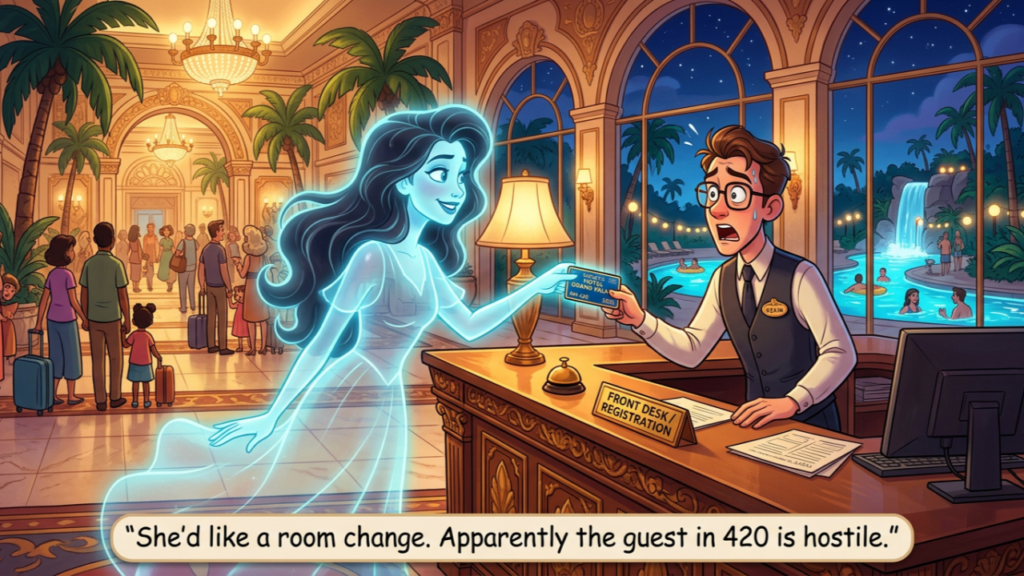
I like to think the ghost went to reception. I like to think she floated down to the front desk at the Gaylord Palms and requested a room change, and the woman behind the counter handed her a new key card without asking why, because at a hotel in Kissimmee she had probably seen worse. I like to think the ghost is still out there somewhere, sitting at a desk in a different room, facing away, not moving, haunting some other couple who will handle it with less volume.
Ruth went back to her phone. That was the end of the haunting.
I have told this story at dinner parties. It works every time. People laugh. Ruth rolls her eyes, which is her version of a laugh, or her version of tolerating me, which at this point in the marriage may be the same thing. Someone tells a ghost story of their own. Someone says they don’t believe in ghosts. I say I don’t believe in ghosts either. The dinner continues.
The question nobody asks is: what did I see?
I do not know. I am a lawyer. I have spent my career taking a set of facts and building from them a narrative that accounts for every element, that leaves no gap, that arrives at a conclusion that can withstand cross-examination. I cannot do it here. Two witnesses. Two matching descriptions. No evidence. No mechanism. No precedent. If this were a case, I would not take it. There is nothing to argue. There is nothing to disprove. There is only the fact that two people saw the same thing in the same room and the thing was not there, and the legal system, my legal system, the one I have built my professional life inside, has no framework for a woman at a desk in a hotel in Florida who was not a woman and was not at a desk and yet was seen, clearly, by two people whose testimony would be admissible in any court I have ever practiced in.
I have tried every explanation available to a man with a law degree and a commitment to the physical world. Light. Exhaustion. A shared hallucination triggered by suggestion, except I didn’t suggest it because Ruth wasn’t listening, a fact I will hold against her in this and every context until one of us dies and tests the afterlife hypothesis personally. And even that doesn’t hold, because I saw it first, and I told her, and she ignored me, and then she saw it independently, after I had already given up and gone back to what I was doing, which means whatever was at that desk did not require my narration or my attention or my belief. It was there whether I was looking or not.
I cannot explain it. I do not like that I cannot explain it. I am a man who explains things for a living, and this thing will not be explained, and it sits in me the way a hung jury sits in a trial lawyer: unresolved, uncomfortable, and unlikely to go away.
Hong Kong does not ask whether ghosts are real.
The question is irrelevant. The question is a Western question, from a tradition that sorts the world into real and not-real and builds policy around the sorting. Hong Kong does not sort. Hong Kong prices.
A ghost in a flat is not a philosophical problem. It is a pricing problem. What is the discount? How many floors are affected? Has the agent disclosed? Is the database current? Not do you believe? but what’s it worth now? The ghost is factored in the way a north-facing window is factored in, the way a highway view is factored in. It is a variable. It has a coefficient. It moves the price.
The city accounts for ghosts the way it accounts for typhoons. Not with faith. Not with debate. With infrastructure. The typhoon signal goes up and the shutters close and nobody argues about whether wind is real. The seventh month comes and the bins appear and the paper burns and the front row empties and nobody argues about whether the dead are hungry. The system activates. The system runs. The system does not require your belief. It requires your participation, and participation is free.
Ruth does not need me to believe. She has never asked me to believe. She follows the rules and does not swim and does not pick up the money and folds the paper and feeds the fire, and when I ask why, she says what she always says:
“It doesn’t cost anything.”
And she is right. It costs nothing to not swim. It costs nothing to not whistle. It costs nothing to leave the front row empty and the roadside money on the ground and the paper in the fire. It costs nothing to hedge a risk you cannot measure, and Ruth, a woman who once made me return a pen I accidentally took from the bank, folds paper money and feeds it to a fire for the dead and does not consider it a waste.
Because it is not a waste.
Because it is not a waste. It is insurance. A premium paid on a policy whose terms are unclear and whose claims department operates on the other side of a boundary that no living person has audited. The premium is cheap. The downside of being wrong is unquantifiable. And Ruth does not leave unquantifiable downsides unaddressed. Not in the marriage. Not in the space between the living and the dead.
I stood at the bin last August. Ruth’s mother was feeding paper into the fire with the practiced hands of a woman who has been making this deposit for sixty years. Ruth was folding. I was holding the stack, because my role in Ruth’s family’s spiritual life is the same as my role at dinner: hold things, stay out of the way, do not ask questions that reveal how little I understand.
The smoke rose. The paper curled and became something else, or became nothing, depending on what you believe. Somewhere, maybe, Ruth’s ancestors were receiving funds. Somewhere in Florida, maybe, a woman with long dark hair was sitting at a desk in a room that someone else had just checked into, haunting quietly, bothering no one, hoping that whoever was in the bed would not be traveling with a Cantonese woman who screams at ghosts the way other people scream at spiders.
I do not believe in ghosts. I have a law degree and a decade of trial experience and a worldview built on evidence and the structural certainty that the dead stay where you put them.