Trevor, the K-Car, and the Banana: How My Wife Met One of My Best Friends and Nearly Left Me at Disney
On first impressions, soft serve at highway speed, and the medical professional who screamed for fruit in a hotel bathroom while my girlfriend reconsidered everything.
Before I tell you about the night my wife, at the time girlfriend, met Trevor, a man I grew up with in Adams, Massachusetts, I need to tell you about the ice cream.
This is important. Not because the ice cream is central to the story, it isn’t, but because you cannot understand Trevor without first understanding what happened at King Cone, and you cannot understand what happened at King Cone without understanding what it’s like to be young, stupid, and driving Route 8 through the Berkshires in July with somewhere to be and no regard for the laws of thermodynamics.
King Cone is a soft-serve place in Pittsfield, Massachusetts. It is not a normal soft-serve place. A normal soft-serve place gives you a twist on a cone, maybe four inches tall, a civilized amount. King Cone gives you what can only be described as an architectural event. Three feet of soft serve, stacked vertically on a standard-issue cone with the structural ambition of a man building a cathedral on a thumbtack. It is magnificent. It is also, in any temperature above 70 degrees, a ticking clock.
It was July. It was the high nineties. The Berkshires, which exist in a climatic state of permanent indecision, it can be snowing in April and broiling in June, sometimes on the same day, had chosen violence. The air was thick. The sun was direct. And Trevor was standing in the King Cone parking lot holding a three-foot column of soft serve that had already begun to weep.
We had places to be. We always had places to be. In Adams, “places to be” usually meant another bar between another church, but the intent was real, and so we piled into the car, Trevor in the back seat, cone and all. Two and a half feet of ice cream, conservatively, still clinging to the cone with the desperate optimism of something that knows it’s doomed.
The car was hot. Parked in the sun, windows up, July in the Berkshires. The interior temperature was roughly that of a kiln. The ice cream, already in a negotiation with gravity, immediately began losing ground. Soft serve ran down the cone, over Trevor’s hand, down his wrist, pooling in the crook of his elbow. He looked like a man trying to hold a candle in a sauna.
Trevor’s solution, because Trevor’s solutions are always both logical and catastrophic, was to hold the cone out the window. Arm extended, ice cream in the breeze, problem solved. And it was solved, briefly, in the way that all of Trevor’s solutions are briefly solved before physics reasserts itself.
We picked up speed on Route 8. The wind did what wind does to three feet of soft serve mounted on a cone being held out the window of a moving vehicle at 55 miles per hour. The entire ice cream portion, not a drip, not a scoop, the entire load, separated from the cone and launched backward with the trajectory and conviction of something that had been fired from a cannon.
It landed on the windshield of the car behind us.
Not near the car. Not on the hood. On the windshield. A direct hit. Two and a half feet of soft serve, delivered at highway speed, splattering across the glass of a stranger’s vehicle like a dairy-based act of war. The driver hit their wipers. The wipers made it worse. We kept driving, because in Adams, you don’t stop to exchange insurance information over ice cream. You just keep going and hope nobody got your plate.
Trevor looked at the empty cone in his hand. He looked at the car behind us, now frosted like a sheet cake. He ate the cone.
This is the man I introduced to my girlfriend.
Ruth and I were at Disney World. We had decided to do it properly, not the budget motel off the highway with the questionable pool, but the Walt Disney World Dolphin Resort. Upscale. Elegant. The kind of place where the lobby smells like money and the staff greets you by name and everything is designed to make you feel like a person who makes good decisions.
I was making good decisions. I was with a beautiful woman. We were staying somewhere nice. I was, for perhaps the first and last time in my life, presenting as a functioning adult with taste and judgment.
Then I told Trevor where we were staying and he said he’d drive down to meet us.
I should have been worried. I was worried. But worry, when it comes to Trevor, is like the speeding alarm on a red minibus, it beeps constantly, you acknowledge it, and then you proceed at the same speed anyway because what else are you going to do?
Trevor called when he was close. We arranged to meet him out front. The Dolphin Resort’s entrance is a curated experience: a sweeping drive, manicured landscaping, valets in pressed uniforms opening doors for guests arriving in rental BMWs and town cars. It is a place designed to make a first impression. Trevor made one.
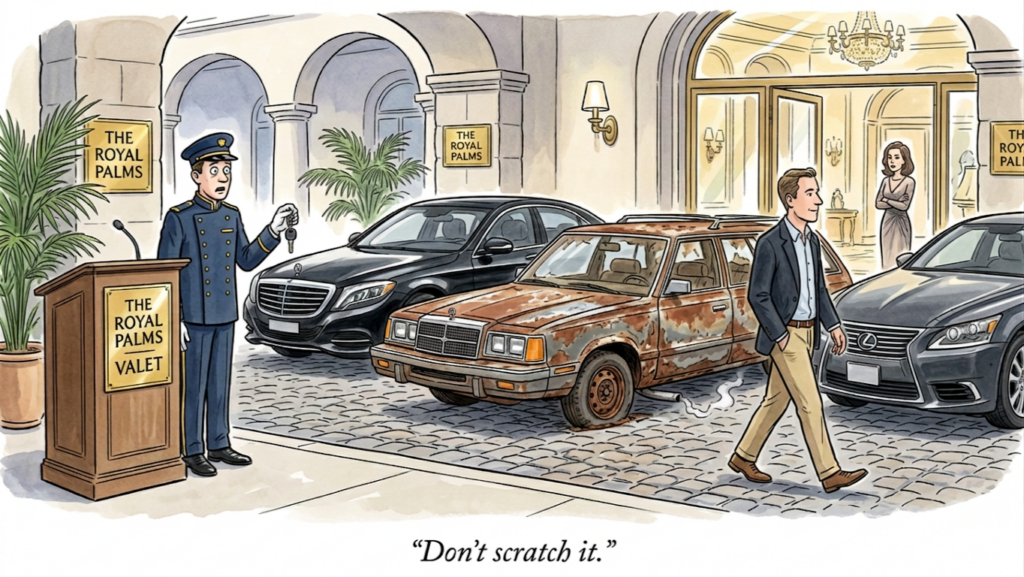
He pulled up in a Chrysler K-car station wagon.
Not a restored K-car. Not a lovingly maintained vintage wagon. A K-car that looked like it had been driven to Florida directly from a salvage yard, possibly without stopping, possibly without a muffler. The paint had oxidized past any identifiable color into a shade I can only describe as “surrender.” Rust had claimed the wheel wells with the confidence of a colonial power. The exhaust pipe was attached by what appeared to be optimism. If you remember Trapper John, M.D., the television show, and the beaten-down motorhome George Gates lived in outside the hospital, a licensed physician, living in a vehicle that looked like it had been condemned by FEMA, that was the energy. That was the exact energy. Except Dr. Gates’ motorhome was stationary. Trevor had driven his across multiple state lines.
He pulled into the valet line. The valet, a young man whose entire professional existence was built around the smooth handling of Lexuses and Mercedes, watched the K-car rattle to a stop with the expression of someone who has just been presented with a problem not covered in training. Trevor got out, handed the man his keys with the confidence of a guest arriving in a Bentley, and said, “Don’t scratch it.”
The valet took the keys. He looked at the car. He looked at Trevor. He looked at the car again, searching, perhaps, for something left to scratch. He drove it away at low speed, possibly out of respect, possibly because he wasn’t sure it could survive anything faster.
Ruth watched all of this from the lobby doors.
“That’s your friend,” she said.
“That’s Trevor.”
“He’s a doctor.”
“He is a doctor.”
She looked at the K-car disappearing around the corner, trailing a faint blue haze. “What kind of doctor?”
“The kind who valet parks that.”
We decided to go to dinner. The Rainforest Cafe, because when you’re at Disney and you’ve already abandoned all pretense of sophistication the moment a rusted K-car wagon rolled into your resort’s valet line, you might as well eat surrounded by fake gorillas and simulated thunderstorms.
When we arrived, the hostess informed us the wait was two hours.
Two hours. I looked at Trevor. I looked at Ruth. I looked at Trevor again, and something came over me. I cannot explain it. I cannot defend it. I can only tell you that it happened, and that I would do it again, and that I am not, by any traditional measure, a good person.
I pulled the hostess aside.
“I’m sorry,” I said, in the low, strained voice of a parent at the end of his rope. “That’s my son.” I gestured toward Trevor, who is the same age as me. We are both adults. We were both, at that time, licensed professionals, he a physician, I an attorney. Two men in their thirties with advanced degrees and the moral compass of raccoons.
“He has autism,” I continued. “If we don’t get seated soon, he’s going to have an episode. It will be … significant.”
The hostess looked at Trevor. Trevor, to his eternal credit and my eternal damnation, had already shifted into character. Not dramatically. Not cartoonishly. Just … slightly off. A vacant stare. A gentle rocking. The posture of a man who was one fluorescent light flicker away from a meltdown. He was, I must say, medically convincing, which makes sense, because he is a medical professional, and if anyone knows how to present symptoms, it’s a man who diagnoses them for a living.
We were seated immediately.
The Rainforest Cafe, for those who haven’t been, is a restaurant designed to simulate a tropical rainforest, which is to say it is a restaurant in which you cannot eat in peace. Every few minutes, the lights dim, thunder rumbles from hidden speakers, lightning flashes across the ceiling, and the animatronic animals mounted throughout the restaurant, gorillas, elephants, parrots, snakes, come alive, shrieking and growling and trumpeting in a coordinated sensory assault that is meant to delight children and does, in fact, delight children, while making every adult in the room wish they had chosen Applebee’s.
Trevor waited for the first thunderstorm. The lights dimmed. The animals stirred. The gorillas began their pre-recorded chest-beating. And Trevor, my “son,” the physician, seated at a family restaurant at the Walt Disney World Resort, began making monkey sounds.
Not quiet monkey sounds. Not subtle, under-the-breath monkey sounds. Full-throated, diaphragm-supported, clinically precise primate vocalizations that were, and I need you to understand this, more realistic than the actual soundtrack playing over the restaurant’s speaker system. The animatronic gorilla was doing its best, and Trevor was doing it better. He hooted. He screeched. He slapped the table with his palms. He was, in that moment, the most convincing primate in the Rainforest Cafe, and the Rainforest Cafe has a lot of primates.
People at surrounding tables turned. Parents pulled their children slightly closer. A waiter paused mid-stride with a tray of nachos and stared. The hostess who had seated us looked over with an expression that said, I knew it. Thank God we got them a table.
Ruth sat across from me. She had not spoken. She had not moved. She was holding her menu with both hands, staring at the laminated pages with the fixed intensity of a woman trying to teleport herself to literally anywhere else. She did not look at Trevor. She did not look at me. She looked at the menu as though the appetizer section contained the answers to questions she was not yet ready to ask.
This was the first time she had met one of my friends.
After dinner, we retired to the hotel room. I had brought a DVD of Caddyshack, because there are certain films that are non-negotiable when Trevor is involved, and Caddyshack is the foundational text. The problem was that the Dolphin Resort had DVD players only in the cabana rooms, and we were not in a cabana room, because cabana rooms cost more than my first car and I am, despite appearances, occasionally mindful of money.
I called the front desk.
“My son,” I said, and I could feel Ruth’s eyes on the back of my head like two lasers, “is autistic. He’s had a very long day. The only thing that calms him down is his favorite movie. If he can’t watch it, I’m afraid we’re going to have a very difficult night. For everyone on this floor.”
The hotel, because Disney hotels are staffed by people who have been trained to say yes to everything short of arson, sent a man up to install a DVD player in our room.
When the technician knocked, Trevor disappeared into the bathroom. The man entered, began connecting cables, and from behind the bathroom door came a sound that I will carry with me to my grave.
“BANANA! I WANT A BANANA! BANANAAAAA!”
Trevor was screaming for a banana. Not asking. Not requesting. Screaming, with the desperate, guttural urgency of a man in genuine crisis, as though the banana were medication, as though the banana were oxygen, as though the absence of the banana was a medical emergency unfolding in real time behind a closed bathroom door. He pounded the door for emphasis. The mirror rattled.
The technician looked at me. I made the face, the tired, apologetic, please-don’t-judge-me face of a father who deals with this every single day. “He needs his banana,” I said quietly. “And his movie. The movie really helps.”
The man installed that DVD player faster than any DVD player has ever been installed in the history of home entertainment. He was out the door in under three minutes, trailing cable and compassion.
Trevor emerged from the bathroom, completely composed, and settled onto the bed.
We watched Caddyshack. The whole thing. Trevor reciting every line before it was spoken. Ty Webb’s philosophy of golf. Al Czervik’s war with Judge Smails. The Bishop’s round in the rain. Carl Spackler and the gopher. The pool scene. “Gunga galunga.” Every beat, every pause, every delivery, performed in a hotel room at Disney World after a man had screamed for a banana to ensure we had the equipment to watch it.
Ruth sat on the edge of the bed. She watched the movie. She watched Trevor watching the movie. She watched me watching Trevor watching the movie. She was very quiet for a very long time.
I turned to her during the scene where Al Czervik swaggers into the pro shop and introduces his playing partner, Mr. Wang, a man who, Czervik assures everyone, owns property on the good side of the Great Wall. I leaned over and whispered: “You know, I now own property on the good side of the Great Wall.”
She did not laugh.
She looked at me the way she would look at me many times in the years to come, the way she looked at me when I served her a pu pu platter from a snowbank, the way she looked at me when I offered to auction her off at Notre Dame Church, the way she looks at me every time Adams reaches out across 8,000 miles and reminds her exactly what she married into.
“I could have dated a banker,” she said. Since then, it is something I heard often, especially when Ruth was in the company of my friends.
She could have. She could have married a man who drove a sedan that didn’t require a tetanus shot to enter. She could have married a man whose best friend had never launched two and a half feet of soft serve into a stranger’s windshield at highway speed. She could have married a man who did not, as a recreational activity, impersonate the parent of a disabled person at a chain restaurant in order to skip a two-hour wait, and then, with the momentum of a grifter who cannot stop grifting, do it again forty-five minutes later to secure a DVD player for a comedy from 1980.
She could have married a banker. But a banker wouldn’t have a Trevor.
Almost nobody has a friend like Trevor. Trevor is a statistical anomaly, a man who exists at the intersection of medical degree and K-car and Chinese bridal sedan chair, a man who will drive a vehicle that is legally closer to scrap metal than automobile across state lines to meet you at a Disney resort and then valet park it without a flicker of self-consciousness. A man who, when asked to pretend to be your autistic adult son in a restaurant full of animatronic wildlife, doesn’t ask why. He asks what kind of autism, because he’s a doctor and he wants to get the details right.
Small-town friends aren’t just people you grew up with. They’re people who grew up with you in a place where there was nothing to do but invent things to do, and the things you invented were strange, and possibly illegal, and definitely inadvisable, and you did them anyway because you were together and together was the whole point. You threw ice cream into traffic. You rolled pumpkins down hills. You screamed for bananas in hotel bathrooms. And thirty years later, you’re still doing it, because the friendship was never about the activity. It was about the willingness to show up, in whatever vehicle you own, however many miles away, and commit fully to whatever insanity the night requires.
Ruth didn’t know any of this when Trevor’s K-car rattled into the Dolphin Resort’s valet line that evening. She didn’t know about King Cone, or the pumpkin, or the bridal sedan chair that was waiting in a garage back in Adams for a moment that hadn’t happened yet. She just saw a rusted station wagon, a man who appeared to need supervision, and the dawning realization that the person she was dating came from a place that produced people like this on purpose.
She married me anyway.
She could have married a banker. The banker would have had a nicer car. The banker would not have faked a disability at the Rainforest Cafe. The banker’s friends would not have screamed for fruit in a bathroom to secure a DVD player for a forty-year-old Bill Murray movie.
But the banker wouldn’t have a Trevor. And a life without a Trevor, whatever else it might be, dignified, quiet, free of unsolicited primate sounds in public restaurants, is a life that’s missing something essential. Something that can’t be replaced by a good salary or a car that starts on the first try.
Ruth knows this now. She won’t admit it, but she knows.
She married into Adams. And Adams, sooner or later, sends a Trevor.