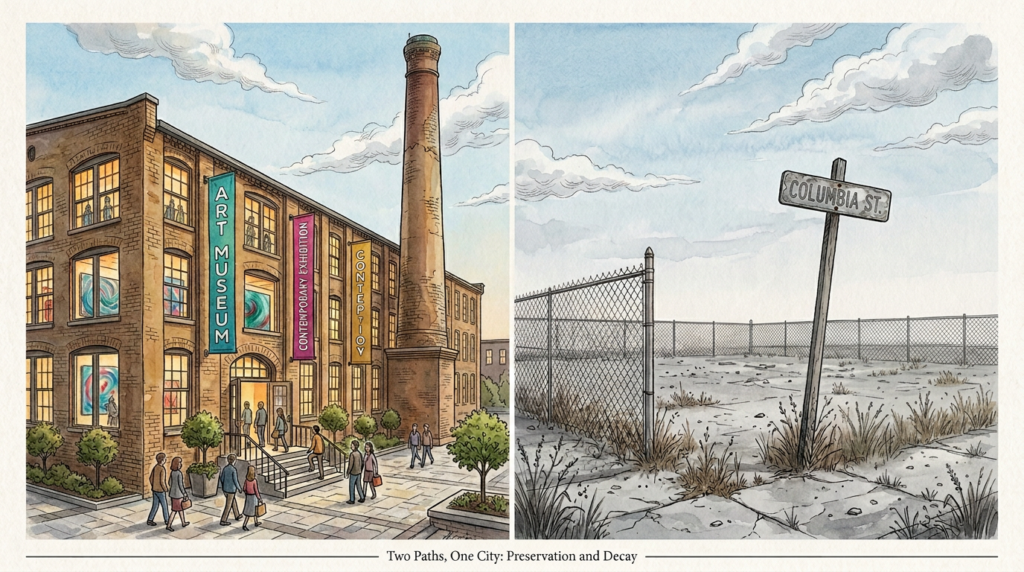
As most of you already know, I grew up in Adams, Massachusetts. A mill town in the northern Berkshires, tucked under Mount Greylock, built on textiles and paper and the kind of work that made your hands rough. The Arnold Print Works ran the Renfrew Mill on Columbia Street. Largest employer in town. Made printed fabrics, employed hundreds. Arnold went bankrupt in 1981. Three years later the mill burned. Nobody rebuilt it. The lot sat empty. Still does, more or less.
A mile up the road in North Adams, the same company had a bigger complex. Same story, same closure, same bankruptcy. But North Adams got lucky. The state spent a hundred and fifty million dollars turning those mills into MASS MoCA, a contemporary art museum that pulls tourists from Boston and New York and makes the town feel like it has a future. Adams got the fire and the empty lot. Same company, same decade, same collapse. One town got reinvented. The other got left behind.
I mention this because I now live in a city that the entire Western policy establishment has decided is the next Adams. The obituary is written. Hong Kong is finished. The listings are gone. The money moved. The factory closed.
Except the money did not leave Hong Kong. It arrived. This brings us to the topic of the HSBC Hong Kong IPO comeback, a pivotal moment that challenges the narrative of decline.
Over a hundred companies listed on the Hong Kong Stock Exchange in the first half of 2026, raising more than forty billion dollars. HKEX posted record profits. Average daily turnover hit 280 billion Hong Kong dollars. The pipeline has over five hundred companies waiting to get in. In that same period, one Chinese company listed in New York. One. It raised twelve million. Last year, thirty-nine Chinese companies raised 886 million on American exchanges. That is not a decline. That is an evacuation. And the evacuees came here.
I can see where they landed from the top deck of my bus. The HKEX building sits in Central, and the bankers at lunch are more numerous this year than last, noticeably more, the way you notice more cars in a parking lot when a factory is hiring. HSBC just poached a dozen bankers from JPMorgan and Goldman and is working on forty IPOs after completing five in all of 2025.
While JPMorgan and Goldman lose ground in Hong Kong, HSBC just got the lift it needed.
The American banks have cut headcount in Hong Kong. They’ve reduced exposure. They’ve treated the city as a risk to be managed rather than an opportunity to be seized. HSBC has done the opposite. It is hiring. It is expanding. It is working forty IPOs while its American competitors struggle to get five across the line. That is not a coincidence. That is a choice. And the choice is already showing up in the numbers.
The money moved. HSBC was ready. The American banks were not.
Prudential doubled its office space. Chinese banks now control seventy percent of Hong Kong’s listing fee pool, up from forty-eight percent in 2019.
The parking lot is full. But first, the why.
The official American story: China stole intellectual property, manipulated its currency, subsidized its industries unfairly, and now poses a national security threat. Therefore the United States must decouple, pull apart the financial and technological wiring that connected the two economies for forty years, restrict capital flows, block listings, sanction and tariff and audit and delist until the relationship is contained.
The actual story is less flattering.
America is a nation in decline that cannot accept second place. China got rich using the same playbook every industrializing country has used since Britain, including America itself in the 1880s. Protect your infant industries, copy what works, subsidize until you reach scale, then compete. The US did this with steel. Germany did it with chemicals. Japan did it with cars. South Korea did it with semiconductors. The playbook is not a secret. It is economic history. The only difference is that China did it bigger, faster, and to an incumbent that assumed the game was already over.
America is not decoupling because China broke the rules. It is decoupling because China learned the rules too well, got too good, and is now threatening to win. And rather than compete, rather than invest in its own infrastructure and education and industrial base the way it did in the 1950s, the United States decided it was easier to kick over the board. Sanction Huawei. Ban TikTok. Delist Chinese companies. Block investment. Restrict chips. None of this is about fairness. It is about making sure nobody else gets big enough to matter.
I watched this dynamic play out in Adams long before I had the vocabulary for it. A town that lost its factory not because the workers did anything wrong, but because the economics shifted and nobody in power thought the town was worth saving. The workers at Arnold Print Works did not steal anyone’s intellectual property. They made fabric. And one day the owners decided they could make it cheaper somewhere else, and the town was on its own. That is what decline looks like from the ground. Not dramatic. Not criminal. Abandonment dressed up as market logic.
The United States is now doing to its own financial system what the owners of Arnold Print Works did to Adams. Abandoning a function it used to dominate, not because the function is broken, but because maintaining dominance requires effort and breaking things is easier. New York was the unquestioned capital of global capital markets for seventy years. It earned that position by being open, transparent, liquid, and welcoming. Now Washington is systematically making it hostile to the fastest-growing segment of global business because that segment is Chinese, and Chinese success is intolerable to a country that still thinks of itself as the only one allowed to win.
The Holding Foreign Companies Accountable Act. SEC disclosure fights. Audit standoffs. Voluntary delistings. The message, delivered through a thousand regulatory paper cuts: we do not want you here. The companies heard it the way a worker hears it when the hours get cut and the locker room empties out. You do not need to be fired. You just need to be made unwelcome.
So the listings came here.
CATL raised five billion dollars. MiniMax and Zhipu, two AI companies that have not turned a profit yet, listed under Chapter 18C, a specialist technology framework Hong Kong built specifically to catch this kind of company. An American gene therapy startup from San Diego, Axiom Biosciences, announced it would IPO in Hong Kong before New York, because the rules here get it to market faster than Nasdaq’s current queue allows. An American company chose Central over Nasdaq. Shorter line, open window.
If you are not a banker, this still matters. It means jobs. Not just for the suits in Central. The woman who runs the print shop producing listing prospectuses. The IT contractors maintaining exchange systems. The driver taking the CFO to the roadshow meeting at the Four Seasons, and the staff serving the lunch. The junior accountant at a mid-tier audit firm who just got promoted because the workload doubled. Forty billion dollars in capital raised does not stay inside the Exchange building. It leaks into rents and restaurant tabs and school fees and MTR fare revenue and the sandwich shop in Admiralty that was half-empty two years ago and now has a line at noon.
Capital markets are the factory. The guy who fixed air conditioners in Adams did fine when the mill was running. The guy who fixes my air conditioning in Hong Kong is booked two weeks out because the factory here is hiring.
Factories close. I know this personally.
From the American side: in June, SpaceX went public. Largest IPO in American history. Seventy-five billion dollars. The underwriters blocked all orders from China and Hong Kong. The website went dark from IP addresses in both places. The explanation cited ITAR, the International Traffic in Arms Regulations, the same law that governs missile parts and satellite encryption. Hong Kong, a city with its own legal system, its own securities regulator, its own currency, got blocked alongside the mainland. Nobody in Wan Chai is building rockets. But in Washington’s compliance architecture, Hong Kong is China. No distinction.
Every global fund manager now runs a split calculation. The correlation between US and Chinese equity returns dropped from 0.80 to 0.22 since 2020. The correlation between Chinese and Hong Kong returns held steady at 0.78. If you are a pension fund in Minnesota, your model treats Hong Kong as China, not as an international financial center. Spreadsheet decision. No appeals process.
Foreign investors pulled 137 billion dollars out of Asian equities in the first half of this year, even while markets soared. The passive money came back only to buy AI proxies. Not regions, not cities, just chipmakers. If your retirement fund used to hold a broad Asia allocation that included Hong Kong property developers and insurers, it probably does not anymore. Your landlord’s stock is less liquid. The REIT that owns your building trades thinner. Not front-page news. But the kind of thing that shows up in your lease renewal.
From the Beijing side: last month, the mainland ordered Futu and Tiger Brokers to liquidate mainland-related accounts within two years. Too many Chinese retail investors were using Hong Kong apps to buy Nvidia and Tesla. Beijing wants capital flowing into Hong Kong, not through it. Inbound investment in Chinese listings, welcome. Outbound money from Chinese savers reaching American stocks through Hong Kong brokerage apps, shut it down.
The brokerage industry that employed thousands servicing mainland retail accounts is about to shrink. A specific kind of Hong Kong job, the kind that existed because this city sat between two pools of capital and charged a fee for connecting them, is getting squeezed from both directions.
Two governments, both holding wrenches, both reaching for the valve.
The pipe stays open anyway.
The parking lot is still full. Fuller than it has been in years.
Beijing needs Hong Kong more than it has in decades. Not emotionally. Structurally. The mainland cannot replicate what this city does. Shanghai’s STAR Market does not have common-law courts. Shenzhen’s exchange does not clear in a convertible currency. Neither offers the international legibility that makes a sovereign wealth fund in Abu Dhabi comfortable writing a check. When CATL raised five billion, it raised it from everyone, from sovereign wealth funds and European insurers and family offices in Singapore. That only works here. It only works because of the legal system, the regulatory independence, the free flow of capital, the English-language disclosure regime. The things that make Hong Kong expensive and maddening are the same things that make it irreplaceable.
Washington needs Hong Kong too, though it will never say so. It needs a place where price discovery on Chinese assets still happens in the open, in a transparent market with recognizable rules. The alternative is Chinese companies raising capital entirely onshore, in markets Washington cannot see, cannot monitor, cannot sanction. Every time the compliance architecture pushes Hong Kong further from the American system, it pushes the city closer to the thing Washington claims to fear. Self-fulfilling prophecy dressed up as national security. A declining empire breaking its own tools because it cannot stand that someone else learned to use them.
I grew up watching a parking lot empty over twenty years. A town that used to make something important became a town that remembers making something important. The mill burned and nobody rebuilt it. Next door, they turned the same kind of building into a museum, and that town got a second life, not because it deserved it more, but because someone with capital decided it was worth the bet.
Hong Kong is not Adams. Hong Kong is getting the investment, getting the listings, getting the work that left New York the way work left the Berkshires thirty years ago. Whether it keeps the work depends on two governments understanding something the owners of Arnold Print Works never had to care about: that the people inside the factory matter, that the city around it matters, that you do not get to extract value from a place and walk away when a cheaper option appears.
Both Beijing and Washington will keep reaching for the valve. Both will keep testing how much flow they can restrict without flooding their own basements. Hong Kong’s job is the same one it has had for a hundred and eighty years. Stand in the middle. Keep the money legible. Keep the door open. And hope the guys holding the wrenches keep deciding that a functioning pipe is worth more than a political point.
So far they have. The parking lot is full. The tailors on Queens Road have work. The restaurants are open past ten. The air conditioning guy is booked solid. The sandwich shop has a line.
I grew up in the town the work left. I live in the city the work found. And I do not think that happened by accident. One place kept the door open. Another place bricked it shut. The money, as always, walked through the open door.
I will take that.