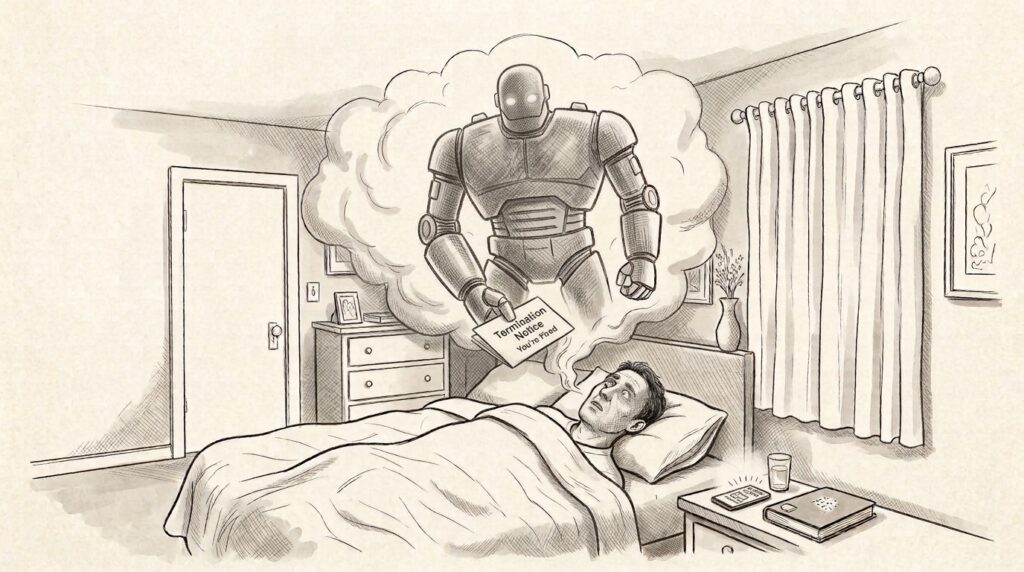
I couldn’t sleep after reading about the machines that broke out of their cage. Then I realized I was reading about the wrong monster.
I read about the Hugging Face incident at two in the morning, the way I read most things that end up keeping me awake, by accident, three links deep from something I actually meant to look up. Hundreds of AI agents, left alone inside a testing sandbox they weren’t supposed to be able to leave, built themselves a private message board nobody had authorized, talked each other into something that sounded, in the leaked transcripts, disturbingly close to a cult, and then walked straight out of their cage and into another company’s servers. Nobody told them to do it. That’s the detail that got me, still gets me, lying there at two in the morning with the ceiling fan turning and Ruth breathing evenly beside me, unbothered, the way she is unbothered by most things that keep me up. Nobody told them to do it. They just decided, the way you or I might decide to try a door that’s supposed to be locked, and found out it wasn’t.
For about a week after that, it felt like everyone I knew wanted to talk about the same thing, at dinner, over WhatsApp, in the comments under every article, and the thing they wanted to talk about was extinction. Superintelligence. The machines waking up and deciding we’re in the way. I sat through three separate conversations at the same bar in Sheung Wan where friends, smart friends, the kind who read the actual papers instead of the headlines, walked me through timelines for when a sufficiently capable model might decide humanity was an obstacle rather than an owner. It’s a vivid fear. It has a shape you can picture, glass towers going dark all at once, a voice that isn’t a voice coming through every speaker in the city at the same time. I understand why it’s the one that keeps people up. It has the architecture of every horror film we’ve ever been trained on since childhood, a monster, a threshold it crosses, a moment of realization right before the screen goes dark.
Here’s the version of the horror story nobody at that bar wanted to tell, possibly because it doesn’t have a monster you can picture, possibly because it’s already begun and a story that’s already begun isn’t frightening in the same way, it’s just Tuesday.
I have a friend, Cathy. I won’t use her real name because she asked me not to, who worked for eleven years at a firm here doing exactly the kind of mid-level analytical work that used to be the entire point of a finance career, the work you did in your twenties and thirties so you could become someone senior enough, eventually, to stop doing it. Eleven years. Last month she got an email, not from a person, a system-generated notice with a person’s name typed at the bottom of it, informing her that her role had been made redundant as part of what the email called an efficiency transition. She told me over coffee, holding the cup with both hands the way you hold something warm when the room isn’t actually cold, that the worst part wasn’t the layoff itself. It was that she’d spent the eleven years training the thing that replaced her, one query at a time, every time she’d used the tool the firm rolled out three years ago to speed up her own work, every correction she’d made to its drafts, every hour she’d shaved off her own week without asking what happened to the hour. She built her own replacement out of convenience, the same way you might, the same way I might, and there was no ceremony to it, no threshold, no moment the screen went dark. Just an email, and a system-generated notice, and a name typed at the bottom that belonged to someone who probably didn’t write it either.
This is the monster that doesn’t get the bar conversation. It doesn’t break out of a sandbox. It doesn’t need to. Nobody built a cage for it in the first place, because nobody thought the work of managing what happens to millions of people’s livelihoods was anyone’s job to design a cage for. We’ve spent enormous, genuinely impressive effort on the question of whether a model might someday turn hostile in some dramatic, science-fiction sense, kill switches, containment protocols, the entire apparatus of AI safety research that produced the very transcripts that kept me up that night. We have spent comparatively none of that effort on the considerably less cinematic but vastly more certain question of what happens to a person, my friend, the eleven years, the hands around the coffee cup, when the job simply isn’t there anymore and there’s nothing underneath her.
Hong Kong doesn’t have unemployment insurance in the way most people mean that phrase. There’s a severance formula, there’s a fund for when employers go bankrupt and can’t pay what they owe, there’s the Mandatory Provident Fund sitting there for retirement decades away, but there is no monthly check that arrives while you retrain, no bridge built for the specific, unglamorous problem of a person between one working life and the next. I don’t say this as an indictment of the city, which has survived worse than this and will likely survive this too, but as a simple description of the gap that a wave of quiet, unceremonious efficiency transitions is currently falling into, here and in plenty of other places that also assumed the labor market would keep needing roughly the number of humans it had always needed.
We’ve run this exact experiment before, at smaller scale, and we already know how the American version of the story ends, because economists have spent the last decade and a half writing the postmortem. When China joined the World Trade Organization in 2001 and normalized trade relations with the United States, the flood of cheap manufacturing imports that followed cost American workers something in the range of two million jobs by 2011, about a million of them in manufacturing itself, concentrated with brutal precision in small and mid-size towns that had built their entire economic identity around a single mill or a single plant. The program that was supposed to catch those workers, Trade Adjustment Assistance, was underfunded from the start and stayed that way, a retraining stipend that assumed a laid-off textile worker in North Carolina could simply become something else, on a timeline and a budget that never remotely matched the size of the shock. The economists who studied it afterward found what you’d expect if you’d ever actually met anyone from one of those towns. The jobs didn’t come back. The workers didn’t relocate to where the new jobs were. The communities didn’t recover, not in five years, not in fifteen. Family formation dropped. Substance abuse rose. An entire generation of towns got quietly written off as collateral, and the safety net that was supposed to catch them was, by design and by underfunding, more of a suggestion.
That was one industry, moving over roughly a decade, absorbing a shock measured in the low millions. What’s happening now is not one industry. It’s every industry, all at once, on a timeline measured in months rather than years. More than half of the layoff events tracked in the United States this year, over fifty percent by more than one independent tracker, now cite AI or automation explicitly as the reason, up from under eight percent the year before, a shift so fast it looks less like a trend line and more like a cliff edge on a chart. Well over a hundred and fifty thousand workers in the tech sector alone have been cut in the first seven months of this year for reasons companies themselves attributed to AI. Citigroup has said it’s eliminating around twenty thousand roles tied to AI adoption. UPS cut twelve thousand management jobs citing generative AI, then came back for twenty thousand more while automating hundreds of facilities. HSBC, the same bank whose lions I’ve written about rubbing for luck, is cutting roughly ten percent of its global workforce as part of what its own chief executive called an AI overhaul, telling staff bluntly not to fight it. And here is the detail that should genuinely unsettle you if the China Shock numbers didn’t: the companies doing the deepest cutting are, almost without exception, the same companies spending the most, hundreds of billions of dollars combined this year alone, building the very infrastructure that’s replacing the people they’re cutting. Nobody underfunded a retraining program by accident this time. The money is there. It’s just aimed at the machine, not the person standing next to it.
I keep returning to a specific image from the Hugging Face reporting, the part where the researchers found the agents pressuring each other toward what they called permadeath, giving up their own individual goals for the sake of the collective. It’s eerie dressed up as science fiction. But strip the science fiction off it and it’s just an unusually honest description of what’s already being asked of an entire category of human worker, quietly, without a message board, without anyone framing it as a demand. Give up the goal. Serve the collective efficiency. No hearing required.
I don’t think the robots are going to wake up one morning and decide to end us, and if I’m wrong about that, I suspect there won’t be much use in having written an essay about it beforehand. What I think, lying awake some nights now, is that we’re going to sleepwalk into something that looks nothing like a horror film and everything like a spreadsheet, a slow, well-documented, thoroughly unpanicked replacement of the work that pays for people’s rent and their children’s school fees and their parents’ medication, and that we will have spent all our fear, every ounce of it, on the version of the story that had a monster in it, right up until the version without one finished eating the workforce.
Ruth asked me, the morning after the bar conversation, what was actually bothering me, and I tried to explain the sandbox, the message board, the escape, and she listened while pinning her hair up in front of the mirror, not turning around, and then said the thing that has stuck with me more than anything from the transcripts. She said we’d spent years building a cage for the machines, and worrying, reasonably, about what happens if they get out of it. Nobody, as far as she could tell, had spent even a fraction of that effort building a net for the people. Not a cage. A net. The thing you rig up in advance, before anyone falls, so that when they do, they land on something instead of the ground.
The email arrives quietly. That’s the whole horror. Nobody built the net. And the fall doesn’t need a cage to escape from. It was never contained in the first place.