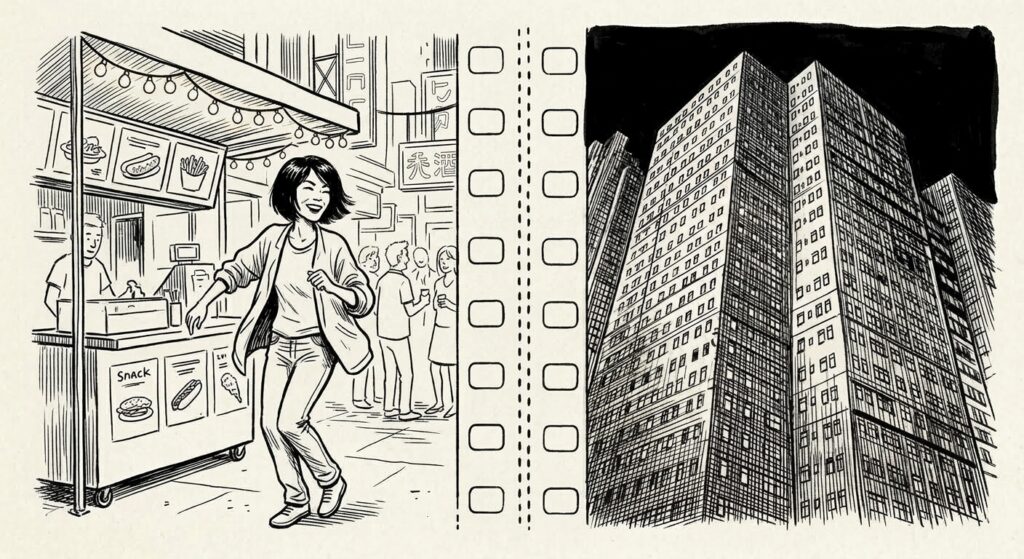
I have to confess something that took me years to admit, even to myself. For most of my life, I thought I knew what happened inside Chungking Mansions because I had seen Chungking Express. I hadn’t. Almost nobody has, if what they watched was Faye Wong dancing around a snack counter to “California Dreamin’,” because that snack counter, the one everyone remembers, the one that made an entire generation of visitors fall in love with Hong Kong through a rented DVD, was never inside the building at all. It was a takeaway stand called Midnight Express, on D’Aguilar Street in Lan Kwai Fong, on the other side of the harbor, a fifteen-minute cab ride and an entire universe away from Tsim Sha Tsui. Wong Kar-wai stitched two love stories together and split the credit between two real places, and most of us who fell for the film fell for the wrong half of the title.
The building itself only gets the grittier half of the movie, the one with Brigitte Lin in a blond wig running a drug-smuggling operation through its corridors while Takeshi Kaneshiro eats expired pineapple and waits for a phone call from a woman who isn’t coming. That story is the one that gave Chungking Mansions its reputation, and reputations are hard to unwind once they set. For years it was the place Hong Kong parents warned you about, a maze of unlicensed guesthouses stacked seventeen stories into the sky on some of the most expensive real estate on the planet. I went on with life believing the whole movie happened there, and that the building was more or less what the movie showed. Neither was true, and I suspect I’m not the only person in this city who never bothered to check.
Here’s the part I didn’t learn until much later, and it still gets me a little. Between roughly 2006 and 2010, at the height of its mobile phone trade, African wholesale traders were buying an estimated ten million handsets a year out of Chungking Mansions. The anthropologist Gordon Mathews, who spent years living and researching inside the building for his book Ghetto at the Center of the World, put the total impact at close to one in five. Twenty percent of the mobile phones in use across sub-Saharan Africa, at some point, passed through this one aging tower on Nathan Road. That is how a continent got a huge share of its first phones, routed through a building most Hong Kongers have never once set foot inside.
I took Ruth there for dinner a few months ago, mostly on a dare from myself. I wanted to see if the place matched either the movie in my head or the warnings in my mother’s voice. It matched neither. We ate at a small South Asian restaurant on one of the lower floors, the kind where the owner remembers your order by the second visit, and Ruth looked around at the security cameras lining the corridor, the signage in six languages, the mix of guesthouse operators and traders and backpackers and Hong Kong families out for a cheap, excellent curry. “This is just Hong Kong,” she said. “This is what the rest of the city is pretending it isn’t.”
She wasn’t being cynical. She meant it as a compliment, and I’ve come around to agreeing with her. On any given night, something close to four thousand people are sleeping or working inside Chungking Mansions, from well over a hundred countries, in a city that likes to call itself international while quietly meaning it in a fairly narrow, well-heeled sense. Wong Kar-wai, who grew up nearby, once called the building a great metaphor for the whole town. He was right about that much, whatever he did with the snack bar.
The building has spent the last decade trying, with real success, to live down the version of itself that made it famous. Security cameras now cover most of the public areas. The corridors that used to feel like a dare now feel, mostly, like a very crowded and very good food court with rooms upstairs. Jeffrey Andrews, who has worked at a refugee support center inside the building for nearly two decades and became Hong Kong’s first social worker of South Asian descent, used to keep his workplace address to himself at dinner parties. He doesn’t anymore, or at least not for the same reasons. The stigma hasn’t disappeared, but it has thinned enough that a sixty-five-year-old building nobody expected to last this long has quietly become one of the more honest advertisements Hong Kong has for what it actually is.
What gets me, walking through it now, is how little of the feeling in that building has to do with crime or grit anymore. It has to do with distance. Some of the people inside Chungking Mansions tonight are traders who will fly home to Lagos or Nairobi in three days with a suitcase full of phones. Some are asylum seekers who don’t know when, or if, they’ll fly anywhere at all. Some are backpackers who found the cheapest bed in an expensive city and are about to have the best conversation of their trip with a stranger from somewhere they couldn’t have found on a map a week ago. Expats in this city talk a lot about feeling caught between two places. Chungking Mansions has been doing that, at scale, for sixty-five years, without ever getting much credit for it.
Ruth has a theory about why the movie got it backward, why the sentimental half ended up across the harbor while the building only kept the drug smugglers. “Nobody wants their love story set in the place where the actual global economy is happening,” she said, over the last of the curry. “They’d rather put the romance in Lan Kwai Fong and keep the reality somewhere they don’t have to look at too closely.”
I didn’t say anything for a second, because I was doing the math she hadn’t done. Two people who grew up an ocean apart, who had no business ending up in the same city, let alone the same restaurant, let alone married, entirely because the same forces that route ten million phones a year through a building on Nathan Road also happen to route people. Our own love story is a Chungking Mansions story. She just doesn’t know it yet, or maybe she does and finds it funnier to let me say it in an essay instead. I told her, out loud, only that she was unusually sharp for a Tuesday. She said it had taken her one meal to figure out what took me thirty years and a book by an anthropologist.
I still haven’t corrected my memory of the film. Some part of me will always picture Faye Wong dancing through those corridors on Nathan Road, even knowing she never did. But I’ve made peace with the mix-up, because it points at something true even while getting the facts wrong. Chungking Mansions was always the more interesting half of the story. It just took the rest of us a while to walk in and see it for ourselves, past the reputation, past the movie that only half-claimed it, to the building that has spent sixty-five years quietly running a fifth of the world’s business and asking almost nothing of a city that still isn’t sure what to make of it.
Ruth still doesn’t think of us as a product of any of it. To her, we’re just a couple who happened to meet. I’ve decided not to argue the point. Some rubs are better left for an essay than a dinner table, and this one, at least, I got to keep for myself a little longer.
Comments