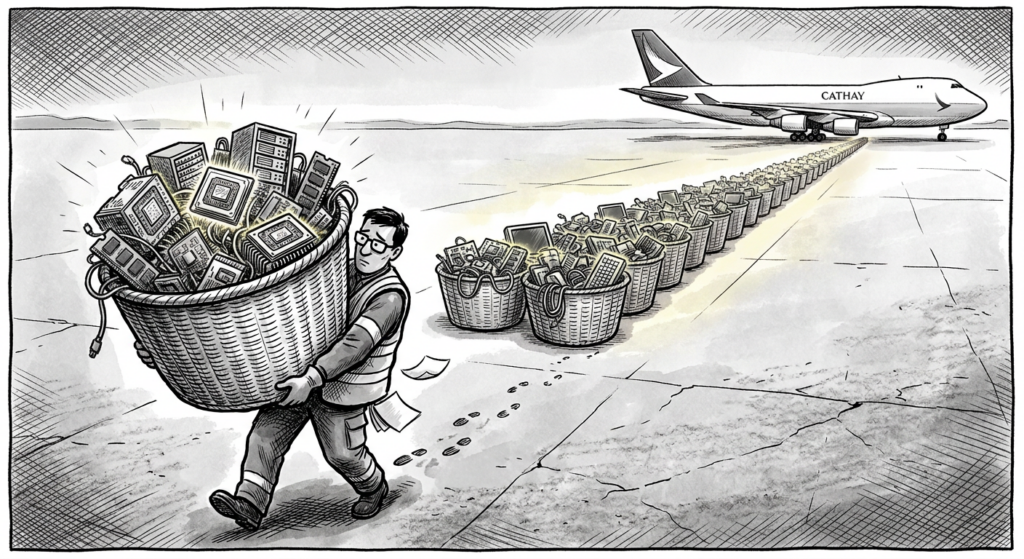
Extraordinary trade numbers mask an extraordinary concentration risk in Hong Kong Exports, and the logistics implications run far deeper than headline growth suggests.
When a single product category accounts for 70% of a territory’s total merchandise exports and is growing at 53% a year, the correct response is not celebration. It is alarm. Hong Kong’s Half-Yearly Economic Report for Q2 2026, released on 14 August, reveals a trade picture that should keep every forwarder, air cargo operator, and shipping line with significant Hong Kong exposure awake at night, not because the numbers are bad, but because they are dangerously lopsided.
AI-related merchandise exports, semiconductors, memory chips, integrated circuits, networking devices, servers, rose by 53.1% in the first half of 2026, outpacing the 39.1% growth in overall merchandise exports. These products now comprise approximately 70% of Hong Kong’s total merchandise exports. In Q2 alone, the AI-related category accelerated to 63.7% growth, up from 41.5% in Q1. June’s total export figure of HK$641.1 billion was the highest single-month value since March 1984, driven almost entirely by electronics demand flowing through the territory.
The headline GDP numbers look spectacular. Real GDP grew 5.1% in the first half of 2026, the strongest half-yearly performance in nearly five years. Total exports of goods surged 28.9% year-on-year in real terms in Q2. The government has revised its full-year GDP forecast upward to 3.5–4.5%, from 2.5–3.5% in May. But strip out the AI trade and the picture deflates sharply. Non-AI merchandise exports, the other 30%, are growing at a fraction of the headline rate, if they are growing at all.
The plumbing behind the boom
Hong Kong produces almost none of this hardware. It is, as it has always been, a re-export hub. The government’s own data shows that mainland China routed approximately one-third of its total integrated circuit exports through Hong Kong in H1 2026. The WTO estimated that global trade in semiconductors, processors, and other AI-enabling products rose 21.9% in value to US$4.18 trillion in 2025, accounting for 42% of total global trade growth. Hong Kong is capturing a disproportionate slice of that flow, not because it is making the chips, but because it sits at the junction between Chinese fabs and the world’s data-center builders.
For air cargo, the implications are direct. HKIA handled 2.5 million tonnes of cargo in the first half of 2026, up 4.1% year-on-year, reinforcing its position as the world’s busiest cargo airport for the 15th time since 2010. Transshipment volumes are growing fastest, up 19.5% in June alone, which tracks exactly with Hong Kong’s role as a throughput node for electronics moving between mainland production sites and overseas markets. Cathay Cargo carried 9% more tonnage in the first six months, with the airline specifically citing “semiconductor and pharmaceutical shipments” as growth drivers.
But the 4.1% cargo tonnage growth at HKIA sits oddly beside the 53.1% merchandise export value growth. The gap tells you something important: this is partly a price story, not just a volume story. Memory chip prices have more than doubled over the past two to three years, as one SCMP analysis noted, meaning the same number of pallets generates dramatically higher trade values. Forwarders booking capacity out of HKG are handling valuable, dense, time-sensitive shipments, good for yield, but not necessarily the tonnage growth that fills freighter bellies in the traditional sense.
The concentration risk nobody wants to talk about
The vulnerability is threefold, and all three risks converge on logistics operators.
First, regulatory exposure. The US imposed new tariffs of 10–12.5% on imports from Hong Kong effective 24 July 2026, replacing the previous temporary 10% universal tariffs. The Hong Kong Trade Development Council noted that “various exemptions remain in place, including for certain electronic products, which account for the majority of Hong Kong’s exports to the [US].” For now, that exemption shields the critical flow. But the exemption is not guaranteed. Any future tightening of US export controls on advanced semiconductors or AI-related hardware, a perennial risk in the current geopolitical environment, would hit Hong Kong’s trade numbers, and by extension its cargo volumes, with disproportionate force. When 70% of your exports are one product category flowing to one end-use (data-center buildout), you are one executive order away from a very different conversation.
Second, demand cyclicality. Even the Hong Kong government’s own report hedges. It warns that “risks associated with the rapid expansion of global AI investment also require monitoring,” citing OECD estimates that AI-related capital spending accounted for nearly half of US GDP growth in one recent period, compared with just 8% in 2023 and 2024. If the AI investment cycle cools, as every investment cycle eventually does, Hong Kong’s trade figures will not decelerate gently. They will collapse. Bruce Pang, research director at the Hong Kong Trade Development Council, has already flagged that “a likely gradual steadying of the technology upcycle” and high base effects will moderate growth in coming months. The question is whether “moderate” means “slow slightly” or “reverse.”
Third, the Middle East wildcard. HKIA’s March cargo figures already showed what conflict exposure looks like: a 62.1% year-on-year drop in exports to the Middle East caused an overall 4.4% decline in total cargo volume for the month. The disruption was temporary, Middle East traffic recovered by June, but it demonstrated how fragile the network can be when concentrated flows are interrupted.
What logistics operators should be watching
For forwarders and carriers with significant Hong Kong-origin exposure, the operating environment is excellent right now. Cathay is ordering A350F freighters. HKIA is expanding its Dongguan Logistics Park to handle cross-boundary cargo from the Greater Bay Area, with tonnage and value through that facility growing more than 90% year-on-year. The world’s appetite for AI hardware shows no sign of immediate exhaustion.
But anyone building capacity or network strategy around the assumption that Hong Kong’s trade boom continues at anything like this pace should be modelling the downside with equal rigor. A territory where 70% of merchandise exports depend on a single, geopolitically sensitive product category routed predominantly through mainland China is not a diversified trade hub. It is a leveraged bet on one supply chain remaining open.
The numbers are real. The growth is real. But so is the concentration, and in logistics, concentration is just another word for fragility.