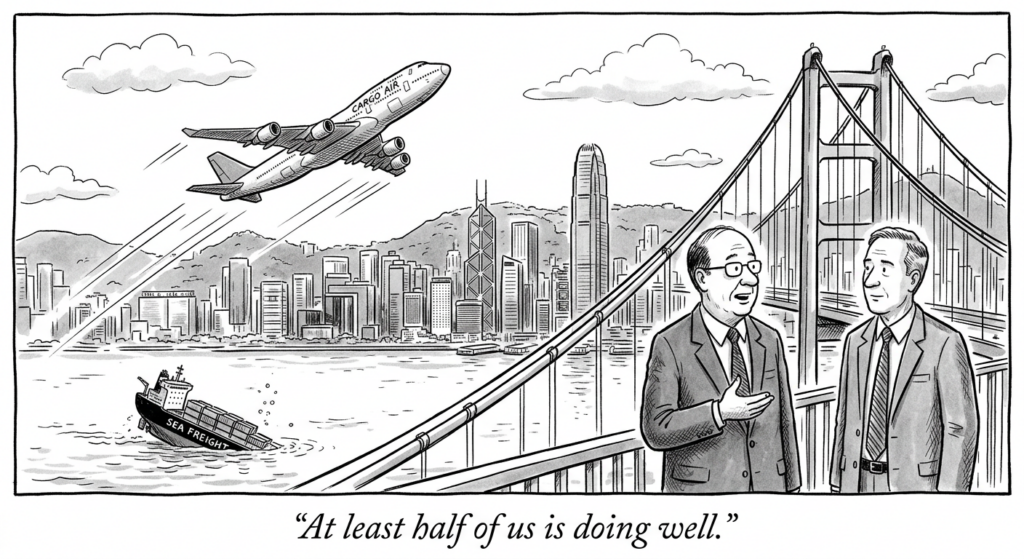
The territory’s two transport modes are telling opposite stories about its future as a trade hub. Hong Kong’s port paradox.
Hong Kong’s Census and Statistics Department released its Q2 2026 port data on September 3. For anyone who tracks the territory’s container numbers, the figures landed with the dull thud of inevitability.
Total port cargo throughput fell 0.2% year on year to 42.3 million tonnes. Inward cargo dropped 3.8%. Seaborne volumes declined 3.2%. On a seasonally adjusted quarter-on-quarter basis, the picture was worse: total throughput slid 6.4%, with inward and outward cargo falling 7.7% and 4.6% respectively. Container throughput managed a nominal 1.1% year-on-year gain to 3.24 million TEU, but even that number flatters the trend. For the first half of 2026 as a whole, Hong Kong’s ports handled 6.38 million TEU, down 3.0% from a year earlier.
This is not a new story. Hong Kong’s container port has been declining for years. Full-year throughput in 2025 fell 5.1% to 12.99 million TEU. Alphaliner’s latest global port rankings, released in late August, placed Hong Kong 14th in the world for the first half of 2026. A port that set its throughput record of nearly 24 million TEU in 2007 and held the title of world’s busiest from 1987 to 1989, from 1992 to 1997, and from 1999 to 2004, now moves barely a quarter of that peak volume in a half-year period.
Shenzhen, sitting just across the border, handled 18.56 million TEU in the same six months, up 7.7%, according to Alphaliner. It is now nearly three times the size of Hong Kong’s container operation.
Meanwhile, at the airport
Walk ten miles west from Kwai Tsing Container Terminals to Hong Kong International Airport and the mood is entirely different. HKIA handled 2.5 million tonnes of air cargo in the first half of 2026, up 4.1% year on year, reinforcing its position as the world’s busiest cargo airport for the 15th time since 2010.
Chapman Fong, the Airport Authority’s Director of Hub Development, said in July that “the continued growth in cargo throughput in the first half of 2026 epitomised HKIA’s resilience empowered by our strong connectivity and excellent cargo services.”
The annual report for FY2025/26 showed 5.1 million tonnes handled across the full year, with passenger traffic up 14.7% to 63 million. Cathay Cargo reported that its total tonnage in the first half of 2026 was up 9% year on year, buoyed by strong trade flows from the Chinese mainland into Southeast Asia and the Americas. The HKIA Dongguan Logistics Park, which allows export cargo from the Greater Bay Area to be screened and palletized inland before being shipped directly to HKIA’s airside, had 30 airlines and 144 agents operating by year-end, with cargo tonnage and value both up more than 90%.
The divergence is stark. High-value, time-sensitive goods, server racks, semiconductors, pharmaceuticals, perishables, e-commerce parcels, are moving through HKIA in growing volumes. Lower-value containerized trade, the bread and butter of any container port, is draining away to mainland Chinese competitors that offer lower costs, deeper hinterland connections, and increasingly modern infrastructure.
The structural problem
Hong Kong’s container port still has real advantages. Transport Secretary Mable Chan told the Legislative Council in May that containerships spent an average of just 1.03 days in Hong Kong in 2025, compared with a 1.99-day average for the world’s top 20 container ports. Free port status, efficient customs clearance, and strong international liner connectivity remain genuine selling points.
But the economics work against it. Land in Hong Kong is expensive. Labor is expensive. Kwai Tsing’s terminals, while efficient, are constrained by geography. And the Pearl River Delta ports of Shenzhen, Nansha, and Guangzhou offer direct access to the manufacturing heartland that generates the cargo in the first place. For shippers who can truck containers to Yantian or Nansha in a few hours, the premium of routing through Hong Kong is increasingly hard to justify.
The government is aware. In May, Hong Kong’s Legislative Council debated a motion to strengthen the territory’s shipping ecosystem. The Transport and Logistics Bureau has proposed making permanent a directorate post focused specifically on maritime and port development, a tacit admission that the problem requires long-term structural attention rather than another round of promotional talking points. Planning continues for a potential Container Terminal 10, with sites under consideration at southwest Tsing Yi and northwest Lantau, though the business case for new terminal capacity in a shrinking market invites some skepticism.
The global backdrop makes it worse
Hong Kong’s port decline is playing out against a global reshuffling that is not doing it any favors. The collapse of Jebel Ali, which fell from 10th to 32nd in the Alphaliner rankings after Strait of Hormuz disruptions cratered its throughput by nearly 60% in the first half of 2026, has redirected transshipment volumes to Southeast Asian hubs. Port Klang and Tanjung Pelepas have both climbed into the top 11, while Colombo posted growth of nearly 12% and Nhava Sheva surged almost 14%. None of that redirected traffic is flowing to Hong Kong.
Two hubs, one city
The paradox at the heart of Hong Kong’s trade infrastructure is that both stories are true simultaneously. The airport is thriving. The container port is withering. And the two are not interchangeable: air cargo and ocean freight serve fundamentally different markets, move at different price points, and respond to different competitive pressures.
What connects them is the broader question of whether Hong Kong can sustain its role as an international trade gateway in a region where mainland Chinese infrastructure is growing faster, cheaper, and closer to the source of goods. The airport has found its answer for now: specialization in high-value cargo, smart investment in GBA integration, and a carrier base anchored by Cathay’s expanding freighter fleet. The port has not.
The Q2 numbers will not alarm anyone who has been watching this trajectory. But placed alongside the airport’s performance, they frame the choice facing Hong Kong’s policymakers with unusual clarity. The territory can be many things in global trade. It is becoming less clear, with every quarterly data release, that a major container port is one of them.