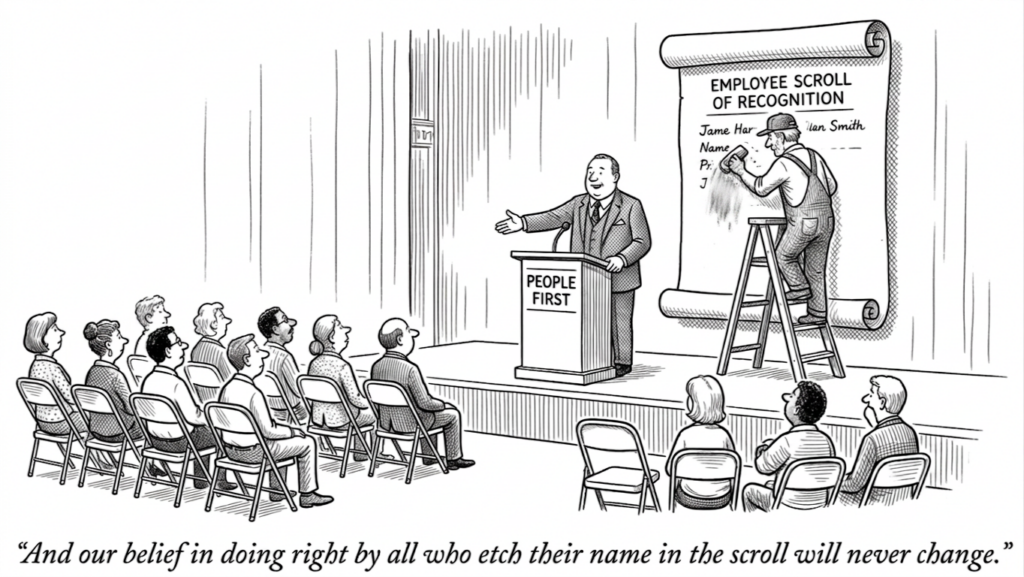
On the people who etched their names in it, and the company that is erasing them.
In 1961, in a part of Arkansas where the soil is red and the money is short and the distance between ambition and bankruptcy is measured in truckloads, a man named Johnnie Bryan Hunt and his wife Johnelle founded a rice hull operation in Stuttgart. Hunt was the son of sharecroppers, born in 1927 in rural Cleburne County. He left school after the seventh grade to work at his uncle’s sawmill. He picked cotton. He sold lumber. He drove trucks. He married Johnelle DeBusk in 1952, a detail-oriented pragmatist whose father was in the poultry business and who had been driving her daddy’s big trucks since high school. He was a forward-thinking optimist who did not like details. She was the one who dealt with whatever followed. Between the two of them, they had everything a business needs and nothing a business school would recognize.
The rice hull operation lost over twenty thousand dollars in its first year. They kept going. Eventually the company turned around, and Hunt was shipping poultry litter throughout the nation. In 1969, he established a trucking company as a sideline, five trucks and seven trailers, and by the end of the next decade J.B. Hunt Transport Services, Inc. was shipping goods across the country. The 1980 deregulation of the trucking industry, which Hunt had foreseen, played a major role in the company’s development. In 1983, the company went public on NASDAQ under the ticker JBHT. By the 1990s, Hunt presided over a company earning over a billion dollars annually.
He did not build it alone. Mrs. Hunt managed the finances and the books. She was the default business manager from the day the company was founded, entering an industry where she had very few female peers. He was the dreamer. She provided the encouragement and support to turn the dreams into reality. Together they hosted company picnics at their home. Together they walked the halls. Together they built what the people inside the building would eventually call, when asked to describe the culture in one word, family.
There is a logo on the side of every J.B. Hunt truck. A scroll. Black and yellow. Chosen by Mr. Hunt himself. The company says the scroll is a constant reminder of the hard work and innovative spirit of the founders, that it represents every employee who has etched their name into the company’s history. The scroll is one of the most recognized symbols in transportation, proudly marking thousands of trucks and trailers moving across North America. By honoring the scroll, the company says, we ensure that as we dream of new ways to innovate and grow, we stay grounded in integrity, respect, innovation, safety and excellence.
The scroll is a covenant. It says: your name matters here. Your work is written into the story. You are not a cost center or a headcount number or a line item on a restructuring spreadsheet. You are part of the record. The scroll carries your name the way a family Bible carries a birth.
Mrs. Hunt once said of her husband: there is an imaginary sign outside this building. None of us can see it, but the people that are passing by can. It says, if you have a crazy idea come here, there is a man that will listen to you.
When he walked the halls of corporate, he would ask, is today going to be big?
Hunt died on December 7, 2006, several days after he slipped on ice and fell, hitting his head. He was seventy-nine years old. His widow Johnelle and his son Bryan continued as directors of the firm. The company he built from rice hulls and a seventh-grade education is today one of the largest supply chain solutions providers in North America, with annual revenues exceeding twelve billion dollars.
And the company that calls every employee a name on the scroll is quietly erasing the names.
I need to tell you about the people-first language, because the language is thick, and it is everywhere, and it has been doing work for decades that the company is now undoing in months.
The company’s careers page says, build your career at a company that puts people first. The company’s own blog, published in August 2023, is titled “J.B. Hunt’s History: Built by People.” It opens by saying that from the beginning, Mr. Hunt, along with his wife Johnelle, knew the company’s success relied on one thing: its people. The Hunts ignited a people-first culture that still fuels the company to this day. The blog says that to the Hunts, everyone who worked for J.B. Hunt was family. That Mr. Hunt invested in people who were invested in J.B. Hunt. It says that no matter how the company grows and evolves, people will always be a priority. That the company’s belief in doing right by all who etch their name in the scroll will never change.
Read that again. Will never change.
The blog then quotes a senior manager in the tax department named Charlene, who says: J.B. Hunt is a great company that values its people. While other companies lay off people when times are difficult, like the 2008 recession, J.B. Hunt does not.
That quote was published in 2023. The company approved its publication. The company’s communications team reviewed it, formatted it, and posted it on the company’s own platform. It was not an offhand remark at a cocktail party. It was a curated, corporate-sanctioned statement published for recruiting purposes, and its meaning is unambiguous: this company does not do layoffs. Not during recessions. Not during pandemics. Not when times are difficult. That is who we are.
If that sounds familiar, it should. Expeditors maintained an identical promise for forty years. Published it on its website. Repeated it in SEC filings and proxy statements and recruiting materials. Used it as the most powerful talent acquisition tool in the logistics industry. Come here, stay here, we do not do that to our people. And then, in January 2023, the CEO of Expeditors sent a locked, confidential email to every district manager worldwide directing them to eliminate roughly two thousand positions, immediately, while building documentation to make the reductions look like individual performance failures rather than what they were: a mass economic layoff disguised as a performance culling. Three months later, the same CEO told the SEC and the investing public that the company was lowering headcount without resorting to layoffs. The company’s own locked email said attrition alone would not suffice. The public filing said no layoffs occurred. Both sentences came from the same man, fourteen weeks apart.
Expeditors’ no-layoff promise was eventually denied by the company’s own lawyers in federal court. They called it precisely the type of vague assurance that courts have rejected. They said the employees who believed it were unreasonable. And the company quietly edited its website, inserting the words “short-term” before “no layoff policy,” as though they had always been there.
J.B. Hunt has not gone that far. Not yet. But the architecture is assembling itself, and the people inside the building can see it happening in real time, the way the people inside Expeditors saw it in 2023 and did not yet have the vocabulary to name what they were watching.
What the architecture looks like
On Glassdoor, a review titled “Hidden layoffs while CEO profits” describes the mechanism in language that could have been written by an Expeditors employee in February 2023: JBH says they do not lay off employees but give them “voluntary separation” ultimatum to force their hand into moving or losing their job, even if hired to be remote. People are scared, some even talking of how it is impacting their health. This company does not care about their people.
The same review notes that the company’s spoken values do not match its actions. That leadership gives no transparency. That stability and job security are gone as the company continues to give the CEO millions and employees are given one percent raises to compensate them for their hard work. That benefits are lacking. That culture does not matter, and good leaders are forced out for advocating for their people.
Another Glassdoor review, from a software engineer who spent more than five years at the company, describes a place that used to be very chill and friendly, and then notes the sudden announcement of massive layoffs and a five-day return-to-office mandate designed to cut headcount.
A different reviewer writes: it is very stable. They take a lot of pride in avoiding layoffs. This does sometimes mean that they try to encourage attrition to right-size.
Encourage attrition to right-size. That is the phrase that connects J.B. Hunt to Expeditors, to C.H. Robinson, to every company in this series.
It is the phrase that means: we will not fire you, because firing you would require us to own the word. Instead, we will make staying untenable, and when you leave, we will record your departure as voluntary, and the database will say attrition, and the investor Q&A will say attrition, and every one of those records will be technically accurate and substantively false.
At Expeditors, the mechanism was a locked email and manufactured performance reviews. At J.B. Hunt, the mechanism is a return-to-office mandate calibrated to a commute radius that someone, somewhere, calculated would be intolerable for exactly the percentage of the workforce they needed to shed. You do not fire someone. You tell someone hired to work remotely that their position now requires five days a week in Lowell, Arkansas. The person who lives in Dallas or Chicago or Denver, who was recruited under remote terms, who moved their family and calibrated their mortgage and chose J.B. Hunt over a competitor because the company said it valued flexibility, that person now has a choice that is not a choice. Relocate your entire life to northwest Arkansas, or leave. If you leave, the departure is coded as voluntary. The checkbox says attrition. The proxy statement says the company values its people.
The architecture does not push you through the door. It arranges the lighting so that the door marked “resign” looks like the only rational option.
In behavioral economics, this is called sludge. Bureaucratic friction introduced not by accident but by design. In the Expeditors series, I described this mechanism in the abstract, as a tool companies use to engineer voluntary departures without ever saying the word layoff. You do not fire someone. You make their job fifteen percent harder to physically reach. You restructure their team so that the work no longer exists in the location where they sit. You change the reporting line so that the manager who understood their value is replaced by one with no institutional memory and no incentive to acquire it. You move the goalposts in six directions and wait for the natural, predictable, mathematically modelable percentage of people who will decide it is no longer worth it.
At Expeditors, the mechanism was different in form but identical in function. It was not a relocation mandate. It was a locked email directing managers to build performance documentation after the decision to terminate had already been made, converting an economic layoff into two thousand individual performance failures. It was a bootcamp that made surviving employees audition for the privilege of keeping the jobs they already had. It was a choice architecture that presented employees with a PIP, a termination, or a resignation sweetened by the dangled possibility of rehire, and the architect knew that between sixty and eighty percent of the population would choose the well-lit door when the alternative was ambiguity. Different instrument. Same physics. The company does not need to fire you. It needs to arrange the environment so that leaving becomes your idea, and then record the departure as voluntary.
At J.B. Hunt, the instrument is the relocation mandate. Move to Lowell, or leave. The person leaves. The WARN notice is never triggered. The headcount drops. The company points to the empty desk and says nobody was laid off. And the person sitting at home, trying to explain to someone who depends on them why the company that said it would never do this just did it without ever saying the word, carries the weight alone.
Now the numbers
Now let me show you the numbers, because the numbers tell a story the careers page was not designed to tell.
J.B. Hunt’s total headcount peaked at approximately 37,151 employees in 2022. By the end of 2023, that number had fallen to approximately 29,114. That is a decline of over eight thousand people, a 21.6 percent reduction in a single year. I should note that J.B. Hunt is a trucking company, not a freight forwarder, and a significant portion of the headcount swing reflects the natural cycling of company drivers during a freight downturn, when loads dry up and the trucks that carried them are parked. But the company’s own reporting confirms that the decline was not limited to drivers. According to Trucking Dive, J.B. Hunt reduced its workforce by about a thousand workers from 2023 to 2024 through both attrition and performance management, a formulation that covers corporate and operational roles as well as driving positions. And the Glassdoor reviews describing voluntary separation ultimatums and return-to-office mandates designed to force departures are not written by truck drivers. They are written by software engineers, account managers, and corporate employees who were told the company puts people first.
The company did not file a mass WARN notice. The company did not announce a restructuring. The company’s blog, published during that same year, said people will always be a priority and that J.B. Hunt does not lay people off during difficult times.
Eight thousand people, and the blog said it does not happen here.
By 2024, the number had partially rebounded to approximately 33,646, a recovery driven in part by the acquisition of Walmart’s intermodal trailing equipment and associated operations. But the 2023 decline is the number that matters, because it is the number that reveals the gap between what the company says and what the company does. The company also identified one hundred million dollars in costs to eliminate across efficiency and productivity, asset utilization and technology, and engineered process improvements.
One hundred million dollars. The language is mechanical. The costs that will be eliminated are, in significant part, the salaries of human beings whose names are supposed to be etched in the scroll. But the language does not say that. It says efficiency. It says productivity. It says engineered process improvements. The language was designed for a conference call, not a kitchen table.
By the first quarter of 2026, the company had eliminated over thirty million dollars in structural costs, and the annualized savings run rate exceeded one hundred million dollars. The CFO expressed confidence in exceeding the target. The stock surged. The analysts nodded. And somewhere in Lowell, Arkansas, or in a home office in a city that used to be an approved remote location, a person who etched their name in the scroll opened a calendar invite from someone they had never met and felt the stone settle in their shoe.
At Expeditors, the CEO pay ratio was one hundred and fifty to one. Dan “the Desecrator” Wall earned fifteen million dollars in his first fourteen months while two hundred and thirty people were walked out of the building. At C.H. Robinson, the ratio was one hundred and forty-nine to one. Dave Bozeman collected twenty-eight million dollars while five thousand five hundred people disappeared from the headcount. At FedEx, the ratio was two hundred and eighty-eight to one.
At J.B. Hunt, the outgoing CEO John Roberts received total compensation of $8.45 million in 2024. The company disclosed a CEO pay ratio of 101 to 1, based on Roberts’ compensation and a median employee income of $84,947. Shelley Simpson, who became CEO on July 1, 2024, received $11.31 million in total compensation for that fiscal year, a 140 percent increase from the prior year, driven largely by $10.4 million in stock awards. For the second consecutive year, no named J.B. Hunt executive received incentive bonuses. The executives did not earn their bonuses because the company’s financial performance did not hit the targets. Profit was $571 million, down 21.6 percent from $728 million the prior year. Revenue was $12.09 billion, down 5.8 percent.
The executives did not earn bonuses. The employees were given one percent raises. Eight thousand names were erased from the scroll. And the CEO’s total compensation rose 140 percent.
The gap
I want to be fair to Shelley Simpson, because fairness matters and because the strongest version of the counterargument deserves to be heard before it is weighed.
Simpson is not an outsider. She is not a Dave Bozeman, parachuted in from Amazon and Ford with a manufacturing playbook and no understanding of the business she was hired to cut. She is not a Raj Subramaniam, inheriting a company whose founder died while the DRIVE program was dismantling the P-S-P philosophy. Simpson joined J.B. Hunt in 1994 as a customer service representative. She spent thirty years inside the company, rising through sales, marketing, brokerage, highway services, human resources, and the presidency before being named CEO. She helped found the Integrated Capacity Solutions business. She led the launch of the J.B. Hunt 360 platform. She knows the scroll because she has been reading it since she was in her twenties.
That is what makes the gap so difficult to reconcile. When the man holding the saw is an outsider, the people standing among the stumps can console themselves with the thought that he did not know what he was cutting. When the woman holding the saw grew up in the orchard, that consolation is not available. She knows. She knows the names on the scroll because she watched them being etched. She knows what the culture was because she lived inside it. She knows what it meant to be told this company does not do layoffs, because she was one of the people that promise retained.
And now she presides over a company that is executing voluntary separation ultimatums, mandating return-to-office policies that function as headcount reduction tools, and pursuing one hundred million dollars in cost savings while the careers page says build your career at a company that puts people first.
The comparison to Expeditors is structural, not superficial.
At Expeditors, the promise was explicit: we do not do layoffs. It was on the website. It was in the SEC filings. It was the reason people stayed. At J.B. Hunt, the promise was cultural: while other companies lay off people during difficult times, J.B. Hunt does not. It was on the blog. It was in the recruiting pitch. It was the reason people came.
At Expeditors, the mechanism was a locked email directing managers to document performance failures that did not exist, converting an economic layoff into two thousand individual terminations, followed by a bootcamp that made survivors audition for jobs they already held. At J.B. Hunt, the mechanism is a voluntary separation ultimatum that converts an involuntary relocation into a voluntary resignation, and a return-to-office mandate that converts an economic headcount reduction into a series of individual lifestyle choices.
At Expeditors, the CEO went on a podcast and said his company would try like hell never to lay people off, because that is somebody’s livelihood, that is somebody’s family, that matters. At J.B. Hunt, the company published a blog that said people will always be a priority, and that belief in doing right by all who etch their name in the scroll will never change.
At Expeditors, the company’s lawyers told a federal judge the promise was vapor. At J.B. Hunt, the promise has not yet reached a courtroom. It is still in the liminal space between the blog and the kitchen table, the space where a person who believed what the company told them is sitting across from someone they love, trying to explain why the company that said it does not do this just did it without ever saying the word.
The word. That is the thing. The word is the cost. The word “layoff” carries legal and reputational consequences that the word “voluntary separation” does not. A layoff triggers WARN Act obligations. A layoff appears in trade press headlines. A layoff contradicts the blog and the scroll and the careers page. A voluntary separation triggers nothing. It appears nowhere. It confirms the narrative. The person is gone, the headcount is reduced, and the company can tell investors that it values its people, because every person who left, left voluntarily. The checkbox says so.
At Expeditors, I described the choice architecture that converts a firing into a resignation. The employee is presented with two doors. Behind the first: a performance improvement plan, a demotion, a reassignment to warehouse manual labor, the slow grinding humiliation of a career in reverse. Behind the second: resign, and the company will hold out the possibility of rehiring you in the future. The employee takes the second door. The database says voluntary. The architecture does not push them through the door. It arranges the lighting so that the door marked “resign” looks like safety and the door marked “stay” looks like darkness, and the architect knows that between sixty and eighty percent of the population will choose the well-lit door when the alternative is ambiguity.
At J.B. Hunt, the architecture is different in form but identical in function. The employee is not given a PIP. The employee is given a relocation mandate. Move to Lowell, or leave. The employee who has a spouse with a career in another city, who has children in a school district they chose because the company said remote was permanent, who has a mortgage calibrated to a salary in a market that is not Benton County, Arkansas, that employee looks at the two doors and sees the same lighting. The company did not fire them. The company changed the terms of their existence and waited for the math to do the work.
RTO mandates are layoffs in disguise.
I am not alleging that J.B. Hunt’s return-to-office policy was designed as a headcount reduction tool. I am observing that the policy was implemented during a period in which the company reduced its workforce by over eight thousand people without a mass layoff announcement, that employees describe the mandate as a mechanism for forcing departures, and that the pattern, return-to-office mandate followed by headcount decline coded as voluntary attrition, is identical to the pattern documented at every other company in this series.
Johnnie Bryan Hunt left school after the seventh grade. He picked cotton. He drove trucks. He started a business with rice hulls and lost twenty thousand dollars in the first year and kept going because the man did not know how to stop. His wife drove a truck in high school because that was just what they did. Together they built a company from nothing, from a rural county in Arkansas where the distance between a crazy idea and a Fortune 500 company is measured not in capital or credentials but in the willingness to get in the truck and drive.
When Hunt walked the halls of corporate, he asked, is today going to be big?
For eight thousand people in 2023, it was. Just not the way he meant it.
The scroll is still on the side of every truck. It still says what Mr. Hunt intended it to say: that every name matters, that the work is written into the record, that the company stays grounded in integrity, respect, innovation, safety and excellence. The scroll has not been edited. The scroll has not been revised. The scroll does not yet read “short-term commitment to doing right by all who etch their name in it.”
But the names are being erased. Not with an announcement. Not with a press release. Not with the cold dignity of a CEO standing in front of the workforce and saying we made a commitment we can no longer honor, and we owe you an explanation. The names are being erased with relocation mandates and voluntary separation ultimatums and one percent raises and the particular corporate silence that settles over an organization when the distance between the blog and the balance sheet becomes too wide for a single human voice to bridge.
At Expeditors, I described the sound that silence makes. It sounds like a parking lot at ten in the morning, where a person who woke up that morning employed is sitting behind the wheel, rehearsing how to tell their family. It sounds like a kitchen table where the math does not work without a paycheck. It sounds like a daughter posting online about losing health insurance.
At J.B. Hunt, the silence sounds like the hum of a highway where thousands of yellow trucks carry a black scroll that says every name matters, driven past the homes of people whose names no longer appear on any roster the company maintains, people who were told they were family, who were told the scroll carried their name, who were told that the company’s belief in doing right by them would never change.
The scroll does not know their names. The scroll never did. It was painted on a truck by a man who believed it, in a company that meant it, in an era when the people inside the building and the symbol on the outside of it were the same thing. That era is ending. Not with a locked email, not yet. Not with a federal filing that calls the promise vapor, not yet. But with the slow, grinding replacement of what the scroll says with what the spreadsheet does, administered by people who came up through the building and know exactly what they are dismantling, which makes the dismantling not ignorance but choice.
Johnnie Bryan Hunt asked, is today going to be big?
For the people being handed voluntary separation ultimatums in a company that says it does not do layoffs, the answer is yes.
It is just not the kind of big he had in mind.