Memory
The Fixed Point
A restaurant closes. A life stays there.
There is a legal concept called a fixture. It means something affixed to property so permanently that it becomes part of the property itself. A chandelier bolted to the ceiling. A built-in bookcase. A thing that was once moveable but stayed so long it became inseparable from the structure. My grandmother Polly was a fixture at the Highland Restaurant on Fenn Street in Pittsfield, Massachusetts. She waitressed there so long that people stopped thinking of her as an employee and started thinking of her as a load-bearing wall. She was part of the building. The Highland was part of her. You could not conceive of one without the other, and for many years of my early life I genuinely could not tell you whether we ate at the Highland because the food was good or because my grandmother was the restaurant and the restaurant was my grandmother and the distinction had ceased to exist.
The Highland is closing. August 28th. Ninety years.
I am writing this from Hong Kong, which is nine thousand miles from Fenn Street, which is a meaningless number because Fenn Street is not nine thousand miles away.
Fenn Street is right here. It has always been right here, because the Highland has always been there, and as long as the Highland was there, my past was not a story I told myself. It was a place I could walk into and sit down and order the veal parm and spaghetti and confirm that yes, all of it happened, all of it was real, the world I grew up in still existed in physical space and not merely in the increasingly unreliable architecture of memory.
That is what we lose when a place like this closes. Not a restaurant. A fixed point. The last piece of evidence that your childhood was not a dream.
When I was young, a good report card (not mine, let me be clear, other people’s good report cards) meant dinner at the Highland. A birthday meant dinner at the Highland. My grandmother worked there so the whole place felt like an extension of her kitchen, except the portions were bigger and you didn’t have to do the dishes. The people who worked there were not staff. I will not call them staff. Staff is what a chain restaurant has, the ones who sing happy birthday to every table because a regional manager told them to. The Highland family sang happy birthday when they meant it. When they knew you. When they had watched you grow up from a high chair to a booster seat to the counter. They did not sing for strangers. That was the whole point. If they sang for you, it meant you belonged there, and belonging there meant something, because the Highland did not belong to everyone. It belonged to Pittsfield. It belonged to the people who came back.
The Family Stayed
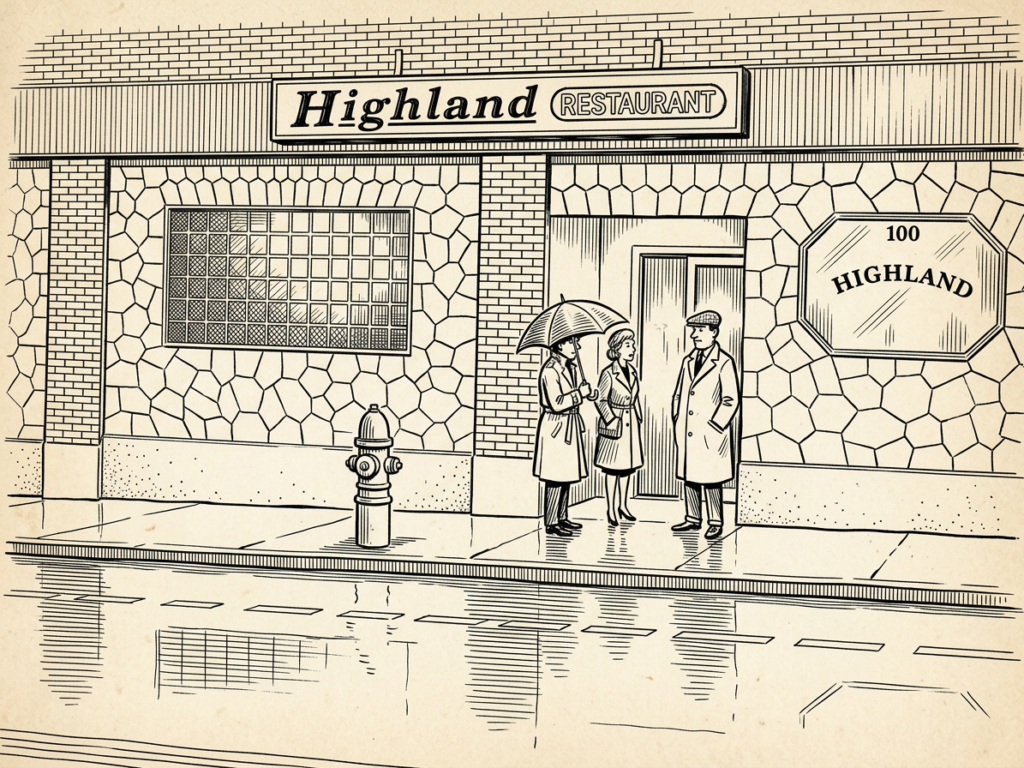
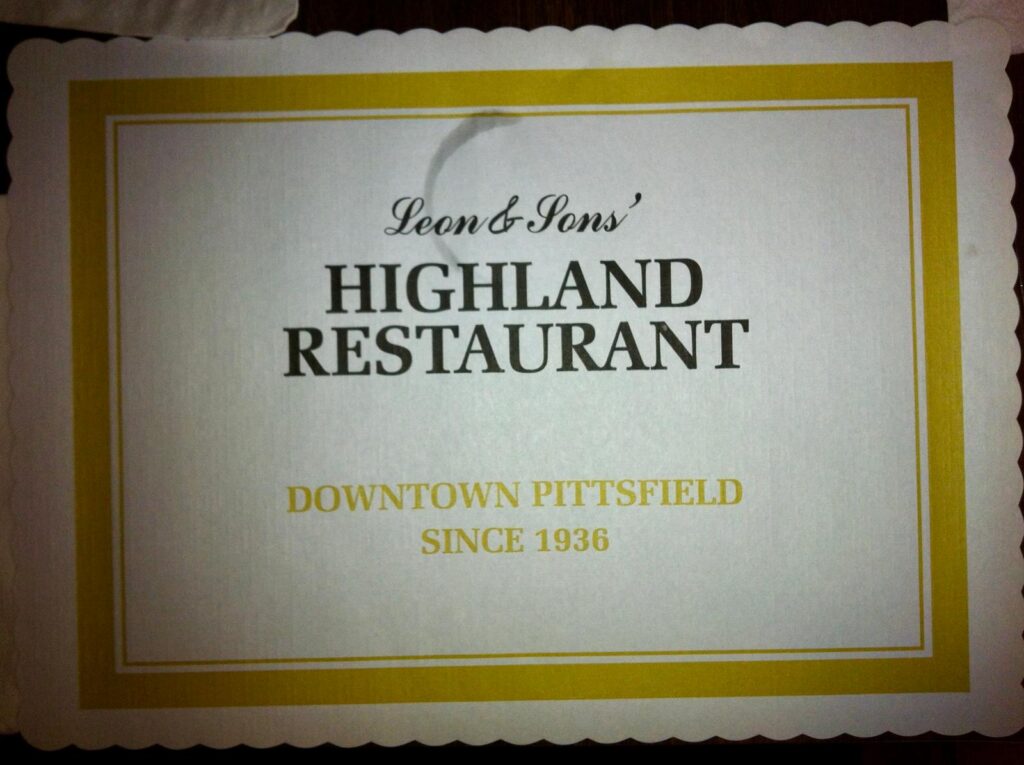
The Araces. Pasquale, Gerardo, Dario. Third generation. Before them it was Leone Arace and Rudy Sondrini. Before them it was Dominick Sondrini and Angelo Balardini, who opened the doors in 1936 when the world was falling apart and Pittsfield needed a place to sit down. Ninety years of the same family pouring sauce from the same recipes in the same building at 100 Fenn Street, right next to City Hall, as if City Hall were the one borrowing legitimacy from the proximity.
The owners wrote, in their farewell, that some employees had been with them for more than fifty years. Fifty years. There are law firms that do not last fifty years. There are governments that do not last fifty years. But a waitress at the Highland could pour coffee in 1975 and still be pouring it in 2025 and nobody would think this remarkable because the Highland was not a place where things changed. That was the whole point. That was the product. You could change. The world could change. Pittsfield could change around it, the old offices emptying out, the professionals drifting to South Street and Bartlett Avenue where parking was easier, but the Highland sat on Fenn Street like a geological formation and you could go back after ten years away and order the same plate and taste the same sauce and feel, for one hour, that time was a lie and nothing had been lost.
My order. It never changed. Why would it change. The veal parm and spaghetti. A salad with the blue cheese dressing. A house glass of white wine. Sometimes, if I was feeling expansive, a scallop sandwich. Sometimes two. My wife Ruth loved the chicken parm. I brought her to the Highland early after we married because you cannot understand me without understanding that restaurant and you cannot love me properly without sitting in one of those booths and eating that food and recognizing that this is where I come from. She lived in Pittsfield for a time. She became a regular. Of course she became a regular. Everyone did.
Later, when I became a lawyer and lived in Pittsfield, the Highland stopped being a special occasion and became a daily fact of life. Weekdays. Lunch. The counter.
It was a not-so-well-known secret among the legal community that the Highland counter at lunchtime was essentially a satellite courthouse.
The old guard. Men who had practiced in Pittsfield for thirty, forty years and who treated the Highland counter like chambers. They would hash out settlements between bites of spaghetti. They would gossip about judges. They would, and this was a more well-known secret, occasionally be there on court recess, and the martinis would be flowing at a pace that might alarm the modern compliance officer.
I plead the fifth on whether I participated.
The ranks thinned over the years. The old bar members aged out, retired, passed on. The faces at the counter changed and then the counter itself felt different, and by the time I left Pittsfield and relocated to Hong Kong it was not quite the same daily parliament it had been. But for a stretch of years that I now realize were some of the best of my professional life, the Highland was where I practiced law in every sense that mattered. The courtroom was where you performed. The Highland was where you actually were a lawyer, among lawyers, in a place that had fed lawyers since before any of us passed the bar.
A 2010 photograph published in the Berkshire Eagle shows longtime waitress Sharon Dewey laughing with John and Carole Campoli at the Highland. It was that kind of place. The lawyers were not customers. They were family. The waitresses were not serving them. They were tolerating them. There is a difference, and anyone who has been a regular anywhere knows exactly what I mean.
I worked for a time with the firm of Campoli and Campoli, as it was then known. During my time there I became involved in a case that required me to take the deposition of one of the Highland’s owners.
I wanted to withdraw from the case.
Not for any legal reason. Not for any conflict of interest that would satisfy a bar ethics committee. I wanted to withdraw because I was terrified of being banned from the Highland. I imagined myself walking up to Fenn Street the next day and being turned away at the door. I imagined my lunch counter seat given to someone else. I imagined the veal parm denied to me for the rest of my natural life.
The deposition went fine. It went well, even. And the very next day I walked into the Highland for lunch specifically to test whether I would be kicked out. I was not kicked out. I was welcomed with open arms. I sat at the counter. I ordered my food. Nobody mentioned it. Because that was the Highland. Business was business. Family was family. And the two things operated on separate tracks in a way that only Italian families truly understand. You could take a man’s deposition on Tuesday and eat his spaghetti on Wednesday and nobody would find this strange because the food and the law were both just life happening, and life at the Highland happened without grudges.
What It Was Not
Down on East Street there was Elizabeth’s. Tom and Liz Ellis ran it from 1988 until the pandemic finally gave them permission to do what they had probably been thinking about doing anyway. Elizabeth’s was something else entirely. It was in an old mill house, cash only, IOUs accepted, and Tom Ellis made everything from scratch and would sometimes recommend a literary paperback along with the specials, and the whole operation felt like eating in the home of a very talented, very opinionated friend. Mediterranean-influenced, French-inflected. Reservations required. Wednesday through Saturday. If you called Elizabeth’s upscale Italian, nobody would argue, though the setting (cramped, personal, deliberately eccentric) suggested something beyond category.
The Highland was not that. The Highland was not upscale. The Highland was not eccentric. The Highland was not trying to be anything other than what an Italian family dinner is: all business. Sit down. Here is your food. It is plentiful and it is correct and it does not need a literary recommendation or a political statement or a chef who will explain the provenance of the mushrooms. The sauce is homemade. It has been homemade since 1936. It will taste exactly like it tasted the last time you were here, whether that was last week or last decade. Eat.
Elizabeth’s was a wonderful restaurant. But Elizabeth’s was a restaurant you chose. The Highland was a restaurant that chose you.
It claimed you the first time your grandmother brought you in and it never let go and you never wanted it to.
I cannot go back for a last meal. I am nine thousand miles away. August 28th will come and go and I will be in Wan Chai or Central or wherever my day takes me and the Highland will lock its doors for the last time and I will not be there and I do not know what to do with that.
People are lining up. I have read the articles. They are standing in the rain on Fenn Street, waiting for a table, waiting to say goodbye. The way you come to a funeral, not because the dead can hear you but because you need to be in the room where the thing you loved last existed in physical form. You need the proof. You need to stand in the space and say I was here, this was real, this happened to me.
The Araces wrote that they hope the Highland will be remembered “not just for the meals we served, but for the moments shared around our tables.” This is exactly right and it is also exactly wrong. Because the meals were the moments. That is what people who have never been a regular somewhere do not understand. The food is not separate from the memory. The food is the memory. The taste of that blue cheese dressing is my grandmother. The scallop sandwich is a Tuesday in 1998 when I was a young lawyer who had just deposed an owner of my favorite restaurant and was nervous about being banned and walked in anyway and was welcomed. The veal parm is Ruth’s face across the table after we were married. These are not metaphors. These are facts. The Highland encoded my life in flavor, and when the last plate is served and the last table is wiped down, those encodings will begin to fade, because there will be nowhere to go to refresh them.
The point
Here is what I want to say.
It is not what the other articles are saying, and it is not sentimental in the way you might expect.
The Highland lasted ninety years because it did not try to be important. It did not try to be a landmark or an institution or a cultural artifact. It did not put its manifesto on the outside walls. It did not court food critics or Instagram influencers or the Berkshire tourism board. It just opened its doors every Tuesday through Saturday and made the sauce and served the food and let people sit there for as long as they wanted, and it turned out that this, the simple act of being the same place every single day for nine decades, was the most radical thing a business can do. In a world that tells you to pivot, to disrupt, to rebrand, to chase the next thing, the Highland just stayed. It just stayed. And by staying, it became the thing that cannot be replaced, because you cannot open a restaurant in 2026 and decide to be a ninety-year-old fixture of someone’s childhood. That takes ninety years. There are no shortcuts.
The lesson is not that the Highland was special. The lesson is that the Highland was ordinary, and it committed to being ordinary with such consistency and for so long that it became sacred. There is a kind of greatness that consists entirely of not leaving. Of being there. Of showing up every day and making the same sauce and pouring the same coffee and welcoming the same faces and never once deciding that you are above this, that you have outgrown this, that there is something better or more interesting or more profitable elsewhere.
The Highland never left Pittsfield. Pittsfield left.
The professionals moved their offices. The Eagle moved its building. The young people moved to Boston or New York or, in my case, Hong Kong. We all left. The Highland stayed. And now that it is the Highland’s turn to go, we are lining up in the rain to say goodbye, and if that is not a lesson about loyalty and regret and the things we take for granted until they announce their last month of business on a Facebook post, then I do not know what is.
My grandmother would have had something to say about that. She would have said it while carrying three plates on one arm and refilling a coffee with the other and she would not have slowed down and she would have been right.
The Highland Restaurant. 100 Fenn Street. 1936 to 2026. I was there. It was real. All of it happened.