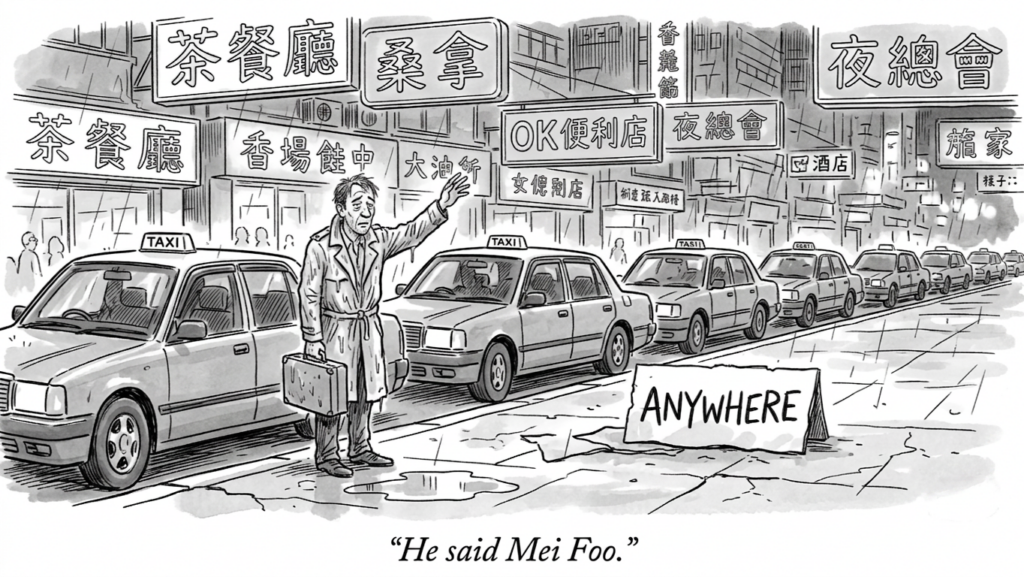
Reflections on Hong Kong taxi culture.
I have been rejected by women. I have been rejected by employers. I have been rejected by graduate schools, landlords, and a particularly discerning cat who lived in my building for three years without once acknowledging my existence. None of these rejections prepared me for the Hong Kong taxi driver.
REJECTION, HONG KONG STYLE
The first time it happened, I didn’t understand. I was standing on a busy street in Wan Chai, arm raised, taxi light on, the universal signal of a human who wishes to exchange money for transportation. A red Toyota Crown pulled up beside me. The window rolled down. The driver looked at me expectantly.
“Mei Foo,” I said, making the little U-shape with my hand, the universal Hong Kong gesture for “yes, I know it’s across the harbor, yes, I’m willing to go through the tunnel, please take me there.”
The driver’s face changed. Not anger, exactly. Something closer to the expression you’d make if someone asked you to help them move on a Sunday.
He shook his head once and drove away.
I stood there, arm still half-raised, watching his taillights disappear into traffic. The window had already rolled back up before I could ask why. Before I could negotiate. Before I could offer an alternative.
My wife, who had been watching this unfold with the resigned expression of someone who had seen it coming, just shook her head.
“It’s Mei Foo,” she said. “They never want to go to Mei Foo.”
In Hong Kong, I have since learned, hailing a taxi is not a transaction. It is a negotiation. And the driver holds all the cards.
The driver holds all the cards.
I wrote recently about the red minibus, that glorious chaos machine that barrels through Hong Kong’s streets with its speedometer beeping and its stops determined by whoever yells loudest. I described it as Hong Kong at its most alive, a system that works despite, or because of, its refusal to be optimized.
I may have been too kind to the red minibus. At least the red minibus lets you on.
The taxi will stop, roll down the window, let you believe for one shining moment that you are about to go somewhere, and then leave you standing on the pavement, wondering what you did wrong.
The system, such as it is, works like this: you want to go somewhere. The driver does not want to take you there. What happens next is a kind of interpretive dance, conducted through open windows at intersections, in which you state your destination and the driver decides whether your journey aligns with his personal preferences, his shift schedule, his dinner plans, or the general direction he was already heading.
The light being on means nothing.
The light being on means nothing. The light is a suggestion. The light is aspirational.
“Tsim Sha Tsui?” you ask, making the U-gesture to indicate cross-harbor. The driver considers this. Tsim Sha Tsui is a major destination. Tsim Sha Tsui is directly across the harbor. Tsim Sha Tsui should be an easy yes.
The driver shakes his head. The window goes up. The taxi pulls away.
Why? I will never know why. Perhaps he doesn’t want to deal with the tunnel traffic. Perhaps he’s about to end his shift. Perhaps he took a passenger to Tsim Sha Tsui in 1987 and something happened there that he’s never discussed with anyone.
The reasons are unknowable. The rejection is absolute.
I have developed theories.
Theory one: the shift change. Hong Kong taxis operate on two shifts, and drivers supposedly don’t want to pick up fares that will take them far from where they need to return the car. This explains some rejections. It does not explain being rejected at 2 PM for a destination ten minutes away.
Theory two: the tunnel question. There are three cross-harbor tunnels, and each has different toll prices and traffic patterns. Some drivers prefer one tunnel. If your destination suggests the wrong tunnel, you are dead to them. I once had a driver ask me which tunnel I wanted, and when I said “whichever is fastest,” he looked at me like I had suggested we drive into the sea.
Theory three: they simply don’t want to. This is the theory I have come to accept. The Hong Kong taxi driver is a free agent, an entrepreneur, a man who has looked at the gig economy and said, “I was doing this before there was a word for it.” He does not work for you. He is not obligated to you. If he doesn’t like the look of your destination, your face, or the particular angle of the afternoon sun, he will exercise his right to leave you standing on the curb.
I respect it. I don’t like it. But I respect it.
FRICTIONLESS IS FORGETTABLE
“Just use Uber,” my friends back home say, as if this solves anything.
I have used Uber in Hong Kong. Uber exists in Hong Kong the way speakeasies existed during Prohibition, technically illegal, technically everywhere, operating in a gray zone that everyone acknowledges and no one resolves. You can open the app. You can request a ride. A driver will come, eventually, in a car that is trying very hard not to look like it’s doing what it’s doing.
And it’s fine. It works. The driver accepts your destination before arriving, so there’s no rejection, no negotiation, no window rolling down only to roll back up again. You get in, you go, you get out. The transaction is frictionless.
But here’s the thing about frictionless: it’s also forgettable.
The Uber driver doesn’t have opinions about where you’re going. He doesn’t have three phones mounted on his dashboard, each one telling a different story about the city. He doesn’t know the shortcut through Sheung Wan that saves four minutes during the evening rush. He’s following a blue line on a screen, and when the blue line says turn, he turns.
The Uber driver will never tell you that the restaurant you’re going to used to be better before they changed owners. He will never ask if you’re a Lakers fan. He will never shake his head at your destination with an expression that suggests you have made a profound error in your life choices.
The Uber driver is providing a service. The taxi driver is having a relationship.
It’s a difficult relationship. It’s a relationship in which one party holds all the power and exercises it capriciously. It’s a relationship that leaves you standing on the street four times out of five, watching taillights disappear.
But when it works, when the window rolls down and the driver nods and you slide into that frozen cabin with its glowing dashboard, you are not just going somewhere. You are participating in something. You have been chosen. You have been deemed worthy of transport.
You have been chosen.
Uber cannot give you that. Uber doesn’t even know what that is.
When you do get in a taxi, when the stars align and your destination pleases the driver and you have not committed whatever unknowable offense causes the window to roll up, new adventures await.
Dashboard theology.
The first thing you will notice is the dashboard. Or rather, you will not notice the dashboard, because the dashboard has ceased to exist as a distinct surface. It has become a mobile phone storage facility. Three phones, sometimes four, mounted at various angles, each running a different app, each emitting its own notifications. One for dispatch. One for navigation. One for whatever else demands the driver’s attention while he’s merging across three lanes of traffic.
The phones will light up. The phones will ping. The driver will glance at them, occasionally tap one, and you will wonder which of these devices is actually guiding your journey and which is showing him a WhatsApp message from his wife asking him to pick up char siu on the way home.
The second thing you will notice is the air conditioning, which operates on two settings: “arctic” and “off.” There is no middle ground. The driver, who has been sitting in this car for eight hours, has acclimated to conditions that would concern a penguin. You, having just walked three blocks in Hong Kong humidity, will go from sweating to shivering in approximately forty-five seconds.
The driver knows where he’s going. The driver does not need your input. The driver has been navigating these streets since before you knew Hong Kong existed, and the fact that your phone’s GPS is suggesting an alternate route is not information he requires. His three phones agree with him. That’s a quorum.
There is an art to getting a taxi in Hong Kong.
There is an art to getting a taxi in Hong Kong, and I have spent years learning it.
First: know your destination in Cantonese. Not approximate Cantonese. Not “I’ll just show him Google Maps” Cantonese. You need to be able to say exactly where you’re going in a way that communicates you are a serious person who deserves to be taken there. My pronunciation of “Causeway Bay” has been refined through dozens of interactions to the point where drivers only wince slightly.
Second: master the hand signals. If you’re going cross-harbor, you make the U, a little swooping motion under an imaginary ocean. It says: I know what I’m asking. I understand there’s a tunnel involved. I am prepared for this journey. Without the U, you are just someone shouting a destination. With the U, you are a participant in the ritual.
Third: have a backup destination. If your first choice is rejected, you need a pivot. “Mongkok? No? How about… Prince Edward?” You are not begging. You are negotiating. There is a difference, and the difference is how quickly you can name somewhere else.
Fourth: carry cash. Yes, taxis technically accept Octopus cards now. Yes, there’s an app. The driver does not care about the app. The driver has thoughts about the app that he will share with you in Cantonese at a volume that suggests strong feelings. Cash is king. Small bills are better. Do not hand a five hundred-dollar note for a forty-dollar fare unless you want to see a man perform the physical manifestation of disappointment.
THIS IS NOT PERSONAL. THIS IS HONG KONG.
Fifth: accept that you will sometimes fail. You will stand on the street and watch taxi after taxi stop, consider your destination, and pull away. This is not personal. This is Hong Kong.
The thing about Hong Kong taxis is that when they work, they work beautifully.
The driver who actually wants to take you somewhere becomes a different creature entirely. He knows every shortcut, every light sequence, every moment when it’s worth cutting through the back streets of Sheung Wan versus when it’s faster to stay on the main road. He will get you where you’re going at a speed that suggests the red minibus drivers taught him everything he knows.
He will also offer opinions.
“You going to that restaurant? Good choice.”
“You live there? Expensive.”
“You from America? Ah. Lakers or Celtics?”
He will also offer opinions.
The Hong Kong taxi driver who has accepted you into his vehicle becomes a temporary guide to the city, offering commentary on the construction that’s blocking Hennessy Road, the new building going up in Kowloon, the general state of the world as observed from behind the wheel of a Toyota Crown with a dashboard that looks like a mobile phone convention.
I have learned more about Hong Kong from the inside of taxis than from any guidebook. The trick is getting inside them.
There is a hierarchy of Hong Kong transport, and I have come to understand my place in it.
The MTR is for everyone. It is democratic, efficient, indifferent to your personal story. You tap in, you ride, you tap out. The system does not care who you are or where you’re going. It simply moves you.
The red minibus, as I wrote before, demands participation. You must know when to yell, where to look, how to read the driver’s inscrutable relationship with the speed limit. It is chaotic, but it is an honest chaos. The minibus does not pretend to want you and then change its mind. It simply goes, and you either keep up or you don’t.
The taxi exists in a different category altogether. The taxi makes you prove yourself worthy. The taxi asks a question every time it rolls down its window: are you going where I want to go? And if the answer is no, the window goes back up, and you are left to contemplate your choices.
The taxi makes you prove yourself worthy.
Last week, I stood on Queen’s Road Central for fifteen minutes. Four taxis stopped for me. Four taxis rolled down their windows, looked at me with something approaching hope.
“Mei Foo,” I said each time, making my little U under the imaginary harbor.
Four times, the expression changed. Four times, the head shake. Four times, the window rolling back up, the taxi pulling away, leaving me standing there with my hand still curved in its futile gesture.
The fifth taxi stopped. The window rolled down.
“Mei Foo?” I asked, tracing my U, bracing for rejection.
The driver considered this. Looked at the traffic. Looked at me. Looked at one of his phones, then another.
“Okay.”
I got in before he could change his mind. The air conditioning hit me like a wave. The dashboard glowed with screens.
And we drove, through the Western Harbour Tunnel and into Kowloon, because on this particular day, at this particular moment, the stars had aligned.
The meter ticked. The driver said nothing. One of his phones pinged. He ignored it.
I thought about the MTR, clean and reliable and utterly without personality. I thought about the red minibus, its speedometer beeping its eternal soundtrack. And I thought about this taxi, which had asked me four times where I wanted to go and four times found my answer wanting.
This is Hong Kong.
This is Hong Kong. A city with one of the greatest public transportation systems on earth, where getting a ride can still feel like a minor miracle.
The driver glanced at me in the rearview mirror.
“Mei Foo,” he said, in a tone that suggested he was still not entirely convinced this had been a good idea.
I nodded.
We drove on.
We drove on.