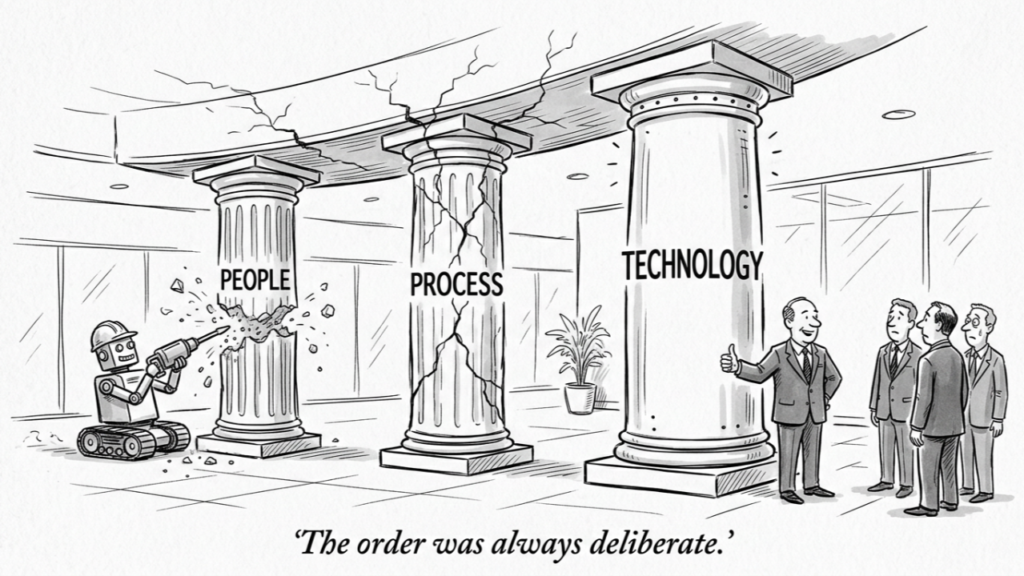
David Bozeman‘s AI-driven transformation has delivered Wall Street a dream. The 5,500 people who no longer work there due to the C.H. Robinson layoffs got something else.
C.H. Robinson was known across the industry for three pillars: people, process, and technology. The order was deliberate. People came first. That language still appears on the company’s investor relations page, but it has been quietly overshadowed. What Bozeman actually talks about is something different: Lean AI. And what he repeats at every investor call, every McKinsey interview, every Bloomberg hit is a newer mantra: fit, fast, and focused.
Fit. Fast. Focused.
One employee on TheLayoff.com translated the new vocabulary more plainly: there were significant layoffs at the end of September and more in November, the CEO continues to scream fit, fast, focused, and “fit means as few employees as possible to keep the stock price up.”
The company’s workforce has been steadily declining over the past two years. Total headcount fell from about 14,990 employees in the first quarter of 2024 to roughly 12,085 by the fourth quarter of 2025, while its North American Surface Transportation division alone dropped from about 6,004 to 4,970. Zoom out further and the picture is starker. Employment peaked at 17,399 in 2022. The Eden Prairie-based logistics company has since reduced its total employment by 31% as it deploys hundreds of AI agents. At the end of the last fiscal year, the company had approximately 11,855 employees. That is a loss of more than 5,500 positions in three years.
The company did not do this with a single dramatic announcement. Executives have repeatedly said the reductions are tied to productivity improvements rather than freight volumes, as automation and AI reduce the need for manual work. C.H. Robinson’s own 2023 10-K disclosed a total employee turnover rate of 24%. By mid-2025, CFO Damon Lee was citing turnover in the “low to mid-teens,” which tells you something about who remains, and how much harder the natural runoff may become from here.
But attrition is not the whole story. In June 2024, C.H. Robinson laid off around 80 of its remaining 150 U.S. enterprise sales representatives, according to FreightWaves. The company disputed the figure but declined to provide its own breakdown, saying only that “less than 2% of NAST roles were impacted.” Industry sources now report more recent cuts in global forwarding: 50 entry writers in one round, 12 warehouse workers in Chicago in another. The pattern is consistent and accelerating.
Not freight forwarding
Bozeman arrived at C.H. Robinson in June 2023 following the involuntary termination of his predecessor Bob Biesterfeld. He previously served as VP of Ford’s Customer Service Division, VP of Amazon Transportation Services from 2017 to 2022, and held roles of increasing seniority at Caterpillar and Harley-Davidson. It is a CV of manufacturing, middle-mile transportation, and supply chain operations. What it is not, as multiple industry veterans have noted, is a CV in freight forwarding.
On Glassdoor, one employee wrote: “We are constantly restructuring, which is just creating a downhill spiral for this company. They paid off our old CEO to quit, so Dave Bozeman could pick up a $20 million package and tell every employee we cannot receive our earned bonuses and yearly .50 merits.” The review described terrible benefits and zero appreciation, noting this happened right after thousands were laid off and bonuses were taken away from people covering multiple roles.
That characterization of C.H. Robinson’s benefits as “terrible” deserves scrutiny. Bill Paul, whose firm Logitalent has recruited in freight forwarding for three decades and counts C.H. Robinson as its longest-standing client, pushed back on that claim directly: “In terms of health benefits and costs to employees, that’s simply not true. In that regard, CHR benefits are excellent.” What Paul did note, however, is that C.H. Robinson switched to an unlimited PTO model under Bozeman. The company now offers what it calls Flexible Time Off to U.S. salaried employees, with no accruals and no caps. The practical effect, as Paul put it, is that it was “a way of ensuring that they didn’t have to pay out unused PTO when people left.” When the headcount is shrinking by thousands and the exit door is revolving, that distinction matters.
The board got what it hired him to do. The company now has hundreds of agentic AI agents that help process freight orders. Productivity has increased by more than 40% since 2022, a figure Bozeman recently updated to 45% at Fortune Brainstorm Tech in Aspen. NAST adjusted operating margin, excluding restructuring costs, rose to 36.4% in Q4 2025, up from 33.3% a year earlier, with a long-term target of 40%. The stock is up more than 100% in the past year. BofA calls Robinson “an AI disruptor.”
What happens to the people?
On Glassdoor, another employee recalled that from the pandemic era to mid-2023, C.H. Robinson “was a great place to work. It was very inclusive, there were a lot of opportunities and, hate to say it, but it actually felt like a family. Unfortunately Dave Bozeman took over and the shift into corporate culture was INTENSE.” There were no raises the year after Bozeman took over, and the 25-year employee trip was cancelled.
On Indeed, a long-time employee was blunter: “It used to be great but the company insists AI is the answer. Spoiler alert: it’s not. Due to this, all of the good workers are leaving. And what is senior management response to this: give the loyal people that stayed behind more work with no OT.”
Another described a workplace where “the company used to be a great place to work with great culture and comradery. Corporate has had so many layoffs and created a work environment that everyone is spread so thin that everyone is extremely stressed out. There is no immediate reinforcements and a ‘figure it out’ atmosphere now.”
On TheLayoff.com, one poster offered a longer view: “So much talent walked out the door from 2019-2021 when leadership changed at the CEO/CIO level. That new regime didn’t ask or care as people left in droves. I bet they care now. Now all that remains are 20 somethings that don’t know better and a bunch of lifers that are trying to survive to retirement.”
Another wrote: “Right now the company is strategically focused on making changes that solely benefit Wall Street.” And simply: “Everyone here is miserable right now, the company has completely forgotten about its people.”
That employee named Wall Street. Wall Street has names. Vanguard, BlackRock, and State Street collectively own roughly 20 to 25 percent of C.H. Robinson. They also own roughly 20 to 25 percent of Expeditors. The same passive institutional giants profiting from Bozeman’s AI-driven headcount reduction are profiting from Expeditors’ restructuring across town. These firms do not pick sides. They do not care which company treats its people better. They own the field. And on both sides of it, the play call is the same: shrink the workforce, widen the margin, lift the stock. Different CEOs. Different cultures. Different promises. Same owners. Same pressure. Same result.
Bill Paul, whose firm Logitalent is considered the premier recruiting company for international freight forwarding and domestic truck brokerage, and who is the most recommended logistics recruiter on LinkedIn, recently said publicly that he cannot in good conscience recommend candidates join C.H. Robinson at this time. He cited the case of a proven leader with more than a decade of tenure, whose wife has stage 4 cancer, being let go as part of the ongoing restructuring. That is not an anonymous forum complaint. That is a man whose business depends on placing people at C.H. Robinson telling his network to look elsewhere.
Follow the money
The salary structures of the two companies at the center of the industry’s transformation tell the story more concisely than any essay could. Expeditors’ proxy statement discloses that all executives receive an annual base salary capped at $100,000, intentionally well below market, with incentives paid at a fixed percentage of U.S. GAAP operating income. Dan Wall’s 2024 proxy filing shows $100,000 in base salary, with total yearly compensation of $4.59 million, comprised of 2.2% salary and 97.8% bonuses, including company stock and options. If Expeditors has a bad year, Wall has a bad year. If the branches don’t produce, neither does he.
Bozeman, by contrast, receives a $1 million base salary, with total 2024 compensation of approximately $8.78 million, including $1,625,731 in bonus and $5,610,682 in stock awards. That million dollars arrives regardless of how the company performs. It is the difference between a compensation model that says “we eat what we kill” and one that says “we guarantee the CEO’s kitchen is stocked before anyone else sits down.” In the Peter Rose era at Expeditors, the CEO’s base salary was an act of philosophy. At C.H. Robinson under Bozeman, it is an insurance policy.
But even Wall’s model deserves scrutiny. On February 27, 2026, with the stock near multi-year highs, Wall sold 6,100 shares of Expeditors stock for $884,927. According to his most recent SEC filings, he still directly holds approximately 68,691 shares of common stock, worth roughly $11.5 million at current prices, plus another 20,250 restricted stock units vesting over the next three years, bringing his total equity exposure to approximately $15 million. Under the Expeditors compensation model, every headcount reduction that improves operating income does two things simultaneously: it increases Wall’s incentive compensation in real time, and it lifts the share price that determines the value of his personal equity stake. The model that Peter Rose designed to align leadership with the workforce now creates a direct financial incentive to shrink it. Every employee shown the door arguably adds to the CEO’s bottom line at the expense of theirs.
Speaking at Fortune Brainstorm Tech in Aspen last week, Bozeman insisted the transformation is not tied to mass layoffs. Instead, he said automation is targeting entry-level operational roles that historically suffer from high turnover rates. He has told the StarTribune there are no workforce reduction goals tied to AI. And yet the workforce has shrunk by a third.
Not wrong. Not right.
On the Q2 2025 earnings call, when an analyst asked NAST president Michael Castagnetto how much lower headcount could go, he replied: “I don’t believe I would buy the idea that there’s a limit.” But he added: “I think there’s a ton of unknown.” Bozeman himself has said the NAST segment is in its “third inning” of transformation and the global forwarding segment is in the “first inning.” If the first three innings of NAST cost roughly a thousand NAST jobs, the forwarding teams, the entry writers, the customs brokers, the warehouse workers in Chicago, have reason to wonder what innings two through nine look like for them.
C.H. Robinson never had a no-layoff policy. It never promised its people they were safe. But it did spend decades telling people they were a pillar, the first pillar, of the company’s identity. AI is doing work that people used to do, and the company is pocketing the difference.
One Glassdoor reviewer summed up the view from inside: zero room for growth, frequent layoffs, management positions eliminated whenever someone quits, low pay, AI implementation that “doesn’t improve work, but creates more work,” decisions made “without thoughtfully thinking of how it impacts their employees or customers.” And then the line that deserves to be the company’s unofficial motto: “It’s like landing a plane before it’s been built.”