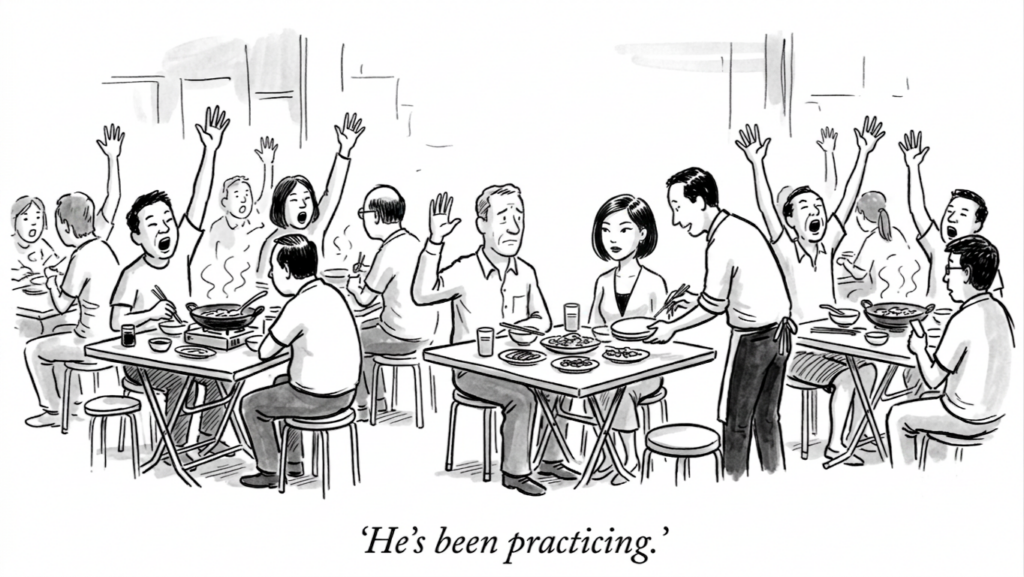
In the West, getting a waiter’s attention is a performance of restraint, but in Hong Kong restaurant culture, the dynamics change significantly.
You sit. You wait. You make eye contact, or you try to make eye contact, which is a different thing entirely, because the waiter is performing his own choreography, a carefully designed route through the dining room that appears attentive while remaining strategically unavailable. You raise your eyebrows slightly. You do the little half-nod. You shift in your seat in a way that says “I need something” without saying it too loudly, because saying it too loudly would be a violation, a breach of the social contract that governs Western dining, which states that you are a guest in this establishment and the server will come to you when the server is ready and not one moment before.
You do not raise your hand.
Raising your hand is what you did in school. Raising your hand is what a child does. Raising your hand in a restaurant in London or New York or San Francisco would cause a small, almost imperceptible ripple of discomfort at the surrounding tables. People would glance. They wouldn’t say anything. But they would glance.
In Hong Kong restaurant culture, you raise your hand.
You raise it high. You raise it with purpose. You raise it the way you would if you were flagging down a rescue helicopter, except you are not being rescued, you are trying to get more rice, and the urgency is approximately the same.
“M̀h gōi!”
The first time I witnessed this, I flinched. Not physically. Internally. Some deep programming activated in my nervous system, something inherited from growing up in a small town in western Massachusetts where people communicated their needs through silence, patience, and the occasional meaningful look at an empty coffee cup.
I grew up in Adams, Massachusetts. Population eight thousand, give or take, depending on whether you count the people who technically live in Cheshire but say Adams because it’s easier. Adams is the kind of town where you don’t need to get anyone’s attention because everyone already knows you’re there. Everyone already knows what you want.
At the Daily Grind, which is the coffee shop on Park Street where I spent most of my adolescence and a good portion of my twenties pretending to write, they don’t do the raised hand. They don’t do the polite eye contact. They don’t do any of the choreography I’m about to describe.
At the Daily Grind, they just call your name.
You walk in. You order. You sit down. And then, at some point, a voice cuts through the room.
“Adam! Adam, your coffee’s up!”
And you go get your coffee. There is no hand. There is no signal. There is just your name, called out by someone who has known you since you were fifteen, who knew your mother, who knows you take it black with one sugar and will occasionally just make it that way without asking because the line is long and you always order the same thing anyway.
That’s Adams. That’s how it works when you grow up in a place small enough to hold you entirely.
Hong Kong is not Adams.
Hong Kong is seven million people in a space roughly the size of a place that doesn’t want to be compared to Adams, Massachusetts, and yet here I am, comparing them, because these are the two places that made me and the way I exist in a restaurant is a product of both.
We were at a dai pai dong in Sham Shui Po. My wife’s family, six of us around a metal table that wobbled on one leg, the kind of table that exists in a state of permanent negotiation with gravity. The food was coming in waves, dish after dish landing with the precision of a military supply drop, and at some point my father-in-law decided we needed more soup.
He didn’t look around hopefully. He didn’t try to catch anyone’s eye. He didn’t perform the Western ritual of patient suffering. And he certainly didn’t wait for someone to call his name, because no one here knows his name, and that is fine, because that is not how this works.
He raised his hand, straight up, like a man who had been doing this for sixty years, which he had, and called out with a volume that I would have reserved for warning someone about an oncoming bus.
“M̀h gōi! M̀h gōi ah!”
A woman appeared. Not annoyed. Not startled. Not performing the tight smile that a Western server deploys when a customer has crossed an invisible line. She just appeared, notepad ready, as if this were the most normal thing in the world.
Because it is. Here.
In Adams, if you yelled across the Daily Grind, people would turn. Not because it’s rude, exactly, but because it’s unnecessary. The room is small. Everyone can see everyone. The woman behind the counter is already looking at you because there are only a few tables and she’s been working here since before you were born. You don’t need to raise your hand. You barely need to speak. You can just sort of exist in her direction and she’ll say, “Another one?” and you’ll nod and it’ll come.
That’s a system too. It’s a system built on intimacy, on smallness, on the luxury of being known. It doesn’t scale. You can’t run a city of seven million people on “another one?” and a knowing nod. But it works in Adams, and there’s a part of me that misses it with an ache that is hard to explain to anyone who didn’t grow up in a place like that.
I have now lived in Hong Kong long enough to raise my hand in restaurants. I do it. I have become a hand-raiser. But I want to be honest with you: it took years. And there are still moments, particularly in the quieter restaurants, the ones with tablecloths, where my hand goes up and some part of me whispers, “What are you doing? You are causing a scene.” I am not causing a scene. I am ordering water. But the programming runs deep.
The thing about the raised hand in Hong Kong is that it is not rude. I need to say this clearly because I think anyone reading this from a Western context, or from a small-town context, or from an Adams context, will assume it must be, that it must carry some weight of entitlement or impatience, that the person raising their hand must be the kind of person who snaps their fingers at waitstaff.
It’s the opposite. “M̀h gōi” means, roughly, “excuse me” or “I wouldn’t dare impose,” depending on how literally you want to translate it. It is a polite word. It is a word that contains its own apology. The raised hand plus m̀h gōi is not a demand. It is a signal, clear, unambiguous, efficient, designed to function in a loud room where subtlety would be wasted and eye contact is physically impossible because the waiter is carrying four plates and navigating between tables with the spatial awareness of a Formula One driver.
In Adams, politeness is built into the silence. You wait because waiting is polite. You don’t interrupt because interrupting is rude. You trust that you’ll be seen, because in Adams, you’re always seen. You’ve always been seen. The town is too small to be invisible in.
I am here. I exist. I need something.
Hong Kong is a city where invisibility is the default. Seven million people, and unless you make yourself known, you are just another body in a room full of bodies. The raised hand is not aggression. It is the opposite of invisibility. It is a person saying: I am here. I exist. I need something. And the waiter responding: I see you. I hear you. It’s coming.
Western restaurant culture treats the act of getting attention as something that should be invisible. The waiter should notice you without being told. The waiter should appear at the precise moment you need something, as if by telepathy. And when this doesn’t happen, when the waiter is busy or distracted or simply hasn’t noticed that your water glass has been empty for ten minutes, you sit there. You suffer. You tell yourself it’s fine. It’s not fine. You’re thirsty. But the alternative, raising your hand, calling out, being seen to need something, is somehow worse than the thirst.
Hong Kong looked at this system and said: no.
Hong Kong said: you need something, you say so. You raise your hand. You use your voice. The waiter hears you, comes over, and the transaction is complete. No one’s feelings are hurt. No one’s dignity is compromised. No one sits for ten minutes performing patience while quietly dying inside.
It is, I have come to believe, the more honest system.
Adams solved the same problem a different way. Adams said: we already know what you need because we already know who you are. The system is not efficiency. The system is familiarity. The system is a town small enough that every transaction carries the residue of every previous transaction, going back years, going back generations.
Both systems work. Neither translates.
I cannot raise my hand in the Daily Grind because there is no one to raise it at who doesn’t already know me. And I cannot wait to be known in a Hong Kong dai pai dong because no one there will ever know me, not like that, and waiting to be seen is just waiting to be hungry.
There is a spectrum in Hong Kong, of course.
At the dai pai dong, where the tables are packed and the kitchen is separated from the dining area by nothing more than a counter and an attitude, the raised hand is accompanied by full voice. You are competing with twenty other tables, with sizzling woks, with the television mounted in the corner playing horse racing at volume. Restraint would be functionally useless. You raise your hand, you call out, you make yourself known. The food comes. Life continues.
At a cha chaan teng, the beloved Hong Kong diner, the hand goes up but the volume adjusts. The waiter is closer, the space is smaller, and besides, at a proper cha chaan teng the waiter is already moving toward you before your hand reaches its full height. They are watching. They are always watching. Not out of obsequiousness but because speed is the currency of the cha chaan teng, tables need to turn, orders need to fly, and a customer sitting with an empty glass is a customer not ordering their next milk tea.
The cha chaan teng is the closest Hong Kong gets to the Daily Grind, now that I think about it. Not because of the food, which could not be more different, but because of the recognition. Go to the same cha chaan teng enough times and the waiter will start to nod when you sit down. Come back enough and he’ll bring your usual without asking. Come back for years and he might, one day, almost smile. This is the Hong Kong equivalent of being known. It takes longer. It is earned in a different currency. But it is real, and when it happens, the hand doesn’t need to go up quite as high.
At a proper restaurant, the hand still goes up. This is the part that would scandalize a Western diner. White tablecloths, wine glasses, a prix fixe menu, and there, at table four, a woman raising her hand to get the server’s attention, and the server coming over with exactly the same professionalism and warmth as if she had been standing at the table already.
There is no shame in it. There is no breach. It is simply how things are done.
I think about this more than a person probably should.
I think about it because I grew up in Adams, Massachusetts, where I was known before I could speak, where every coffee shop and diner and bar held me in a kind of invisible net of familiarity, and then I moved to a city of seven million people where no one knows my name and no one is going to call it out when my order is ready. I had to learn a new system. I had to learn to make myself known in a place that doesn’t know me.
The raised hand was that lesson.
The raised hand was that lesson. And it took years.
My wife does not think about this. My wife has never thought about this. My wife raises her hand with the easy confidence of a person for whom this gesture carries exactly zero emotional weight. It is like breathing. It is like blinking. It is the simple mechanical act of communicating a need to another human being in a noisy room.
She finds it genuinely baffling that I ever found it difficult.
“You just raise your hand,” she says, in a tone that suggests I am overcomplicating something that does not require complication.
She’s right. I know she’s right. And yet.
She’s been to Adams. She’s sat in the Daily Grind and had someone bring her a coffee before she ordered it because they saw our car pull up outside. She thought it was charming. I thought it was home. And there’s a difference between visiting a place like that and being made by one, between seeing the warmth and knowing what it feels like to leave it behind, to move somewhere you have to announce yourself every time you want something. It’s a small adjustment. It shouldn’t matter. But the small adjustments are the ones that reveal the most about where you came from.
Last week we were at a hotpot restaurant in Tsim Sha Tsui. Twenty tables, steam rising from every one, the sound of boiling broth and conversation creating the kind of ambient noise that makes a library seem oppressive by comparison. We needed more lamb. We needed more of the hand-pulled noodles that you drop into the broth and fish out two minutes later, soft and slippery and perfect.
My wife raised her hand. “M̀h gōi!”
The waiter came. She ordered. He left. The lamb arrived in under a minute.
I watched this happen with the admiration of a person who has studied the art form for years and still feels like an apprentice. She didn’t think about it. She didn’t hesitate. She didn’t perform the internal calculation that I still perform, every time, the one that weighs the need against the social cost and tries to determine whether the waiter looks busy, whether the timing is right, whether someone at another table might judge me for being too loud.
She just raised her hand.
And here is where I tell you that it’s changing.
Not everywhere. Not yet. But enough that I’ve noticed, and enough that it bothers me more than it probably should.
The QR code.
You sit down at a restaurant now, increasingly, and there is no waiter coming over. There is no hand to raise. There is a small laminated square on the table, or a sticker on the wall, and you are meant to take out your phone, open your camera, scan the code, wait for the menu to load, scroll through a website that was clearly designed for a screen three times larger than the one you’re holding, find what you want, add it to a cart, and submit your order into the digital void.
No hand. No voice. No m̀h gōi.
No hand. No voice. No m̀h gōi. No human being acknowledging that you exist and that you are hungry and that you would like some rice, please.
Just you, your phone, and a QR code that takes four seconds to load on a good day.
I hate it.
I understand it. I understand that labor is expensive. I understand that a QR code doesn’t call in sick, doesn’t get orders wrong, doesn’t need a lunch break. I understand that for the restaurant owner doing the math on staffing costs, the QR code is elegant. Efficient. Modern.
But I didn’t spend years learning to raise my hand just to scan a code.
I didn’t spend years unlearning the quiet patience of Adams, Massachusetts, didn’t train myself to call out across a room with confidence, didn’t finally make peace with the raised arm and the projected voice, only to have the whole system replaced by a two-inch square of black and white pixels.
The QR code solves a problem that, in Hong Kong, was never a problem. The raised hand worked. It worked beautifully. It was fast, it was human, it was a tiny moment of connection between two people, one who needed something and one who could provide it. The waiter heard you, nodded, brought your food. Done. Thirty seconds. No app required. No Wi-Fi necessary. No loading screen spinning while your hotpot boils dry.
And now, in its place: silence. Everyone at their tables, heads bowed over phones, scrolling through menus that have too many pages and not enough pictures, trying to figure out whether “House Special #3” is the thing they had last time or something else entirely. No one raising a hand. No one calling out. The room is quieter, and it is a worse kind of quiet.
It’s not the quiet of peace.
It’s not the quiet of peace. It’s the quiet of disconnection.
The QR code is not the Daily Grind. The Daily Grind’s system works because a person knows you. The QR code’s system works because no person needs to. These are not the same thing. One is warmth. The other is absence.
I don’t go to the QR code places anymore. Not if I can help it. Life is short and there are still enough restaurants in this city where a raised hand brings a person to your table, where you can point at the menu and ask what’s good today, where the waiter might say “the fish, get the fish” and you get the fish and it’s perfect because he knew and you didn’t and that exchange cannot happen through a QR code.
I don’t go back to the States much either. I don’t want the silence of the QR code, but I also don’t want the American way, sitting there hoping to be seen, performing patience I don’t feel, waiting for a server who may or may not notice that I exist before I die of old age.
I want the hand. I want the voice.
I want the hand. I want the voice. I want the human transaction, direct and unashamed, that Hong Kong taught me was possible.
Or I want the Daily Grind. I want someone to see my car pull up and start making my coffee before I walk through the door. I want someone to call my name across a small room and hand me what I need without my having to ask.
But you can’t have the Daily Grind in a city of seven million. You can’t be known like that here. The best you can get is the raised hand, the called-out m̀h gōi, the waiter who nods and brings what you need because you had the courage to ask for it.
That’s enough. That’s more than enough.
It’s certainly better than a QR code.
I’m writing this from a cha chaan teng in Mong Kok. I have been sitting here for twenty minutes with an empty cup of milk tea. I want another one. The waiter is three tables away, wiping down a surface, his back to me.
There is no QR code on this table. There is no app to download. There is no one here who knows my name or my order or my mother. There is just me, and him, and the noisy room between us.
In Adams, I wouldn’t need to do anything. The refill would come. It would come because I’m Adam and this is what Adam drinks and he’s been coming here for years and his cup is empty and that’s all anyone needs to know.
Back home, I would wait. I would sit with my empty cup and I would wait, and eventually the waiter would turn around and eventually he would see me, and eventually I would have my tea. Five minutes. Maybe ten. A small death.
Here, I raise my hand.
“M̀h gōi!”
He turns. He nods. He’s already walking toward the kitchen.
The tea arrives in thirty seconds.
I don’t know why it took me so long to learn this. I don’t know why a simple gesture, hand up, voice out, can carry so much invisible weight for someone raised in a different system. But I know that learning to raise my hand in a Hong Kong restaurant taught me something small and true about the difference between politeness and clarity, and how often we mistake one for the other.
Somewhere in Adams, Massachusetts, a woman behind a counter is pouring a coffee for someone whose name she’s known for twenty years, without being asked, without a hand going up, without a sound.
Here in Mong Kok, a waiter is bringing me milk tea because I raised my hand and used my voice and made myself known in a room full of strangers.
Both of these things are beautiful.
Both of these things are beautiful. Both of these things are disappearing.
The QR code doesn’t know your name.
The QR code doesn’t know your name. The QR code doesn’t hear your voice.
Raise your hand. Say what you need.
Raise your hand. Say what you need. The waiter is not going to judge you.