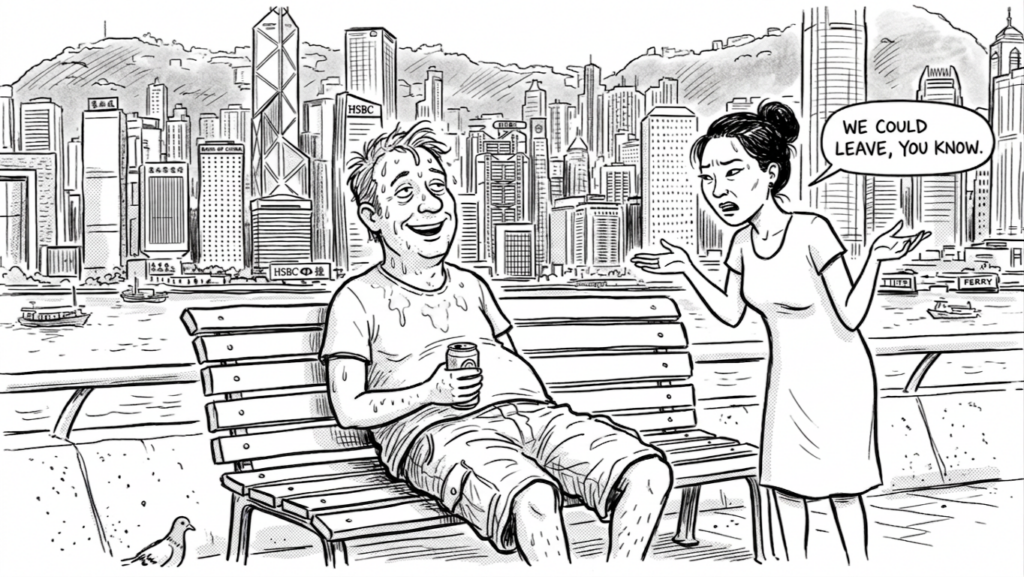
An incomplete and emotionally compromised list, written by the same man who wrote the love letter, because love and complaints are the same thing if you have been somewhere long enough.
I have lived in Hong Kong for fifteen years. I wrote an essay about the ten things I love about it. It did well. People shared it. People sent it to friends. People sent it to me, which was confusing, because I wrote it.
What nobody asked, and what I did not volunteer, is that I also have another list. Everyone who lives in Hong Kong has another list. The love list is the one you share at dinner parties. The other list is the one that comes out at 2 AM when the construction outside your building has been going for six hours and you have given up on sleep and are lying in bed composing mental essays about everything that drives you crazy about this city while Ruth sleeps next to you with the serene indifference of a woman who can sleep through a jackhammer, a typhoon, and her husband’s existential crisis, simultaneously.
Ruth read the love essay. Ruth said it was nice. Ruth said “nice” the way Ruth says most things, with a tone that implies she has three additional thoughts she is choosing not to share. Then she said, “You left out everything that actually makes you interesting, which is how much you complain.” She is correct. She is almost always correct. This is one of the things I hate about Hong Kong, which is that Ruth is in Hong Kong, and Ruth being correct is therefore a Hong Kong problem.
This is the complaint list. It is ranked. The ranking is subjective, emotionally compromised, and deeply personal. Ruth will disagree with most of it. Ruth disagrees with most things I say, which is one of the reasons I married her, because she keeps me honest in a way that is both admirable and profoundly irritating, and I mean that as a compliment, and she will not take it as one.
Here are the ten things. They are ranked in order of how much they make me question my life choices. The ranking is correct and I will not be taking questions, though I will be taking complaints, because that is what this entire piece is about.
10. The Construction That Never Ends
The construction outside my building in Mei Foo has been ongoing since, by my estimation, the Qing Dynasty. I do not know what they are building. I do not know what they are renovating. I do not know what they are doing. I have asked. Nobody knows. The workers do not know. The foreman does not know. The building management does not know. The construction exists in a state of pure being, without origin, without destination, without purpose, a jackhammer koan, a philosophical exercise in the Buddhist concept of impermanence except that the one thing that is not impermanent is the construction itself, which will outlast me, my building, and possibly the concept of buildings.
It starts at seven. I know this because I wake at five-forty and sit in the dark writing, and at seven the jackhammer begins, and whatever sentence I was composing is replaced by the feeling of having my skull drilled from the outside. I have adapted. I have habituated. I no longer hear it, which is somehow worse, because it means the construction has become part of me, has been absorbed into my nervous system, has been metabolized into background noise, and I am now a man who does not notice jackhammers the way a fish does not notice water, and if that is not a sign that I have lived somewhere too long then I do not know what is.
Ruth sleeps through it. Ruth has always slept through it. Ruth could sleep through the demolition of our building, wake up in the rubble, and ask what’s for breakfast.
9. The Humidity in August
I have experienced weather in many places. I grew up in Adams, Massachusetts, where winter is a personal attack and summer is the four days between winter and the next winter. I have been to Bangkok in April. I have been to cities where the heat has opinions and the sun has a grudge.
None of it prepared me for August in Hong Kong.
The humidity in August is not weather. It is a relationship. It is a relationship you did not consent to, with a partner who is clingier than anyone you have ever dated, who wraps around you the moment you step outside and does not let go, who follows you into the MTR and the elevator and somehow into your apartment even though you are certain you closed the door. It is a humidity so thick and personal that it feels like being worn by the weather rather than wearing it. Your glasses fog when you leave any air-conditioned space. Your shirt is wet before you reach the end of the block. Your body, which has served you reasonably well for fifty-six years, simply stops functioning as a cooling system and becomes instead a humidifier, adding moisture to an atmosphere that already has more moisture than the ocean.
I step outside in August and immediately begin to dissolve. Not metaphorically. I am, in a physical and verifiable sense, becoming liquid. I am a man-shaped puddle with a mortgage.
Ruth does not sweat. I have never seen Ruth sweat. I do not understand how this is possible. I do not understand how a human being can walk through Hong Kong in August and emerge dry, composed, and mildly judgmental about my appearance. I have asked her about this. She said, “I’m from Hong Kong.” As if that explains anything. As if growing up in humidity grants you some kind of biological exemption. As if the city itself has a loyalty program and one of the perks is functioning sweat glands.
8. The Size of the Flats
I live in Mei Foo. My flat is, by Hong Kong standards, not small. By Hong Kong standards, my flat is spacious. By the standards of anywhere else I have lived, my flat is a convincing argument for minimalism, not because I believe in minimalism but because minimalism is the only philosophy compatible with a kitchen that cannot fit two people standing and a closet that accommodates exactly three seasons of clothing if you are willing to fold everything into rectangles the size of playing cards.
I am from Adams, Massachusetts. I am from a place where houses have yards and yards have trees and trees have space between them. I am from a place where the concept of “not enough room” referred to the garage, not the apartment you are paying more for than your parents’ entire house.
Ruth says the flat is fine. Ruth says I take up too much space. She is referring to both my physical presence and my emotional footprint. She is correct about both.
7. The Rent
I am going to write a number. The number is what an average family pays for housing in Hong Kong. I am not going to write the number. I am going to let you imagine the number. Whatever number you imagined, if you do not live in Hong Kong, you are wrong. It is higher. If you do live in Hong Kong, you already know, and you have the same look on your face that I have on mine, the look of a person who has done the math and understands the math and cannot explain the math to anyone who has not also done the math.
My parents never bought a house in Adams, Massachusetts. They didn’t need to. You could live in Adams, Massachusetts. That was the whole arrangement. Housing was something that existed and cost what things cost and nobody talked about it at dinner because there was nothing to talk about. In Hong Kong, I own a flat where I can hear my neighbor’s television through the wall and the wall is also the ceiling because the flat is arranged vertically in a way that suggests the architect was working with a dare rather than a blueprint. What I paid for it would buy most of Adams. Possibly all of Adams. Possibly Adams and the next town over, with enough left for lunch.
I stay. I pay the management fees. I stare at the mortgage statement. The property values go up, which sounds like good news until you remember that you already live here and you are not selling and the only thing rising faster than the value is the cost of everything around it. This is the cycle. This is the Hong Kong cycle. It is not a housing market. It is a hostage negotiation in which the hostage has Stockholm syndrome and also genuinely loves the building.
Ruth says we should move. Ruth has been saying we should move for years. We do not move. We will not move. Mei Foo is home. The mortgage is the price of home. I pay it the way I pay taxes, reluctantly, inevitably, with the full understanding that the alternative is worse.
6. The Air Quality on Bad Days
There are days in Hong Kong when the sky is so blue and the harbour is so clear that you could take a photograph and it would look like a postcard and nobody would believe it was real. Those days exist. I want to be clear about that. Those days are real and they are beautiful and they are the days you show people when they ask what Hong Kong looks like.
Then there are the other days.
On the other days, the sky does not exist. The sky has been replaced by something grey and thick and faintly hostile, a haze that sits over the city like a lid on a pot, and you check the Air Quality Index on your phone and the number is high enough to make you close the app and then open the app and then close the app again because checking the number did not change the number and knowing the number only made the breathing worse, psychologically if not physically.
On bad days, the harbour disappears. The buildings across the water become suggestions. The Peak becomes a rumor. The city loses its depth, its dimension, its drama, and becomes a flat grey painting of itself, a city drawn by someone who ran out of colors and decided grey was close enough.
I go outside anyway. I breathe anyway. I complain anyway. Ruth checks the app and tells me the number. I tell her I do not want to know the number. She tells me the number again. This is marriage.
5. The Landlords
This entry is not about my landlord specifically, which is Ruth. This entry is about a system, a structure, a reality of Hong Kong life that operates with the precision of a natural law and the compassion of a parking meter.
A neighborhood becomes interesting. Artists move in. A good coffee shop opens. A little bookstore. A bar with no sign. The neighborhood develops what real estate people call “character” and what I call “a reason to walk there.” Then the landlords notice. The landlords always notice. The rents go up. The coffee shop closes. The bookstore closes. The bar with no sign is replaced by a store with a very large sign selling something nobody needs. The artists leave. The neighborhood is no longer interesting. The rents do not go back down. The rents never go back down. The rents exist in a state of permanent escalation, like a conflict nobody wants but nobody can stop, and the neighborhood is left with a higher price tag and a lower pulse.
Hong Kong does not lose its old places because they fail. It loses them because success in one form triggers eviction in another. A dai pai dong that has been feeding a neighborhood for thirty years is not unsuccessful. It is successful in a way that does not translate into the kind of rent that the building’s new owner requires, and so it goes, and something else comes, and the something else is always a pharmacy or a cosmetics shop or a chain that sells things you already own in packaging that suggests you need more of them.
Ruth says this is capitalism. Ruth says this as if she is explaining gravity to a man who keeps jumping off things. She is not wrong.
4. The Disappearance of the Old Places
This is related to number five but it is not the same. Number five is about why. Number four is about grief.
The congee shop on the corner that became a pharmacy. The dai pai dong that became a 7-Eleven. The watch repairman on a folding table who is just gone, not closed, not relocated, not retired, just gone, the table folded, the space empty, and then not empty, filled by something new and clean and utterly without history.
The Hong Kong I moved to fifteen years ago, the one I have mentioned elsewhere with the old man fixing watches on a folding table and the woman selling fish balls from a cart she wheeled out every morning at five, that Hong Kong did not die. It was simply replaced, one lease at a time, by a city that is newer and shinier and somehow less interesting, the way a new car is less interesting than the old car that had the dent in the door from the time you hit the post and the stain in the back seat from the coffee you spilled driving to a wedding and the scratch on the dashboard from the dog you used to have. The old car was yours. The new car is just a car.
I know nostalgia is a liar. I know the past was not better, only different. I know the watch repairman had bad knees and probably wanted to retire and probably did not share my romantic attachment to his folding table. But I miss the folding table. I miss the fish ball cart. I miss the version of the city that did not know it was being replaced.
Ruth says I romanticize the past. Ruth says everyone romanticizes the past. Ruth says the difference between me and everyone else is that I do it in writing, which makes it permanent and therefore more embarrassing. She is correct. She is almost always correct. This, also, is a complaint.
3. The Escalator Etiquette, or the Lack Thereof
Stand on the right. Walk on the left. This is not complicated. This is not ambiguous. This is not a cultural nuance requiring years of study. This is a binary system, two sides, two functions, stand or walk, right or left, and yet every single day, without fail, with the reliability of sunrise and the predictability of rent increases, someone stands on the left.
A tourist. A local. A man in a suit looking at his phone with the concentration of someone defusing a bomb, completely oblivious to the queue of silent, seething professionals forming behind him, a queue that grows and compresses and radiates collective fury in a frequency only other commuters can hear, and nobody says a word, because saying a word would violate the unspoken rule about not confronting people who violate the unspoken rule, and so instead everyone stands there, vibrating with repressed irritation, performing the Hong Kong ritual of suffering in public silence.
I have not done the math. But I am confident that if you added up all the seconds lost to people standing on the left side of escalators in Hong Kong over the course of a year, the total would be enough to watch every film ever made, or read every book I keep saying I will read, or finally learn Cantonese, which I have been “about to start” learning for fifteen years.
Ruth stands on the right. Ruth always stands on the right. Ruth would no sooner stand on the left than she would wear socks with sandals or order a steak well done. The escalator rule is, for Ruth, a moral principle, and violating it is not an inconvenience but a character flaw, and she judges accordingly, silently, completely, from the right side of the escalator, where she belongs, where we all belong, where civilization itself depends on us remaining.
2. The Chain Pharmacies and the Sameness
Watsons. Mannings. Sasa. Watsons. Mannings. Sasa. Watsons. Mannings. Sasa. This is not a sentence. This is a walking tour of any street in Hong Kong.
I walked past a storefront in Wan Chai last year that had been a family-run congee shop for decades. It is a Sasa now. Nobody held a funeral. Nobody held a wake. Nobody stood outside with a candle and said a few words about the congee, which was excellent, and the woman who made it, who knew your order before you said it, who had been there so long she was less a shopkeeper and more a feature of the street itself, like a lamppost or a mailbox, fixed, permanent, reliable, and then, like a lamppost or a mailbox, removed one day without ceremony or explanation.
Every corner in Mong Kok looks like every other corner in Mong Kok. Every block in Causeway Bay looks like every other block in Causeway Bay. The sameness has a weight to it, a gravitational pull, as if the city has decided that variety is inefficient and efficiency is the only value worth pursuing, and so the same five storefronts reproduce themselves across every neighborhood like a franchise of franchises, a chain of chains, a recursive loop of retail that makes you feel, walking from one block to the next, that you are not moving at all, that the city is a treadmill and the scenery is on repeat and the only thing that changes is your capacity to notice.
Ruth says I am being dramatic. Ruth shops at Watsons. Ruth shops at Mannings. Ruth does not see the contradiction. I do not point out the contradiction. I have been married long enough to know which contradictions are worth pointing out and which ones are better left in the overlap where love and hypocrisy keep each other warm.
1. The Fact That I Will Miss All of This If I Ever Leave
This is the complaint I cannot fix. This is the complaint that sits underneath all the other complaints like a foundation under a building, invisible, structural, load-bearing.
I will miss the construction. I will miss the humidity. I will miss the tiny apartment and the obscene rent and the grey days when the harbour disappears. I will miss the pharmacies and the sameness and the escalator violations and the landlords and the vanishing dai pai dongs. I will miss all of it, every single thing on this list, because every single thing on this list is evidence that I live here, that this is mine, that I have been here long enough for the complaints to be specific and the frustrations to be personal and the grievances to be intimate in the way that only a long relationship produces intimate grievances.
You do not complain about a city you are visiting. You complain about a city you live in. You complain about it the way you complain about a spouse, not because you want to leave but because you have stayed long enough to see the flaws up close and you have decided, every day, sometimes twice a day, sometimes at 2 AM with the jackhammer going, that the flaws are part of the deal and the deal is worth it and you are staying.
Ruth once told me that if I ever actually left Hong Kong, I would miss the construction and the humidity and the small flats and the chain pharmacies, because I would have nothing left to complain about, and complaining is the only hobby I have ever maintained consistently. I told her she was wrong. She said I was wrong. We were both right. That is the whole marriage, right there. That is the whole city, right there. Two people in a small apartment, disagreeing about everything, agreeing about the one thing that matters, which is that this is home, and home is the place you complain about to people who do not live there, and defend to people who do not live there, sometimes in the same sentence, sometimes in the same breath, always with the same stubborn, illogical, entirely non-negotiable love.
I got lost in the lobby once. Drunk, confused, fifteen meters from my own front door. I called Ruth. She hung up. She did not come down.
She knew I would complain about it later. She was right. I have been complaining about it ever since.
That is the thing about Hong Kong. It gives you everything you need, including the things you need to complain about. And I am grateful for all of it. Even the jackhammer. Even the humidity. Even the left-side escalator people.
Even the lobby.