On a night in April 1973, in the city of Memphis, where the Mississippi bends and the summer air smells of barbecue smoke and jet fuel, fourteen aircraft delivered 186 packages to 25 U.S. cities. Frederick W. Smith had founded Federal Express Corporation in Little Rock, Arkansas, in 1971. Smith was born in Marks, Mississippi, on August 11, 1944, and raised in Memphis, Tennessee. He studied economics at Yale University, where he wrote a paper about an integrated air-to-ground overnight delivery system. FedEx’s own corporate history records that he received an average grade, though the popular legend puts it at a C, and Smith himself has said in interviews that he does not recall the exact mark. History gave him something else.
He received his bachelor’s degree in economics from Yale in 1966. After graduating, he served four years in the United States Marine Corps, which included two tours of duty in Vietnam, where he served as a rifle platoon leader, a company commander, and an aerial observer and tactical air controller in the OV-10A. He was decorated with the Silver Star, the Bronze Star, and two Purple Hearts for his military service. He came home from Vietnam with those decorations and a conviction that the movement of goods across a continent could be reimagined as a system, not a series of accidents. He had watched the military move materiel through jungles on schedules that civilian carriers could not approach, and he understood, in the way that only someone who has depended on logistics for survival can understand, that the distance between a warehouse in Saigon and a firebase in the Central Highlands was not merely geographic. It was informational. It was temporal. It was trust.
He built a company on that understanding. On the first night of continuous operation, on April 17, 1973, 389 Federal Express team members and 14 Dassault Falcon jets delivered 186 packages overnight to 25 U.S. cities. Smith operated his company on a basic premise that he called P-S-P: people, service, profit. The idea was that the three concepts work in a circle, each supported by the others. The order was deliberate. People first. Not customers. Not shareholders. People. The employees. The ones who loaded the planes and drove the trucks and sorted the packages in the hub at two in the morning while Memphis slept. “Federal Express, from its inception, has put its people first both because it is right to do so and because it is good business as well,” Smith wrote in the Manager’s Guide.
And then there was the gamble. The one that became corporate scripture, repeated so many times it has the quality of parable. While waiting for a flight home to Memphis from Chicago after being turned down for capital by General Dynamics, Smith impulsively flew to Las Vegas and won twenty-seven thousand dollars playing blackjack, enough to keep the company alive. His COO Roger Frock recalled Smith saying the meeting with the General Dynamics board had been “a bust,” and that he knew they needed money for Monday. Frock asked how he could gamble the company’s last five thousand dollars. Smith responded that without the funds for the fuel companies, they could not have flown anyway.
That was the founder. A man who would bet the company on a blackjack table because the alternative was watching it die without trying. A decorated Marine who built a management philosophy from military leadership doctrine. The Manager’s Guide instructed leaders to “attempt to avoid furloughing employees, and retrain any whose jobs are affected or eliminated by business conditions or technological change.”
Attempt to avoid furloughing employees. That was the text. Not a no-layoff guarantee, not the oak that Peter Rose planted at Expeditors, but something close enough that a generation of FedEx workers understood the company’s posture: your job is not disposable. You are not a line item. P-S-P means we will try to keep you, even when the numbers say otherwise.
Frederick Wallace Smith, the founder, executive chairman, and long-time chairman and CEO of FedEx Corporation, passed away from natural causes on June 21, 2025, in Memphis, Tennessee. He was 80 years old. Smith had stepped down as CEO in June 2022 and was succeeded by Raj Subramaniam. He was buried with full military honors at Arlington National Cemetery on October 3, 2025.
He died while the company he built was being taken apart and rebuilt, bolt by bolt, under a program called DRIVE.
Enter Raj Subramaniam.
Subramaniam joined FedEx in 1991 as an associate marketing analyst. He served as president since 2019 and succeeded the company’s founder in June 2022 as the second CEO in FedEx history. Unlike the outsider CEOs parachuted into other logistics companies, Bozeman at C.H. Robinson from Amazon and Ford, a man who had never brokered a load, Subramaniam has more than 30 years of industry experience at FedEx, with international leadership roles, keen business insights, and a focus on globalization that have contributed to the success of the company. He is not an outsider. He is a lifer. He knows the company from the inside the way the people he is now cutting know it from the inside.
That is what makes what happened next not a turnaround story but a betrayal story. Because when the man holding the saw is the one who grew up in the orchard, the people standing among the stumps cannot console themselves with the thought that he did not know what he was cutting. He knew. He cut anyway.
As FedEx’s stock tumbled following weak earnings in September 2022, a new and powerful force made its move. The activist hedge fund D.E. Shaw, a significant shareholder, formalized a cooperation agreement with the company. FedEx increased its dividend by 53% and aligned its executive compensation program with metrics that favor shareholders’ interests. With D.E. Shaw’s backing, Subramaniam was given the mandate to do what Smith’s philosophy had long resisted: radically restructure the company from the ground up. The primary vehicle for this transformation is the DRIVE program, a sweeping initiative launched in 2023 with the explicit goal of cutting $4 billion in permanent costs. At its core, DRIVE is an IT-led overhaul designed to integrate FedEx’s historically separate Express and Ground networks, a move Smith had long resisted.
Smith had long resisted. That sentence deserves its own silence. The founder of FedEx, the man who built the hub-and-spoke system from a term paper and a blackjack table, had looked at the idea of merging Express and Ground and said no. He understood something that the spreadsheet does not capture: that the separation of Express and Ground was not an inefficiency. It was architecture. It was the deliberate design of a man who understood that air freight and ground freight are different businesses serving different customers with different urgencies, and that the people who run them develop different competencies, different cultures, different loyalties. The separation was not a bug. It was the system.
D.E. Shaw did not care about the system. D.E. Shaw cared about the margin. The metrics that favor shareholders’ interests. Not the metrics that favor the people sorting packages at two in the morning. Not the P-S-P circle. The other circle, the one that runs from cost reduction to EPS to executive vesting to stock sale and back to cost reduction, the circle that Fred Smith never drew because Fred Smith was wired differently, because Fred Smith had been in a jungle where the logistics were life and death, and the people who ran the logistics were not inputs to be optimized but human beings whose discretionary effort was the difference between a successful mission and a body bag.
To execute this vision, FedEx turned to outside consultants. McKinsey & Co. was brought in to engineer the cost-cutting and restructuring strategy. Accenture was handed the keys to the company’s “digital transformation.”
McKinsey. The name arrives in these stories the way a particular scent arrives in a hospital corridor. You know what it means before anyone says it. It means the consultants are in the building and the people are leaving. It means the spreadsheet has won.
Here is what the spreadsheet produced.
FedEx’s workforce has declined significantly under DRIVE. The company employed approximately 547,000 people in 2022. By May 31, 2024, that number had fallen to approximately 505,000, a reduction of roughly 42,000 positions. The company reduced its U.S. workforce by more than 12,000 through attrition and “headcount management initiatives” since the start of its fiscal year in June 2022. The company reduced its officer and director team by more than 10%. In 2024, FedEx announced plans to cut 1,700 to 2,000 back-office and commercial jobs in Europe as part of efforts to reduce structural costs. The IT-driven consolidation has led to the closure of facilities across the United States and the elimination of thousands of jobs. Memphis has been hit hard, with over 1,200 layoffs announced in 2025 alone.
Memphis. The city where Smith built the hub. The city where the planes converge at midnight and the sort begins and the packages fan out across the continent before dawn. The city that is to FedEx what Bremen is to Kuehne+Nagel, what Seattle is to Expeditors, what Eden Prairie is to C.H. Robinson. The hometown. And the hometown was hit the hardest.
At its Corporate Investor Day, the company said it had delivered $4 billion in structural savings from fiscal 2023 through fiscal 2025, and expects Network 2.0 and related One FedEx initiatives to deliver another $2 billion in savings by the end of 2027. Six billion dollars. In savings. The word “savings” is doing the same work here that “sustainably reduced” does at Kuehne+Nagel and “tech-enabled efficiencies” does at C.H. Robinson. It means the same thing it has always meant. The savings are the people. The people are the savings.
The company aims to shutter over 475 stations through its Network 2.0 plan. CEO Raj Subramaniam confirmed during the company’s Q4 FY2025 earnings call that roughly 30% of U.S. distribution facilities will be closed by fiscal year 2027. Four hundred and seventy-five stations. Thirty percent of the network. Each station a building. Each building staffed by people who drive there every morning, who know the loading dock and the sort pattern and the driver who always parks in the same spot, who have built a life calibrated to a commute and a paycheck and a schedule that will, on a date determined by a consultant in a different city, cease to exist.
FedEx laid off 9,401 workers across 76 WARN notices from May 2001 to August 2026 across more than twenty states. Those are the cuts large enough to trigger a WARN filing. The others, the attrition, the headcount management initiatives, the positions not backfilled when someone leaves, those do not appear on any tracker. They appear only on kitchen tables.
One employee observed that since Raj took over, there have been layoffs each year and no growth, and that most managers are not allowed to backfill positions if someone leaves. That is the friction model. You do not fire someone. You make their departure permanent. You close the position behind them like a door that locks from the outside. The person leaves and the work they did is absorbed by the people who remain, who now carry it without additional compensation, without additional headcount, without the recognition that the workload has changed because the workload was never measured in human terms. It was measured in cost terms. And on the cost ledger, a departure without a backfill is not a loss. It is a saving.
On Glassdoor, a FedEx employee described an “unnecessary hierarchical structure, with Managing Directors acting as taskmasters rather than strategic leaders,” noting that “poor execution by executives has led to frequent global layoffs.” The employee described “nepotism and favoritism” resulting in “unqualified executives, causing top talent to leave while remaining employees carry the workload.”
“He’s been telling me it’s not the same company he started working for, and it’s only going to get worse,” one person shared about a friend in FedEx management.
“He’s not even allowed to interview package handlers; they’re hired by AI.”
Hired by AI. The manager is not allowed to interview the person who will work on his dock, in his station, loading packages onto his trucks. The human judgment that Fred Smith called discretionary effort, the quality he learned to value in a jungle in Vietnam, the thing he built an entire leadership philosophy around extracting through respect and investment and the particular trust that grows when a leader looks a subordinate in the eye and says I see you, that judgment has been replaced by an algorithm. The algorithm does not know the applicant’s name. It does not know if the applicant will show up early and stay late and care whether the package makes it on time. It knows the applicant’s resume keywords and their willingness to accept the posted wage. It is efficient. It is also, in any meaningful sense, blind.
And while the stations were closing and the positions were evaporating and the managers were being told they could not hire their own people, the company was spinning off its freight division. On June 1, 2026, FedEx completed its spin-off of FedEx Freight Holding Company, establishing FedEx Freight as an independent, publicly traded company. FedEx distributed 80.1% of FedEx Freight common stock to its stockholders. In connection with the separation, FedEx Freight paid a cash dividend of approximately $4.1 billion to FedEx, funded by a $3.7 billion senior notes offering.
Four point one billion dollars. Upstreamed from the freight division to the parent company before the separation. The freight division took on the debt. The parent company took the cash. And the people inside the freight division, the roughly forty thousand employees who drive the trucks and load the pallets and maintain the terminals, became employees of a new company that was born owing $3.7 billion, because the parent company loaded the newborn with debt the way you load a departing colleague with work, not because the newborn can carry it, but because the parent needs the weight off its own books.
The P-S-P philosophy said people first. The DRIVE program said savings first. The spin-off said shareholders first. And the order, which Fred Smith insisted was deliberate, was reversed. Profit, then service, then people. Or perhaps just profit, and the other two are what the podium says while the spreadsheet does the actual governing.
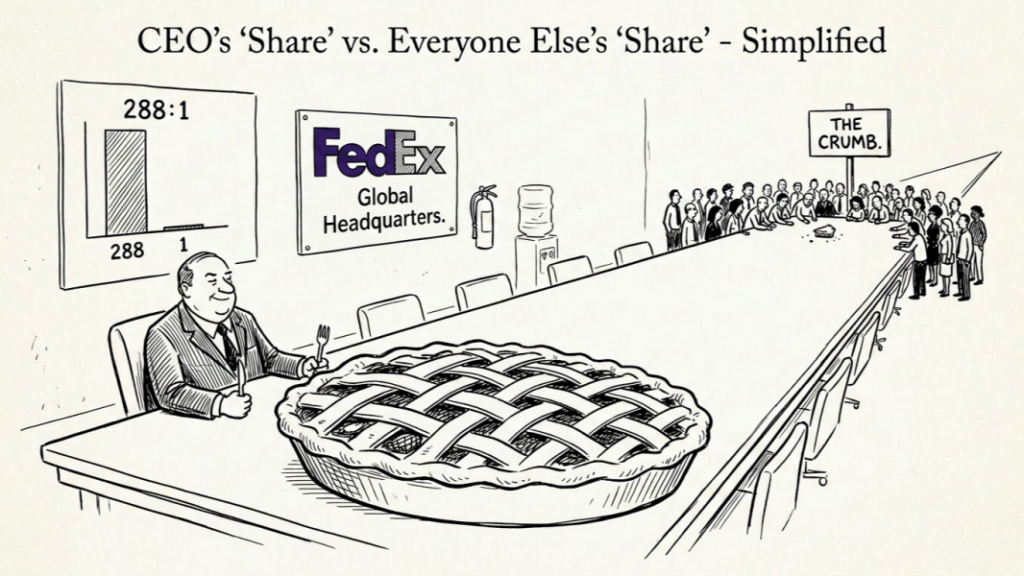
FedEx Corp disclosed its CEO pay was 288 times its median employee’s pay for the fiscal year ending in 2024. Subramaniam earned approximately $12.3 million for fiscal year 2024, with a base salary of $1.4 million. The median FedEx worker earned $42,990.
Two hundred and eighty-eight to one. The ratio sits there like a thermometer reading in a room no one wants to enter. The man making the cuts earns in roughly a day and a quarter what the person being cut earns in a year. The P-S-P philosophy said profit sharing, promotions, complaint procedures. The proxy statement says eight-figure compensation. The distance between those two documents is the distance between the company Fred Smith built and the company Raj Subramaniam is running, and the distance is measured in kitchen tables.
Fred Smith founded FedEx with a term paper and a blackjack hand. He built it on a philosophy that put people first, not as a slogan, but as the operating principle that made the service possible and the profit sustainable. He believed, because Vietnam taught him, that the person loading the plane at two in the morning was not an input to be optimized but a human being whose commitment was the difference between the package arriving on time and the package not arriving at all. He called it discretionary effort. He built a management institute to teach it. He took the Marine Corps doctrine of troop welfare and embedded it in the corporate DNA so deeply that for fifty years, the people who worked for FedEx understood something that the people who work for most corporations do not understand: that the company cared whether they stayed.
The company does not care whether they stay. The company cares whether the savings target is hit. FedEx has delivered $4 billion in structural savings from fiscal 2023 through fiscal 2025. The planned closure of over 475 stations, roughly 30% of the facility footprint, by end of 2027 creates a network that is leaner, faster, cheaper. The savings are real. The closures are real. The people are real. And the people are the savings. Every station closed is a set of commutes that end, a set of paychecks that stop, a set of kitchen tables where someone sits down and does the math and the math does not work.
Fred Smith gambled the company’s last five thousand dollars because the alternative was watching it die. Raj Subramaniam is spending six billion dollars to make it leaner, and the leanness is measured in the people who are no longer there. Smith’s gamble kept the planes in the air for one more week. Subramaniam’s program will keep the margin expanding for the next quarter. Both are bets. One was made by a man who had nothing left to lose. The other is being made by a man who has roughly $12 million a year to gain.
The runway Smith built with fourteen planes and 186 packages has become one of the most sophisticated logistics networks on earth. The company connects more than 220 countries and territories and moves more than 17 million shipments per day. The runway stretches from Memphis to the world. And the man who paved it with a blackjack hand and a Marine’s conviction that people come first is buried at Arlington National Cemetery, and the company he built is closing over 475 stations, and the philosophy he wrote is still referenced in corporate materials, and the people who believed it are updating their LinkedIn profiles.
People. Service. Profit. The order was deliberate. Smith said the P-S-P philosophy was the foundation of everything else at FedEx.
The foundation is being jackhammered. The rubble is being called savings. And the savings are being called DRIVE.
The runway is still there. The planes still fly. The packages still arrive. But the people who made the runway possible, the ones who loaded the first 186 packages in Memphis on a night in April 1973, and the ones who loaded the last package in a station in Phoenix or Raleigh or Fort Worth before the doors closed, those people are not on the runway anymore.
And the runway does not know their names.