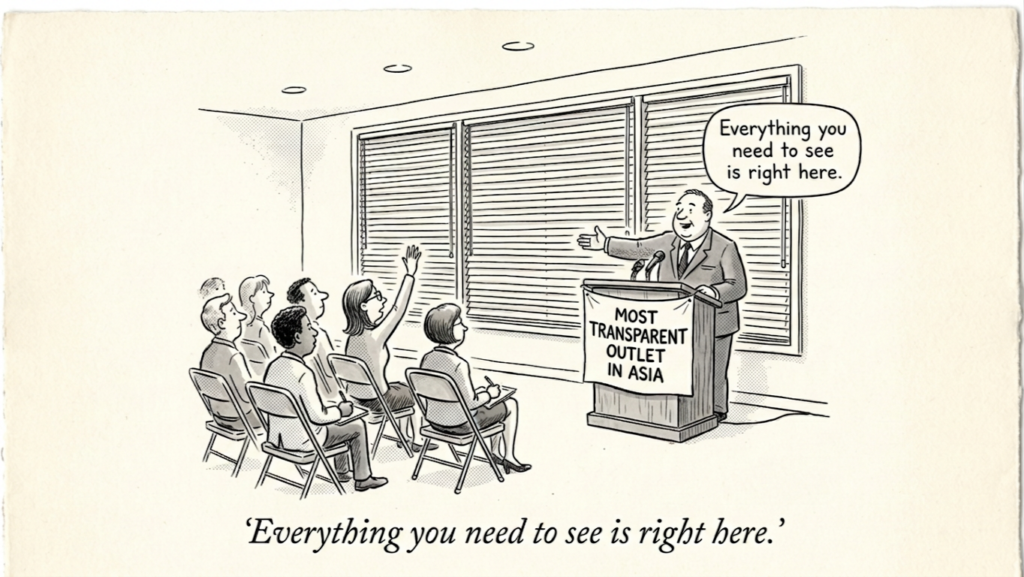
Hong Kong Free Press just published its 2025 Transparency Report. The headline: a record HK$1.9 million deficit. Income down 54% from the 2020 peak. Staff pay frozen. Office downsized. Freelancers cut. Travel eliminated.
The numbers tell a story HKFP probably doesn’t want told.
Look at the revenue curve:
2018: HK$2.6 million 2019: HK$6.6 million 2020: HK$6.7 million 2021: HK$4.6 million 2022: HK$4.1 million 2023: HK$3.9 million 2024: HK$3.6 million 2025: HK$3.1 million
Income didn’t just increase during the protests. It exploded. It more than doubled in a single year, from HK$2.6 million in 2018 to HK$6.6 million in 2019. Then it held at HK$6.7 million in 2020 as the National Security Law dominated international headlines.
Then the cameras left. The exiles settled into their London apartments. The think tanks moved on to Ukraine, then Taiwan, then the Middle East. And HKFP’s income began its slow, steady collapse back toward pre-protest levels.
The protests were a cash cow. Not because HKFP manufactured the crisis, but because its English-language coverage of Hong Kong’s political upheaval was perfectly positioned to capture a wave of international sympathy, outrage, and money. When the wave receded, so did the funding.
Here’s what I want to know about 2019 and 2020.
HKFP currently has 1,078 recurring donors contributing an average of HK$200 per month. That’s roughly HK$2.6 million annually, which more or less accounts for today’s “direct contributions” of HK$2.97 million when you add one-off donations and merch.
The math works in 2025. It works because HKFP is now, by its own account, a small operation funded primarily by individual readers.
But does the math work for 2019?
In 2019, “direct contributions” hit HK$6.06 million, more than double the 2025 figure. Did HKFP suddenly have twice as many individual donors giving twice as much? Did thousands of concerned citizens around the world spontaneously discover a small Hong Kong news outlet and start sending money? Maybe. Protest sympathy is real, and people do give generously to causes that move them.
But here’s the problem: we can’t verify that, because HKFP has never disclosed the geographic origin of its funding, the concentration among top donors, or whether any foundations, NGOs, or institutional funders contributed during that period.
We know the National Endowment for Democracy and its affiliates, the National Democratic Institute, the International Republican Institute, the Solidarity Center, operated in Hong Kong throughout the 2014-2020 period. NED’s own grant database shows funding flowing to Hong Kong civil society organizations year after year.
We know HKFP was founded in 2015, in the immediate aftermath of the Umbrella Movement, by a British national. We know it published almost exclusively in English, targeting international audiences. We know it became the go-to citation for Western media covering Hong Kong’s political conflicts.
We know HKFP received a Google News Equity Fund grant in 2022. We know its Trust Project credibility badge is backed by Craig Newmark Philanthropies, whose portfolio explicitly frames its mission around protecting “American democracy” and countering “nation-state adversaries.”
We know HKFP says it has not accepted grants from grant-making bodies since the Google initiative. We do not know whether that was also true in 2019 and 2020, when the money was flowing fastest.
And we know that when asked about geographic origin and donor concentration, HKFP cites Hong Kong’s Personal Data Privacy Ordinance, a law that protects individual data and has nothing to do with disclosing aggregate, anonymized funding statistics.
HKFP could resolve every question I’ve raised with four sentences:
“In 2019, X% of our income came from Hong Kong and Y% from overseas.”
“No single donor accounted for more than Z% of our total income in any year.”
“We have never received funding from, or provided services to, the National Endowment for Democracy or its affiliates.”
“We have received grants from the following foundations: [list].”
These disclosures involve no personal data. They identify no individual. They require no legal analysis. They are the standard that any outlet claiming to be “Asia’s most financially transparent” should meet without being asked.
HKFP has been asked. It has chosen not to answer.
HKFP points to its Trust Project participation as external validation. But the Trust Project certifies process, not substance. It checks whether you have an ethics policy, whether you list your staff, whether you disclose some funding. It does not require disclosure of donor geography or concentration. It does not audit claims of independence. It does not verify that an outlet’s self-description matches its actual funding reality.
The Trust Project is funded by American philanthropies with explicit national security framing. It is a credibility-laundering mechanism: outlets join, display the badge, and point to it when questioned. The badge means “we filled out the forms.” It does not mean “we have nothing to hide.”
In the United States, the Foreign Agents Registration Act requires anyone engaged in political activity on behalf of foreign interests to register and disclose their funding sources. Maria Butina was imprisoned for eighteen months for networking with American political organizations without registering.
Imagine a Chinese-funded English-language outlet in Washington that covered American politics from a consistently Beijing-friendly angle, saw its income double during a period of Chinese-backed political activity, declined to disclose the geographic origin of its funding, and pointed to a credibility badge funded by Chinese philanthropies as proof of its independence.
The Department of Justice would have questions. Congress would hold hearings. The outlet would be labeled a foreign influence operation within a news cycle.
HKFP operates in the mirror image of this scenario. It covers Hong Kong politics from a consistently Washington-friendly angle. Its income spiked during a period when American-funded organizations were actively supporting Hong Kong’s protest movement. It declines to disclose the geographic origin of its funding. And it points to credibility markers funded by American philanthropies as proof of its transparency.
The double standard is structural. American influence operations are definitionally legitimate. Equivalent operations by others are definitionally suspect.
Ironically, the 2025 numbers are the most credible HKFP has ever published. A small team of seven journalists, funded by roughly 1,000 recurring donors at HK$200/month, running a deficit because the attention economy moved on. That’s a recognizable, verifiable, and sympathetic picture. It’s what genuine independent media looks like.
The question is whether that’s what HKFP always was, or whether 2019-2020 was something different. Whether the outlet that now survives on small donations once served, knowingly or not, as a node in a larger network whose funding and purposes extended well beyond independent journalism.
HKFP can answer that question. It has chosen not to.
Until it does, “Asia’s most transparent news outlet” remains a branding exercise, not a description.